Der Beitrag Travelling Harmonium by James Smith & Son c. 1875 erschien zuerst auf Eric Feller Early Keyboard Instruments Collection.
]]>The origins of the harmonium lie at the intersection of European organ traditions and Asian mouth-organs such as the Chinese sheng. In 1779, Christian Gottlieb Kratzenstein in Copenhagen designed the first free‑reed instrument, drawing direct inspiration from Chinese prototypes. By circa 1810, Germany witnessed the production of early keyboard instruments employing free reeds—namely the Aeoline (Eschenbach & Schlimbach) and the Physharmonika (Anton Haeckl)—which anticipated the harmonium’s structure and mechanics. A pivotal advancement came thereby in around 1833, with Gabriel Joseph Grenié’s orgue expressif in France, enabling dynamic tonal variation through air pressure modulation. The consummate form was realised by Alexandre‑François Debain, who patented the first instrument under the name harmonium in 1840/42. Equipped with pedal‑operated bellows and a wind reservoir, Debain established the technical benchmarks that would define harmonium construction throughout the nineteenth century.
Technical Variants: Pressure‑bellows versus Suction‑bellows Systems
Debain’s original conception was a pressure‑bellows instrument, whereby the air stored in a wind reservoir is released upon key depression. In the United States, from the 1860s onwards, James Cahart and subsequently Mason & Hamlin introduced the suction‑bellows harmonium, wherein air is drawn through under‑pressure. This design proved simpler, more economical, and better suited to mass production—and by around 1870 had come to dominate the world market.
The Harmonium’s Evolution in India
In the late nineteenth century, the harmonium was introduced to India by European missionaries and colonial officials. Encountering a rich indigenous musical tradition, the instrument was rapidly adapted to local contexts. A transformative innovation was made by Dwarkanath Ghose of Dwarkin & Sons in Calcutta in 1875: he replaced the European pedal‑bellows design with a hand‑pump, to accommodate the practice of performing while seated on the ground. Additionally, drone‑stops and a scale‑changer were incorporated to meet the exigencies of Indian music—such as the rendering of ragas and microtonal intervals.
By approximately 1915, India had become a principal centre of harmonium production—especially in Bengal and Gujarat. The so‑called Indian hand harmonium emerged as a standard instrument across devotional, classical, and popular musical spheres.
Integration and Controversies
During the twentieth century, the harmonium became central to ensemble accompaniment and solo expression throughout South and Southeast Asia—particularly in Ghazal, Qawwali, Bhajan, and Hindustani classical styles. Musicians such as Bhaiyya Ganpatrao integrated the instrument into the thumri repertoire of the Khayal tradition.
At the same time, the harmonium was embroiled in cultural controversy. In India’s nationalist movement, it was widely perceived as a symbol of Western hegemony. Rabindranath Tagore famously described it as “the bane of Indian music”. All India Radio banned its use in classical music broadcasts in 1940—a prohibition that was not fully lifted until 1971. Nonetheless, the Indian harmonium remained an enduring fixture of South Asian musical practice to this day.
Travelling Harmoniums in the Late Nineteenth Century
Concurrently with the harmonium’s adoption in India, a specialised variant—the travelling harmonium—emerged during the late nineteenth century. These instruments were compact, foldable, lightweight, and able to withstand challenging climatic conditions—making them ideal for missionary use in remote territories.
Christian mission societies introduced travelling harmoniums to numerous colonial regions, including India, China, and Japan. They were employed in liturgical accompaniment, in mission schools, at ecclesiastical stations, and in domestic worship—especially where full‑scale organs or pianos were impracticable.
- In China, from the 1890s, harmoniums were integrated into mission schools to teach Western hymnody and music theory.
- In Japan, during the Meiji era (1868 – 1912), harmoniums featured in Christian educational institutions. Notably, Yamaha later emerged as one of the first domestic producers of such reed‑organs.
- In India, travelling harmoniums delivered by missionaries quickly became adapted locally and absorbed into indigenous musical forms (as noted above).
These instruments were generally foldable into case‑form, with reduced keyboards and limited registers—features that rendered them practical for improvised congregational accompaniment, whether in a tent‑meeting or mission school setting. Moreover, they served an educational function: facilitating hymn‑singing, choir practices, and instruction in Western music notation. In this capacity, they exerted a significant influence upon local musical cultures—particularly in India, where the harmonium ultimately evolved into a culturally transformed, indigenous fixture.
The Travelling Harmonium by James Smith & Son
The specimen under discussion is a foldable travelling harmonium, crafted circa 1875 by James Smith & Son of Liverpool. Its case is fashioned from polished rosewood (palisander), and it is preserved within its original travel box, complete with brass handles on either side for practical carriage.
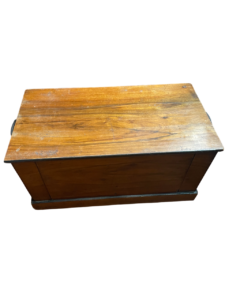
Harmoium James Smith and Son, Liverpool ca. 1875 (3) – Eric Feller Collection
The instrument features a keyboard overlaid with ivory and rosewood, spanning three octaves (C–C³). Beneath the keyboard lie five register levers, activating the registers Clarinette, Flute, Forte, Celeste, and one undecipherable label, each mounted with small ceramic plaques bearing inscriptions.
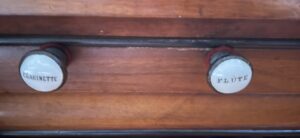
Harmoium James Smith and Son, Liverpool ca. 1875 (7) – Eric Feller Collection
In the open state, two cloth‑lined foot pedals emerge, housing the bellows mechanism. On the instrument’s upper surface appears the following signature:
“By Special Appointment
76, 74, & 72 Lord St. – James Smith & Son Liverpool
To The Queen.”
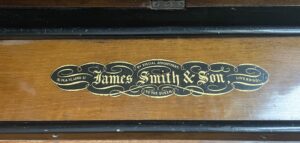
Harmoium James Smith and Son, Liverpool ca. 1875 (signature) – Eric Feller Collection
The timbre is notably compact, direct, and somewhat nasal in character. Though its resonating body is modest compared to that of larger cabinet harmoniums, it retains the quintessential tonal hue of free‑reed instruments. Articulation is immediate, with limited sustain.
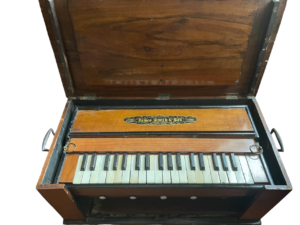
Harmoium James Smith and Son, Liverpool ca. 1875 (5) – Eric Feller Collection
Registers such as Flute or Celeste produce softer, flute‑like tones, whereas Forte and Clarinette render brighter, more assertive colours. Although acoustically constrained by virtue of its compact size, the instrument nevertheless yields a surprisingly lively and tonally varied sound, subtly refined by the player’s manipulation of air pressure.
James Smith & Son (Music Sellers), Liverpool
The firm James Smith & Son (Music Sellers) Ltd., located at 72–76 Lord Street, Liverpool, is one of the most longstanding musical instrument retailers in northern England. Its development not only reflects the history of the music trade in the 19th and 20th centuries but also the profound transformations that the British musical landscape underwent due to industrialisation, colonial history, wartime impacts, and technological change.
1. Foundation and Rise (1825–1912)
Founded in 1825, James Smith & Son quickly established itself as a significant music shop on one of Liverpool’s central commercial streets. The location on Lord Street provided high visibility and accessibility – a decisive advantage in this booming port and industrial city. By the latter half of the 19th century, the company ranked among the leading suppliers of keyboard instruments, particularly pianos and grand pianos, as well as harmoniums and organs.
A renovation of the premises by the renowned architectural firm William Culshaw & Son in 1874/75 gave the shop a modern appearance. The display of musical instruments – notably over 24 concert grands – testified not only to economic strength but also to cultural ambition.1
2. The Wright Era and the Golden Age (1912–1939)
In 1912, the company was acquired by Ernest Sidney Wright, whose family ran it for several generations. Under his leadership, James Smith & Son became the largest sheet music retailer in the Merseyside region and a supplier to numerous cultural institutions.
Of particular note was the company’s role in equipping transatlantic luxury liners of the Cunard Line with high-quality grand pianos – a task requiring both craftsmanship excellence and logistical expertise. The premises also served as a venue for concerts by prominent pianists and as an examination site for music grades. The store thus became a cultural centre far beyond mere commerce.2
3. Destruction during World War II and Loss of Archives
A decisive event was the destruction of the premises during the 1942 air raids. As a result of the German bombings of Liverpool (The Blitz), the shop and all company archives were lost to fire. Consequently, essential documents relating to the company’s early history were irretrievably destroyed – a loss which significantly complicates historical reconstruction today.3
4. Structural Change and End of Instrument Trading (1945–1974)
After the war, both economic and cultural circumstances changed fundamentally. With the advent of new media, altered consumption habits, and a declining interest in classical home music, the company’s focus shifted.
The sale of the last grand piano in 1974 symbolised the end of active musical instrument retail at James Smith & Son. In this context, the longstanding piano tuning contract with the Liverpool Philharmonic Orchestra was also terminated – another indicator of the company’s evolving role.4
5. Present Day: From Musical Instrument Retailer to Consumer Electronics Store
Today, the company continues under the original name James Smith & Son (Music Sellers) Ltd., but has entirely specialised in the sale of television and audio equipment. It operates branches in the Southport area and the surrounding Liverpool region. The tradition is thus maintained, albeit under changed conditions.
Despite this transformation, the company’s history remains a significant testimony to the role of music retail in British urban and cultural history. It exemplifies how closely trade history, colonialism, urban infrastructure, instrument manufacturing, and musical culture are interwoven.
References
- Bygone Liverpool, “Lord Molyneux’s House and the Early Development of Lord Street, Liverpool,” https://bygoneliverpool.wordpress.com/2021/02/14/lord-molyneuxs-house-and-the-early-development-of-lord-street-liverpool/.
- Facebook post on the history of James Smith & Son (Music Sellers), https://www.facebook.com/photo.php?fbid=741153039382821&id=127403904091074.
- British Record Shop Archive, “James Smith & Son, Liverpool,” https://britishrecordshoparchive.org/shops/james-smith–son/.
© Eric Feller – Early Keyboard Collection – June 2025
Der Beitrag Travelling Harmonium by James Smith & Son c. 1875 erschien zuerst auf Eric Feller Early Keyboard Instruments Collection.
]]>Der Beitrag Michael Schütte – Zuckermann after Flemish models 1984 erschien zuerst auf Eric Feller Early Keyboard Instruments Collection.
]]>From the late 16th century well into the 18th century, Flanders played a central role in the development of harpsichord building and keyboard music. In particular, the workshops of the Ruckers family in Antwerp established a building tradition whose tonal and structural principles had an enduring impact far beyond the region itself. Their instruments were distinguished by a clear, resonant tone, precise articulation and a balanced overtone spectrum – characteristics that came to define the so-called “Flemish sound” and served as a benchmark for subsequent generations of harpsichord makers.
The Ruckers harpsichords, often conceived as single-manual instruments with 4′ and 8′ or 8’ and 8’ registers, were also noted for their robust construction, linear scaling, and their striking, architecturally austere aesthetic. Their richly decorated lids, featuring emblematic imagery, floral arabesques and Latin mottoes, were an expression of both humanist learning and Baroque culture of representation. During the 17th century, many of these instruments were modified through so-called ravalements – particularly in France – to meet evolving tonal and technical demands.
Parallel to this flourishing of instrument making, a distinctive repertoire also emerged. Composers such as Pieter Cornet, Jan Pieterszoon Sweelinck, and later Jacques Duphly (whose family originated from Flanders) combined contrapuntal heritage with idiomatic keyboard writing. The influence of Franco-Flemish vocal polyphony remained noticeable for a long time, though it was increasingly overlaid by French ornamentation and dance forms. The toccatas, fantasias and variation cycles of Flemish origin, in particular, demonstrate a deep understanding of the harpsichord as an independent artistic medium.
The Flemish harpsichord tradition is therefore not only a milestone in the history of instrument making, but also a key to the aesthetic and stylistic diversity of European keyboard music before 1750.
An Instrument after Flemish Models
This single-manual harpsichord, based on Flemish models, comes from the workshop of Wolfgang Zuckermann and was built in 1984 by Michael Schütte with great craftsmanship. It was constructed following historical principles. The case, in a square wing form, is made of cedarwood and features ornate brass hinges and contrasting panels in various shades of red. The interior is lined with Flemish-style wallpaper, and the inside of the lid bears the inscription:
“Sine scientia ars nihil est”
(Without knowledge, art is nothing)
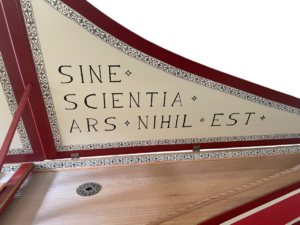
Harpsichord made by Michael Schütte in 1984 after Flemish Models (4) – Eric Feller Collection
Above the keyboard is the signature:
“Michael Schütte me fecit A.D. 1984”
The keyboard is made of ivory and rosewood, the soundboard of spruce, with a carved rose in the centre. The instrument has two 8′ registers, a lute stop, two sets of jacks and Delrin plectra. It rests on a Flemish-style wooden stand with decorative elements. The sound of the instrument is dark and lyrical, offering a rich palette of tonal colours.
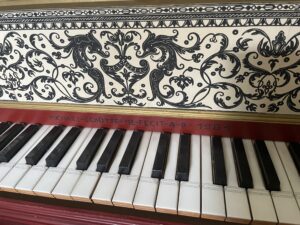
Harpsichord made by Michael Schütte in 1984 after Flemish Models (3) – Eric Feller Collection
With the rise of the historical performance movement, the demand for harpsichords increased. Firms such as Neupert and Sperrhake produced instruments largely built in the modern “Rastenbauweise” (frame construction method), incorporating many elements of modern piano making – though they had little in common with historical harpsichords in terms of tone and construction. Historically accurate copies were rare and expensive. Wolfgang Zuckermann recognised this gap in the market and, in the late 1950s, began offering affordable kits for harpsichords built along historical lines in the United States. These kits were (and still are) available in different levels of completeness, allowing customers to build their own harpsichord at relatively low cost. However, these self-built harpsichords have always reflected the abilities of their individual makers.
Wolfgang Zuckermann (1922–2018)
Wolfgang Zuckermann was born in Berlin on 11 October 1922. Due to the family’s Jewish faith, he fled with his parents to the United States in 1938. After training as a child psychologist, he turned his attention to harpsichord building and, in the 1950s, began selling harpsichord kits based on historical models. In 1969, he sold his company (which continues to operate internationally under different ownership) and moved to England. In 1995, he settled in Avignon, France. He authored two books on harpsichord building:
- The Modern Harpsichord. October House, 1969
- The Modern Harpsichord: Twentieth Century Instruments and Their Makers. Reprint Services Corp, 1986
Wolfgang Zuckermann passed away on 3 November 2018.
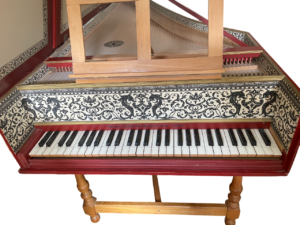
Harpsichord made by Michael Schütte in 1984 after Flemish Models (2) – Eric Feller Collection
Der Beitrag Michael Schütte – Zuckermann after Flemish models 1984 erschien zuerst auf Eric Feller Early Keyboard Instruments Collection.
]]>Der Beitrag Pleyel „Grand Modèle de Concert” – Wanda Landowska 1928 erschien zuerst auf Eric Feller Early Keyboard Instruments Collection.
]]>
The History of Pleyel Harpsichords
The 1889 World Exhibition in Paris marked a significant milestone in the rediscovery of the harpsichord, as instruments of this type were presented there for the first time in many years (historical original instruments such as harpsichords, spinets, clavichords and square pianos were exhibited, including an original instrument by Henri Hemsch from 1755). The Exhibition took place from 6 May to 31 October 1889 on the occasion of the centenary of the French Revolution. Three renowned firms—Pleyel, Erard, and Tomasini—showcased harpsichords whose construction was inspired by a historical instrument built by Pascal Taskin (1723 – 1793).
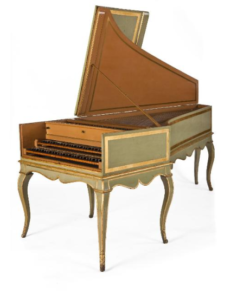
Harpsichord by Pascal Taskin, Paris 1769 St. Cecilias’s Hall Edinburgh
This harpsichord, made in Paris in 1769 and now housed in St Cecilia’s Hall in Edinburgh, was acquired by the Paris Museum around 1880 and restored in 1882 by Louis Tomasini. As part of this restoration, Tomasini produced a copy, which is now displayed at the Berlin Museum of Musical Instruments. Despite certain “improvements” introduced by Tomasini, this reproduction is considered one of the first historical reconstructions.
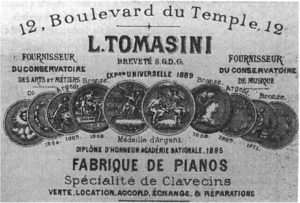
Business Card of Louis Tomasini, c. 1889
The original Taskin harpsichord was also extensively studied by Pleyel. Based on these studies and the examination of other historical instruments, Pleyel developed a new harpsichord that integrated elements of modern piano construction. These included increased string tension and a reinforced structure, featuring additional transverse ribs in the soundboard — similar to those found in contemporary grand pianos. The instruments produced by Pleyel, Erard, and Tomasini followed Taskin’s original construction and dimensions: they had two manuals, a compass of F’–f”’ (five octaves), and were equipped with two 8′ stops and a 4′ stop. However, Pleyel extended its model by adding six pedals, allowing performers to change registers quickly. Additionally, the case was reinforced, though the earliest harpsichords of this period did not yet feature a metal frame.
A review of the new harpsichord exhibited by Pleyel at the 1889 World Exhibtion appeared in the “Revue des arts décoratifs”, page 16:
- „C’est là un progrès d’une extrême importance. J’allais oublier de dire que la maison Pleyel expose aussi un superbe clavecin moderne, dont la valeur bénéficie naturellement de la supériorité de la facture actuelle sur celle du temps passé. Car on revient au clavecin, qui peut vivre en bon voisinage avec le piano, et qui reste fort utile, ainsi que l’ont prouvé les séances si intéressantes de M. Diéner, la musique écrite jadis par de grands maîtres pour cet instrument ne produisant nullement sur le piano, instrument au son ample et prolongé, l’effet cherché par le compositeur pour un instrument à sonorité sèche et douce à la fois. Ce clavecin est superbe et d’une sonorité exquise. Enfin, j’ajoute que la fabrication de la maison Pleyel a dépassé aujourd’hui le quatre-vingt-dix-septième mille, et qu’elle compte, avant un an, fêter la naissance de son cent millième piano ! Elle sera la première, dans le monde, à pouvoir célébrer un tel résultat.“
- “I almost forgot to mention that the Pleyel company is also exhibiting an excellent modern harpsichord, whose value naturally benefits from the superiority of today’s craftsmanship over that of the past. Let us now return to the harpsichord, which serves as a valuable complement to the piano and, as the highly interesting sessions of Mr. Diéner have demonstrated, remains very useful. The music written by great masters of the past for this instrument does not achieve the intended effect on the piano—a sonorous instrument with broad and sustained tone—since the composers envisioned a sound that is both crisp and delicate. This harpsichord is outstanding and has an exquisite tone.” (Revue des arts décoratifs, 1889, p. 16)
Accompanying the Paris World Exhibition, the pianist and composer Louis Diémier (1843 – 1919) played concerts on the newly introduced harpsichord for the first time.
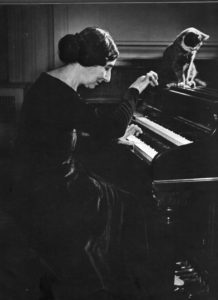
Wanda Landowska’s interest in the harpsichord led her, from 1903/04 onwards, to actively incorporate Pleyel harpsichords into her concert performances, thereby significantly increasing public interest in the instrument. In close collaboration with Pleyel, she contributed to the development of a harpsichord that would meet both her tonal ideals and the demands of historical performance practice, while also accommodating the requirements of modern concert settings.
This collaboration between Landowska, Pleyel’s chief engineer Monsieur Lamy, and the company’s director and acoustician Gustave Lyon (1857 – 1936) culminated in the creation of an innovative harpsichord model. The result of their joint efforts was publicly unveiled at the VI. German Bach Festival of the Neue Bachgesellschaft in Breslau from 15–17 June 1912: the Pleyel harpsichord “Grand Modèle de Concert,” which prominently bore Landowska’s name on the jack rail.
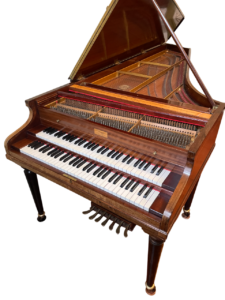
Pleyel Cembalo – Wanda Landowska – Grand Modèle de Concert, Paris 1828 – Eric Feller Collection (9)
The new Pleyel harpsichord combined traditional craftsmanship with innovative mechanical improvements, designed to enhance the instrument’s stability, volume, and versatility. This newly developed model differed significantly from its Baroque predecessors, as well as from the early Pleyel harpsichords introduced at the 1889 Paris Exhibtion, particularly through the introduction of a metal frame from 1923 onwards. Such a structural innovation had previously been absent from harpsichords of this type, and it greatly improved the instrument’s stability, enabling higher string tension, which resulted in a more powerful and resonant tone.
Furthermore, the harpsichord’s mechanism was carefully refined, allowing for a more consistent key response and greater precision in sound control. The tuning pins were improved, leading to the development of double tuning pins, which ensured exceptional tuning stability. The registers were activated via pedals, facilitating ease of use for performers.
One of the most striking features of the new Pleyel harpsichord was the introduction of a 16′ register, which, at Landowska’s request, was incorporated into all instruments from 1912 onwards, adding depth and richness to the sound spectrum.
Pleyel produced two variations of this harpsichord:
- “Modèle Réduit” – 6 pedals, compass: AA–f³, without a 16′ register
- “Grand Modèle de Concert” – 7 pedals, compass: FF–f³, with a 16′ register
In 1968, Pleyel produced another model called the “Modèle Trianon.” Only three instruments were built. The instruments were crafted in a modern style, no longer featuring a metal frame, and lacked the 16′ register.
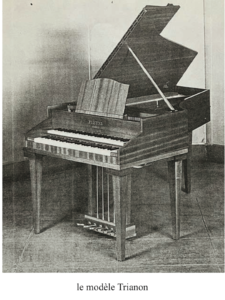
Harpsichord Pleyel “Modèle Trianon“
The instrument’s design and acoustics were largely the work of Gustave Lyon, the chief acoustician and head of Pleyel. One of his key innovations was the damping system, which became a defining characteristic of Pleyel harpsichords. When a performer played an 8′ register on one manual, the corresponding 8′ register on the second manual vibrated sympathetically, provided it was perfectly in tune. This unique acoustic effect contributed significantly to the distinctive and unparalleled sound of Pleyel harpsichords, solidifying their reputation in both historical performance and modern concert practice.
The Pleyel harpsichord in the Eric Feller Collection
The harpsichord presented here was made in 1928 by the Pleyel company in Paris and is the “Grand Modèle de Concert“. The case of the instrument is made of the finest rosewood, which is decorated with charming inlays all around. While the majority of the harpsichords made by Pleyel were made of mahogany, only a few examples were made of rosewood. It has five legs with gilded bases and a lyre with seven pedals to control the registers.
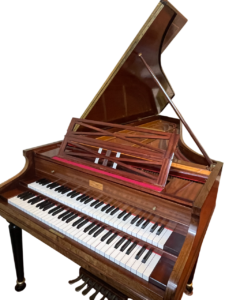
Pleyel Cembalo – Wanda Landowska – Grand Modèle de Concert, Paris 1828 – Eric Feller Collection (5)
The instrument has two manuals and is equipped with five different registers that allow for a wide variety of sound designs:
- lower manual: 8′, 16′, 4′
- upper manual: 8′, 8′-nasal, lute stop for both registers
- Manual coupler
The registers are distributed over the pedals from left to right as follows:
| Pedal 1 | Pedal 2 | Pedal 3 | Pedal 4 | Pedal 5 | Pedal 6 | Pedal 7 |
| lower manual 16‘ – register | lower manual
4‘ – register |
lower manual
8‘ – register |
Lute stop for both
8‘ – registers (upper manual) |
manual coupler | upper manual
8‘ – register nasal |
upper manual
8‘ – register |
The registers are switched on when the pedals are pressed down, others switch when they are released.
Due to the disposition, there are up to 55 different registration options. The following combinations of registers are possible:
Step 1: Individual manuals
Lower manual: 8′, 16′, 4′
→ Can be used individually or in combinations:
- 8′
- 16′
- 4′
- 8′ + 16′
- 8′ + 4′
- 16′ + 4′
- 8′ + 16′ + 4′
- → 7 combinations
Upper manual: 8′, 8′-nasal, lute stop
→ Can be used individually or in combinations:
- 8′
- 8′-nasal
- 8′ + 8′-nasal
- 8′ + lute stop
- 8′-nasal + lute stop
- 8′ + 8′-nasal + lute stop
- → 6 combinations
Step 2: Taking the manual coupler into account
If the manual coupler is activated, both manuals can sound at the same time. This means that any of the 7 combinations of the lower manual can be combined with any of the 6 combinations of the upper manual.
Total number of registration possibilities
The combinations without coupling are:
- 7 (lower manual only) + 6 (upper manual only) = 13 possibilities
With coupling:
- 7 (lower manual) × 6 (upper manual) = 42 possibilities
Total number of possible registrations:
13 + 42 = 55 different combinations
All registration possibilities are listed below:
- Registrations without manual coupling
Lower manual only (7 combinations)
- 8′
- 16′
- 4′
- 8′ + 16′
- 8′ + 4′
- 16′ + 4′
- 8′ + 16′ + 4′
Upper manual only (6 combinations)
- 8′
- 8′-nasal
- 8′ + 8′-nasal
- 8′ + lute stop
- 8′-nasal + lute stop
- 8′ + 8′-nasal + lute stop
- Registrations with manual coupler (42 combinations)
Each of the 7 combinations of the lower manual can be combined with each of the 6 combinations of the upper manual:
- (8′) + (8′)
- (8′) + (8′-nasal)
- (8′) + (8′ + 8′-nasal)
- (8′) + (8′ + lute stop)
- (8′) + (8′-nasal + lute stop)
- (8′) + (8′ + 8′-nasal + lute stop)
- (16′) + (8′)
- (16′) + (8′-nasal)
- (16′) + (8′ + 8′-nasal)
- (16′) + (8′ + lute stop)
- (16′) + (8′-nasal + lute stop)
- (16′) + (8′ + 8′-nasal + lute stop)
- (4′) + (8′)
- (4′) + (8′-nasal)
- (4′) + (8′ + 8′-nasal)
- (4′) + (8′ + lute stop)
- (4′) + (8′-nasal + lute stop)
- (4′) + (8′ + 8′-nasal + lute stop)
- (4′) + (8′ + 8′-nasal + lute stop)
- (8′ + 16′) + (8′)
- (8′ + 16′) + (8′ + 8′-nasal)
- (8′ + 16′) + (8′ + lute stop)
- (8′ + 16′) + (8′ + 8′-nasal + lute line)
- (8′ + 4′) + (8′)
- (8′ + 4′) + (8′-nasal)
- (8′ + 4′) + (8′ + 8′-nasal)
- (8′ + 4′) + (8′ + lute stop)
- (8′ + 4′) + (8′-nasal + lute stop)
- (8′ + 4′) + (8′ + 8′-nasal + lute stop)
- (16′ + 4′) + (8′)
- (16′ + 4′) + (8′-nasal)
- (16′ + 4′) + (8′ + 8′-nasal)
- (16′ + 4′) + (8′ + lute stop)
- (16′ + 4′) + (8′ + lute stop)
- (8′ + 16′ + 4′) + (8′)
- (8′ + 16′ + 4′) + (8′-nasal)
- (8′ + 16′ + 4′) + (8′ + 8′-nasal)
- (8′ + 16′ + 4′) + (8′ + lute stop)
- (8′ + 16′ + 4′) + (8′-nasal + lute stop)
- (8′ + 16′ + 4′) + (8′ + 8′-nasal + lute stop)
The case of the instrument is open at the bottom and the construction is based on a solid steel frame similar to the modern grand pianos of the time. In the soundboard there is a gilded rosette with the initials “P” and “C“, which further accentuates the aesthetic design of the harpsichord and is reminiscent of the historical harpsichords. The bass strings are wound, which significantly amplifies the sound. The jacks are made of wood and covered with leather.
A notable feature of this harpsichord are the tuning pins: each string is equipped with a double pin. The first pin is used for coarse adjustment and this is made possible by a ratchet mechanism located on a joint on the sound post. Behind this ratchet pin protrudes a small wing, which has a two-pronged fork shape. Between these prongs is positioned a second pin, which is firmly screwed into the sound post. By precisely screwing and unscrewing this second pin, the ratchet assembly is set in a back and forth swinging motion on its joint, which allows for extremely fine adjustment of the string. Although the ratchet mechanism is rarely used directly in practical tuning work, this system enables an exact adjustment of the pitch that would be very difficult to achieve with traditional tuning pins.
These so-called micrometer tuning pins or “Alibert-pins” as they were called by Pleyel, were developed by the inventor Jean-Pierre Alibert and patented in 1875 by Auguste Wolff (1821 – 1887).
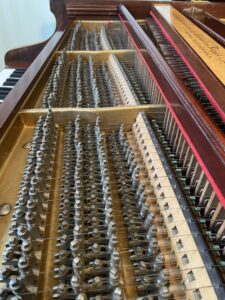
Pleyel Harpsichord – Wanda Landowska – Grand Modèle de Concert, Paris 1828 – Eric Feller Collection (“Alibert-pins”)
The entire construction of the instrument is characterized by remarkable precision and reflects the high production standards and the brilliant construction system that Pleyel used in the manufacture of this harpsichord. The nameboard is signed:
“Pleyel
Facteur à Paris
Fondé en 1807“
A further signature is on the jack rail:
“Le Jeu grave dit par les Anciens “de 16 Pieds” fut introduit dans les
Clavecins Pleyel à partir de l’année 1912, sur la demande & les suggestions de
Wanda Landowska.”
The instrument has the serial numbers 73F432 and 185.600, which are noted on the wrest plank. Based on these numbers, it can be seen from Pleyel’s production books that the harpsichord was sold to Amsterdam on October 12, 1928 for a price of 33,536 francs. Taking inflation and the stable exchange rate into account, this amount would correspond to a purchasing power of around 83,400 Euros today (2025). In addition, the Pleyel company charged an additional fee of 1,225 francs for packaging the instrument. According to Pleyel’s original delivery books, the buyer was a music store in Amsterdam.
The shop in Amsterdam lent out the instrument for various concerts and recordings. An interesting recording of the song “I’ve Found A New Baby” was made in 1954 by the “Dutch Swing College Band“, founded in 1945, with this harpsichord. The harpsichordist on this unusual recording was the Dutchman Joop Schrier (1918 – 1995). To hear the recording, click here!
The importance of the Pleyel harpsichords today and the “reduced Rastenbauweise“
Pleyel’s “Grand Modèle de Concert” was the decisive pioneer for the revival of harpsichord construction at the beginning of the 20th century and formed the starting point for numerous developments in harpsichord construction in Europe. The model designed established itself as the decisive prototype for the construction of modern harpsichords and served as a reference model that was replicated many times, but whose qualitative standards were never achieved again. At this point I would like to introduce the term “reduced Rastenbauweise” into my explanations in order to be able to make a more precise distinction between the other instruments and Pleyel. Instrument makers such as Maendler-Schramm, Neupert and Dolmetsch began to design instruments based on Pleyel’s harpsichords or were significantly inspired by them. In the early stages of development, these instruments exhibited a strong resemblance to the harpsichords by Pleyel, with their structural design, particularly the raster construction, being almost identically adopted. In an effort to reduce costs, simplify the construction process, be able to produce a large number of instruments in a short time or to experiment with sound, the so-called harpsichords in a “reduced Rastenbauweise” were created. However, these had very few similarities with the original Pleyel design (and of course hardly anything in common with the later historical copies). This type of instrument lacks a steel frame, the scale lengths are different, strings are not wound, the body construction is lighter, the base is partially closed, etc. The aforementioned changes led to a significant change in the sound character, which is clearly different from Pleyel’s instruments.
These instruments (also because they were produced in large numbers to meet growing demand) shaped the idea of sound until the 1970s. It was not until the 1970s that historical copies of original instruments began to be made, which have now become established as the standard in historical performance practice.
Pleyel’s construction is impressive due to its precise execution, which not only reflects high production standards, but also a sophisticated manufacturing system that was used in the manufacture of these instruments. Almost 100 years after production, as in the example of the Pleyel harpsichord in the collection described here, the exceptional craftsmanship remains intact. This well-thought-out production ensures an acoustic performance that massively distinguishes the Pleyel harpsichord from other harpsichords. The ingenious construction creates a richness of sound and versatility that is absolutely unique and cannot be compared to any other instrument. The Pleyel harpsichords are based on historical principles, but use modern materials, construction methods and experience from modern piano construction to achieve greater tonal assertiveness. Compared to other harpsichords of the “reduced Rastenbauweise“, the sound can certainly be seen as more “historical”, but due to the construction it is louder and more brilliant.
So why did the “reduced Rastenbauweise” prevail for so long in the 20th century and shape the sound of this first generation in historical performance practice, while Pleyel’s designs were no longer built or produced in large numbers?
To answer this question, several factors must be considered. A central aspect is the economic dimension. Considering the production costs of a Pleyel harpsichord at the time and the high demand for this rediscovered instrument, it became economically necessary to provide cheaper alternatives for the expanding market. This led to a reduction in the construction effort, which made cheaper production possible.
Another relevant factor is the historical framework of the Second World War. During the war years and in the immediate post-war period, the availability of high-quality materials was severely limited, so that instrument makers were forced to resort to lower quality materials or use other solutions.
In addition, harpsichord construction was in a continuous development process, during which both sound optimization and adaptation to historical originals were sought. A notable example of this is the harpsichord made by Kurt Hutzelmann in 1967, which is also in the collection. (Click here for more information on this instrument!) Hutzelmann developed a mechanism that made it possible to raise the dampers using a pedal – analogous to the damper release on a piano. However, this design does not establish a historical reference to the harpsichords of the 17th and 18th centuries, but rather reflects the attempt to make sound modifications in the sense of a subjective improvement.
With the onset of the 1970s, a fundamental paradigm shift took place in harpsichord construction. While previously the focus was on the gradual improvement of the sound potential and the economically adapted construction, the aim increasingly shifted to the exact replication of historical instruments. This development was closely linked to the growing interest in authentic performance practice and historical sound research, which did not yet exist to this extent at the beginning of the 20th century. Cultural and educational impulses encouraged this trend. The promotion of historical performance practice at universities and by cultural institutions increased awareness of the importance of authentic instruments. This gave harpsichord construction an idealistic and educational impulse, which led to increased research and innovation in this area.
The new approaches aimed to faithfully reconstruct the construction principles and sound properties of the instruments of the 17th and 18th centuries, whereby the “reduced Rastenbauweise”, which dominated harpsichord construction for over 50 years, faded into the background and is now considered obsolete.
With his harpsichords, Pleyel created masterpieces of instrument making that build a bridge between the past and the modern. They are well thought out, sophisticated, innovative and forward-looking! They were also the trigger and inspiration for composers of the 20th century to compose pieces for this type of instrument (for example the “Concert champêtre” by Francis Poulenc (1899 – 1963), which he wrote for Wanda Landowska in 1927/28).
Pleyel used historical instruments as an opportunity to improve the construction of the harpsichord. The aim was not to simply copy a historical instrument, but to further develop the harpsichord!
The company wrote in the “Catalogue Pleyel, Wolff & Cie.” from 1892, page 11:
- « Pleyel, Wolff et Cie dans leur facture courante et, de plus, M. Lyon avait très habilement reconstitué le clavecin et le dotant de qualités que n’avaient pas les meilleurs instruments des siècles passés. Aussi, il faillait récompenser à la fois le mérite des inventions attachées au nom de Pleyel, les qualités de ses instruments et le goût artistique qui présidait à leur construction. A l’unanimité des mebres du jury international de la classe 13, un Grand Prix, la plus haute récompense mise à la dispension des jurys, a été décerné à la maison Pleyel, Wolff et Cie. »
- “… and in addition, Mr. Lyon had reconstructed the harpsichord extremely skillfully and given it properties that even the best instruments of past centuries did not possess. It was therefore important to appreciate both the merits of the inventions associated with the name Pleyel and the quality of his instruments and the artistic taste that underlay their construction.”
A new instrument was created with distinctive features compared to all other types of harpsichords and this is how these instruments must be viewed and classified! Today, Pleyel harpsichords are repeatedly compared with other instruments. However, a comparison would be similar to trying to compare two fundamentally different objects whose properties do not correlate in a way that allows a fair or informative comparison.
Sources:
- Anthony, James R. Landowska: The Life and Work of the Great Harpsichordist. Amadeus Press, 2003.
- de Vries, Willem „Sonderstab Musik: Organisierte Plünderungen in Westeuropa 1940-45“.
- Di Stefano, G.P. (2012). Pleyel after Pleyel. The instruments of Auguste Wolff and Gustave Lyon at Universal Exhibitions (1855-c.1905). MUSIQUE, IMAGES, INSTRUMENTS, XIII(XIII), 77-99.
- Elste, Martin: Die Dame mit dem Cembalo. Wanda Landowska und die Alte Musik. Katalog zur Sonderausstellung im Berliner Musikinstrumenten-Museum, Berlin 2009
- Glendon, Frank: Remembering Hilda Jonas. In: The Diapason – Harpsichord News. Dezember 2014.
- Gutmann, Peter. “Wanda Landowska: Revolutionary and Traditionalist.” New England Review and Bread Loaf Quarterly, vol. 26, no. 4, 2005, pp. 143-152.
- Heyer, John Hajdu. “Wanda Landowska and Early Music: A Personal View.” Early Music, vol. 14, no. 3, 1986, pp. 301-305.
- Hsu, Samuel. Wanda Landowska: The Woman and the Artist. Westport, CT: Greenwood Press, 1979.
- Jonas, Hilda: Harpsichord Festival Scheduled. In: The Harpsichord. Vol. III, No 4, 1970.
- Joseph, Charles M. Wanda Landowska: The Search for Authenticity. Ithaca, NY: Cornell University Press, 1991.
- Kallberg, Jeffrey. “Landowska and Her Circle: The Shared Aesthetics of Music and Art.” In The Cambridge Companion to Wanda Landowska, edited by Mark Kroll, pp. 100-118. Cambridge University Press, 2021.
- Kroll, Mark. “The Artistry of Wanda Landowska.” Early Music America, vol. 6, no. 1, 2000, pp. 30-35.
- Landowska, Wanda. Landowska on Music. London: Gerald Duckworth & Co Ltd, 1964.
- Lawrence, D.H. “Wanda Landowska: The Pianist Who Made the Harpsichord Sing.” The Adelphi, June 1932, 148-156.
- Lubitz, Andrea. “Wanda Landowska and Her Collaborators in Interwar France.” In The Cambridge Companion to Wanda Landowska, edited by Mark Kroll, pp. 82-99. Cambridge University Press, 2021.
- McAllister, Alastair: “Talking Harpsichords”, The Rhykane Press 2014.
- Mould, Charles (Hrsg.): Amendments and additions to clavichord-related information in the Third Edition of Donald Boalch’s Makers of the Harpsichord and Clavichord 1440–1840. 1995.
- Neupert, Hanns: Das Klavichord. Bärenreiter Verlag, Kassel 1977.
- Schmidt, Martin-Christian: Das 16’-Register im deutschen Cembalobau des 18. Jahrhunderts. Groteske oder beachtenswerte Erscheinung mit aufführungspraktischer Relevanz? In: Eszter Fontana (Hrsg.): Festschrift für Rainer Weber. Halle 1999, ISBN 3-932863-98-4. S. 63–72. (= Scripta Artium, Bd. 1. Schriftenreihe der Kunstsammlungen der Universität Leipzig).
- Oja, Carol J. Making Music Modern: New York in the 1920s. Oxford University Press, 2000.
- Owen, Barbara. “Wanda Landowska: A Pianist of the Harpsichord.” Early Music, vol. 4, no. 4, 1976, pp. 469-478.
- Piekarska-Duraj, Jolanta. Wanda Landowska: A Biography. Krakow: Polskie Wydawnictwo Muzyczne, 2012.
- Restout, Denise. Wanda Landowska: A Life in Music. New York: W.W. Norton & Company, 1981.
- Rosand, Ellen. “Wanda Landowska’s Aesthetic of Early Music.” Early Music, vol. 14, no. 3, 1986, pp. 306-312.
- Rosenblum, Sandra P. Landowska: Wanda Landowska Remembered. Hillsdale, NY: Pendragon Press, 2000.
- Rubin, Ruth J. “Wanda Landowska and the Harpsichord Revival.” In Women Making Music: The Western Art Tradition, 1150-1950, edited by Jane Bowers and Judith Tick, pp. 225-238. University of Illinois Press, 1986.
- Rosati, Vincent J. Wanda Landowska and Early Music: The Quest for Authenticity. Bloomington: Indiana University Press, 1998.
- Sauer, Theresa. “Wanda Landowska’s Contributions to the Early Music Revival.” The Musical Quarterly, vol. 81, no. 2, 1997, pp. 201-224.
- Wolfgang Zuckermann: The modern harpsichord, twentieth century instruments and their makers. October House, New York 1969.
© Eric Feller – Early Keyboard Collection – March 2025
Der Beitrag Pleyel „Grand Modèle de Concert” – Wanda Landowska 1928 erschien zuerst auf Eric Feller Early Keyboard Instruments Collection.
]]>Der Beitrag Fredericus Beck 1778 erschien zuerst auf Eric Feller Early Keyboard Instruments Collection.
]]>Beck specialized in the construction of square pianos, incorporating innovative mechanical solutions into his instruments. These developments were influenced by contemporary advancements made by Johann Christoph Zumpe and other leading piano makers of the time. However, Beck’s particular skill lay in refining these techniques and crafting instruments that were not only technically precise but also acoustically outstanding. His square pianos set new benchmarks in terms of tonal clarity and dynamic responsiveness. The design of his instruments was not only functional but also aesthetically sophisticated. Beck placed great emphasis on the selection of high-quality materials and meticulous craftsmanship. These details elevated his pianos beyond mere musical instruments to works of art, which held a prestigious place in the homes of the affluent bourgeoisie.
The instrument presented here is a rare example of Frederick Beck’s craftsmanship. This square piano, built in London in 1778, is one of only three surviving Beck instruments featuring an exceptionally rare stand with cabriole legs. Among these three, it is the oldest known example. This type of stand is not only unique among Beck’s surviving instruments but also represents an exceptional feature in the broader context of late 18th-century English square pianos, as it is collapsible. To date, only five other English instruments with foldable legs are known:
- Charles Trute, ca. 1771?
- Ferdinand Weber, 1772
- Frederick Beck, London, 1780/86? – known as the first piano arrived in Australia
- Frederick Beck, 1789
- Ferdinand Weber, undated
- Longman & Broderip, ca. 1790
(see Lancaster, G.: The First Fleet Piano, A Musician’s View, The Australian National University Press, 2015; and Cole, Michael: Frederick Beck Piano Maker).
The instrument and stand are crafted from mahogany, adorned with multi-coloured banded inlays in a simplified version of Tunbridgeware, a design typical of Beck’s early instruments. It features a five-octave range (FF – f3), and the keyboard is made of ivory and ebony. To the left of the keyboard, three hand-operated stops control divided dampers and a lute stop. The nameboard bears an elongated cartouche inscribed with:
“Fredericus Beck Londini Fecit 1778
No. 1 and 10 Broad Street Golden Square”
On either side of the cartouche, three filled holes are visible, indicating that the instrument was originally equipped with a pair of candle holders, which are no longer present (see Cole, Michael: Frederick Beck Piano Maker).

Tafelklavier Fredericus Beck, London 1778 – Eric Feller Collection (Nameboard)
The square piano is double-strung with a simple single action after Zumpe. It features single dampers, though a notable characteristic is that damping extends only up to c3. This distinctive feature is a hallmark of Beck’s instruments, as it deviates significantly from the conventional damping systems employed by other piano makers of the time. This innovation allows the undamped strings to vibrate freely, producing a resonance rich in overtones, which enhances the instrument’s tonal depth and brilliance.
Frederick Beck’s decision to exclude dampers from the highest five notes of his square pianos represents a unique innovation, likely inspired by the contemporary English aesthetic preference for a tone that was resonant and overtone-rich.
Arnold Frederick Beck was presumably born in 1738 in Württemberg and was baptized in the same region on May 30, 1738. After 1756, he left Germany and travelled via France to London. Between 1756 and approximately 1762, Beck settled in Paris, where he established a workshop at 364 Rue Saint-Denis. During this period, he maintained business relations with the renowned harpsichord maker Pascal Taskin (1723–1793), who sold instruments made by Beck. According to Frank Hubbard, Taskin was indebted to Beck for 660 livres in 1777 (see Hubbard, F.: Three Centuries of Harpsichord Making, Harvard University Press, 1965).
During this time, Beck left the European continent and relocated to London. From 1763 onward, he began manufacturing guitars there. In that same year, his residential and business address was recorded as Glassonbury Court, near Covent Garden Market. In the 1760s, Beck entered into a business partnership with Charles Pinto († 1791), about whom little information is available. Only one surviving guitar from 1764 bears the inscription “Pinto and Beck.”
On November 20, 1765, Beck was documented as serving as a juror at the Westminster Coroner’s Court, with his address still listed at Glassonbury Court. Between 1769 and 1773, he collaborated with the firm Longman, Lukey & Co., one of the most prestigious companies in the London musical instrument trade. On September 23, 1770, he married Mary Coles in London. By mid-1771, Beck had relocated his residence and workshop to 4 Broad Street, Carnaby Market.
In the late 1770s, the house number of his property on Broad Street was changed from 4 to 10. On September 7, 1779, Beck entered into a second marriage with Rose Ann Shudi. Between 1782 and 1791, they had six children, including three sons.
Between 1780 and 1789, Beck manufactured an average of 222 pianos per year, indicating both a substantial production capacity and high demand for his instruments. Toward the end of 1790, he began collaborating with piano maker George Corrie. Beck remained active in piano production at 10 Broad Street as late as 1794. It is assumed that he passed away around 1798.
His instruments are still regarded as outstanding examples of 18th-century musical instrument craftsmanship and continue to be of great interest to collectors, museum collections, and musicians alike.
Other Surviving Instruments by Arnold Frederick Beck:
- 1769 Square Piano – McLean Museum, Inverclyde, Scotland
- 1778 Square Piano – Royal Museums of Art and History, Brussels, Belgium
- c. 1785 Square Piano – Hamamatsu Museum of Musical Instruments, Hamamatsu, Japan
Der Beitrag Fredericus Beck 1778 erschien zuerst auf Eric Feller Early Keyboard Instruments Collection.
]]>Der Beitrag Joseph Kirckman 1805 erschien zuerst auf Eric Feller Early Keyboard Instruments Collection.
]]>Kirckman’s instruments were characterized by fine craftsmanship, precise mechanics, and clarity of sound. A distinctive feature of Kirckman’s pianos was the elaborate workmanship of the case, often adorned with fine inlays. He also placed great importance on technical innovations to improve the playability and longevity of the instruments.
The square piano presented here dates from 1805 and was made in London. The case of the instrument is crafted from mahogany and features surrounding multi-colored inlays made from different types of wood. The instrument itself stands on a French stand with a music shelf. The lower keys are covered with ivory, and the upper keys with ebony. The nameboard is made of various types of wood and decorated with fretwork on the sides. In the center, there is an oval cartouche with the signature:
“Joseph Kirckman
Piano Forte Maker
to Her Majesty
London 1805”
The instrument has a pedal to control the dampers. The action operates on the double-action principle, with hammers covered in leather, and the square piano is double-strung. Instruments from the Kirckman workshop are very rare and characterized by excellent craftsmanship and an exceptional sound aesthetic, valued for its warm, sustained, and clearly defined tone quality.

Square Piano by Joseph Kirckman, London 1805 – Eric Feller Collection (nameboard)
Other surviving instruments by Joseph Kirckman:
- c. 1830 Cabinet Piano – Glasgow Museums & Art Galleries, Glasgow England
- c. 1835 Cabinet Piano – Western Australian Academy of Performing Arts, Edith Cowan University, Perth Australia
- Grand Fortepiano – Royal Palace Mafra, Portugal

Square Piano by Joseph Kirckman, London 1805 – Eric Feller Collection (Keyboard)
Der Beitrag Joseph Kirckman 1805 erschien zuerst auf Eric Feller Early Keyboard Instruments Collection.
]]>Der Beitrag Cabinet Piano John Broadwood and Sons c. 1820 erschien zuerst auf Eric Feller Early Keyboard Instruments Collection.
]]>The cabinet piano was a form of upright piano distinguished by its tall, often intricately decorated case, adorned with elaborate wood inlays, turned columns, and elegant embellishments that complemented the interiors of the affluent bourgeoisie. Unlike the smaller square pianos, it offered a more powerful sound and longer string length while occupying less space than a grand piano. Its tall soundboard and vertical construction allowed for greater string tension, resulting in a fuller and more resonant tone than earlier domestic instruments. The popularity of cabinet pianos endured until the mid-19th century but was eventually supplanted by the cottage piano, a more compact and practical version of the upright piano.
The instrument presented here was made around 1820 by John Broadwood & Sons in London. The case is made of solid mahogany and is richly decorated with ornate brass appliqués, while the front panel is covered with its original yellow silk. Stylistically, the instrument adheres to the Regency aesthetic, characterised by elegant, clean lines and intricate decorative elements.
The natural keys are covered with ivory, while the sharps are made of ebony. The instrument is equipped with two wooden pedals (dampers and una corda).
The hammers are leather-covered, and the instrument features a bichord stringing, ensuring a warm and resonant tonal quality. It features the English double-action with abstract levers, known for its precision and dynamic response. The nameboard is adorned with brass inlays and bears the signature:
“John Broadwood and Sons. / Makers to His Majesty and the Princesses /
Great Pulteney Street London Golden Square”

Cabinet Piano J. Broadwood and Sons,c. 1820 – Eric Feller Collection (signature)
This cabinet piano bears the serial number 2652. The tuning pins are positioned at the top. Beneath the keyboard, there are two small compartments with lockable doors. On either side above the keyboard, retractable candle sconces can be extended when needed.
This instrument is distinguished by its exceptional elegance and produces a rich, warm, and resonant tone, making it a remarkable example of early 19th-century piano craftsmanship.
John Broadwood was born on 6th October 1732 in Oldhamstocks near Cockburnspath in Scotland. He learned the profession of being a cabinetmaker like his father before.
In 1761 he started working for Burkat Shudi (1702 – 1773) in London and in 1770 became his business partner. In 1771 he opened his own shop on Great Pulteney Street in London. In 1769 he married Burkat Shudi’s daughter Barbara in her first marriage and had four children with her. After his wife’s death in 1776 he married Mary Kitson in 1781 and had six children with her. He died on 17th July 1812 in London.
Other surviving Cabinet Pianos by John Broadwood and Sons:
- 1827/28 Cabinet Piano (No. 3538) – Gemeentemuseum, The Hague The Netherlands
- 1828/29 Cabinet Piano (No.4042) – Metropolitan Museum of Art, New York USA

Cabinet Piano J. Broadwood and Sons, c. 1820 – Eric Feller Collection
Der Beitrag Cabinet Piano John Broadwood and Sons c. 1820 erschien zuerst auf Eric Feller Early Keyboard Instruments Collection.
]]>Der Beitrag Zuckermann after Georg Woytzig (1688) 1990 erschien zuerst auf Eric Feller Early Keyboard Instruments Collection.
]]>Although the clavichord was increasingly replaced by the more advanced fortepiano in the late 18th and early 19th centuries, it experienced renewed appreciation in the 20th century through historical performance practice, led by Wanda Landowska (1879 – 1959). In modern musicology, it serves as a key instrument for researching the playing practice and musical expression of the Baroque and early Classical periods. Working with the clavichord not only offers a return to past musical traditions, but also a deeper insight into the sound aesthetics of an era in which the connection between musician and instrument was more direct and personal than ever before.

Clavichord Zuckermann King of Sweden, c. 1990 after Georg Woytzig (1688) – Eric Feller Collection (2)
The clavichord presented here was built from a kit by Zuckermann around 1990, which was designed based on an instrument by Georg Woytzig from 1688. This model is marketed by Zuckermann under the name “King of Sweden” and is very popular with musicians. Due to its compact shape, low weight and charming sound, this instrument offers the possibility of authentically reproducing the literature of the 16th and early 17th centuries.

Clavichord Zuckermann King of Sweden, c. 1990 after Georg Woytzig (1688) – Eric Feller Collection (3)
The instrument does not have a stand. The case is built from American cherry wood and the soundboard consists of spruce. The tangents are made of brass. The range is 45 keys (C/E – c3), the strings are double-chord and made of brass. The clavichord is triple-fretted.

Clavichord Zuckermann King of Sweden, c. 1990 after Georg Woytzig (1688) – Eric Feller Collection (4)
As the only mechanical keyboard instrument, the clavichord has the possibility of influencing the sound even after the tangent has been hitting the string by changing the pressure on the key periodically. This creates the typical vibrato effect that only clavichords can produce.

Clavichord Zuckermann King of Sweden, c. 1990 after Georg Woytzig (1688) – Eric Feller Collection (5)
Der Beitrag Zuckermann after Georg Woytzig (1688) 1990 erschien zuerst auf Eric Feller Early Keyboard Instruments Collection.
]]>Der Beitrag John Broadwood and Son 1799 erschien zuerst auf Eric Feller Early Keyboard Instruments Collection.
]]>In the late 18th century, music was an essential element of education and cultural life in England, especially for the affluent middle class. The square piano became the preferred instrument of the middle and upper-middle classes. Smaller and more affordable than the grand piano or harpsichord, it increasingly found a place in bourgeois households. Piano music was primarily learned by women, as it was considered an indispensable skill for social education and cultural participation. As an accessible yet respected instrument, the square piano was ideal for domestic music-making, serving not only as a tool for musical education but also as an instrument for private concerts, where families and guests gathered to enjoy music.
One example of such an instrument is this square piano built in 1799 by the renowned company John Broadwood and Son. A similar instrument from the same year is also part of the Eric Feller Collection (click here for further information).
The case of this instrument is made of mahogany with surrounding inlays of various woods. The piano rests on a “French stand” with four brass castors and features an integrated “music shelf” underneath. Round brass appliqués cover the screws of the stand on either side.
The natural keys are covered with ivory, and the sharps are made of ebony. The nameboard is crafted from different woods and is signed in a cartouche with the following inscription:
“John Broadwood and Son.
Makers to his Majesty and the Princesses
Great Pulteney Street London Golden Square.”
The instrument includes a damper lift and is double-strung. The action is a simple single action with leathered hammers and Broadwood’s characteristic underdampers, a mechanism patented by John Broadwood in 1783.

Square Piano by John Broadwood and Son, London 1799 – Serial number – Eric Feller Collection
Interestingly, the date on this square piano has been overpainted. This practice was common in the early 19th century due to a thriving market for used instruments, where demand for “new and modern pianos” was high. Used instruments were more affordable than new ones, and sellers sometimes removed or altered the manufacturing date to make the instrument appear newer, thus fetching a higher price. Another example of this practice is a square piano by Ferdinand Weber of Dublin, also part of the Eric Feller Collection (click here for more information on the instrument – Ferdinand Weber, Dublin, circa 1775).
John Broadwood was born on October 6, 1732, in Oldhamstocks near Cockburnspath, Scotland. Like his father, he trained as a cabinetmaker. In 1761, he began working for Burkat Shudi (1702 – 1773) in London and became his business partner in 1770. In 1771, Broadwood established his own workshop on Great Pulteney Street in London.
John Broadwood married Shudi’s daughter, Barbara, in 1769 and had four children with her. After Barbara’s early death in 1776, he married Mary Kitson in 1781, with whom he had six more children. John Broadwood passed away on July 17, 1812, in London.
Other Surviving Instruments by John Broadwood and Son:
- 1798 square piano (No. 4200), National Museum of American History, Washington, USA
- 1791 square piano (No. 1552), Kenwood House, Hampstead, UK
- 1795 square piano (No. 2844), Richard Burnett Collection, Finchcocks, Goudhurst, UK
Der Beitrag John Broadwood and Son 1799 erschien zuerst auf Eric Feller Early Keyboard Instruments Collection.
]]>Der Beitrag Joseph Dale & Son 1806 – 1809 erschien zuerst auf Eric Feller Early Keyboard Instruments Collection.
]]>
The case and stand of the instrument are made of mahogany and adorned with multi-coloured inlays. The action features a single action with underdampers, double-stringing, and a pedal for lifting the dampers, which is missing. The lower keys are covered with ivory, while the upper keys are made of ebony. The nameboard of the instrument shows the following inscription within an oval cartouche:
“Joseph Dale & Son
Piano Forte Makers
(By Appointment) To His Royal Highness
The Prince of Wales
Cornhill, Oxford Street & New Bond Street
London.”
This square piano is dated between 1806 and 1809. In 1805, Joseph Dale entered into a partnership with his son, William Dale, and both were granted the privilege of supplying instruments to the English royal family (“By Appointment To His Royal Highness / The Prince of Wales“). This distinction was prominently advertised by the company, as evidenced by the Prince of Wales’ heraldic badge—a green-painted emblem of three ostrich feathers—located above the inscription on the nameboard. Between 1806 and 1809, the Prince of Wales was George Augustus Frederick, the future King George IV. He was the eldest son of King George III and held the title of Prince of Wales from 1762 until his accession to the throne in 1820. In 1809, William Dale left his father’s company and established his own business under his own name.

Square Piano Joseph Dale & Son, London 1806 – 1809 – nameboard – Eric Feller Collection
During the examination, the monogram “J D” of Joseph Dale was found handwritten in ink beneath the action. Additionally, the serial number 304 was inscribed in ink on the wrest plank. A historical metal quill pen was also discovered inside the instrument.

Joseph Dale & Son, London 1806 – 1809 – Signature by J. Dale – Eric Feller Collection
Joseph Dale was born in 1750 and worked as an instrument maker and music publisher. In 1783, he opened his business at 132 Oxford Street, and shortly thereafter, at 19 Cornhill Street. In 1805, he entered into a partnership with his son William Dale (born circa 1780–1785, died circa 1827). The following year, their business received significant recognition by being appointed as instrument makers to the Prince of Wales and the royal family.

Trade Card 1806 Joseph Dale and Son – The British Museum
In 1809, William decided to establish his own business, while Joseph continued to work independently from 1808 until his death in 1821. William Dale passed away in 1827, and his wife Elspeth Dale continued to run the business until 1832.
Other Surviving Instruments by Joseph Dale & Son:
- Circa 1805 square piano – Sigal Music Museum, Greenville, USA
- Circa 1805 square piano – Private Collection, Haxby, England

Workshop Results 1 – Museum betont – Eric Feller Collection

Workshop Results 2 – Museum betont – Eric Feller Collection
Workshops of this kind will be held regularly at the “betont – Ton und Tasten Museum” in Kellinghusen. Further dates can be found on the museum’s website.
https://www.kellinghusen.de/museum

Workshop – Eric Feller Collection
Der Beitrag Joseph Dale & Son 1806 – 1809 erschien zuerst auf Eric Feller Early Keyboard Instruments Collection.
]]>Der Beitrag Zuckermann after Flemish Models, 1990 erschien zuerst auf Eric Feller Early Keyboard Instruments Collection.
]]>- Soundboard: Typically made of spruce, the soundboard is crucial for tonal quality.
- Double manual design: Many Flemish harpsichords feature double manuals, allowing performers to switch between different tonal colours or dynamics.
- String length: Flemish harpsichords often have longer string lengths, contributing to their powerful sound.
Flemish harpsichords are also famous for their rich decoration and painting. The outer casings were often adorned with intricate paintings or marbling, while the inner lid was decorated with floral patterns or biblical scenes. The interior of the instruments was frequently lined with fine wallpaper.
The instruments crafted by Flemish builders significantly influenced music and harpsichord construction throughout Europe. Many Baroque composers valued these instruments for their balanced and clear tone. Furthermore, Flemish harpsichords served as models for later French instruments, which developed these designs further.
Today, Flemish harpsichords are often used as templates for reproductions, as they are considered quintessential Baroque harpsichords.

Flemish Harpsichord by W. Zuckermann – Eric Feller Collection
This double–manual harpsichord, based on Flemish models, comes from the Wolfgang Zuckermann workshop and was built in 1990. It is constructed in a historically authentic manner. The case, in a rectangular grand-piano shape, is made of cedarwood and features ornate brass hinges. It is painted green with gilded panels and leather inlays on both the outer and inner lid. The keyboard is made of rosewood, and Flemish wallpaper is affixed around the keyboard and the interior casing. The spruce soundboard is painted and features a carved central rose. The instrument has three registers (8’, 8’, 4’), a double lute stop, a coupler, three rows of plastic jacks, and Delrin plectra. It also includes a manual register stop for engaging the 4’ register and a lute stop, which can be activated for both 8’ registers on both manuals. The harpsichord rests on a decorated stand. Its sound is dark, resonant, and lyrical, with a wide range of tonal colours.

Keyboard and Flemish decoration – Eric Feller Collection
With the rise of historical performance practice, the demand for such instruments increased. Companies like Neupert and Sperrhake predominantly produced harpsichords using the modern “Rastenbauweise” (frame construction method), which combined many elements of modern piano construction but had little in common with historical harpsichords or their sound. Authentic copies were relatively rare and very expensive. Wolfgang Zuckermann identified this gap in the market and began offering affordable harpsichord kits constructed in a historically accurate manner in the late 1950s in the United States. These kits were available in various levels of completion, allowing customers to build their own harpsichord at a relatively low cost. However, these self-built harpsichords always reflected the skill of their builders.
Wolfgang Zuckermann was born on October 11, 1922, in Berlin. Due to his family’s Jewish faith, he fled to the United States with his parents in 1938. After training as a child psychologist, he became involved in harpsichord construction and began selling harpsichord kits inspired by historical originals in the 1950s. In 1969, he sold his company (which still operates worldwide today under various names) and moved to England. In 1995, he relocated to France and lived in Avignon. He authored two books on harpsichord construction:
- The Modern Harpsichord (1969, October House)
- The Modern Harpsichord: Twentieth Century Instruments and Their Makers (1986, Reprint Services Corp)
Wolfgang Zuckermann passed away on November 3, 2018.
Der Beitrag Zuckermann after Flemish Models, 1990 erschien zuerst auf Eric Feller Early Keyboard Instruments Collection.
]]>Der Beitrag Joshua Done 1795 erschien zuerst auf Eric Feller Early Keyboard Instruments Collection.
]]>The case of the instrument and the matching original French stand are made of mahogany and decorated with multi-coloured inlays set in a cassette-like manner. The action is a single action with single dampers, double-strung strings, and two hand levers for divided dampers. The hammers are covered with leather. The lower keys are covered with ivory and the upper keys with ebony. The nameboard is decorated with garlands and flowers in inlays and signed in an oval cartouche with:
“Joshua Done Londini Fecit 1795
Chancery Lane”
The square piano, with its single action and divided damper stops follows the tradition of early instruments by Zumpe. However, from an external appearance, it seems modern for its time. Joshua Done, matching the taste of the 1790s, built a french stand for this instrument. One of the first piano makers to build french stands for his square pianos was Christopher Ganer. As early as 1777/78, he initiated the new trend that only truly took hold in the 1790s and replaced the trestle stands.

Square Piano by Joshua Done, London 1795 – Eric Feller Collection (2)
Joshua Done was active in London from around 1780 and quickly established himself as a respected piano maker. Little is known about him to date. From 1792 to 1814, his workshop was located on Chancery Lane, and from 1793 there was also a branch on Great James Street, Bedford Row.
Further surviving instruments by Joshua Done:
- 1780 square piano – National Museum of American History, Washington, USA
- 1789 square piano – Private Collection, Oxford, England
- ca. 1795 square piano – Collection of Mr. and Mrs. Wilson Cotton, London, England
- 1796 square piano – Monart Piano Collection, Colm O’Leary, Enniscorthy, Ireland
- ca. 1805 – 1814 square piano – Collection of June Funk, Orinda, USA
Der Beitrag Joshua Done 1795 erschien zuerst auf Eric Feller Early Keyboard Instruments Collection.
]]>Der Beitrag Augustus Leukfeld c. 1803 erschien zuerst auf Eric Feller Early Keyboard Instruments Collection.
]]>The case of the square piano is made of solid mahogany and richly decorated with inlaid decorative bands and oval cartouches on the keyboard flap and in the extensions of the light wooden legs. The front two corners of the case are rounded. The instrument stands on four turned legs and the lid has two locks decorated with ivory, one of which is only attached for symmetry and has no function. When the lid is half opened, exquisite fretwork covered with green silk is inserted above the strings.

Square Piano by Augustus Leukfeld, London c. 1803 – Eric Feller Collection (Fretwork above the strings)
The keyboard has a compass of 5 ½ octaves (FF – c4), the lower keys are covered with ivory and the upper keys with ebony. The square piano is double strung and has a double action. The hammers are covered with leather. A pedal is used to control the dampers. The nameboard also has exquisite fretwork covered with green silk and bears in a cartouche the signature:
“Leukfeld
Piano Forte Maker
27
Tottenham Street
Fitzroy Square
London”
The entire instrument is made of excellent quality and is characterized by precision craftsmanship, high-quality materials and individual elegant design options.

Square Piano by Augustus Leukfeld, London c. 1803 – Eric Feller Collection (Keyboard)
Little is known about Ludwig Augustus Leukfeld. He can be traced back to around 1790 as a piano maker and worked until 1810. Until 1796, he was in a partnership with John Geib (1744 – 1818) for some time. His successor, who took over the company, was Thomas Holmyard, who died in 1841. It can be assumed that Leukfeld was already in a partnership with him in his later lifetime or that Holmyard worked for him. The factory was located at No. 1 Tottenham Street. 27 Fitzroy Square in London.

Trade card of the Piano Factory of Augustus Leukfeld c. 1790 – © The Trustees of the British Museum
In the collection of the British Museum in London is a trade card from the company. It shows the factory building and sales rooms. In the front we can see workers loading a square piano into a horse-drawn cart for delivery. Looking closely at the instrument, we can see that it has the same shape and inlays as the square piano presented here. Leukfeld’s factory was known for the production of exquisite and elegant square pianos, which could be ordered – like this instrument – with rounded corners. He also built grand and upright pianos, harps and organs, of which none have survived. In addition to the instruments, he also produced oval tables and sideboards (also shown in the picture) for the wealthy London aristocracy. His instruments and furniture had the best reputation and were of excellent quality.

Square Piano by Augustus Leukfeld, London c. 1803 – Eric Feller Collection (case with inlays)
In “The Gentleman’s Magazine and Historical Chronicle from July to December 1810” (Volume 108) and in “The Monthly Magazine or British Register” are entries that Augustus Leukfeld died in 1810 (from further announcements in “The London Gazette” probably around November 22, 1810).

Death notice of Augustus Leukfeld in “The Monthly Magazine 1810“
Other surviving instruments from Augustus Leukfeld:
- c. 1805 (No. 334) – formerly Dr. Andreas Beurmann Collection, Hamburg, Germany
- 1806 Square Piano (No. 530) – Monart Piano Collection, Colm O’Leary, Enniscorthy, County Wexford, Ireland
Der Beitrag Augustus Leukfeld c. 1803 erschien zuerst auf Eric Feller Early Keyboard Instruments Collection.
]]>Der Beitrag Christopher Ganer c. 1785 erschien zuerst auf Eric Feller Early Keyboard Instruments Collection.
]]>
Christopher Ganer, London ca. 1785 – Eric Feller Collection
The case of this delicate and elegant instrument is made of solid mahogany and richly decorated with inlaid decorative ribbons (also at the inside of the lid). It rests on its original trestle stand. The lower keys are covered with ivory and the upper keys with ebony. There are two small decorative notches on each lower key which were coloured with iron gall ink. This detail was very common as a decorative element on harpsichord keys and can be found here as a decorative remnant. It is mainly found on very early instruments.
Inside there are two hand stops on the left side for dampers and lute. The hammers are covered with leather and the instrument is double strung. The action is an English Single Action according to Zumpe.

Christopher Ganer, London ca. 1785 – Eric Feller Collection (Inscription on nameboard)
The nameboard is painted with flowers and garlands and bears the signature in an oval cartouche:
“C. Ganer
Grand and Small Forte Piano Manufacturer
Broad Street, Golden Square
London”
The number 1070 is handwritten on the soundboard. Whether this is the serial number has not yet been clarified with certainty, as Ganer did not usually sign his instruments with a serial number. The square piano originally comes from Birtles Hall in Cheshire and was sold at Sotheby’s in 1994 (catalogue number 137).

Christopher Ganer, London ca. 1785 – Eric Feller Collection (serial number (?) on soundboard)
Christopher Ganer was born in Leipzig around 1750. Like many instrument makers, he left the continent and immigrated to England where he worked as a harpsichord and piano maker from 1774 onwards (as well as a harp maker from around the mid-1780s). At that time, his workshop was at No. 22 Broad Street, Golden Square, later at No. 47 Broad Street. Until around 1784, Ganer always dated his instruments with the Latin inscription “Christopher Ganer Londini Fecit”. In 1774 he married Lydia Willey and had four daughters and a son, who died in infancy. According to different sources, he died in 1811 (in some sources also in 1818).
Principally special about Christopher Ganer’s instruments is that, in addition to the typical “trestle stands“, he also built the “French stands“, which became fashionable from 1777/78. Such an instrument with a “French stand” can also be seen in the Eric Feller Collection. His skills as an excellent cabinetmaker allowed him to build particularly elegant instruments decorated with exquisite inlays. All of his instruments are individually designed and all are different.
Other surviving instruments by Christopher Ganer:
- ca. 1785 square piano (No. ?) – Fondazione Cassa di Risparmio, Bologna Italy
- ca. 1785 square piano (No. ?) – Eric Feller Early Keyboard Instruments Collection, Germany
- ca. 1785 square piano (No. 456) – National Museum of American History, Smithsonian Institution, Washington USA

Christopher Ganer, London ca. 1785 – Eric Feller Collection (5)
Der Beitrag Christopher Ganer c. 1785 erschien zuerst auf Eric Feller Early Keyboard Instruments Collection.
]]>Der Beitrag J. G. Irmler 1924 erschien zuerst auf Eric Feller Early Keyboard Instruments Collection.
]]>“J. G. Irmler
Leipzig”
The hammers of the piano are covered with felt, triple strung (double strung in the bass) and single dampers. The instrument is cross-stringed over a steel frame and has two pedals for dampers and due corde. The keyboard has a compass of 7 ¼ octaves, AAA – c5. The soundboard shows the serial number 24883.
This grand piano is impressive with its warm sound and excellent craftsmanship.
The instrument is currently on permanent loan in the Old Pastorate in Stellau/Wrist.

Art Déco Grand Piano by J. G. Irmler, Leipzig 1924 (2) – Eric Feller Collection
Johann Christian Gottlieb Irmler was born on February 11th in Obergrumbach, near Dresden. He learnt to play the piano and violin in his youth and was considered very musical. He later learnt a profession in carpentry and travelled through Saxony, Thuringia and Bavaria. He studied piano making in Vienna but settled in Leipzig and worked for Breitkopf & Härtel for some time. He then became self-employed in Leipzig and, at the age of 28 and founded his own piano making house on April 8, 1818, based in the Barfußmühle. Irmler’s instruments had a very good reputation and the company quickly expanded due to growing demand. In 1828 the company moved to larger premises on Leplaystrasse. The company also distinguished itself through new inventions in piano construction. In 1842, Johann Christian Irmler received the Great Golden Saxon Royal State Medal from the King of Saxony for a new type of repeating action.

J. G. Irmler Pianoforte Company – Eckert & Pflug, Leipzig 1893
Johann Christian Irmler died on December 10, 1857 and the company was continued by his sons Otto (1820 – 1861) and Oswald (1835 – 1905). In 1861 the company was modernised by using steam engines. Due to Otto’s early death at the age of just 41, Oswald, then only 26 years old, continued to run the company alone until his death. Oswald’s son then continued to run the company. During the Second World War, the company on Leplaystrasse and the warehouse on Turnerstrasse were completely destroyed in 1943. Instruments were then manufactured until the 1950s.

Art Déco Grand Piano by J. G. Irmler, Leipzig 1924 (3) – Eric Feller Collection
Der Beitrag J. G. Irmler 1924 erschien zuerst auf Eric Feller Early Keyboard Instruments Collection.
]]>Der Beitrag Heugel 2013 erschien zuerst auf Eric Feller Early Keyboard Instruments Collection.
]]>The heyday of the clavichord took place in the 17th and 18th centuries, particularly in Central Europe. The German and Scandinavian regions became important centres for the production of this instrument type. Instrument makers, including well-known personalities such as Gottfried Silbermann (1683 – 1753), Johann Adolph Hass (1713 – 1779) and Christian Gottlob Hubert (1714 – 1793), contributed to perfecting the clavichord by introducing innovative mechanisms and construction techniques.
The clavichord continued to develop into an instrument of great versatility. Musicians such as Carl Philipp Emanuel Bach (1714 – 1788) and Wolfgang Amadeus Mozart (1756 – 1791) appreciated the expressive nature of the clavichord, which made it possible to convey subtle emotional nuances in music.

Clavichord Heugel, 2013 – Eric Feller Collection (keyboard & action)
This small portable clavichord was made in 2013 from a kit produced by Heugel. It is based on original instruments from the 17th century. The case is made of oak and the instrument has no legs. These small instruments are simply placed on a table and played there. The light weight of only 14 kg makes it an ideal travel instrument. The keyboard is made of pear and ebony. The compass is 4 octaves plus 2 tones (C – d3), double strung. As further characteristic, this clavichord is unfretted, which means that there are two strings for each key. As the only mechanical keyboard instrument, the clavichord thus has the possibility of influencing the sound even after the tangent has been hitting the string by changing the pressure on the key periodically. This creates the typical vibrato effect that only clavichords can produce. The tangents are made of brass and the soundboard is made of spruce.
This instrument has a lovely singing, delicate and lyrical sound.

Clavichord Heugel, 2013 – Eric Feller Collection (case)
Der Beitrag Heugel 2013 erschien zuerst auf Eric Feller Early Keyboard Instruments Collection.
]]>Der Beitrag August Kulmbach 1828 – 1835 erschien zuerst auf Eric Feller Early Keyboard Instruments Collection.
]]>The growing middle-class society of the 19th century also contributed to the popularity of the square piano. Music became an important part of middle-class life, and the piano found its place in many middle-class households.

August Kulmbach, Heilbronn c. 1828 – 1830 – Eric Feller Collection (music stand)
The square piano presented here is a testimony to German piano making in the first half of the 19th century. The instrument was made between 1828 – 1835 in Heilbronn by the German piano maker August Kulmbach. The case and original legs are made of cherrywood and painted with shellac. The lyre is painted black and decorated with bronze applications. Two candle holders with bronze grommets are attached to each side of the keyboard. Behind the damper system is a dustcover that is fixed with a screw. The music stand can be opened and has a fan shape. The individual wooden elements of the fan are connected with a yellow ribbon. This type of music stand is typical for Kulmbach instruments.

August Kulmbach, Heilbronn c. 1828 – 1830 – Eric Feller Collection (nameboard)
On the nameboard there is an inlaid cartouche with the inscription:
“Aug. Kulmbach
in Heilbronn A/N”
The square piano has a range of 6 octaves plus 2 keys (FF – g4) and has a Viennese action with leather-covered hammers. The keys are covered with bone plates. The instrument also has 3 pedals (dampers, moderato, bassoon). It has been restored twice in its past, as shown by a paper note stuck inside the instrument (1980, 1990). The serial number 200 is handwritten on the bottom of the case, under the action. The instrument is in playable condition and impresses with its great sonority and light touch of the keyboard, which makes it a perfect instrument of the classical and early romantic eras.

August Kulmbach, Heilbronn c. 1828 – 1830 – Eric Feller Collection (dampers and dust cover)
The square piano was provided in December 2023 by the city of Hilchenbach, which I would like to thank at this point!

Wilhelm Kulmbach Advert – Regensburger Tageblatt No. 20, 1859
(Friedrich) August Kulmbach was born in 1803 and comes from a family of instrument makers that was founded in 1818 by his brother (Martin Friedrich) Ludwig Kulmbach (1790 – 1855). Ludwig Kulmbach lived at Schelengasse 256 and had his workshop behind the Nicolaikirche. His brother August Kulmbach worked with him from the first years of the company’s existence. Around 1826/27 August Kulmbach became self-employed and made his own instruments. Towards the middle of the century, Ludwig’s son Wilhelm Kulmbach (1833 – 1879) took over management of his brother’s Kulmbach factory. It is not yet known how long August Kulmbach made instruments. He died in 1856.
Other surviving instruments by August Kulmbach:
- c. 1835 square piano – Gemeentemuseum, The Hague, Netherlands

August Kulmbach, Heilbronn c. 1828 – 1830 – Eric Feller Collection (Keyboard)
Der Beitrag August Kulmbach 1828 – 1835 erschien zuerst auf Eric Feller Early Keyboard Instruments Collection.
]]>Der Beitrag Johannes Morley 1970 erschien zuerst auf Eric Feller Early Keyboard Instruments Collection.
]]>
Harpsichord by Johannes Morley, London 1970 – Eric Feller Collection (Keyboard)
The instrument presented here comes from the workshop of John Morley and was built in London in 1970. The case is made of walnut and has a rounded wing shape with a soundboard that opens downwards. The instrument stands on 4 legs and has 2 rows of jacks with plastic jacks, Delrin quills and a range of 5 octaves (GG – g3).
The nameboard bears the inscription:
“Johannes Morley Londini Fecit”

Harpsichord by Johannes Morley, London 1970 – Eric Feller Collection (Nameboard)
The harpsichord has 2 registers (8′, 4′), which can be switched via two pedals, and a lute stop for the 8′ register, which can be switched via a hand register. On the left side of the wrest plank is the serial number 2135. The signature “John Morley London” can also be found on the soundboard.

Harpsichord by Johannes Morley, London 1970 – Eric Feller Collection (serial number)
The instrument is in perfect and playable condition. The sound is very voluminous, percussive and clear.
The Morley factory in London has a long tradition of instrument building. An overview of the history of the company can be found on their website (click here).

Harpsichord by Johannes Morley, London 1970 – Eric Feller Collection (soundboard)
Der Beitrag Johannes Morley 1970 erschien zuerst auf Eric Feller Early Keyboard Instruments Collection.
]]>Der Beitrag Anonymous 1716 erschien zuerst auf Eric Feller Early Keyboard Instruments Collection.
]]>Harpsichords from the Iberian Peninsula are still rare. So far, research has largely focused on Italian, French or English harpsichords because of the greater number of survived instruments from these regions.

Harpsichord Anonymous Fr. Ant. L. Fec., 1716 – Eric Feller Collection (1)
This single manual harpsichord made by an unknown maker impresses with its excellent sound and the painting on the case and stand. The delicate instrument rests on a richly decorated, two-part frame and has a length of 195 cm. Inside are three sets of jacks. The jacks are made of pear wood and Delrin. The harpsichord also has 3 registers (8′, 8′, 8′ nasal) and a compass of 4 only octaves (C/E – c3) with short octave. The nameboard bears the signature:
“Fr. Ant. L. Fec. / Gloria Deo / Año D. 1716”

Harpsichord Anonymous Fr. Ant. L. Fec., 1716 – Eric Feller Collection (2)
The keyboard is richly decorated and made of pear and boxwood, the soundboard of spruce wood.

Harpsichord Anonymous Fr. Ant. L. Fec., 1716 – Eric Feller Collection (3)
The instrument could not be attributed to any instrument maker yet. Further research is currently in progress. This harpsichord was formerly part of the collection of Richard Burnett, Finchcocks and was acquired for the Eric Feller Collection in 2017. It has been carefully restored and it is in fully playable condition. The sound is very rich in overtones and it is a rare example of instruments from the Iberian Peninsula.

Harpsichord Anonymous Fr. Ant. L. Fec., 1716 – Eric Feller Collection (4)
Der Beitrag Anonymous 1716 erschien zuerst auf Eric Feller Early Keyboard Instruments Collection.
]]>Der Beitrag Neupert 1949 erschien zuerst auf Eric Feller Early Keyboard Instruments Collection.
]]>
Harpsichord by Neupert, Bamberg 1949 – Eric Feller Collection (soundboard, strings and music stand)
The harpsichord described here dates from 1949 and was made by Neupert in Bamberg. It is perfectly preserved and all parts are original and playable. The case is made of dark walnut with an open bottom and stands on 3 decorated legs. The inner lid is veneered with light wood. The harpsichord has 1 manual with 2 rows of jumpers (so-called “Troho jumpers” – Trolon plastic-wood jacks), which consist of a wooden core and framed with plastic on each side. The quills are made of leather, two registers (8′ and 4′) and a lute slide for the 8′ register, which is divided. The compass is 4 ½ octaves (CC – f3). The keyboard is decorated with plastic coverings and the soundboard has a wooden rose to strengthen the sound.

Harpsichord by Neupert, Bamberg 1949 – Eric Feller Collection (nameboard)
The signature
“Neupert Bamberg”
is located in the middle of the nameboard. The serial number is 17584 and is stamped on the right of the wrest plank.

Cembalo Neupert, Bamberg 1949 – Eric Feller Collection (serial number)
The sound of the instrument is very clear and strong. However, it must be clearly stated here that the sound is not at all comparable with a historical harpsichord. It is a completely new instrument due to its modern construction, which only has the sound generation in common with the old harpsichords. In comparison to instruments built from the 1960s and 1970s, however, the sound is many times more convincing and beautiful.

Harpsichord by Neupert, Bamberg 1949 – Eric Feller Collection (keyboard)
Der Beitrag Neupert 1949 erschien zuerst auf Eric Feller Early Keyboard Instruments Collection.
]]>Der Beitrag Virginal Alec Hodsdon 1961 erschien zuerst auf Eric Feller Early Keyboard Instruments Collection.
]]>
Virginal Alec Hodsdon, Lavenham 1961 – Eric Feller Collection (2)
The virginal presented here was made by Alec Hodsdon in Lavenham/England in 1961. The case is made of walnut and decorated with beautiful inlays all around (also the inside of the lid). The virginal stands on a trestle-stand. The nameboard bears the signature in an inlaid cartouche:
“Alec Hodsdon Lavenham Suffolk fecit anno 1961”
The soundboard is made of spruce with two bridges, wooden jacks and Delrin plectra. The keys are made of ebony and sycamore maple.

Virginal Alec Hodsdon, Lavenham 1961 – Eric Feller Collection (3)
The sound is very rich in overtones and the instrument has a variety of timbres. These timbres are due to the construction, as the instrument has two bridges that rest on the soundboard.

Virginal Alec Hodsdon, Lavenham 1961 – Eric Feller Collection (5)
Unfortunately, little is known about Alec Hodsdon. He was born in Sidcup, Kent in 1900 and studied chemistry. In 1916 he met Margaret Fletcher in Brighton, the niece of Major George Henry Benton Fletcher (1866 – 1944), who became famous for his collection of historical instruments (which are on display and can be seen at Fenton House, National Trust, Hampstead). Margaret and Alec married and moved into an old timber-framed house in Lavenham in Suffolk. Due to the good financial situation resulting from his marriage to Margaret Fletcher, who came from a wealthy family, Alec Hodsdon stopped working as a chemist. Among his most important hobbies were steam-driven cars and model railways. Through his own interest but especially from his wife’s musical background, he began to build historical keyboard instruments and opened a workshop.

Advert by Alec Hodsdon in The Musical Times 1944
In his early days Hodsdon was very experimental and produced a wide range of instruments of all kinds, including a number of highly complex harpsichords and other period instruments. Some of his harpsichords had metal constructions to guarantee better tuning. However, he did not follow the continental trend and increasingly built instruments with 16′ stops (in tradition of the so-called “Bach harpsichord“, which was usually used as a model for new instruments at the beginning of the 20th century), like his colleague Arnold Dolmetsch (1858 – 1940). Through his wife’s reference and access to original historical instruments in the Fletcher Collection, Hodsdon later oriented himself towards original instruments. In his workshop he worked together with Fred Sykes and other employees. Fred Sykes came from nearby Sudbury and worked as a furniture maker after his former company went bankrupt and he had to give up his job as a harmonium maker. In addition to building new instruments, Hodsdon’s workshop also restored historic instruments.

Advert by Alec Hodsdon in The Musical Times 1947
Often his clavichords and harpsichords turned out to have structural defects. His virginals, on the other hand, were characterised by solid workmanship and a particularly beautiful sound and quickly advanced to become popular instruments with musicians and composers. As one of the first builders of period keyboard instruments in England, Hodsdon is of great importance. Through him, the revival of the construction of historical keyboard instruments and historical performance practice in Great Britain was strongly influenced. Alec Hodsdon retired from his business in the late 1960s while Fred Sykes continued to produce instruments under Hodsdon’s brand. He soon discontinued this and built instruments under his own name.
Alec Hodsdon died in Lavenham on 11 December 1986.
Der Beitrag Virginal Alec Hodsdon 1961 erschien zuerst auf Eric Feller Early Keyboard Instruments Collection.
]]>Der Beitrag Walther Ebeloe 1939 erschien zuerst auf Eric Feller Early Keyboard Instruments Collection.
]]>An important pioneer in this revival was the harpsichordist Wanda Landowska (1879 – 1959), who began playing the harpsichord and popularizing it again on concert stages in the 1920s.
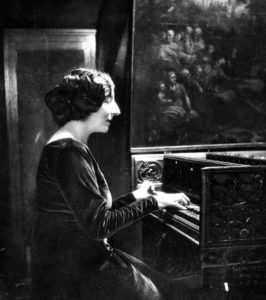
Wanda Landowska 1937
As there was only a limited number of playable historical instruments available at that time, the demand for new instruments grew and many instrument makers had interest in the “new” harpsichord.
The first instrument maker in Hamburg who built harpsichords was Walther Ebeloe. He made the first harpsichords in Hamburg in the 20th century. Since the harpsichord was hardly a major research object at the time, there were less sources and many instrument makers used modern piano construction methods and thus constructed new instruments that represent a kind of hybrid: the sound generation of the harpsichord with jacks and quills in combination with experience and innovations in modern piano construction, as well as modern materials. Partly motivated to build a reliable and perhaps also “improved” instrument, instruments were created that sound little in common with a historical instrument, but in terms of music history they play an important role in preparing the way for today’s historical performance practice.

Harpsichord by Walther Ebeloe, Hamburg 1939 – Eric Feller Collection (2)
The harpsichord described here was completed on December 22nd, 1939 by Walther Ebeloe in Hamburg. It is perfectly preserved and in playable condition.
The case is made of walnut with a shellac polish, has a curved shape and stands on 3 legs. From the outside, the instrument looks like a modern, small grand piano. It has 2 manuals with 3 registers (8′, 8′, 4′), lute and manual coupler. The registers can be operated by hand stops on the left and right side. Below the instrument is a knee lever that operates the manual coupler. The quills were originally made of leather and were changed to Delrin. The compass is 5 octaves (FF – f3). The lower keys are covered with plastic and the upper keys are made of ivory.

Harpsichord by Walther Ebeloe, Hamburg 1939 – Eric Feller Collection (4)
The signature is inlaid in the centre of the nameboard:
“W. Ebeloe
Hamburg”
The serial number is A232 and is stamped on the first key of the upper manual. The date of manufacture can also be found there with “22 DEZ. 1939”.

Harpsichord by Walther Ebeloe, Hamburg 1939 – Eric Feller Collection (7)
In many details, the entire instrument shows a construction and structure that comes from modern piano construction (soundboard, keyboard structure, arrangement of the bridge, case…). Ebeloe probably only had a few construction drawings of historical harpsichords so he developed his own action, in which he adapted parts of a modern piano action for the needs of the sound production of the harpsichord. The result is a hybrid instrument with an extraordinary sound, which clearly stands out from the instruments of other instrument makers of the time. It is more similar to the instruments made by the French company of Pleyel.

Harpsichord by Walther Ebeloe, Hamburg 1939 – Eric Feller Collection (8)
The sound of the instrument is very strong, but a little reserved in the bass due to the length of the instrument.

Harpsichord by Walther Ebeloe, Hamburg 1939 – Eric Feller Collection (5)
Walther Ebeloe was born in 1896 and opened his workshop in 1923, where he worked as the first harpsichord maker in the 20th century in Hamburg. During the Second World War, his workshop was completely destroyed by the bombing raids and it was very difficult for him to start again in the late 1940s. Due to a shortage of materials, it was very difficult for him to rebuild his workshop and establish himself again as an instrument maker. He worked primarily as a piano tuner. In the 1950s, Ebeloe entered into a partnership with Wolfgang Wegener (1918 – 1984) in Braunschweig. Both were influenced by anthroposophical ideas and incorporated them into their work. Ebeloe sold the last harpsichord he had built to the composer, pianist and harpsichordist Yngve Jan Trede (1933 – 2010) for DM 12,000.
Walther Ebeloe died in 1982.

Harpsichord by Walther Ebeloe, Hamburg 1939 – Eric Feller Collection (6)
Sources:
- Hilda Jonas: Harpsichord Festival Scheduled. In: The Harpsichord. Vol. III, No 4, 1970.
- Glendon Frank: Remembering Hilda Jonas. In: The Diapason – Harpsichord News. Dezember 2014.
- Wolfgang Zuckermann: The modern harpsichord, twentieth century instruments and their makers. October House, New York 1969.
- Charles Mould (Hrsg.): Amendments and additions to clavichord-related information in the Third Edition of Donald Boalch’s Makers of the Harpsichord and Clavichord 1440–1840. 1995.
- Hanns Neupert: Das Klavichord. Bärenreiter Verlag, Kassel 1977.
- Olaf Kirsch: De 1900 à 2000 – Un siècle de musique ancienne à Hambourg.
- Kunsthandwerker. In: Hamburger Abendblatt vom 19. Januar 1966.
© Eric Feller – Early Keyboard Collection – February 2023

Harpsichord by Walther Ebeloe, Hamburg 1939 – Eric Feller Collection (3)
Der Beitrag Walther Ebeloe 1939 erschien zuerst auf Eric Feller Early Keyboard Instruments Collection.
]]>Der Beitrag Neupert 1940 erschien zuerst auf Eric Feller Early Keyboard Instruments Collection.
]]>The renaissance of the harpsichord in the 20th century, led by Wanda Landowska (1879 – 1959), came to a temporary halt during the Second World War. In Germany, the production of musical instruments was severely restricted due to the prioritization of war material.
The Neupert company was one of the leading manufacturers in early 20th century for harpsichords in Germany. During the Second World War, Neupert, like many other companies in Germany, had to contend with the economic challenges of the war years.
In 1939, when war broke out, Neupert’s production was curtailed due to rationing and material shortages. However, the company was able to maintain production and continued to supply harpsichords to customers in Germany and abroad. In the later years of the war, many of Neupert’s employees were drafted into military service and the production further declined.

Harpsichord Neupert, Bamberg 1940 – Eric Feller Collection (9)
The harpsichord described here dates from the war year 1940 and was made by Neupert in Bamberg. It is perfectly preserved, all parts are original and it is in full playable condition.
The case is made of dark walnut and stands on 4 Chippendale-style legs.
The harpsichord has 2 rows of jacks with so-called “Troho jacks” (Trolon plastic-wood jacks), which consist of a wooden core and plastic sides. The quills are made of leather, two registers (8′ and 4′) and a lute stop for the 8′ register, which is divided. The compass is 4 ½ octaves (CC – f3).

Harpsichord Neupert, Bamberg 1940 – Eric Feller Collection (12)
The signature
“Neupert Bamberg”
is located in the middle of the nameboard. The serial number is 16866 and is stamped on the right of the wrest plank. The letters “DRGM“, the abbreviation for “Deutsche Reichs-Gebrauchsmuster“, are stamped on the left and right side of the jack rail and decorated in gold letters. The Deutsche Reichs-Gebrauchsmuster was a system for registering and protecting trademarks and designs in Germany that was in force from 1891 to 1945. It was introduced to offer German companies a way to protect their intellectual property rights and thus create an incentive for innovation and creativity.

Harpsichord Neupert, Bamberg 1940 – Eric Feller Collection (DRGM – Signature)
The Deutsche Reichs-Gebrauchsmuster system worked similarly to the patent or trademark protection system, but with the difference that it focused exclusively on the aesthetic properties of a product. It allowed manufacturers to apply for a utility model patent for their product and thus obtain a protection on the use of the design for a period of up to 15 years. The Deutsche Reichs-Gebrauchsmuster was crucial for many companies as it allowed them to stand out from the competition and create unique products that were appreciated by customers. It was also an important protection against product piracy.
During National Socialism, the Reichs-Gebrauchsmuster was used by the Nazis as an instrument of propaganda. Many products were provided with nationalist or partly racist symbols to promote national pride and to create a unified identity for the people.
After the end of World War II, the Reichsgebrauchsmuster system was abolished and replaced by the Deutsche Gebrauchsmuster, which is still in use in Germany today.

Cembalo Neupert, Bamberg 1940 – Eric Feller Collection (1)
The sound of the instrument is very clear and strong. However, it must be clearly stated here that the sound is not at all comparable with a historical harpsichord. It is a completely new instrument due to its construction, which only has the sound generation in common with the old harpsichords. In comparison to instruments built from the 1960s and 1970s, however, the sound is many times more convincing and beautiful.
Der Beitrag Neupert 1940 erschien zuerst auf Eric Feller Early Keyboard Instruments Collection.
]]>Der Beitrag Érard Frères & Compagnie 1796 erschien zuerst auf Eric Feller Early Keyboard Instruments Collection.
]]>This early square piano was made by Érard Frères & Compagnie in Paris in 1796. The case of the instrument and the fluted legs are made of fine mahogany. The instrument is decorated with band inlays all around the case. The nameboard is signed with:
“Érard Frères & Compagnie
Rue du Mail No. 37
à Paris 1796″
The keyboard has a compass of 5 ½ octaves (FF – c4). The lower keys are covered with ivory and the upper keys with ebony. Above the Second Action is the two-parted dust cover and on the right edge of the case is a second foldable music stand.

Sébastien Erard (1752 – 1831)
On the soundboard next to the bridge is the original handwritten signature with the serial number 3346 and the year of manufacture 1796. The square piano has four wooden pedals, which are inserted in a bar between the two rear legs. The functions are: dampers, moderator, lute and nag’s head swell.
The instrument was found in Brittany/France in December 2022 and was in absolutely original condition. Also present were the original tuning hammer and the key for the lock.

Square Piano Erard, Paris 1796 – Eric Feller Collection (original tuning hammer)
According to the original production books from the Érard company, the instrument was delivered to Monsieur Lefort in Orléans. Further research to the provenance of the instrument are ongoing.

Square Piano Erard, Paris 1796 – Eric Feller Collection (2)
For detailed information about the company Érard click here!
Other surviving instruments by Érard Frères & Compagnie:
- 1805 Square Piano (No. 6447) – MKG – Museum für Kunst und Gewerbe Hamburg, Germany
- 1808 Square Piano (No. 7488) – Cité de la Musique Paris, France
Der Beitrag Érard Frères & Compagnie 1796 erschien zuerst auf Eric Feller Early Keyboard Instruments Collection.
]]>Der Beitrag Joseph Fritz c. 1835 erschien zuerst auf Eric Feller Early Keyboard Instruments Collection.
]]>“Joseph Fritz
Wien”

Joseph Fritz, Vienna c. 1835 – Eric Feller Collection (3)
The hammers are covered with leather, Viennese action, straight string with a divided bridge and two pedals (dampers and una corda). The compass is 6 octaves + sixth, CC – a4. The music stand is attached above the wrest plank and has two pivoting candle holders on each side.

Joseph Fritz, Vienna c. 1835 – Eric Feller Collection (4)
Little is known about Joseph Fritz. He was born in Vienna in 1808 and is the son of Johann Fritz (born 1772 – died in Vienna 1834). After his father’s death, he continued to run the workshop and continued the successes of his father, who previously had the reputation of being one of the best piano makers in Vienna. From about 1837 he moved his workshop to Graz and built instruments there.
Other surviving instruments by Joseph Fritz:
- c. 1840 Grand Fortepiano – Collection Cristofori, Historical Keyboard Instruments B.V., Amsterdam / The Netherlands

Joseph Fritz, Vienna c. 1835 – Eric Feller Collection (2)
Der Beitrag Joseph Fritz c. 1835 erschien zuerst auf Eric Feller Early Keyboard Instruments Collection.
]]>Der Beitrag Joseph Kirkman c. 1806 erschien zuerst auf Eric Feller Early Keyboard Instruments Collection.
]]>The oldest surviving fortepiano built by Abraham & Josephus Kirckman in 1789 is also part of the Eric Feller Collection.
Detailed information about this instrument can be found here – click here!
The square piano described here dates from around 1806. The case of the instrument is made of mahogany with surrounding band inlays made of different woods. The instrument stands on 6 fluted legs. The lower keys are covered with ivory and the upper keys with ebony. The nameboard is made of different woods and decorated with fretwork on the sides and signed in an oval cartouche:
“Joseph Kirkman
Grand Piano Forte Maker
To Her Majesty
No.19 Broad Street, Golden Square
London”
The instrument has a pedal for controlling the dampers, a Double Action and leather-covered hammers. Furthermore, it has two strings per key and the action is covered with the original dust cover. Kirkman instruments are characterized by very high-quality workmanship and a particularly beautiful sound.

Trade Card Joseph Kirkman c. 1795 – The British Museum
Other surviving instruments by Joseph Kirkman:
- c. 1830 Cabinet Piano – Glasgow Museums & Art Galleries, Glasgow England
- c. 1835 Cabinet Piano – Western Australian Academy of Performing Arts, Edith Cowan University, Perth Australia
- Grand Fortepiano – Royal Palace Mafra, Portugal
Der Beitrag Joseph Kirkman c. 1806 erschien zuerst auf Eric Feller Early Keyboard Instruments Collection.
]]>Der Beitrag Ignace Pleyel 1863 owned by Charles Albert d’Arnoux – Bertall erschien zuerst auf Eric Feller Early Keyboard Instruments Collection.
]]>
Charles Albert d’Arnoux – Bertall (1820 – 1882) by A. Disdéri
This extraordinary French fortepiano is an important historic instrument in music history, as it comes from the possession of the famous French caricaturist, draftsman and etcher Charles Albert d’Arnoux, or better known as Bertall. He is also known as one of the pioneers of photography. The Pleyel company in Paris was one of the leading piano manufacturers in Europe in the 19th century. Their clients included leading personalities, artists, musicians and composers.
The case of the instrument is made of rosewood with elaborate carvings on the sides near the keyboard. The keyboard is made of ivory and ebony, the hammers are covered with felt and the piano has single dampers. The lyre has two pedals for dampers and una corda. The keyboard has 7 octaves (AAA – a4).

Ignace Pleyel, Paris 1863 owned by Bertall – Eric Feller Collection
The serial number (35351) can be found on the right side of the instrument. The version is the “Petit Patron” model with a total length of 215 cm. The front bears the inscription:
“Ignace Pleyel & Comp.
Paris”

Ignace Pleyel, Paris 1863 owend by Bertall (serial number) – Eric Feller Collection
Inside the piano there are three metal bars. Entries in Pleyel’s original company books indicate that the instrument was completed in 1863 and then sold for 1400 Franc on February 15, 1867 to Charles Albert d’Arnoux – Bertall in Paris. This provenance and the marvellous and beautiful sound make this fortepiano to a special highlight in the collection.

Fortepiano Pleyel 1863 No. 35351 – Eric Feller Collection
Charles Constant Albert Nicolas d’Arnoux de Limoges Saint-Saens (his full birth name) was born on December 18, 1820 in Paris. He was the son of Daniel d’Arnoux de Limoges Saint-Saens (born September 9, 1780 in Grenoble) and his wife Louise-Elisabeth de Limoges (the dates of her life are not yet known), who married in Paris on February 16, 1819. A year later Charles Albert d’Arnoux was born. He was the only child from this marriage. Nothing is known about his childhood so far. Around 1844 he married Albertine Pellapra and together they had 7 children:
- Gabrielle Louise Henriette d’ARNOUX 1845 – 1912
- Georges Noël Adrien d’ARNOUX 1848 – 1917
- Louis Eugene Joseph d’ARNOUX 1859 – 1864
- Daniel Ernest Albert d’ARNOUX 1862 – 1915
- Emilie Albertine d’ARNOUX 1866 – 1949
- Elisabeth Albertine d’ARNOUX 1866 – 1956
- Marie Albertine d’ARNOUX 1866 – 1908

Elisabeth Pellapra de Lolle
On March 18, 1877, his wife Albertine died in Paris at the age of 55. Two years later (on January 12, 1879) Bertall married the sister of his late wife Hortense Pellapra in Paris. They had no children together.
Bertall’s parents intended their son to study at the École Polytechnique, but he devoted himself to painting. He spent the first years in the studio of Michel Martin Drolling (1786 – 1851) and then decided on illustrative drawings and caricatures as his artistic focus.

Michel-Martin Drolling, Self-Portrait (1804)
On advice of Honoré de Balzac (1799 – 1850), he only signed his works with Bertall, an anagram of his first name Albert. On February 3, 1875 he was made a Knight of the Legion of Honour. He drew for various magazines and newspapers and illustrated books, including his own texts. He also showed an interest in photography from an early age and from 1855 worked together with the famous photographer Hippolyte Bayard (1801 – 1887). In the early 1860s, both Bayard and Bertall opened a photo studio at Rue de la Madeleine No. 15 in Paris. In 1866 they separated and Bertall opened his own photo studio. There he specialized in portraits. Shaped by his artistic environment, music was also an important point in his life and family. On March 24, 1882, Bertall died in Soyons.

Hippolyte Bayard – Self-Portrait 1863
Publications by Bertall:
- Les Omnibus, pérégrinations burlesques à travers tous chemins, avec Lefix, 1843
- Les Buses-Graves, prospectus publicitaire, 1843 : parodie des Burgraves de Victor Hugo, Tortu Goth (which was also a pseudonym of Bertall)
- Les Guêpes à la Bourse, 1847
- Cahier des charges des chemins de fer, 1847
- Les Enfants d’aujourd’hui, album de caricatures, 1848
- La Revue comique à l’usage des gens sérieux, novembre 1848 – avril 1849
- Les Infortunes de Touche-à-tout, 1861
- Mlle Marie sans-soin, 1867
- M. Hurluberlu et ses déplorables aventures, 1869
- Les Communeux, 1871. Types, caractères, costumes, 1871
- Le Grelot au Salon. Le Salon de 1872 dépeint et dessiné par Bertall, 1872
- La Comédie de notre temps : études au crayon et à la plume. I. La civilité, les habitudes, les mœurs, les coutumes, les manières et les manies de notre époque. II. Les enfants, les jeunes, les mûrs, les vieux. III. La vie hors de chez soi : l’hiver, le printemps, l’été, l’automne, 3 volumes, 1874-1876
- Les Contes de ma mère, recueillis et illustrés par Bertall, 1877
- La Vigne, voyage autour des vins de France : étude physiologique, anecdotique, historique, humoristique et même scientifique, 1878
- Mademoiselle Jacasse, 1879
- Les Plages de France, 1886
- Georges le distrait, 1889
Illustrated books by Bertall:
- Honoré de Balzac : Œuvres complètes, 20 volumes, 1842-1855
- Eugène Briffault : Paris dans l’eau, 1843
- Pierre-Jules Hetzel : Nouvelles et Véritables Aventures de Tom Pouce, 1844
- Collectif : Le Diable à Paris. Paris et les Parisiens. Mœurs et coutumes, caractères et portraits des habitants de Paris, tableau complet de leur vie privée, publique, politique, artistique, littéraire, industrielle, etc., 2 volumes, 1845-1846
- Honoré de Balzac : Petites Misères de la vie conjugale, 1845
- Alexandre Dumas : La Bouillie de la comtesse Berthe, 1845
- Alexandre Dumas : Histoire d’un casse-noisette, 1845
- Paul Féval : Contes de nos pères, 1845
- Maurice Alhoy : Les Bagnes, 1845
- Maurice Alhoy et Louis Lurine : Les Prisons de Paris, 1846
- Octave Feuillet : Vie de Polichinelle et ses nombreuses aventures, 1846
- Léon Gozlan : Aventures du prince Chènevis, 1846
- Émile Souvestre : Le Monde tel qu’il sera, 1846
- Eugène Briffault : Paris à table, 1846
- Jean Anthelme Brillat-Savarin : Physiologie du goût, 1848
- Nicolas Boileau : Œuvres poétiques, 1846
- Bernardin de Saint-Pierre : Paul et Virginie, 1849
- James Fenimore Cooper : Le Dernier des Mohicans, 1849
- Charles Perrault : Contes, 1852
- Georges Bonnefons : Les Hôtels historiques de Paris, 1852
- Hoffmann : Contes fantastiques, 1856
- Jacques Porchat : Contes merveilleux, 1858
- Paul Boiteau : Légendes pour les enfants, 1861
- Comtesse de Ségur : Les Vacances, Les Petites Filles modèles, 1863
- Wilhelm Hauff : L’Auberge du Spessart, contes allemands, 1863
- Arthur de Gravillon : La Malice des choses, 1867
- Edmond Auguste Texier : Le Journal et le journaliste, 1868
- Miguel de Cervantes : Don Quichotte, 1870
- Alphonse Daudet : Les Petits Robinsons des caves ou le siège de Paris, 1872
- Jean Macé, Contes du petit château, 1876
- Paul de Kock : La Laitière de Montfermeil. Le Muletier, 1878
- Arthur de Rothschild : Histoire de la poste aux lettres et du timbre-poste depuis leurs origines jusqu’à nos jours, 1880

Ignaz Josef Pleyel (1793) after Thomas Hardy
The Pleyel company was founded in 1807 by the Austrian composer and music publisher Ignaz Josef Pleyel (born in Ruppersthal 1757 – died 1831 in Paris) under the name Ignace Pleyel & Comp. Before that, in 1797, he founded a music publishing company in Paris and established himself in the musical life of the French metropolis. In 1802 he designed his first piano (the patent application was made in 1807). Together with the instrument maker Charles Lemme, he founds the piano factory. With the support of various patrons, he was able to establish his business.
He was soon joined by his son (Joseph-Étienne-) Camille Pleyel (born 1788 in Strasbourg – died 1855 in Paris), who became a full partner in 1815. Camille Pleyel studied composition with his father and piano with Johann Ladislaus Dussek (born 1760 in Čáslav / Central Bohemia – died 1812 in Saint-Germain-en-Laye). He spent most of his youth in London but returned to Paris in 1824 to take charge of the firm that year.

Camille Pleyel c. 1840
In the 1820s, the Pleyel factory was located in Saint-Denis. During this time, about twenty workers made about fifty pianos a year. At its first exhibition in Paris in 1827, the firm won a gold medal, awarded for its inventions and for a three-string grand piano that was ranked on a par with the best English pianos. At the Paris Exhibitions in 1839 and 1844 the firm triumphed again by winning more gold medals. The acclaim was an excellent spur to business and by 1844 production had increased to 900 pianos a year.
Camille Pleyel established the first Salon/Salle Pleyel and had many friendly relationships with the most famous people of musical life of the time. Great composers such as Frédéric Chopin (1810 – 1849) or Franz Liszt (1811 – 1886) played instruments made by Pleyel. The Salle Pleyel, one of the earliest concert halls in France and was built on Rue Rochechouart in the late 1820s. Chopin played his last concert there on February 16, 1848.
After Camille’s death in 1855, his son-in-law Auguste Wolff (1821 – 1887) took over the management of the company. He changed the name to Pleyel, Wolff & Cie. and continued the success of the company.
His son-in-law Gustave Lyon (1857 – 1936), who took over the company in 1887, continued the success. In 1971, ten years after the merger of Pleyel with Érard and Gaveau, Schimmel from Braunschweig acquired all three companies.
Other surviving instruments by Ignace Pleyel & Comp. can be found in many museums and private collections worldwide.

Ignace Pleyel, Paris 1863 owend by Bertall (4) – Eric Feller Collection
References:
- René Beaupain: Chronologie des pianos de la maison Pleyel. Éditions L’Harmattan, Paris 2000
- Henri Beraldi, Les Graveurs du XIXe siècle, vol. II, 1885
- Jean-Jacques Eigeldinger: Chopin et Pleyel. Fayard, Paris 2010
- John Grand-Carteret: Les moeurs et la caricature en France. Paris 1888
- Jean-Jacques Trinques: Le piano Pleyel d’un millénaire à l’autre. Éditions L’Harmattan, Paris 2003
- Arnaud Marion: Pleyel. Une histoire tournée vers l’avenir. Éditions de la Martinière, Paris 2005
- Arnaud Marion: La Salle Pleyel: Lieu de Modernité. Éditions de la Martinière, Paris 2006
- Arnaud Marion: La Salle Pleyel. In: Connaissance des Arts, Hors série. 5. November 2006
- Daniel Mason. Der Klavierstimmer Ihrer Majestät. Roman. Blessing 2003
- J. Rousseau, Histoire d’une résurrection: pianissime Pleyel. In: Classica-Répertoire. September 2007, S. 46–47
- Jean Jude: Pleyel 1757–1857. La passion d’un siècle. Imprimerie du Centre Loire, Fondettes 2008
- Gustave Vapereau, Dictionnaire universel des contemporains, vol. 1, 1858
© Eric Feller – Early Keyboard Collection – December 2022
Der Beitrag Ignace Pleyel 1863 owned by Charles Albert d’Arnoux – Bertall erschien zuerst auf Eric Feller Early Keyboard Instruments Collection.
]]>Der Beitrag Rousselot Freres ca. 1834 erschien zuerst auf Eric Feller Early Keyboard Instruments Collection.
]]>The case is made of rosewood and decorated with inlays and brass applications. The keyboard is made of ivory and ebony. The instrument is straight strung, two small metal bars in the treble, Stoßzungenmechanik and two pedals for dampers and due corde. The bridge is divided. The nameboard bears the inscription in a cartouche:
“Rousselot Frères
Facteurs Brevetés à Nîmes
Moitessier a Montpellier”
In the middle of the soundboard is a handwritten signature with the serial number:
“No. 903 Louis Rousselot à Nîmes”
Inside is the original dust cover above the strings, a feature that was only built for a short time on grand fortepianos and has its origins in the early square pianos of the 18th century. The compass is 6 ½ octaves (CC – g4). In addition to the music stand, there are two smaller music stands on either side, which can be lift up to make playing music with others easier.
From this instrument should be emphasised the absolutely high-skilled production as well as the sound. In terms of sound, this fortepiano surpasses also the instruments by Erard and Pleyel which were played by Chopin, Liszt and Schumann. Only a few instruments by Rousselot have survived. A note from the “Journal de Toulouse” of July 23, 1845 shows that Rousselot manufactured all parts for his instruments in his own factory and did not purchase any parts from external suppliers.
This grand piano was found in Marseille / France in autumn 2022 and is in completely original condition.

Fortepiano by Rousselot Frères, Nimes c. 1834 – Eric Feller Collection (Nameboard)
Little is known about the Rousselot company. There were probably three brothers: Louis Rousselot (the life dates are not yet known), who was active as a piano builder, Joseph-François Rousselot (born February 6, 1803 in Nîmes, died September 4, 1880 in Argenteuil), composer and horn player and Scipion Rousselot (born 20 July 1804, died c. 1880), who was also a composer and cellist.
(see Joël-Marie Fauquet, «Rousselot, Scipion», in Joël-Marie Fauquet (dir.), Dictionnaire de la musique en France au xixe siècle, Fayard, 2003, xviii-1406 (ISBN 2-213-59316-7 , BNF 39052242))
The piano factory in Nîmes can be traced back to around 1833, but it is highly probable that instruments were made before that. The signature on the nameboard shows that Louis worked with at least one of his brothers. Whether it is Joseph-Francois, Scipion or another brother has not been clarified yet. Also, no information is known about his apprenticeship years. Further research is currently undergoing! During his active period, Louis Rousselot entered into various partnerships with other instrument makers. Instruments from a collaboration with Decombes and Moitessier in Montpellier have been preserved.
Little is known about the history of the company. An article from 1840 informs that a fire broke out in the factory:
“L’incendie de la fabrique de pianos de MM. Rousselot frères : “L’incendie de la fabrique de pianos de MM. Rousselot frères (1840) fut aussi l’occasion d’une de ces manifestations, où une partie de notre troupe masculine, groupée autour d’une cantatrice de grand talent (Mme Lernoule), se transporta au Grand Théâtre devant un auditoire considérable, accouru pour soulager les malheureux ouvriers de l’établissement détruit. […] Enfin, cette année (1841) fut marquée par un beau concert donné au Théâtre par Mne Lemoule et quelques amateurs (quorum pars. fui), pour aider a la reconstitution de ta fabrique de pianos de MM. Rousselot frères, détruite par un incendie.”
(from „Mémoires de l’Académie de Nîmes“, 1881, Gallica)
Another fire broke out in the factory in 1842:
“Nîmes, 6 septembre – dans la nuit du 4 au 5 de ce mois il y a eu en ville trois incendies ou tentatives d’incendies. […] Chez le sieur Rousselot, fabricant de pianos, place Balore, le feu s’est manifesté dans le magasin où sont renfermés, pour une somme considérable, des bois précieux; heureusement on a pu s’en apercevoir assez à temps pour arrêter les progrès d’un incendie qui pouvait devenir très-considérable. […]”
(from „Le Journal de Toulouse“, 07/09/1842, Rosalis)
At the “Exposition des Produits des Beaux-Arts et de l’Industrie: Dans les galeries du Capitole à Toulouse” in 1840, instruments by Rousselot (and Boisselot) were exhibited and evaluated by a jury. As a result, these were highly acclaimed and placed on par with the Paris-based instruments by Pleyel and Erard:
“M. Rousselot, de Nimes, est également inventeur de quelques nouveaux procédés. Ainsi il peut, au moyen d’une mécanique bien simple appliquée au piano, rendre le clavier doux ou dur au toucher. Mais cet effet ne peut se faire progressivement comme sur les pianos de M. Martin. M. Rousselot a également substitué des ressorts, à boudin à ceux à frottement; ce qui donne plus de force l’échappement, et de grandes garanties pour la solidité.
Boisselot présente plusieurs innovations. Il a imaginé un mécanisme pour les marteaux du piano, à axe fixe et à vis de rappel, qui sert de régulateur. Cette combinaison permet, en cas d’accident, de réparer les marteaux isolément, au lieuque dans les mécanismes anglais, francais ou allemands, pour la moindre réparation, il est indispensable de démonter une série de douze marteaux. Ces derniers peuvent encore attaquer, par une oscillation contraire, des notes qui ne leur sont point destinées.
Boisselot a encore inventé un piano à petite queue, avec barrage par dessous. Ce barrage a été reconnu excellent par la commission de l’industrie, parce que ce système donnait une grande solidité à l’instrument, puisque le sommier des pointes et celui des chevilles ne fesaient plus qu’un seul corps avec la barre de dessous.
Cette construction donne en outre au son beaucoup d’intensité. Mais ce qui mérite les plus grands éloges, et ce qui peut être considéré comme un progrès et une invention éminemment utile, c’est le piano clédiharmonique. Tout le monde sait que le piano offre de grandes difficultés pourmonter deux cordes à la fois en leur fesant tenir un parfait accord.
Cette difficulté semblait devoir rester inhérente à la fabrication du piano; cependant M. Boisselot, par de grandes études et des épreuves réitérées, vient de remédier à cet inconvénient en inventant le clédiharmènique. Cette invention n’a d’autre but que de simplifier l’opération de l’accord en la mettant à la portée de chaque pianiste, et lui permette demonter à la fois et avec la plus grande facilité les deux cordes, en les maintenant à l’unisson parfait aumoyende clés à vis sans fin, de roue d’engrenage, vis de pression, poulies, ovales, etc, etc., le tout formant un mécanisme des plus ingénieux et desmieux combinés, et par lequel toutes les chances d’un’ bon accord sont prévues. Un tel résultat est un pas immense dans l’art de la facture des pianos, parce qu’il résout un problème qui jusqu’à ce jour n’avait point été résolu,malgré toutes les recherches des facteurs.
Après avoir constaté et jugé ces différentes inventions, nous avions à prononcer sur lemérite de chacun des instruments des exposans.
La besogne devenait rude, parce que le nombre de ces instrumens était considérable, et que l’industrie de chacun des fabricans pouvait se ressentir de notre décision. Cependant nous n’avons reculé devant aucune de ces corisidérations. Forts de notre mandat, pénétrés. de nos devoirs de jurés, nous avons jugé tous ces pianos, et nous allons avoir l’honneur de rendre compte de nos jugemens.
Après avoir établi des catégories, les pianos carrés à deux cordes ensemble, ceux à trois cordes, les pianinos, les pianos à petite queue et ceux à grande queue; après les avoir essayés de toutes les manières; après les avoir comparés entr’eux, pesé le fort et le faible des uns et des autres, le juri a trouvé qu’en première ligne se présentaient MM. Pleyel et Pape, facteurs de Paris, dont la réputation est européenne.
Mais ces artistes sont si haut placés, ils ont un mérite si incontestable, ils ont été couronnés si souvent pour l’excellence de leurs produits, que le juri pas cru devoir faire entrer leurs instrumens en lutte avec ceux des différens facteurs du midi de la France.
Mazel, qui est leur 1e présentant à Toulouse, a dans ses magasins les meilleurs pianos qui soient sortis de leurs ateliers, et tout ce que nous pourrions dire n’ajouterait rien à leur réputation. Nos pays méridionaux possèdent deux facteurs de pianos qui peuvent rivaliser avec les premiers de Paris pour quelques-uns de leurs instrumens: ce sont MM. Boisselot de Marseille, et Rousselot de Nîmes.
Ces artistes ont exposé des pianos à queue qui réunissent à une grande élégance, à une solidité à toute épreuve, les qualités si essentielles de la sonorité, de l’égalité dans le clavier, et de la perfection dans le mécanisme.
Une discussion très vive s’est engagée au sein du juri sur le mérite de ces instrumens; il a déclaré à l’unanimité que MM. Boisselot et Rousselot ne le cédaient en rien aux plus habiles facteurs de la capitale pour la fabrication des pianos à queue, et qu’ils pouvaient rivaliser avec eux, si même ils n’établissaient à de meilleures conditions et à des prix moins élevés.
Les instrumens de ces messieurs possèdent des qualités du premier ordre ; tous deux ont établi de ces pianos à deux et à trois cordes qui ne laissent rien à désirer dans aucune partie de leur facture.
Il était donc impossible d’établir la supériorité de l’un sur l’autre : cela devenait d’autant plus difficile, que les instrumens n’était pas identiques dans leur ensemble.
Ainsi, les pianos à petite queue de M. Rousselot ont quatre pouces de longueur en plus que ceux de M. Boisselot, et la qualité du son pouvait avoir, par cette raison, plus d’éclat çependant la différence est peu sensible.
De même que dans les pianos à grande queue, ceux de M. Rousselot ne sont armés que de deux cordes jusqu’au fa, cinquième ligne, clé de sol, tandis que ceux de M. Boisselot ont trois cordes dans toute l’étendue dit clavier.
Quoique ces derniers aient plus de son par cette cause, les instrumens de M. Rousselot ont un mérite bien grand aussi, puisque avec une corde demoins ils produisent de fort beaux effets de sonorité, et peuvent rivaliser avec ceux de M. Boisselot.
Cependant l’importance de l’industrie devant entrer en lutte avec l’excellence des instrumens, le juri a reconnu que M. Boisselot l’emportait sur MM. Rousselot et Moitessier, de Nîmes, et il a décidé que M. Boisselot aurait une médaille d’or pour la bonté de ses pianos à queue, son piano clédiharmonique, ses inventions diverses et l’importance de son industrie.
Il a encore arrêté que MM. Rousselot et Moitessier, de Nîmes, auraient une médaille d’argent avec éloges pour l’excellente facture de leurs pianos à queue. Nous avons à rendre compte de notre jugement sur les pianos carrés à trois et à deux cordes, de MM. Boisselot, Rousselot, Cropet et Martin.
Les pianos carrés à trois cordes ont présenté au juri de grands défauts; chez les uns, le son était sec et le clavier dur ou empâté ; chez d’autres, les sons graves écrasaient ceux du médium ; d’autres encore paraissaient être couverts d’une sourdine; enfin ces instrumens offraient des défectuosités si patentes, que le juri les amis hors de concours, donnant ainsi une leçon sévère aux facteurs, et les avertissant qu’ils avaient de grandes améliorations à introduire dans ce genre d’instrument.
Les pianos à deux cordes ont offert dés résultats satisfaisans, et ceux d’un petit format ont mérité les éloges du juri. La bonté de ces petites instrumens, la modicité de leur prix, qui les met à la portée des plus minces fortunes, ce qui permettra à l’art de se répandre chez les classes les moins aisées de la société, tout faisait un devoir au juri d’encourager ces produits de notre industrie.
ll a été très satisfait de voir que ces instrumens étaient soignés, que le son en était d’une excellente qualité et lamécanique très solidement établie. Les facteurs qui méritent des encouragemens pour ces instrumens sont MM. Martin, de Toulouse, et M. Rousselot, de Nîmes.
Ce dernier avait envoyé un piano de meilleure qualité que ceux de M. Martin ; mais cet instrument étant arrivé après que le jugement avait été rendu, il a été écarté du concours, et la préférence est restée aux pianos de M. Martin.
Il a été accordé à ce facteur, pour ses pianos carrés à deux cordes, son gymnase digital, instrument dès plus recommandables pour le développement et la souplesse des doigts, etc., ses différentes inventions, a fin de l’encourager dans les efforts qu’il fait journellement pour le perfectionnement de ses instrumens, une médaille d’argent.
Boisselot, Martin et Cropet ont exposé chacun un piano droit. Celui de M. Boisselot est un meuble en palissandre, forme moyen-âge, du style le plus gracieux et le plus élégant. Celui de M. Martin est un secrétaire-piano qui sert à la fois de bureau; l’invention en est fort ingénieuse et lemeuble aussi des plus élégans et des plus riches.
Le piano droit de M. Cropet est tout simplement un piano droit fort gracieux et surtout fort bon. Ce piano a lutté avec avantage contre ceux de M. Martin et Boisselot, qui sont cependant fort remarquables.
Le juri a trouvé l’instrument de M. Cropet supérieur, et lui a accordé une médaille d’argent en récompense du laient et des soins qu’il a déployés dans la confection de cet instrument.”
(from “Exposition des Produits des Beaux-Arts et de l’Industrie: Dans les galeries du Capitole à Toulouse en 1840”, p. 106-107)

Rousselot & Decombes – Piano label c. 1840
At the renewed exhibition in Toulouse in 1845, Rousselot was honoured with the gold medal for his excellent instruments. The purity of the sound and the evenness and lightness of the keyboard were emphasized. The silvery timbre and the powerful bass of the grand pianos was also praised. The report says:
“Médailles d’Or. MM. ROUSSELOT et Comp.e, à Nîmes (Gard), Ont exposé des pianos droits, des pianos carrés et un piano à queue petit format.
Ces instruments se recommandent en général par la pureté du son, l’égalité et la facilité de leurs claviers. Les pianos carrés ont été jugés préférables aux pianos droits. MM. Rousselot n’ont exposé qu’un piano à queue petit format. Cet instrument a paru fort bien établi, la qualité de son en est belle, le timbre des notes supérieures est argentin, lemilieu sonore, et les basses ont une grande puissance. Cet instrument a été comparé par le juri à un piano du même format de Pleyel; il a soutenu la comparaison avec honneur; c’est lui faire une belle part d’éloges.
Le juri a reconnu dans les oeuvres de ces facteurs des qualités essentielles; ils occupent un nombreux personnel d’ouvriers et ils confectionnent dans leurs ateliers tout ce qui a rapport aumécanisme du piano, soit en ouvrage de fonte, fer, cuivre, etc., ce qui leur permet d’établir leurs instruments à des prix modérés, tout eu les rendant solides et durables. Par toutes ces considérations, le juri décerne à MM. Rousselot et Comp.e une médaille d’or.”
(from “Exposition des Produits des Beaux-Arts et de l’industrie : A Toulouse dans les galeries du Capitole“, 1845, Rosalis)
Other surviving instruments by Rousselot Frères:
- Grand Fortepiano no. 954 – Musée de Piano, Ville de Limoux
- Grand Fortepiano no. 1299—Eric Feller Collection
Der Beitrag Rousselot Freres ca. 1834 erschien zuerst auf Eric Feller Early Keyboard Instruments Collection.
]]>Der Beitrag Bland & Weller 1794 erschien zuerst auf Eric Feller Early Keyboard Instruments Collection.
]]>The instrument presented here was built in London in 1794 and is a partnership between Anne Bland and E. Weller. It is not yet clear whether E. Weller is also a woman.
The case of the square piano and the original stand are made of mahogany and decorated with multi-coloured inlays. The action is a single action with single dampers, double strung and there are two hand stops for dampers and lute stop. The keyboard is made of ivory and ebony. The nameboard is decorated with garlands of marquetry and bears in an oval cartouche the inscription:
“Bland & Weller
No. 23 Oxford Street London.”

Square Piano by Bland & Weller, London 1794 – Nameboard – Eric Feller Collection
There is also a signature in pencil under the action with the year of manufacture 1794. The decorations on the inside of the keyboard are interesting: the heraldic badge of the Prince of Wales, symbolized by three ostrich feathers, is embedded in multi-coloured inlays on the left and right. It can be assumed that Bland & Weller wanted to suggest a certain closeness to the Royal Family in order to strengthen sales of the business. So far it is not known that they had this privilege to supply the Royal Family. Other piano builders who held this privilege, such as Joseph Dale or John Broadwood, also mentioned it on the nameboard. Additionally, it can be assumed that Anne Bland as a woman did not easy assert herself in a male-dominated society.

Square Piano by Bland & Weller, London 1794 – Inlays – Eric Feller Collection
In 1784, Anne Bland set up her music shop in the Oxford Street, London, dealing in sheet music and instruments. Her date of birth is not yet known. In addition to many well-known compositions by various composers, she published an annual collection of sheet music with dances from around 1790.

Trade Card Bland & Weller, London 1790 – The British Museum
In 1793 she entered into a partnership with E. Weller and the firm was renamed Bland & Weller. In 1818 she retired from the business. From 1819 to 1821 the name listed in trade directories is Weller & Co. In particular the compositions of James Hook (1746 – 1827) were published from 1793 until at least 1800. The first English edition of three Mozart piano sonatas (KV 280, 282, 283) was also published.

Trade Card Bland & Weller, London c. 1810 – The British Museum
In 1805 the company bought the copyrights of 360 songs from the composer, musician and writer Charles Dibdin (1745 – 1814) along with the musical stock from his publishing business, which he had to give up due to financial difficulties. They bought the copyright for £1,800 plus an annual fee of £100 for the next three years.

Square Piano by Bland & Weller, London 1794 – Keyboard – Eric Feller Collection
Other surviving Bland & Weller instruments:
- 1792 – 1818 square piano – Japan/Tokyo: Musashino Academia Musicae, Museum of Musical Instruments, Tokyo Japan
Der Beitrag Bland & Weller 1794 erschien zuerst auf Eric Feller Early Keyboard Instruments Collection.
]]>Der Beitrag Collard & Collard c. 1843 erschien zuerst auf Eric Feller Early Keyboard Instruments Collection.
]]>
Frederick William Collard by Charles Turner, after James Lonsdale – National Portrait Gallery London
The case of this elegant instrument is made of walnut with elaborate carvings on the sides and the three legs. Two wooden applications for closing the lid are attached around the case. The music stand is elaborately decorated and covered with light green silk on the back. The keyboard is made of ivory and ebony, the hammers are covered with felt, double strung and the instrument has got single dampers. The lyre has two wooden pedals for controlling the dampers and una corda. The keyboard range is 6 octaves plus two tones (FF – g4).

Hammerflügel Collard & Collard, London c. 1843 – serial number – Eric Feller Collection
The serial number (45423) is written in ink on the left side of the pin block. There is also a signature that the fortepiano was sold in Leeds. The nameboard bears the inscription:
“Patent Repeater
Collard & Collard
late
Clementi, Collard & Collard
London”

Hammerflügel Collard & Collard, London c. 1843 – Eric Feller Collection (2)
The instrument has a metal plate and three metal bars inside. Overall, this fortepiano impresses with its extremely precise manufacture, the elegant appearance and the very dark sound. Collard & Collard had various instruments on offer. Grand and square pianos were available in mahogany, rosewood, and walnut. At that time, they also offered different sizes in terms of length and number of octaves. The company continued to produced instruments till the early 20th century, but was sold to the Chappell Piano Company of London in 1929. The Collard & Collard name lasted until about 1960. Unfortunately, a fire in 1963 destroyed all of Collard and Clementi’s recordings, which became the property of Chappell Pianos when the company took over in 1929. This makes it extremely difficult today to accurately date the surviving instruments.
For detailed information on the history of Collard & Collard click here!

Hammerflügel Collard & Collard, London c. 1843 – Eric Feller Collection (7)
Other surviving instruments by Collard & Collard:
- 1840 Grand Fortepiano (No. 42573) – Thomas Strange, Easley USA
- 1840 Grand Fortepiano (No. 41978) – formerly Richard Burnett Collection, Finchcocks Musical Museum, England
Der Beitrag Collard & Collard c. 1843 erschien zuerst auf Eric Feller Early Keyboard Instruments Collection.
]]>Der Beitrag Schüler und Wittmayer 1949 erschien zuerst auf Eric Feller Early Keyboard Instruments Collection.
]]>The case of the harpsichord is made of oak and has a square wing shape. The entire case is made very narrow (only 12 cm) and is therefore far ahead of its time and innovative. The instrument stands on three round legs, which form a nice contrast to the case shape, which suits in very harmoniously to the total appearance.
Harpsichord by Schüler und Wittmayer, Bad Reichenhall 1949 – Eric Feller Collection (2)
The harpsichord has 2 rows of wooden jacks with leather quills, two registers (8′ and 4′) and a divided lute for the 8′ register. The compass is 4 ½ octaves (CC – f3). Interesting is that the jacks are pushed down by a metal spring. The nameboard is signed with:
“Schüler und Wittmayer”
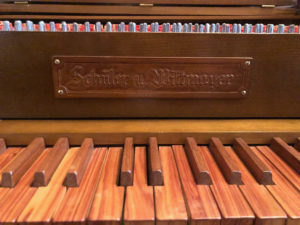
Harpsichord by Schüler und Wittmayer, Bad Reichenhall 1949 – Nameboard – Eric Feller Collection
The lid of the instrument is divided in two parts and the fallboard functions as a music stand. Below is the year of manufacture 1949 written in pencil. The registers can only be switched using a sliding coupler. In the front position the 4′ stop can be heard, in the middle position the combination of 8′ and 4′ and in the rear position the 8′ stop. There are two levers for the lute on the sides.
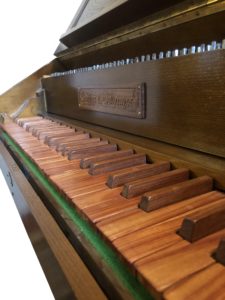
Harpsichord by Schüler und Wittmayer, Bad Reichenhall 1949 – Eric Feller Collection (3)
The sound of the instrument is very clear and rich in overtones. Because of its modern construction it is a completely new designed instrument and the sound is not comparable to historical harpsichords.
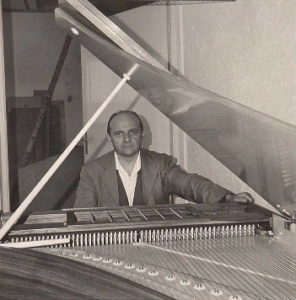
Kurt Wittmayer (1917 – 1997)
Kurt Wittmayer was born on November 22, 1917 in Sibiu, Romania. After graduating from high school, he studied organ in Leipzig, Rome and Salzburg. From 1945 he taught himself how to build harpsichords and clavichords, first alone and later with the engineer Rudolf Schüler (1911 – 1995). In February 1949 they both opened a workshop for historical keyboard instruments in Bad Reichenhall. However, the cooperation lasted only about 3 years and in 1951 both separated and each built their own instruments. Due to the increasing demand for the new instruments, Kurt Wittmayer was able to continuously expand his workshop.
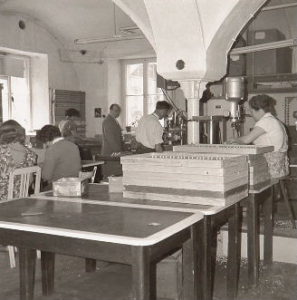
Kurt Wittmayer Company (1)
From 1950 he built instruments in Königsdorf, from 1952 in Geretsried-Gartenberg and in 1967 also in Wolfratshausen. The instruments reached a high production number. In later years, the company also built historical copies, as the trend was getting away from the “Rastenbauweise” (industrial/serial construction). Kurt Wittmayer died on September 4, 1997 in Bad Tölz.
Kurt Wittmayer Company (2)
Der Beitrag Schüler und Wittmayer 1949 erschien zuerst auf Eric Feller Early Keyboard Instruments Collection.
]]>Der Beitrag Robert Wales c. 1810 owned by Carolina Oliphant – Lady Nairne erschien zuerst auf Eric Feller Early Keyboard Instruments Collection.
]]>
Carolina Oliphant, Baroness Nairne, Portrait by John Watson Gordon, c. 1818 – National Galleries of Scotland
London was one of the main locations of piano manufacturing in the late 18th and early 19th century. Accordingly, many piano makers settled there and produced a large quantity of the newly, fashionable Pianofortes. The demand was enormous, since the upper middle class and the nobility showed a huge interest in these instruments. In addition to the well-known piano makers such as John Broadwood (1732 – 1812) or Muzio Clementi (1752 – 1832), there were also a large number of instrument makers who are less well known today, but whose instruments are in no way inferior to the more well-known manufacturer’s instruments. Among these was Robert Wales. As a favourable addition, the here presented instrument has a very interesting history. It was owned by Carolina Oliphant – Lady Nairne (1766 – 1845), known in music history as a collector and composer of many Scottish songs and ballads.
The case of this square piano is made of mahogany with surrounding multi-coloured inlays made of different woods. The instrument stands on six turned legs with brass rollers and bronze applications. The keyboard is made of ivory and ebony and it has a wooden pedal for controlling the dampers. Inside it has a double action with leather-covered hammers and single dampers and it is double-strung. The nameboard is nicely painted and bears the signature in a rectangular cartouche:
„Royal Patent
Robt. Wales
Maker
London”

Robert Wales, London ca. 1810 owned by Carolina Oliphant – Nameboard – Eric Feller Collection
It shows a handwritten serial number on the wrestplank: No. 2300, stamped underneath: R – Wales Maker. There is also a handwritten signature in ink on the soundboard:
„Sold by Rob. Purdie
70 Princes Street
Edinburgh“
Robert Purdie came from a music publishing family that was very active in London and Edinburgh. His Scottish music shop had earned a high reputation through musical instruments and sheet music.

Robert Wales, London ca. 1810 owned by Carolina Oliphant – Signature – Eric Feller Collection
Furthermore, there is a handwritten signature in pencil on the back of the nameboard:
“Carolina Oliphant’s Piano”
Carolina Oliphant – Lady Nairne, Baroness Nairne in the Peerage of Scotland and Baroness Keith of the United Kingdom was a Scottish collector and composer of songs and ballads. Many of her songs are still very popular in England and Scotland today. Like her contemporary Robert Burns (1759 – 1796), Carolina Nairne was strongly influenced by the Jacobean heritage, although both had different approaches to their composition and poetry. Nairne focused on an earlier romanticized version of the Scottish way of life, tinged with sadness about the past. Robert Burns, on the other hand, was more optimistic about a brighter future.

The auld hoose of Gask, Perthshire – Birthplace of Carolina Oliphant
Carolina Oliphant was born on 16th August 1766 at Auld Hoose, Gask, Perthshire (the ancestral home of her father’s family). She was the fourth child of the three sons and four daughters of Laurence Oliphant (1724 – 1792), Laird of Gask, and his wife Margaret Robertson (1739 – 1774). Her mother was the eldest daughter of Duncan Robertson of Struan, chief of the Donnachie clan who fought on the side of the Jacobins in the rebellions of 1715 and 1745. Her father was also a Jacobin and she received a high education, which also included music and art. Carolina grew into a charming young lady who received much praise and encouragement in the respected circles.

Birthregister for Carolina Oliphant Old Parish Register (OPR) – National Records of Scotland
As a young girl, Carolina was engaged to William Murray Nairne, one of Lord Nairne’s grandsons, who became 5th Lord Nairne in 1824. After he was promoted to Deputy Inspector-General of a Scottish barracks, they married on 2nd June 1806. The couple settled in Edinburgh, where their only son, William Murray Nairne (1808 – 1837), was born two years later.

Birth entry of William Nairne – National Records of Scotland
In 1830 Carolina’s husband died and she lived with her son in Ireland and on the Continent for a time. Her son’s poor health worsened and he died in Brussels in December 1837. Carolina then returned to Gask in 1843. After suffering a stroke, her health deteriorated and she died on October 26, 1845.

Carolina Oliphant, Lady Nairne with her son William Murray Nairne, later 6th Lord Nairne by Sir John Watson Gordon – National Galleries of Scotland
Carolina Nairne began composing songs shortly after her father’s death in 1792. According to her high education, she was able to read music and she played the harpsichord and the pianoforte. From an early age she was involved with folk songs and provided well-known melodies with her own lyrics. After the couple moved to Edinburgh in 1806, contact was made with Robert Purdie’s music store, where Carolina most likely also acquired Robert Wales’ square piano. Due to the social conventions of that time, which made it difficult for a woman in a male-dominated society, Carolina spent considerable efforts to hide her identity. She even hid her activities from her husband. In the 1820s she wrote to a friend: “I didn’t even tell Nairne, lest he babble.”
In order to make her compositions available to a larger audience, she began using the pseudonym “Mrs. Bogan of Bogan” or later only under the gender-neutral initials “B. B.” or “S. M.” to publish her work. Much of her work was published in Robert Purdie’s The Scottish Minstrel (1821-24; in six volumes). Once, at the urging of her publisher Purdie, she appeared dressed up as an elderly country lady. She managed to convince Purdie that she was just a collector for the songs she had collected from common country folk. However, the entire editors of The Scottish Minstrel (which consisted only of women) was aware of her identity, as were her sisters, nieces and great-niece. During her official visits to the publishing house of Purdie, she always wore an old, veiled cloak, hoping not to be recognized. She also veiled her handwriting in her submitted works.

„To the Land of the Leal“, composed 1797 – 1798
Lady Carolina Nairne’s musical and literary work is still immanent. Her songs are part of Scottish and English folklore and they are identity-forming for many people.
Unfortunately, very little is known about the instrument maker Robert Wales. Certain is that he was working at Charles Street No. 33, Hampstead Road, Edinburgh. In 1819 he was partner of John Whitaker and had the address Paul`s Churchyard No. 75, which is proved by a single surviving instrument. It is also known that he built pianos for William Hodsoll. Based on the serial number (No. 2300) on this instrument, it can be concluded that he was very active and built many instruments. It is highly probable, however, that these instruments were not only sold under his name, but he also supplied other dealers with them.
Other surviving instruments by Robert Wales:
- 1819 square piano Wales, Robert, & John Whitaker (No. ?) – Western Australian Academy of Performing Arts, Edith Cowan University, Perth Australia
- c.1820 square piano (No. ?) – Patricia Theodorou Collection, England
- 1819 – 1823 square piano by Robert Wales for John Monro (No. ?) – Peter Owen Collection, Blagdon England
- c.1830 Cabinet Piano by R. Wales for William Hodsoll (No. ?) – Leipzig University Collection, Musikinstrumenten-Museum, Leipzig Germany – destroyed in WWII
References:
- Bold, Valentina (2006), Ewan, Elizabeth; Innes, Sue; Reynolds, Siân (eds.), “The Biographical Dictionary of Scottish Women: From the Earliest Times to 2004”, Edinburgh University Press, ISBN 978-0-7486-1713-5
- Fry, Michael (2014), “A Higher World: Scotland 1707–1815”, Birlinn, ISBN 978-0-85790-832-2
- McGuirk, Carol (2006), “Jacobite History to National Song: Robert Burns and Carolina Oliphant (Baroness Nairn)”, The Eighteenth Century, University of Pennsylvania Press
- Rogers, Charles (1869), “Life and Songs of the Baroness Nairne; with a memoir and poems of Caroline Oliphant the younger”, Charles Griffin
- Thomson, Thomas (1875), “Nairn, Carolina”, Biographical Dictionary of Eminent Scotsmen, vol. 2, Blackie & Sons
- Tytler, Sarah; Watson, J. L. (1871), “The Songstresses of Scotland”, vol. 2, Strahan
Der Beitrag Robert Wales c. 1810 owned by Carolina Oliphant – Lady Nairne erschien zuerst auf Eric Feller Early Keyboard Instruments Collection.
]]>Der Beitrag Muzio Clementi 1801 erschien zuerst auf Eric Feller Early Keyboard Instruments Collection.
]]>The case of the instrument is made of mahogany with encircling multicolour ribbon inlays of different woods and brass. The instrument rests on six fluted legs with brass castors. The keyboard is made from ivory and ebony. The instrument has a wooden pedal for controlling the dampers. The action is a double action with leather covered hammers, double strung and single dampers. It originally had a dust cover above the action which is missing. The nameboard is painted with garlands of flowers and tendrils and is signed in a white enamel cartouche with:
“New Patent
Muzio Clementi & Comp.
No. 26 Cheapside
London”

Muzio Clementi, London 1801 – Eric Feller Collection (Nameboard)
The white enamel nameplates on the satinwood nameboard goes back to the instruments made by Longman & Broderip, which signed their instruments this way and which Clementi also used in the early years (also under Longman & Clementi).
Square pianos by Clementi were always provided with two serial numbers: one stamped on the left and one handwritten with ink on the wrest plank (stamped: 1845 – inked: 1481).
The system used by Clementi counts with the inked number the general production of pianos since the acquisition of the company “Longman & Broderip” in 1798. The stamped numbers, however, continue the production of square pianos of the acquired company “Longman & Broderip”, but only instruments with the 1794 introduced “New Patent“. Other instruments (for example single action instruments, grand pianos or cabinet pianos) were added together in other groups.
Based on these serial numbers, the year of construction of this instrument can be derived to 1801. (see: Clementi & Co 1798-1830 Pianoforte Manufacture in London, Leif Sahlqvist 2013)
For more information about the company Muzio Clementi & Co. – click here!
Other preserved instruments by Muzio Clementi & Co.:
- 1803 square piano (No. 3468) – Newton Centre: Marlowe A. Sigal Collection, USA
- 1803 square piano (No. 2335) – Museu da Musica Lisbon, Portugal
- 1806 square piano (No. 4095) – German Museum Munich, Germany
Der Beitrag Muzio Clementi 1801 erschien zuerst auf Eric Feller Early Keyboard Instruments Collection.
]]>Der Beitrag John Broadwood and Sons 1815 – Compensator erschien zuerst auf Eric Feller Early Keyboard Instruments Collection.
]]>The case of the instrument is made of mahogany and rosewood with revolving band inlays in brass. The instrument stands on 6 original turned legs with fire-gilt bronze rings. The entire instrument is made in the typical “Regency-Style“. At the front there are two drawers. The keyboard is made of ivory and ebony. The instrument has a wooden pedal for the dampers. The action is a double action with leathered hammers, single dampers and is double strung. The instrument has the original dust cover, which is located above the strings and inscribed with the number 157 on the back. The same number is also found on the wrest plank. The nameboard is made from different woods and signed in a cartouche:
“John Broadwood and Sons.
Makers to His Majesty and the Princesses
Great Pulteney Street London Golden Square.”

Nameboard John Broadwood & Sons 1815 Compensator Square Piano – Eric Feller Collection
The serial number is located on the inside of the instrument and reads 19968. Based on this serial number, the instrument was made in 1815.
The company John Broadwood produced various models of square pianos. Depending on the design and the used woods the prices varied. This piano has to be one of the expensive models. The standard models were mostly held in mahogany and simpler decorated with some ribbon inlays. The use of rosewood and brass inlays is a clear sign of a high-priced instrument.
Interesting at this instrument is the embedded metal bar above the soundboard. Occasionally, there have been repeated attempts to improve the entire case construction and tuning through reinforcements. The constantly growing range of the compass and the associated increasing tension resulted in many twisted instruments and damaged cases. Looking at grand pianos, these reinforcements prevailed from 1820 onwards. Exceptional examples of these reinforcements are the “Compensator Frame” fortepianos made by Stodart (for more information on these instruments – click here).
Another important factor and a prerequisite for these innovations were the improvements of manufacturing and production processes, which led to higher material quality.
John Broadwood was born on 6th October 1732 in Oldhamstocks near Cockburnspath in Scotland. He learned the profession of being a cabinetmaker like his father before.
In 1761 he started working for Burkat Shudi (1702 – 1773) in London and in 1770 became his business partner. In 1771 he opened his own shop on Great Pulteney Street in London. In 1769 he married Burkat Shudi’s daughter Barbara in her first marriage and had four children with her. After his wife’s death in 1776 he married Mary Kitson in 1781 and had six children with her. He died on 17th July 1812 in London.
Other surviving square pianos by John Broadwood and Sons:
- 1814 square piano (No. 8666) – Stanford University Department of Music, Stanford USA
- 1816 square piano (No. 20108) – Banchory Crathes Castle, The National Trust for Scotland, UK
- 1816 square piano (No. 20953) – Tredegar House, Newport UK
Der Beitrag John Broadwood and Sons 1815 – Compensator erschien zuerst auf Eric Feller Early Keyboard Instruments Collection.
]]>Der Beitrag Maximilian Heilinger 1832 – 1835 erschien zuerst auf Eric Feller Early Keyboard Instruments Collection.
]]>
Concert programm by Franz Liszt 25. Oktober 1846 in Pecs
This fortepiano was built around 1832 – 1835 and still shows the angular shape. It is made entirely of wood, without metal bars. The case is made of walnut and stands on three baluster legs. The keyboard is made of ivory and ebony and the hammers are covered with leather. It has a Viennese Action, is straight string with a divided bridge and two pedals (controlling dampers and una corda). The compass is 6 octaves + fifth (CC – g4). The nameboard is decorated with brass inlays and bears the inscription:
“M. Heilinger “
There is also a second signature that can be found on a decorated paper label on the soundboard:
“Max Heilinger
Fünfkirchen”

Maximilian Heilinger, Fünfkirchen c. 1832-35 (Soundboard Signature) – Eric Feller Collection
The entire fortepiano is made extremely precisely and shows a high level of craftsmanship.
So far, relatively little research has been carried out into piano building in Hungary in the 19th century and unfortunately there are only very few sources that have been examined. Due to the influence by the piano manufacturer in Vienna, piano construction in Hungary developed in a structurally similar way. Far fewer instruments were made, but most with a high standard of craftsmanship. The new developed pianoforte had established itself in Hungary since the 1790s and the demand for these instruments increased constantly. Despite the high acquisition costs and the resulting follow-up costs for tuning and repairs, the demand (especially from the aristocracy) was immensely high.
In the early years, instruments from Vienna served as prototypes and were copied by local carpenters and organ builders. From around 1810 onwards, the company’s own production of the instruments was hardly sufficient and so many pianos were imported and sold from Vienna. The explanations of the Hungarian piano maker Lajos Beregszászy (1817 – 1891) are an interesting source of this development in the first half of the 19th century.
„Von 1825 bis 1848 befanden sich in Ungarn fortwahrend 20-25 Klaviermacher und manche Firma arbeitete mit so vorzüglichem Erfolge, dass sie, angemessen der damaligen Zeit, mit welchem ausländischen Erzeugnis immer die Konkurrenz bestehen konnte. […] Im Jahre 1846 begann ich [Beregszászy] in Pest die Klavierfabrikation, 1847 Balassowits und Weiss; die beiden letzteren erzeugten bis 1848 jährlich 5-10 Klaviere. Aus diesen Daten ist also ersichtlich, dass bis 1848 in Ungarn ungefähr 20-25 Klavier-Fabrikanten existierten, die zusammen 250-300 Klaviere erzeugten und da den damaligen Verhältnissen entsprechend in Ungarn ein Bedarf von 600 Klavieren bestand, so war die Hälfte mit heimischen Erzeugnissen gedeckt, während heute, wo das Klavier so verbreitet ist, dass kaum eine Haushaltung ohne dasselbe existiert, und jährlich 1800 Stück kaum zur Deckung des Bedarfes genügen, – außer meiner Fabrik, in der jährlich 50-60 höchstens 70 erzeugt werden und außer dem Pressburger Karl Schmidt, der jährlich kaum 10-15 herstellt, kein Klavier-Fabrikant existiert und so ist kaum der zwanzigste Theil des Bedarfes durch heimische Produkte gedeckt“
From: L. Beregszászy, The Situation of Piano Manufacturing in Hungary. Budapest 1874. pp. 3 and 5-6.
The main cities of Hungarian piano building were Pest, Buda and Bratislava. In addition, instruments were also produced in other cities. Furthermore, the local manufactured instruments were cheaper to buy and without high transport costs and customs duties, as by imported instruments from Vienna. As a result more piano builders appeared in Hungary from the 1820s onwards. Many piano makers who settled in Hungary in the 1780s, 1790s and the beginning of the 19th century came from Germany.
So far, very little is known about Maximilian (Miksa) Heilinger. A letter kept in the archive of the Janus Pannonius Museum in Pécs shows that he worked in Pécs in 1832.
„Tekintetes Nemes Tanács!
1832-dik Évtől, ugy mint attól az időtől, hogy a Tekéntetes Tanács hozott végzése következtében megengedni kegyeskedett, hogy mesterségemet e nemes városban folytathassam – folytonos fáradozásom után csak ugyann sikerült, – hogy a zongorán, annak nagyobb és biztosabb tökéletessége elnyerésére új találmányomul hozzá járulok – és ezen új találmányomra á Nagy Méltóságú Magyar Királyi Helytartó Tanácshoz elnyerendő magányos kiváltság levél végett folyamodásomat béadandok – melly kiváltságlevél elnyerésére a többek között felmutatni szüksége*. hogy több évek olta számos legényekkel a tisztelt közönségnek tellyes megelégedésével mesterségemet folytattam – Hogy számos legényekkel évről évre dolgoztam, közönségessen tudva vagyon, de különben is az esztendei Popularis Conscriptio annak tanuja.
Továbbá, hogy a tisztelt Közönség tellyes megelégedésével az 1832 Évtől mesterségemet folytattam, ennek nyilvános tanúja az – hogy 15 évek alatt bár melly munkámért Tekéntetes Tanács elébe mint bépanaszolat nem idéztettem -.
Midőn Kegyes pártfogásért alázattal esedeznék a szükséges Bizonyítványt kiadattni kérem, megkülönböző tisztelettel maradván A Tekéntetes Nemes Tanácsnak
legalázatosabb szolgája Heilinger Miksa Zongora készítő“
From: Yearbook of the Janus Pannonius Museum Pécs, No. 32, 1987, published in 1988 Janus Pannonius Museum
It is still unclear where his workshop was located from 1832 to 1845. In 1845 he bought a warehouse at the Déryné Street 5 for 4,500 guilders from Anna and Borbála Bittó. In 1849, however, he sold the building again at a price of 4,000 guilders. (See: József Madas: Grundstücke und Häuser der Innenstadt von Pécs, Pécs, p. 101, 1918.) He probably left Pécs or moved again.

Fehér kereszt, Arad 1880
In November 1846 Franz Liszt played one of his instruments in the Hotel Weißes Kreuz (today Hotel Ardealul) in Arad. Only three other instruments from his workshop are known yet.
Other preserved fortepiano by Maximilian Heilinger:
- 18?? Fortepiano – Arad
- 18?? Fortepiano – Historical Museum of the City of Pécs, Hungary
- 1860/70 fortepiano – Hangszermúzeum (Museum of Musical Instruments), Budapest, Hungary
Der Beitrag Maximilian Heilinger 1832 – 1835 erschien zuerst auf Eric Feller Early Keyboard Instruments Collection.
]]>Der Beitrag Friedrich Hoxa 1839 erschien zuerst auf Eric Feller Early Keyboard Instruments Collection.
]]>
Franz Liszt 1856 – Painting by Wilhelm von Kaulbach (1805 – 1874)
This fortepiano was built around 1839 and still shows the angular shape. At that time, metal bars and metal frames to reinforce the case and structure were already common, which this piano does not have. It is still made entirely of wood according to the traditional construction method. The case is made of walnut and rests on three baluster legs. The keyboard is made of ivory and ebony and the hammers are covered with leather. Viennese action, straight strung with a divided bridge and two pedals (dampers and una corda) the piano has a compass of 6 octaves + fifth (CC – g4). Above the strings there was a second soundboard (similar to the dust / soundboards on French grand pianos or early English square pianos) that was missing. Hoxa received a patent for this in 1826, in which an additional soundboard was attached to the strings.
For more information on additional resonance / dust covers, click here.
The nameboard bears the inscription:
„F. Hoxa
in
Wien
Silberne Medaille Ausstellung 1839“
There is also a second signature that can be found on a paper label to the soundboard:
„Johann Gugl
Klavier – Verkauf
Leih – Etablissement
Hauptgeschäft
Wien“
This signature comes from the workshop of Johann Gugl, who was a piano dealer in the 19th century and who ran an instrument shop at Bauernmarkt No. 588 inside the Gundelhof in Vienna.

Friedrich Hoxa, Wien 1839 – Eric Feller Collection (Nameboard)
Friedrich Hoxa was born in 1793 and it is believed that he was of Bohemian descent. In 1824 he received the citizenship of the city of Vienna and official permission to work as a piano maker. In April 1826 he received a five-year privilege and patent for the invention of a grand piano with a double soundboard, one above and one below the strings. In 1828 he suffered severe strokes of fate: his wife Aloysia Teschmayer (born 1785 in Vienna) died on May 19th and his son Rudolph (born 1826) on August 8th, 1828. She left him two more children: Karolina (born 1819) and Friedrich (born 1821), who also died in the following years. At that time the family lived in Altlerchenfeld No. 73. From 1825 on he was President of the “Corporation of Piano Builders Vienna”. In this position he was highly respected. He was very committed to ensure that only official piano makers with citizenship of the City of Vienna should built instruments. In an article dated March 12, 1843 in the Vereinigte Ofner-Pester-Zeitung, he openly advocated this together with Anton Tomaschek (1806 – 1860).

Newspaper article from 12.3.1843 in “Vereinigte Ofner-Pester-Zeitung”
Hoxa was highly recognized for his commitment and so an article appeared in the magazine “Der Wanderer” on March 8, 1845 about a public honour for his work.

Article 8.3.1845 from the magazine “Der Wanderer”
At the Dritten Allgemeinen Österreichische Gewerbeausstellung in Wien in 1845, Hoxa’s instruments were highly recommended and he received the gold medal as an award for his work.

Report from the 3. Allgemeine Österreichische Gewerbeausstellung in Wien, 1845
Very interesting in this report is the statement that Hoxa’s sales of instruments mostly went to distant countries like Constantinople (now Istanbul), Smyrna (now Izmir) or Egypt. It is very likely that his new innovations in piano building with metal frames, plates and bars were the reason why his instruments were so successful, especially in these warm climatic latitudes.
In 1851, at the London exhibition, Hoxa exhibited a 7-octave grand piano made of Hungarian poplar with metal bars and a brass string plate. Friedrich Hoxa probably died around 1858.
Other preserved instruments by Friedrich Hoxa:
- ca.1830 fortepiano – Conservatorio di Musica Perugia, Italy
- 1840/44 fortepiano – Technical Museum Vienna, Austria
Der Beitrag Friedrich Hoxa 1839 erschien zuerst auf Eric Feller Early Keyboard Instruments Collection.
]]>Der Beitrag Ernst Irmler 1852 – 1854, signed “F. Liszt 1856” erschien zuerst auf Eric Feller Early Keyboard Instruments Collection.
]]>Franz Liszt 1856, after Wilhelm von Kaulbach (1805 – 1874)
The harpsichord-shaped case of the instrument is made of rosewood and rests on three turned legs. A decorative strip with an egg stick pattern is attached around it. The nameboard is signed with:
“Ernst Irmler jun.
Leipzig”
The keyboard is made of ivory and ebony, the hammers are covered with leather and the fortepiano has 3 metal bars that are painted black with floral ornaments. The compass is 6 octaves plus sixth (CC – a4), Viennese Action, the serial number: 2464. The instrument is triple strung (bass double strung). It also has got two pedals for controlling the dampers and una corda.

Ernst Irmler, Leipzig 1852 – 1854 – Eric Feller Collection (Nameboard)
There is a handwritten signature by the composer and pianist Franz Liszt, which came to light during the cleaning process – “F. Liszt 1856”. In the 19th century it was sometimes common for pianists to immortalize themselves on the instrument they played after a concert. So, there are some surviving instruments that are signed, for example, by Franz Liszt, Sigismund Thalberg (1812 – 1871) or Ignaz Moscheles (1794 – 1870). In 1856 Franz Liszt stayed in Weimar. It can be assumed that he played the instrument there.

Ernst Irmler, Leipzig 1852 – 1854 – Eric Feller Collection (Signature: “F. Liszt 1856”)
The I. G. Irmler company manufactured square and upright pianos and also grands from their beginning in1818 and enjoyed a high reputation. The instruments were excellently crafted and were very much appreciated. Far less known (but no less qualitative) are the instruments of Ernst Irmler, a close relative who manufactured instruments under his name in Leipzig from around 1850.
Little is known about Ernst Irmler so far. He first worked in the family business to become a piano maker. He later sat up his own business and made pianos in Leipzig under his own name. He was active from around 1850 to 1879.
Other preserved instruments made by Ernst Irmler:
- 1852 – 1854 Grand Piano – Michaelstein Monastery Collection, Blankenburg Germany
- 1853 Square Piano – Deutsches Museum, Munich Germany

Ernst Irmler, Leipzig 1852 – 1854 – Eric Feller Collection (Soundboard)
Der Beitrag Ernst Irmler 1852 – 1854, signed “F. Liszt 1856” erschien zuerst auf Eric Feller Early Keyboard Instruments Collection.
]]>Der Beitrag Muzio Clementi 1809 erschien zuerst auf Eric Feller Early Keyboard Instruments Collection.
]]>The case of this square piano is made of fine mahogany with surrounding multi-coloured inlays made of different woods. The instrument rests on four turned legs with brass castors and the keyboard is made from ivory and ebony.
The square piano also has a wooden pedal for controlling the dampers. It further has a double action with leather-covered hammers and single dampers and is double strung. The nameboard is painted and bears the signature in a rectangular cartouche:
“New Patent
Muzio Clementi & Co.
Cheapside, London”

Muzio Clementi, London 1809 – Eric Feller Collection (Nameboard)
Clementi’s square pianos always had two serial numbers: one stamped on the left side and one handwritten in ink on the wrest plank (stamped: 6738 – inked: 7710).
The system used by Clementi uses the handwritten number to count the general production of pianos since the acquisition of Longman & Broderip in 1798. The stamped numbers, however, continue the production of square pianos of the acquired company “Longman & Broderip”, but only instruments with the 1794 introduced “New Patent“. Other instruments (for example single action instruments, grand pianos or cabinet pianos) were added together in other groups.
Based on these serial numbers, the year of construction of this instrument can be derived to 1809. (See: Clementi & Co 1798-1830 Pianoforte Manufacture in London, Leif Sahlqvist 2013)
For more information about the company Muzio Clementi & Co. – click here!
Other preserved instruments by Muzio Clementi & Co.:
- 1803 square piano (No. 3468) – Newton Centre: Marlowe A. Sigal Collection, USA
- 1803 square piano (No. 2335) – Museu da Musica Lisbon, Portugal
- 1806 square piano (No. 4095) – Deutsche Museum Munich, Germany
Der Beitrag Muzio Clementi 1809 erschien zuerst auf Eric Feller Early Keyboard Instruments Collection.
]]>Der Beitrag Longman and Broderip 1782 – Travel Piano erschien zuerst auf Eric Feller Early Keyboard Instruments Collection.
]]>In the history of instrument making, travel instruments have been documented as early as the 17th century. They were rarely made and mostly on explicit request of a customer. For more information on the history of travel instruments, please click here.
The case of the instrument is made of mahogany with different inlays. It rests on a simple mahogany frame and each the four legs have brass castors at the ends. To the left of the keyboard is a small hand stop for controlling the dampers.
The instrument has a Single Action, single damper and is double strung. The nameboard is decorated with multi-coloured, inlaid garlands and bears the inscription in an oval cartridge:
“Longman and Broderip
Musical Instrument Makers
No. 26 Cheapside and No. 13 Haymarket
London”
The keys are made of ivory and ebony, and the lower keys are each decorated with an additional notch that has been coloured with iron gall ink. This detail was very common as a decorative element on harpsichord keyboards and can be found here as a decorative remnant.

Longman and Broderip, London c. 1782 Travel Piano – Eric Feller Collection (2)
For detailed information about Longman & Broderip here!
So far, only one other travel piano with similar specifications by Longman and Broderip has survived and is now in the Metropolitan Museum in New York. The instrument there has a smaller range of only 3 octaves and has even smaller dimensions.

Portable Square Piano by Longman & Broderip c. 1790 – Metropolitan Museum New York (1)

Portable Square Piano by Longman & Broderip c. 1790 – Metropolitan Museum New York (2)
Der Beitrag Longman and Broderip 1782 – Travel Piano erschien zuerst auf Eric Feller Early Keyboard Instruments Collection.
]]>Der Beitrag Dulcitone Thomas Machell and Sons c. 1870 erschien zuerst auf Eric Feller Early Keyboard Instruments Collection.
]]>At the same time as Thomas Machell, the French Victor Mustel invented the Typophone in 1866, also a tuning fork piano like the Dulcitone. Mustel continued to experiment and finally invented the Célesta in 1886, which he patented in the same year. The Dulcitone is now considered the precursor of the celesta.
The Dulcitone in the Eric Feller Collection is made of dark mahogany and has a range of 5 octaves (AA – a3). It is the model F, which has the largest compass. A wooden pedal is attached to the front right leg, which can be used to operate the dampers. The keys are made of ivory and ebony. The back of the instrument is decorated with fretwork and red cloth and bears the words Dulcitone. The signature is on the front cover and bears the inscription:
“Dulcitone
Patentees and Sole Makers
Thomas Machell and Sons
Glasgow, Scotland”
In the early days Machell produced three models of these instruments in different price ranges:
- Model B: 3½ octaves in mahogany (Chippendale shape) or oak (smoked) complete with music stand for £ 12
- Model R: 4 octaves in mahogany or oak for £ 15
- Model F: 5 octaves in mahogany or oak for £ 18.
Other versions were added later, which were related to the taste of the time.
You can find an original catalogue of the company here – click here.

Dulcitone Thomas Machell, Glasgow ca. 1870 – Eric Feller Collection (3)
The Dulcitone was used because of its size and the fact that it did not go out of tune, especially on trains and ships. It was also often taken by missionaries to remote areas to accompany church services there. As a result of this, many of these instruments found their way into the most various areas of the world. Around 6,000 of these instruments were made, but only a few have survived in playable condition to this day.

Hints on adjusting the Dulcitone
Other preserved instruments by Thomas Machell & Sons:
- 1897 – Whittaker’s Musical Museum, New Zealand
- 1875 – 1899 – National Museum of American History, USA
Der Beitrag Dulcitone Thomas Machell and Sons c. 1870 erschien zuerst auf Eric Feller Early Keyboard Instruments Collection.
]]>Der Beitrag Cottage Piano William Rolfe and Sons 1835 erschien zuerst auf Eric Feller Early Keyboard Instruments Collection.
]]>The case is made of solid mahogany with very fine inlays and the front is decorated with red silk. The keyboard is made of ivory and ebony. At both ends of the keyboard are two retractable platforms for candle holders that can be pulled out via a small ivory button. The instrument has two wooden pedals (dampers & una corda) and a compass of 6 octaves (FF – f4). The hammers are covered with felt and the instrument is double strung with an English Double Action and abstracts. The nameboard is decorated with various brass inlays and bears the signature:
„W. Rolfe & Sons
Manufacturers
112 Cheapside London”
The serial number 1656 appears on the right sight of the pin block. The music stand rests under the keyboard and can be hung into the cylindrical cover lid.
The instrument comes from the former collection of Mary and Kenneth Mobbs in Bristol. According to records, it was acquired from Rev. Gordon Robinson on April 7th, 1977. During the time in the possession of Mary and Kenneth Mobbs, the piano was loaned and exhibited at the Royal Academy of Music Museum.

Cottage Piano W. Rolfe & Sons, London 1835 – Eric Feller Collection (Nameboard)
William Rolfe worked as a piano maker from 1785 to about 1828. His exact dates of birth and death are not known yet. From 1785 he worked with Samuel Davis and the company was run under the name Rolfe & Davis. In 1797 both developed a patent for a “Turkish-Music-Stop” with cymbals and drums. According to R. Harding, this patent is the oldest testimony to such a change in the form of a janissary stop, which was very popular in the 1820s (especially by Viennese instruments) and then disappeared very quickly.
At the same time William Rolfe worked as an instrument maker and music publisher and was a partner of Thomas Culliford with whom he produced instruments for the company Longman & Broderip. He also sold his instruments under his name. After the bankruptcy of Longman & Broderip in 1796, he worked only under his name.
In 1807, his two sons Nicholas and Thomas became partners in the father’s company. From 1814, the company was renamed to William Rolfe & Sons and there were additional premises in the London Wall Street no. 32 added. The main address was since its founding in Cheapside 112. From about 1820 instruments were made under the name William Rolfe and Compy. The company existed until 1889.
Other surviving instruments by William Rolfe & Sons:
- 1820 – 1825 – Upright Piano – Private collection, Gates County USA
- 1814 – 1820 – Upright Piano – Museu da Musica Lisbon, Portugal
Der Beitrag Cottage Piano William Rolfe and Sons 1835 erschien zuerst auf Eric Feller Early Keyboard Instruments Collection.
]]>Der Beitrag Broderip & Wilkinson 1798 erschien zuerst auf Eric Feller Early Keyboard Instruments Collection.
]]>This square piano is similar in almost every detail to instruments from the late period of the Longman & Broderip company. The case is made of mahogany with surrounding, multi-coloured inlays made of different woods and rests on a French stand with brass castors. On each side around the stand are brass applications that cover the screws of the frame. The keys are covered with ivory and ebony. Interesting is that the ivory coverings are of less quality than those from instruments of the earlier production period under Longman & Broderip. It can be assumed that the supplier for the ivory changed and / or that Broderip & Wilkinson purchased cheaper materials in order to reduce costs. It is proved that Longman & Broderip had their instruments built by different well-known instrument makers and then provided them with their label. Broderip & Wilkinson continued this practice. This leads to the question of whether the company was now supplying their instrument makers with components in order to reduce the costs? Further research on this is currently ongoing.
There are two stops for dampers and lute and the piano is double strung. The stamped serial number 450 is located on the left inner side near the hand levers. The nameboard is also stamped with the number 54 and is decorated with an oval cartouche made of enamel. It bears the inscription:
“Broderip & Wilkinson
No. 13 Haymarket
London”

Tafelklavier Broderip & Wilkinson, London 1798 – Eric Feller Collection (Nameboard)
The square piano has a single action with leather-covered hammers, single dampers and has a compass of 5 octaves (FF – f3). The original dust cover, which is covered with dark green silk, is preserved.
At the time of purchase, it was in absolute original condition and was never been revised or restored before. By examining the piano, a one penny coin from 1863 was found under the keyboard.
For more information about Longman & Broderip, click here.
George Wilkinson was born on November 5, 1785. After entering into a business relationship with Francis Broderip, his eldest brother Charles Wilkinson joined the company in 1805. After the death of Francis Broderip in 1807 he produced instruments under the name Wilkinson & Co. On September 23 1809, he married Elizabeth Cecilia Mary Broadhurst. The marriage was announced in the “Gentleman’s Magazine” of 1809. Together they had 7 children (Ann (1814 – 1814), Emma (1815 – 1889), Matilda (1817 – 1876), Oriana (1818 – 1853), Louisa (1820 – ?), Alfred Broadhurst Wilkinson (1822 – 1854), and Henry Broadhurst Wilkinson (1824 – ?).
In 1809, Wilkinson commissioned Augustus Leukfeld and George Astor to produce licensed pianos under William Southwell’s patent (EN 3029, 1807). In 1810 he sold the publishing business to Thomas Preston (1789 – 1834) and entered into a new business relationship with Robert Wornum (1780 – 1852), having borrowed £ 12,000 from his father. The Wilkinson & Wornum company now produced improved upright pianos and the factory and showrooms were located near Hanover Square at 315 Oxford Street and 11 Princes Street. The warehouse and factory were destroyed by fire in 1812, with up to 70 workers were laid off and debts over 16.500 pounds were left. In 1813 the partnership broke up and the company was transferred to Wilkinson’s father, who paid the debts.
Towards the end of 1813 Wilkinson rented a house on Howland Street No. 32 and founded a piano factory in Oxford Street No.315. In 1816 he added showrooms on New Bond Street. Instruments from this period were highly commended by Pleyel.
Together with Ferdinand Hirschfeld, he entered into a new partnership after 1830. Both produced special patented candles. However, this partnership also ended in bankruptcy in 1835.
In 1854, George Wilkinson left London and went to Milford Haven to escape the cholera in London. There he died in 1855 from a stroke.

Portrait of George Wilkinson, in pencil, by Haughton, 1847
Other surviving instruments by Broderip & Wilkinson:
- 1798 – 1807 square piano – Musikhistorisk Museum & Carl Claudius’ Samling, Copenhagen Denmark
- 1798 – 1807 square piano – Geoff Watson, Barnard Castle, England
Der Beitrag Broderip & Wilkinson 1798 erschien zuerst auf Eric Feller Early Keyboard Instruments Collection.
]]>Der Beitrag Cottage Piano John Broadwood and Sons 1833 erschien zuerst auf Eric Feller Early Keyboard Instruments Collection.
]]>According to the serial number, this instrument was made in London in 1833. The case is made of solid mahogany and the front is decorated with green silk. The keyboard is made of ivory and ebony. At both ends of the keyboard there are two retractable platforms for candle holders that can be pulled out via a small ring. The instrument has two wooden pedals (dampers, “blind pedal” with no function) and a compass of 6 octaves (FF – f4). The hammers are covered with felt and the instrument is double strung with an English double action with abstracts. The nameboard is decorated with various inlays and bears the signature:
“John Broadwood and Sons. / Makers to his Majesty and the Princesses / Great Pulteney Street Golden Square London”
There is a second handwritten signature on the wrest plank: “H. B.” or “J. B.” (illegible) The serial number is 1778 and can also be found on the wrest plank.
The instrument comes from the former collection of Mary and Kenneth Mobbs in Bristol. According to records, the instrument was acquired from Rev. W. T. H. B. Davies on February 19, 1986. During the time in the possession of Mary and Kenneth Mobbs, the piano was loaned and exhibited at the Royal Academy of Music Museum.
John Broadwood was born on October 6, 1732 in Oldhamstocks near Cockburnspath in Scotland. He learned the trade of cabinet maker like his father had before. In 1761 he started working for Burkat Shudi (1702 – 1773) in London and became his business partner in 1770. In 1771 he opened his own shop on Great Pulteney Street in London. John Broadwood married Burkat Shudi’s daughter Barbara in 1769 and had four children with her. After the early death (1776) of his wife, he married Mary Kitson in 1781 and had six children with her. He died in London on July 17, 1812. (see: M. Clinkscale: Makers of the Piano 1700 – 1820, Oxford University Press 1999)
Other surviving instruments by John Broadwood & Sons:
1823 – Cottage Piano – David Brenner, Riverside USA
c. 1835 – Cottage Piano – Musée des Instruments de Musique, Brussels Belgium
c. 1840 – Cottage Piano – The Royal Academy of Music, London England
Der Beitrag Cottage Piano John Broadwood and Sons 1833 erschien zuerst auf Eric Feller Early Keyboard Instruments Collection.
]]>Der Beitrag Neupert 1954 erschien zuerst auf Eric Feller Early Keyboard Instruments Collection.
]]>This large clavichord was made by Neupert in Bamberg / Germany and represents a modern instrument from the post-war period. Based on the serial number, the clavichord was made in 1954. Due to historical performance practice, the construction of harpsichords, spinets and clavichords was increasingly resumed in the 20th century.
The case is made of walnut and the instrument has 4 curved Chippendale style legs. The signature by Neupert and the stamped serial number (No. 18588) can be found inside of the case on the left side.
The inverted keyboard has a compass of 5 octaves (FF – f3) and the instrument is double strung. A further characteristic is that this clavichord is unfretted, which means that there are two strings for each key. In contrast to this construction is the fretted Viennese clavichord from c.1780 in the Eric Feller Collection (for further information click here).
Playing with the typical vibrato effect is also possible on this instrument. As the only mechanical keyboard instrument, the clavichord thus has the possibility of influencing the sound even after the tangent has been hitting the string by changing the pressure on the key periodically.
The instrument impresses with its warm and exquisite sound. Due to its size, a comparatively loud sound can be achieved, especially in the bass range.
The instrument was acquired in the 1950s by Rudolf Knop who was the first principal of the new established Music School in Wolfsburg.

Rudolf Knop playing the Neupert Clavichord (c. 1960)

Rudolf Knop – Newspaper article 28.3.2017
Instruments from the Neupert company were produced in large numbers and the company is still producing instruments today. You can find a summary of the company’s history on their website (click here).
Der Beitrag Neupert 1954 erschien zuerst auf Eric Feller Early Keyboard Instruments Collection.
]]>Der Beitrag Neupert 1934 erschien zuerst auf Eric Feller Early Keyboard Instruments Collection.
]]>This single manual harpsichord made by Neupert in Bamberg is one of the rare harpsichords from the pre-war period, perfectly preserved with all parts original and playable.
The case is made of dark walnut and has a square wing shape with closed case at the bottom. On the right side there is a small brass hook for locking the instrument. The harpsichord has 2 rows with wooden jacks with leather quills (so-called “troho jacks“), two registers (8′ and 4′) and a lute stop for the 8 ‘register, which is not divided. The compass is 4 ½ octaves (CC – f3).
The signature “Neupert Bamberg” is located in the middle of the nameboard. The serial number is 15978.
The sound of this harpsichord is very warm und present. Because of its modern construction it is a completely new designed instrument and the sound is not comparable to historical harpsichords. Compared to identical instruments from the 1960s and 1970s, the sound is convincing multiple times.
Der Beitrag Neupert 1934 erschien zuerst auf Eric Feller Early Keyboard Instruments Collection.
]]>Der Beitrag Thomas Tomkison c. 1815 erschien zuerst auf Eric Feller Early Keyboard Instruments Collection.
]]>
The case of the instrument is made of mahogany and rosewood with surrounding inlays in brass. The instrument rests on 4 turned legs. The keyboard is made of ivory and ebony and it has a compass of 5 ½ octaves (FF – c4) with a double action and single dampers. The hammers are covered with leather.
There is also a wooden pedal for controlling the dampers. The nameboard is made of rosewood with brass inlays and is signed in a cartouche with:
“Thomas Tomkison
London.”
There are two serial numbers. One is stamped on the left with: 4672 and the other handwritten number is: 1274. This numbers show that the piano was made around 1815.
Like other companies Thomas Tomkison produced different models of instruments. The prices varied depending on the version and the used materials and decoration. Using rosewood and brass inlays are clear signs of a high-priced instrument. The instrument impresses with an absolutely high-quality craftsmanship and a clear and charming sound.
For the time being very little is known about Thomas Tomkison. He was actively detectable from 1799 to 1851 and had his workshop in Dean Street Soho 55/77 in London. From 1778 he began his apprenticeship as a piano maker. Recent research shows that Tomkison emerged in late 1798 / early 1799 as the successor to bankrupt piano maker James Henry Houston and that there are remarkable similarities between the first pianos of Tomkison’s workshop and the surviving instruments from Houston. Within a few years, Tomkison became a serious competitor to the many major piano factories in London and his instruments were highly valued. Because of Tomkisons’ outstanding craftsmanship and business skills, a large number of his instruments have been exported to America, Australia and India. He died on November 10, 1853.
Further surviving instruments by Thomas Tomkison:
- 1808 grand piano (No. 317) – University of Leipzig, Musical Instrument Museum, Leipzig Germany
- c. 1816 square piano (No. 4202) – John R. Watson, Williamsburg, USA

Thomas Tomkison, London ca. 1815 (nameboard) – Eric Feller Collection
Der Beitrag Thomas Tomkison c. 1815 erschien zuerst auf Eric Feller Early Keyboard Instruments Collection.
]]>Der Beitrag Giovanni Crudeli c. 1830 – 1835 erschien zuerst auf Eric Feller Early Keyboard Instruments Collection.
]]>The case is made of walnut and rests on three baluster legs. The keyboard is made of ivory and ebony. There are two brass pinecone on each side at the end of the keyboard as part of the elegant decoration. The hammers are covered with leather.
The nameboard is signed with a ceramic label framed in brass with:
“Giovanni Crudeli
in
Livorno“
The instrument has a Viennese action and two pedals (dampers and una corda). The compass is 6 octaves + fifth (CC – g4).

Giovanni Crudeli c. 1830 – Nameboard – Eric Feller Collection
In the early 19th century Italian fortepianos were very much influenced by Viennese instruments.
Very little is known about Giovanni Crudeli. Certain are that he comes from a dynasty of organ builders. An entry about the company can be found in the “Guida di Livorno ossia Almanacco commerciale per l’anno 1831”.

Giovanni Crudeli in Livorno 1831 – Eric Feller Collection
No other surviving fortepianos by Giovanni Crudeli are known yet.
Der Beitrag Giovanni Crudeli c. 1830 – 1835 erschien zuerst auf Eric Feller Early Keyboard Instruments Collection.
]]>Der Beitrag Longman and Broderip c. 1785 for Charles Burney erschien zuerst auf Eric Feller Early Keyboard Instruments Collection.
]]>The case is made of mahogany with surrounding inlays of different coloured woods. On display are various flowers and tendrils as well as Greek amphorae, all are made with coloured inlays. Above the keyboard are also garlands and various flowers inlays. The entire decoration is outstanding and of the highest artistic ability. The instrument rests on a trestle stand. The nameboard bears the inscription on a rosewood shield:
“Longman and Broderip
London
No. 26 Cheapside & No. 13 Haymarket”

Tangentenflügel Longman & Broderip c. 1785 – Eric Feller Collection (Tangent Piano) – Nameboard
Inside are handwritten the initials J. W. and the signature:
“Made for Mr. Burney”
The keyboard has a compass of 5 octaves (FF – f3) and is made of ivory and ebony. The keys are each decorated with fine lines, which was coloured with ink. This detail of decoration was very popular on harpsichords and can be found here as a decorative remnant. The instrument has a tangent action with bare wooden tangents and single dampers. Under the instrument are two knee levers for controlling the dampers and moderator. The bridge is not divided. In the bass range, the bridge is delicately carved as a stylized fishtail.

Portrait of Charles Burney by Joshua Reynolds 1781 – National Portrait Gallery London
The signature indicates that the instrument was built for Charles Burney and ordered directly from Longman & Broderip. Burney, who through his travels in Europe visited a variety of personalities of musical life at the end of the 18th century and various instrument makers, must there have come into contact with tangent pianos. Back home in England he commissioned the company to build such an instrument for him. Tangent actions were barely known in England. Only a few instrument makers (Frederick Beck, Humphry Walton, John Statman and Charles Trute) were familiar with that kind of action.
Like Vienna and Paris, London was the major centre of instrument making in the 18th and 19th centuries. In the mid-1760s some instrument makers, mostly German-speaking, immigrated to England. Above all, the German instrument maker Johann Christoph Zumpe (1726 – 1790) from Fürth.
In the 1750s he immigrated to London and worked at the workshop of the famous harpsichord maker Burkat Shudi (1702 – 1773). In 1761 he founded his own business on Princes Street and built the first Fortepianos in England. The instruments of Zumpe were all daintily built and have a simple single action. So far, however, there is no evidence that Zumpe has not built instruments with other actions. Due to its origin, it is likely that he also knew other actions from his time in southern Germany.
The St. Petersburg-born and Naples-based piano maker Giacomo Ferdinando Sievers (1810 – 1878) wrote in 1868:
“Il Pianoforte. Guida pratica per construttori, Accordatori, Dilettanti and Possessori di Pianoforti con 300 disegni parte intercalati nel testo e parte in apposito atlante di Giacomo Ferd. Sievers Fabbricante di Pianoforti in Napoli” that in 1828 he repaired several instruments with tangential actions in Riga. Furthermore, he also describes in detail the tangent action that Zumpe is said to have built:
“In England and Germany some harpsichords were made with jacks that struck two unison strings. In 1828, when I was in Riga, I repaired several of these instruments that had been made in Nuremberg in 1754. In England, during that period, Zumpe produced the same model with an intermediate lever. This maker covered the jacks with soft leather, thus they produced a faint but quite pleasant sound; those [percussive jacks] made in Germany were not covered with leather and produced a shrill sound. These jacks were placed inside a leathered guide, which looked like a comb, that which was supported in order to allow space between the key and the jack; Zumpe’s intermediate lever was written on the back by means of a parchment.”
It is not sure if Sievers really meant Zumpe in his description or maybe another instrument maker. Also possible are instruments from Zumpes workshop, which were revised with a new action. However, this is one of the main sources of tangent instruments in England.
Today there are only three instruments with tangent action are known ( November 2019):
- Tangent piano by Fredericus Beck 1790 (private collection England),
- Tangent piano Anonymous, probably also made by Beck (Collection of the Museum of the College of Music in Osaka, Japan),
- Remains of a case of an Anonymous grand, probably made in England first half of the 19th century (Collection Germanisches Nationalmuseum (Inv.: MINe 153, Nürnberg, formerly in the Neupert Collection).
Furthermore the Eric Feller Collection can add to this two other English tangent instruments:
- Tangent piano by Longman & Broderip, London 1785,
- Tangent square piano by Charles Trute, London 1790
The development and commonness of tangent instruments in the United Kingdom has happened quite occasionally.
A detailed article about tangent pianos can be found at the publications of the Eric Feller Collection (click here)!
Further research on the instrument is still ongoing!
Sources:
- AWOUTERS, M. – DE GEYSER, I. – VANDENBERGHE, S., Catalogus van de Muziekinstrumenten, Brugge, Gruuthusemuseum, 1985.
- BAUER, Wilhelm A. – DEUTSCH, Otto Erich, Mozart. Briefe und Aufzeichnungen, vol. II, 1777-1779, New York, Bärenreiter, 1962.
- BOALCH, Donald H., Makers of the Harpsichord and Clavichord 1440-1840, Oxford, Claredon Press, 1995.
- BRUNNER, Hans, Das Klavierklangideal Mozarts und die Klaviere seiner Zeit, Augsburg, Filser, 1933
- BURNEY, Charles, The present state of music in France and Italy, 2. Edition, London, 1773.
- FORKEL, Johann Nicolaus, Allgemeine Litteratur der Musik oder Anleitung zur Kenntniß musikalischer Bücher, welche von den ältesten bis auf die neusten Zeiten bey den Griechen, Römern und den meisten neuern europäischen Nationen sind geschrieben worden, Leipzig, Schwickertschen Verlage, 1792.
- CLARKE, Christopher, The English piano, in Music of the past: instruments and imagination. Actes des Recontres Internationales hormoniques, Lausanne, 2004, Bern-Berlin-Frankfurt-New York-Oxford-Wien, 2006, pp. 239-270.
- CLINKSCALE, Martha Novak, Makers of the Piano 1700-1820, Oxford, University Press, 1993.
- COLE, Michael, The pianoforte in the classical Era, Oxford, University Press, 1998.
- DI STEFANO, Giovanni Paolo, Il Pianoforte in Sicilia. Storia e costruttori dal XVIII al XX secolo, tesi di laurea in Discipline dell’Arte della Musica e dello Spettacolo, Università degli Studi di Palermo, Facoltà di Lettere e Filosofia, relatore Prof. Amalia Collisani, 2003.
- ESCHLER, Thomas Jürgen, Die Sammlung historischer Musikinstrumente des Musikwissenschaftlichen Instituts der Universität Erlangen-Nürnberg, Wilhelmshaven, Noetzel, Heinrichshofen-Bücher, 1993.
- GOBBETT, Aldo James, Fortepiano a tangenti (Tangentenflügel) Späth e Schmahl Regensburg 1790, in Strumenti per Mozart, a cura di Marco Tiella e Romano Vettori, Rovereto, Edition Longo, pp. 181-191.
- HARDING, Rosamond E. M., The Pianoforte. Its History Traced to the Great Exhibition of 1851, Cambridge, University Press, 1978.
- HENKEL, Hubert, Besaitete Tasteninstrumente. Deutsches Museum Kataloge der Sammlungen, Musikinstrumentensammlung, Frankfurt am Main, Bochinsky, 1994.
- HERRMANN, Heinrich, Die Regensburger Klavierbauer Späth und Schmahl und ihr Tangentenflügel. Inaugural-Dissertation zur Erlangung der Doktorwürde der hohen philosophischen Fakultät der Bayerischen Friedrich-Alexanders-Universität Erlangen, Erlangen, Buchdruckerei Karl Döres, 1928.
- JURGENSON, William, The importance of the Tangentenflügel to the Development of the German Piano, in Instruments à claviers – expressivité et flexibilité sonore. Actes des Recontres Internationales harmoniques, Lausanne, 2002, Bern, Peter Lang, 2003, pp. 55-61.
- KLAUS, Sabine Katharina, Der Instrumentenmacher Johann Matthäus Schmahl (1734- 1793) im Spiegel der Ulmischen Intelligenzblätter, «Musica Instrumentalis», I, 1998, pp. 72-93.
- KÖNIG, Johann Ulrich, Des Marchese, Scipio Maffei, Beschreibung eines neu erfundenen Claviceins auf welchem das piano und forte zu haben, nebst einigen Betrachtungen über die Musikalischen Instrumente, in Johann Mattheson, «Critica Musica», II, Hamburg, 1725, pp. 335-342.
- LATCHAM, Michael, Mozart and the Pianos of Johann Andreas Stein, «The Galpin Society Journal», LI, 1998, pp. 114-153.
- LATCHAM, Michael, Franz Jakob Spath and the Tangentenflügel, an Eighteenth-Century Tradition, «The Galpin Society Journal», LVII, 2004, pp. 150-170.
- MARPURG, Wilhelm, Kritische Briefe über die Tonkunst, vol. II, Berlin, 1763.
- MENGER, Reinhardt, Der Tangentenflügel – ein Fortepiano, in De musica et cantu, Studien zur Geschichte der Kirchenmusik und der Oper. Helmut Hucke zum 60. Geburtstag, Hildesheim, Zürich, New York, 1993, pp. 523-526.
- RIECHE, Christiane, Der Späthsche Tangentenflügel, in «Händel-Hausmitteilungen», 1996/1, p. 24.
- RIPIN, Edwin M.. – POLLENS, Stewart, Tangent piano, in The New Grove’s Dictionary of Music and Musicians, 2. Auflage, London, 2001.
- SCHMID, Armin, „Waren mir dir spättischen Clavier die liebsten“. Orgeln. Tangenten – und Hammerflügel, Clavichorde von Späth und Schmahl in Regensburg für Kirche, Adel und Bürger, «Mälzels Magazin Zeitschrift für Musikkultur in Regensburg», IV/1, 2001.
- SIEVERS, Giacomo Ferdinando, Il Pianoforte. Guida pratica per costruttori, accordatori, dilettanti e possessori di Pianoforti, Napoli, Stabilimento Tipografico Ghio, 1868.
- TAGLIAVINI, Luigi Ferdinando, Giovanni Ferrini and his harpsichord a penne e a martelletti’, in «Early Music», XIX, 1991, pp. 398-408.
- THON, Christian Friedrich Gottlieb, Über Klavierinstrumente, Sondershausen, Bernhard Friedrich Voigt, 1817.
- VOGEL, Benjamin, Two Tangent Square Pianos in Poland, «Journal of the American Musical Instrument Society», XX, 1994, pp. 84-110.
© Eric Feller – Early Keyboard Collection – November 2019
Der Beitrag Longman and Broderip c. 1785 for Charles Burney erschien zuerst auf Eric Feller Early Keyboard Instruments Collection.
]]>Der Beitrag Kurt Hutzelmann 1967 erschien zuerst auf Eric Feller Early Keyboard Instruments Collection.
]]>The one-manual instrument was built by Kurt Hutzelmann in 1967 in Eisenberg / Thuringia. It has a register (8 ‘). With a special construction via pedal, this harpsichord can lift the dampers (similar to the right pedal on modern pianos). Furthermore, the instrument has a lute stop. The case is made of ash wood. Above the keyboard is the inscription:
“K. Hutzelmann
Eisenberg Th.”
The instrument is single-strung and has a steel frame to ensure a longer tuning. The serial number is 1747 and is engraved on the right in the steel frame. The jacks are equipped with goose quills.

Kurt Hutzelmann Cembalo 1967 – Eric Feller Collection – Keyboard
Due to the sophisticated construction of the jacks (separating the damper from the jack and using a pedal for lifting the dampers), it is possible to create very interesting sound effect. This can also be combined with the lute. Unfortunately, this construction did not prevail and only very few instruments were made of this series.
Kurt Hutzelmann was born in 1889. On August 17, the piano factory Kurt Hutzelmann was founded in Eisenberg and exists till today (2019). Kurt Hutzelmann died in 1971. A more detailed description of the company history can be found on their homepage (click here).

Kurt Hutzelmann Cembalo 1967 – Eric Feller Collection – Nameboard
Der Beitrag Kurt Hutzelmann 1967 erschien zuerst auf Eric Feller Early Keyboard Instruments Collection.
]]>Der Beitrag Neupert 1961 – Telemann erschien zuerst auf Eric Feller Early Keyboard Instruments Collection.
]]>The case is made from walnut and has a square wing shape with an open soundboard. The instrument has 2 sets of jacks and has the new called OK-Jacks with silver tone plectra’s developed by Neupert. The elongated and round jacks are made of light metal and have two spring-assisted hand adjustment screws on both ends. These innovations are intended to minimize the susceptibility of the jacks and the instrument is easier to regulate. Removing the jacks to regulate is no longer necessary.
The instrument has a compass of 4 ½ octaves (CC – f3) and a plastic keyboard. Furthermore, there are two registers (8 ‘and 4′) as well as a divided lute stop for the 8’ register. On the nameboard is the signature “Neupert” on the right side. The serial number is 20193 and is stamped on the right side of the wrest plank.
According to old sales catalogs of the Neupert company, the instrument is called the Telemann model, based on the composer Georg Philipp Telemann (1681 – 1767). The designation of individual models of harpsichords after well-known composers was very popular in the 1950s – 1970s by many harpsichord makers (Neupert, Sperrhake, Wittmayer, etc.).
The sound of the instrument is very present. Because of its modern construction it is a completely new designed instrument and the sound is not comparable to historical harpsichords.
Der Beitrag Neupert 1961 – Telemann erschien zuerst auf Eric Feller Early Keyboard Instruments Collection.
]]>Der Beitrag Franz Xaver Christoph c. 1780 – 1785 erschien zuerst auf Eric Feller Early Keyboard Instruments Collection.
]]>This fortepiano is decorated in Rococo style and has various rocailles fields with richly floral paintings. The case is flat without plastic decorative elements. The filigree frame construction has carved ornaments on the sides, which lead over five curved legs. The five legs are connected 6-9 cm above the ground with filigree curved footbridges. In the centre of the bridge, it has an attached oval ornamental element, edged with carved acanthus leaves. The hinged three-leaf lid is attached to the back of the case with three hinges. The lid itself consists of six grooved fillings, which are slightly recessed on the inside, and through the raised frieze, the surface is divided; this in contrast to the outer surface, which forms a smooth surface. The instrument was not originally painted and had no frame base, but five legs, which were screwed into the case.
Before the piano was painted in two different stages, the surface was treated dark brown.
1st version:
There was a red basic colour with gilded bands and tendril ornaments on the case and frame.
2nd version:
About the red version came a chalk foundation for the following tempera painting with green colour base around the 15 gilded rocailles fields with filigree internal drawing. In that area it has floral motifs in colourful colours on a white background. The lid is painted green on the inside; in the six fields it has analogous outside floral motifs, which are also bordered in the two largest fields with line and acanthus tendrils. Over the cover friezes are leaves. On the green frame, the carved decoration in different shades yellow, red, blue and set with gilding.
The entire painting and decoration is of outstanding quality and made with highest artistic skills and taste and has been restored by a professional restorer for painting in Switzerland.

Fortepiano by Franz Xaver Christoph, Vienna c. 1780 (closed lid) – Eric Feller Collection
The instrument is unsigned but shows in all structural details features that it is clearly attributed to Franz Xaver Christoph. The piano has a compass of 5 octaves (FF – f3) and the keyboard is made of ebony and bone. The instrument features a Viennese Stoßzungenmechanik with forward facing hammers, Stiefeldämpfung and non divided bridge. On the underside of the keys are brass capsules with wire eyelets (in older instruments, these eyelets are made of gut string loops). A knee lever is controlling the dampers and in the middle of the nameboard is a hand stop for controlling a moderator stop.

Fortepiano by Franz Xaver Christoph, Vienna c. 1780 (Keyboard) – Eric Feller Collection
About Franz Xaver Christoph is only little known. He was born in Vienna in 1733 and was christened on 1 December 1733. He is today known as one of the best organ and piano makers in Austria in the 18th century. It is likely that he spent part of his education abroad. The first proven organ dates from 1768. It is the organ of the parish church Oberlaa / Vienna.
In 1776 one of his most important baroque organs was completed, the organ in the pilgrimage church Sonntagberg at Ybbs. His business was at Wieden No. 59 in Vienna. From 1777 to 1793 he received money for maintenance of the organs in the cathedral of St. Stephen in Vienna. 1784/85 he took over repairs to the Füchsel-Baldachin-Organ. From 1785 to 1788 he supervised the organ in the church of St. Michael in Wieden, which was also renovated by him in 1785. His pupil was Ignaz Kober (1755 – 1813). He continued Christoph’s work and brought it to perfection. On April 18th 1793 Franz Xaver Christoph died in Windmühle. After his death, Franz Hubert (around 1770 – 1810), who came from Bratislava, took over the business after he had married Christoph’s second wife Cäcilie Geill (1751 – 1807).
Further research to this instrument is still ongoing!
Further preserved instruments by Franz Xaver Christoph:
- 1785/90 combination instrument organ & square piano – Kunsthistorisches Museum, collection of old musical instruments, Vienna, Austria (click here)
- 1790 square piano -Muzej za umjetnost i obrt, Zagre, Croatia
Der Beitrag Franz Xaver Christoph c. 1780 – 1785 erschien zuerst auf Eric Feller Early Keyboard Instruments Collection.
]]>Der Beitrag Broderip & Wilkinson 1802 erschien zuerst auf Eric Feller Early Keyboard Instruments Collection.
]]>An exquisite instrument from that period is shown here. It was made in 1802 and is in almost all details equal as instruments from the late time of Longman & Broderip. The case is made of mahogany with circumferential and multi-coloured ribbon inlays of different wood. The instrument rests on a French stand with brass castors. The keys are covered with ivory and ebony. Furthermore, it has a wooden pedal for controlling the dampers and it is double strung. The nameboard is decorated with an oval enamel cartridge and bears the signature:
“New patent
Broderip & Wilkinson
Haymarket
London“
On the first key is handwritten signature with the year “1802.” The instrument has a double action with leather covered hammers and single dampers. The compass is 5 ½ octaves (FF – c4). Above the action is the original dust-cover, which is covered with green silk.
For more information about Francis Fane Broderip and the company Longman & Broderip click here.
George Wilkinson was born on November 5, 1785. After entering into a business relationship with Francis Broderip, his eldest brother Charles Wilkinson joined the company in 1805. After the death of Francis Broderip in 1807 he produced instruments under the name Wilkinson & Co.

Announcement of George Wilkinson and Elizabeth Broadhurst in The Gentleman’s Magazine of 1809
On September 23 1809, he married Elizabeth Cecilia Mary Broadhurst. The marriage was announced in the “Gentleman’s Magazine” of 1809. Together they had 7 children (Ann (1814 – 1814), Emma (1815 – 1889), Matilda (1817 – 1876), Oriana (1818 – 1853), Louisa (1820 – ?), Alfred Broadhurst Wilkinson (1822 – 1854), and Henry Broadhurst Wilkinson (1824 – ?).
In 1809, Wilkinson commissioned Augustus Leukfeld and George Astor to produce licensed pianos under William Southwell’s patent (EN 3029, 1807). In 1810 he sold the publishing business to Thomas Preston (1789 – 1834) and entered into a new business relationship with Robert Wornum (1780 – 1852), having borrowed £ 12,000 from his father. The Wilkinson & Wornum company now produced improved upright pianos and the factory and showrooms were located near Hanover Square at 315 Oxford Street and 11 Princes Street. The warehouse and factory were destroyed by fire in 1812, with up to 70 workers were laid off and debts over 16.500 pounds were left. In 1813 the partnership broke up and the company was transferred to Wilkinson’s father, who paid the debts.
Towards the end of 1813 Wilkinson rented a house on Howland Street No. 32 and founded a piano factory in Oxford Street No.315. In 1816 he added showrooms on New Bond Street. Instruments from this period were highly commended by Pleyel.
Together with Ferdinand Hirschfeld, he entered into a new partnership after 1830. Both produced special patented candles. However, this partnership also ended in bankruptcy in 1835.
Portrait of George Wilkinson, in pencil, by Haughton, 1847
In 1854, George Wilkinson left London and went to Milford Haven to escape the cholera in London. There he died in 1855 from a stroke.
Other surviving instruments by Broderip & Wilkinson:
- 1798 – 1807 square piano – Musikhistorisk Museum & Carl Claudius’ Samling, Copenhagen Denmark
- 1798 – 1807 square piano – Geoff Watson, Barnard Castle, England
Der Beitrag Broderip & Wilkinson 1802 erschien zuerst auf Eric Feller Early Keyboard Instruments Collection.
]]>Der Beitrag Gabriel Buntebart for James & John Simpson 1779 erschien zuerst auf Eric Feller Early Keyboard Instruments Collection.
]]>This interesting instrument shows the relationship between the renowned instrument maker Gabriel Buntebart and the James & John Simpson company, who in the late 18th century in London acted with musical instruments and various instruments. So far only three other instruments have been survived from Simpson.
The case is made in mahogany and has no inlays. To the left of the keyboard are three hand stops for dampers and lute. The instrument has a simple English single action and is double strung. It rests on the original trestle stand. The keys are made of ivory and ebony. The nameboard bears the inscription:
“Simpson Fecit No 15 Sweetings Alley Royal Exchange London”
Furthermore, there are several handwritten signatures inside, which appeared during the cleaning and examination. A signature behind the nameboard and in the inner case bears the inscription:
“Gabriel Buntebart 1779”
and shows the maker and the year of manufacture. Furthermore, several signatures show that the instrument was around 1840 in the possession of Lady Joyce and was repaired. Further research is ongoing. The instrument has a small size and is simple but very well made.
In 1732 John Simpson founded a music store and sold sheet music and instruments (mainly violins and flutes). These instruments were subcontracted to various instrument makers and were sold under their own name “Simpson.”
After John Simpson’s death (around 1750/51) his wife Ann took over the business together with her new husband John Cox, whom she married in 1751. John Cox was also a music publisher and had his own business. Furthermore he was a singer and was a regular member of the G. F. Handel choir. He sang the Habdonah in Handel’s oratorio Esther in 1751. He also sang in Handel’s Messiah in the performances of 1754, 1758 and 1759 (see: Philip H. Highfill, Jr., Kalman A. Burnim, Edward A. Langhans: A Biographical Dictionary of Actors, Actresses, Musicians, Dancers, Managers, and Other Stage Personnel in London, 1660 – 1800).
Later Ann’s son James joins the company and then from 1767 his son John. Old records indicate that in 1769 the company’s entire inventory was insured for £ 1,000, which was one of the highest sums insured at that time. This shows that the business flourished (see: David Barnett: The structure of Industry in London 1775 – 1825). The business was continued until 1795.
Gabriel Buntebart was one of the most renowned instrument makers in the late 18th century in England. He came 1761 during the Seven Years’ War (1756 – 1763) from Strelitz (Mecklenburg Germany) to England. The hope for a better life and a regular income was the motivation to immigrate. He was in business relationship with Johann Christian Bach (1735 – 1782). Together with Johannes Zumpe (1726 – 1790) he built from 1769 to 24 September 1778 instruments. After the end of this partnership Buntebart entered into a new partnership with Christopher Sievers from 1783 to 1792, while Zumpe entered into a partnership with the two brothers Frederick and Christian Schoene. An instrument from this period is also in the Eric Feller Collection (square piano by Schoene & Co. 1788). Gabriel Buntebart died in 1794.
This instrument, signed by James & John Simpson, was built by Buntebart in 1779, exactly one year after he ended his partnership with Johannes Zumpe. Interesting is another preserved instrument owned by David Hackett, which is also attributed to Gabriel Buntebart.
Other surviving instruments by James & John Simpson:
- 1775 square piano – John Hobsen, Wellesbourne England
- 1780 square piano – formerly in the Colt Collection, Bethersden England
- 1780/85 square piano – David Hackett, Chelveston England
Der Beitrag Gabriel Buntebart for James & John Simpson 1779 erschien zuerst auf Eric Feller Early Keyboard Instruments Collection.
]]>Der Beitrag Virginal after Vitus de Trasuntino c. 1990 erschien zuerst auf Eric Feller Early Keyboard Instruments Collection.
]]>
Catharina van Hemesser 1548 – Wallraf-Richartz Museum Köln
Virginals are much smaller than harpsichords. The strings run parallel to the keyboard and are pucked by a jack.
The Virginal in the Eric Feller Collection was made by Heugel after original instruments. It is constructed on the basis of instruments made by Vitus de Trasuntino (Venice).
The case is made of walnut with a circumferential profile edge. The soundboard is made of spruce wood and has two bridges. The instrument uses plastic jacks with Delrin quills. The keyboard is made of pear wood and the case rests on a renaissance-style stand. On the left side next to the keyboard is a small box with lid.
The sound is very warm and has a variety of timbres. These timbres arise due to the design. Virginals have two bridges that rest on the soundboard. Due to the small dimensions it can be used very well for solo and chamber music.
Der Beitrag Virginal after Vitus de Trasuntino c. 1990 erschien zuerst auf Eric Feller Early Keyboard Instruments Collection.
]]>Der Beitrag Johannes Morley 1968 erschien zuerst auf Eric Feller Early Keyboard Instruments Collection.
]]>The case of the delicate instrument is painted white and stands on four fluted, tapering legs. The lid is painted blue inside and bears the Latin inscription in golden colour:
“MUSICA MAGNORUM EST SOLAMEN DULCE LABORUM”
This inscription can be found on historical instruments and was often used for decoration on modern instruments. The translation is: “Music is a sweet consolation for great efforts.” The name board is signed with:
“JOHN MORLEY LONDINI FECIT”
The keyboard is made with black lower keys and white upper keys. The compass is 4 octaves and two tones (CC – d3) and the instrument is double strung. A further characteristic is that this clavichord is unfretted, which means that there are two strings for each key. In contrast to this construction is the fretted Viennese clavichord from c.1780 in the Eric Feller Collection (for further information click here).
Playing with the typical vibrato effect is also possible at this instrument. As the only mechanical keyboard instrument, the clavichord thus has the possibility of influencing the sound even after the tangent has been hitting the string by changing the pressure on the key periodically.
The entire instrument shows excellent workmanship and has a very sweet sound. Due to the small size and the low weight, it can be used well as a travel instrument.
The Morley factory in London has a long tradition of instrument building. An overview of the history of the company can be found on their website (click here).
Der Beitrag Johannes Morley 1968 erschien zuerst auf Eric Feller Early Keyboard Instruments Collection.
]]>Der Beitrag Clementi & Co. 1804 erschien zuerst auf Eric Feller Early Keyboard Instruments Collection.
]]>The case of the instrument is made of mahogany with encircling multicolour ribbon inlays of different woods. The keyboard is made from ivory and ebony. It has a single action with leather covered hammers, double strung and single dampers. The nameboard bears the inscription:
„Clementi & Co.
Manufactures of Musical Instruments
And Music Sellers
26 Cheapside & Tottenham Court Road
London”
Square pianos by Clementi were always provided with two serial numbers: one stamped on the left and one handwritten with ink on the wrest plank (stamped: 236 – inked: 3742).
The system used by Clementi counts with the inked number the general production of pianos since the acquisition of the company “Longman & Broderip” in 1798. The stamped numbers, however, continue the production of square pianos of the acquired company “Longman & Broderip”, but only instruments with the 1794 introduced “New Patent“. Other instruments (for example single action instruments, grand pianos or cabinet pianos) were added together in other groups.
Based on these serial numbers, the year of construction of this instrument can be derived to 1804. (See: Clementi & Co 1798-1830 Pianoforte Manufacture in London, Leif Sahlqvist 2013)
Why did the company still build quite a few instruments around 1804 that were already old-fashioned when the developments to a larger compass already existed and the improved Double Action? It can be assumed that there was still a small demand for these instruments. There was, of course, a flourishing trade in second-hand instruments, but by then these instruments could have been around 20-30 years old. It can be assumed that this instrument was built as a kind of a “practising-instrument” for a private school or piano teacher to complete the musical education of rich daughters.
I would like to thank Michael Cole for his support in researching this instrument.
For more information about the company Muzio Clementi & Co. – click here!
Other preserved instruments by Muzio Clementi & Co.:
- 1803 square piano (No. 3468) – Newton Centre: Marlowe A. Sigal Collection, USA
- 1803 square piano (No. 2335) – Museu da Musica Lisbon, Portugal
- 1806 square piano (No. 4095) – German Museum Munich, Germany
Der Beitrag Clementi & Co. 1804 erschien zuerst auf Eric Feller Early Keyboard Instruments Collection.
]]>Der Beitrag John Broadwood and Son 1807 erschien zuerst auf Eric Feller Early Keyboard Instruments Collection.
]]>The case of the instrument is made of mahogany with revolving band inlays in different woods and it stands on 6 legs. The keyboard is made from ivory and ebony and there is a pedal for controlling the dampers. It as a double action with leather covered hammers and single dampers. The instrument is double strung and above the action is the original dust-cover, which is covered with blue fabric.
The nameboard is made in different woods and signed in an oval with:
„1807
John Broadwood and Son.
Makers to his Majesty
and the Princesses
Great Pulteney Street Golden Square
London.”
The signature John Broadwood and Son shows still clearly the period in which only the eldest son James Broadwood worked in the company of his father. The second son Thomas did not join the company until 1808. After this all instruments were signed with John Broadwood and Sons.
On the wrestplank is the handwritten serial number: 10567. The case of the instrument is structurally similar to the square piano made in 1800 (Square Piano by John Broadwood & Son 1800 – click here), but features the more modern double action, like the instrument of 1814 in the Eric Feller Collection (Square Piano by John Broadwood & Sons 1814 – click here).
John Broadwood was born on 6th October 1732 in Oldhamstocks near Cockburnspath in Scotland. He learned the profession of being a cabinetmaker like his father before.
In 1761 he started working for Burkat Shudi (1702 – 1773) in London and in 1770 became his business partner. In 1771 he opened his own shop on Great Pulteney Street in London. In 1769 he married Burkat Shudi’s daughter Barbara in her first marriage and had four children with her. After his wife’s death in 1776 he married Mary Kitson in 1781 and had six children with her. He died on 17th July 1812 in London.
Other preserved instruments by John Broadwood and Son:
- 1798 square piano (No. 4200) – National Museum of American History, Washington USA
- 1791 square piano (No. 1552) – Kenwood House, Hampstead UK
- 1807 square piano (No. 10250) – Western Australian Academy of Performing Arts, Edith Cowan University, Perth

John Broadwood and Son, London 1807 – Eric Feller Collection – serial number
Der Beitrag John Broadwood and Son 1807 erschien zuerst auf Eric Feller Early Keyboard Instruments Collection.
]]>Der Beitrag Meincke & Pieter Meyer 1811 – 1818 erschien zuerst auf Eric Feller Early Keyboard Instruments Collection.
]]>The piano is made of mahogany and stands on four, tapering legs with ormolu ornaments. The front edges are chamfered and the case is decorated all around with brass inlays and a veneered backside. It has a second action and a pedal for controlling the dampers.
The dark nameboard bears the signature with gold-plated letters in an oval blue cartouche:
“M. & P. Meyer
Rokin No. 175
Amsterdam“
With a compass of 6 octaves (FF – f4) and leather covered hammers the instruments keyboard is made of ivory and ebony. It is double strung and has single dampers. The whole instrument is extremely well made and the sound is strong and more like a grand fortepiano than other square pianos from that period.
Meincke Meyer was born around 1740; an exact year of birth is unknown. He worked with the Saxonian piano maker Johann Zumpe until 1779 in London. From that cooperation in London two instruments made in 1776 and 1778 are preserved. In 1779 Meincke went back to Amsterdam and opened together with his brother Pieter (the year of birth is also unknown) a piano factory. The newspaper “Amsterdamsche Courant” of 10 June 1779 reports that the two brothers have returned from London and opened a piano business:
„MEINCKE MEYER, geweezene Compagnon van JOHANNES ZUMPI, beroemde Muziek-Instrumentenmaker tot Londen, neemt de vrijheid, lieden van Distinctie en verdere Kenners der Muziek te berigten, dat hy zig te Amsterdam gestabileerd heeft, in Compagnieschap met zyn Broeder PIETER MEYER, tot voortzetten van dezelfde Affaires, in ‘t maaken van allerhande soorten van FORTEPIANO INSTRUMENTEN, door hem veel verbeterd, en verre overtreffende alle andere tot nog toe bekend; zy verzoeken ieders Gunst en Recommandatie. Hunne Woonplaats is op de Kolk, op den hoek van de Voorburgwal, by de Brug, te Amsterdam.“
The tremendous demand for the new Pianofortes made by Johannes Zumpe in England quickly reached the continent, allowing the two brothers to build a flourishing business in a short period. Their instruments were highly prized and enjoyed ever-increasing popularity. For some time the company held the privilege of court piano makers (Piano forte Fabrikeurs van hunne Majesteiten).
In 1796 the company expanded and a branch office was opened in Hamburg. It was located at Grosse Bleichen Nr. 304 and was operated there until 1813.
Meincke died around 1800 and his sons, as well as other relatives of the two brothers, worked in the company and became partial partners:
- Meincke (Michael) Andries Meyer (born: London 1767)
- Jan Lodewijk Meyer (born: London 1771)
- Hilmer (Hilmar) Meyer (born: January 1773 – died: Amsterdam August 20, 1816)
- Andreas Meyer (born: Hittfeld October 15, 1775 – died: Hamburg August 21, 1845) – from 1813 to 1850 Andreas Meyer’s own piano factory was listed at Neustadt’s Fuhlentwiete No. 121 in Hamburg, after remaining at the Hamburg location. His son joined this company around 1830.
Due to the high demand, the company needed larger premises and moved several times:
- 1781 • Op de hoek van de Kolk en N.Z. Voorburgwal
- 1781 • te May op den N. Dijk, het 14de huis van den Dam
- 1782 – 1786 • Op de Nieuwendijk, ‘t 14de huis van den Dam
- 1787 – 1788 • Op de Nieuwendijk, ‘t 13de huis van den Dam
- 1789 – 1806 • Op ‘t Rockin ‘t 4de huis van de Nauwe Kapelsteeg, 156.
- 1809 – 1810 • Op ‘t Rokin bij de Naauwe Kapelsteeg, 156.
- 1811 – 1818 • Op ‘t Rokin, bij het Valbruggetje, 175.
- 1819 • Op de Keizersgragt bij de Huidenstraat, 205.
- 1821 • M.A. Meyer, Keizersgr. bij de Leydschegr. 205.
- 1823 – 1831 • Rockin over de Nieuwezijdskapel No 50.
- 1835 – 1836 • Kerkstr. bij de Spiegelstr., 814.
Further preserved instruments by Meincke & Pieter Meyer:
- 1810 Tafelklavier – Rijksmuseum, Amsterdam
- 1815 Tafelklavier – Royal Palace (Gemeentemuseum, The Hague) Amsterdam
Der Beitrag Meincke & Pieter Meyer 1811 – 1818 erschien zuerst auf Eric Feller Early Keyboard Instruments Collection.
]]>Der Beitrag William Rolfe 1803 erschien zuerst auf Eric Feller Early Keyboard Instruments Collection.
]]>The case is made of mahogany with surrounding and multi-colour ribbon inlays of different woods. The instrument rests on a French stand with brass castors. The keyboard is made from ivory and ebony, it has a wooden pedal for controlling the dampers and is double strung. Garlands of flowers, tendrils and fruits are painted on the nameboard. In a cartouche is the slightly faded signature:
“William Rolfe
No. 112 Cheapside London”
The stamped serial number reads 4490 on the wrestplank. Furthermore the instrument has a double action with leathered hammers and single dampers. The compass of the keyboard is 5 ½ octaves (FF – c4).
The dating (if none is found) of many instruments is often difficult and is then based only on the structural characteristics and on the basis of the little information the signature on the nameboard can give. Unfortunately no documents about the production by Rolfe are known, so dating is difficult. For this instrument however the exact production date could be determined, since the instrument with the serial number 4480 (thus only 10 serial numbers earlier – a combination instrument from square piano and organ) is signed with the year 1803. It is located in the Colonial Williamsburg Foundation in Williamsburg / USA.
William Rolfe worked as a piano maker from 1785 to about 1828. His exact dates of birth and death are not known yet. From 1785 he worked with Samuel Davis and the company was run under the name Rolfe & Davis. In 1797 both developed a patent for a “Turkish-Music-Stop” with cymbals and drums. According to R. Harding, this patent is the oldest testimony to such a change in the form of a janissary stop, which was very popular in the 1820s (especially by Viennese instruments) and then disappeared very quickly.
At the same time William Rolfe worked as an instrument maker and music publisher and was a partner of Thomas Culliford with whom he produced instruments for the company Longman & Broderip. He also sold his instruments under his name. After the bankruptcy of Longman & Broderip in 1796, he worked only under his name.
In 1807, his two sons Nicholas and Thomas became partners in the father’s company. From 1814, the company was renamed to William Rolfe & Sons and there were additional premises in the London Wall Street no. 32 added. The main address was since its founding in Cheapside 112. From about 1820 instruments were made under the name William Rolfe and Compy. The company existed until 1889.
Other preserved instruments by William Rolfe:
- 1803 square piano & organ (No.4480) – Colonial Williamsburg Foundation, Williamsburg / USA
- 1803 square piano (No. 4481) – Cambridge University, Cambridge England
Der Beitrag William Rolfe 1803 erschien zuerst auf Eric Feller Early Keyboard Instruments Collection.
]]>Der Beitrag William de Blaise 1961 erschien zuerst auf Eric Feller Early Keyboard Instruments Collection.
]]>The case is made in walnut with shellac and stands on three conical round legs. The jacks are made of wood and have leather plectrums. Furthermore, it has a lyre with four pedals and a hand stop on the left side above the keyboard. The instrument is made in the typical “Rastenbauweise” (industrial/serial construction) of that period. The nameboard bears the inscription:
“William de Blaise
London“
On the right side of the wrest plank the stamped serial number 578. In addition to the serial number, there is a drilled holder for the original tuning key. The keyboard has a compass of 5 octaves (GG – g3) and is made of plastic. The disposition (8 ‘, 8’-lute, 4 ‘, 16′, 16’-lute) is based on the popular Bach disposition of that time. This goes back to the disposition of a harpsichord in the Musical Instruments Museum in Berlin. The harpsichord in the Berlin collection, which was probably built by Johann Heinrich Harrass (1665 – 1714), acted as some kind of prototype with its disposition for the newly build harpsichords (see: H. Henkel: „Der Cembalobau der Bach-Zeit im sächsisch-thüringischen und im Berliner Raum“, in: „Bericht über die Wissenschaftliche Konferenz zum II. Internationalen Bach-Fest der DDR“, Leipzig 1977, pp. 361–374.)
The instrument by Harrass supposedly came from the possession of Wilhelm Friedemann Bach, who is said to have inherited it from his father Johann Sebastian Bach. However there is no proof of this. It can be assumed that the aura of the name and the alleged provenance of Johann Sebastian Bach have contributed decisively to the fact that precisely that instrument in Berlin acted as a prototype.
The entire William de Blaise harpsichord is very well and precise made (especially the case). The cases were made by the Welmar Piano Company and the other works like stringing, voicing and action were made by de Blaise himself. Through the cooperation with Welmar he was able to produce around 60 instruments per year.
The sound of this harpsichord is very rich in overtones and more “silvery” than for example the instrument by Martin Sassmann in the Eric Feller Collection (see: Harpsichord Martin Sassmann ca. 1960 – click here).

William de Blaise at his workshop
William de Blaise was born in Latvia in 1907 and was a flutist in the Israel Philharmonic Orchestra until he moved to England in 1952. There he built harpsichords, which were in the modern construction tradition of the German instrument makers. In addition to the usual instruments he built also small harpsichords with small dimensions under the name Harpsichord Traverso, which he sold with great success. He also was the only one who built three-manual harpsichords after the dispositions of Hieronymus Albrecht Hass (1689 – 1752).

Cembalo William de Blaise 1961 – Eric Feller Collection – Nameboard

Harpsichord by William de Blaise 1961 – Eric Feller Collection – Soundboard
Der Beitrag William de Blaise 1961 erschien zuerst auf Eric Feller Early Keyboard Instruments Collection.
]]>Der Beitrag Christian Müller 1784 erschien zuerst auf Eric Feller Early Keyboard Instruments Collection.
]]>The case of the instrument and the original legs are made of cherry wood and mahogany and decorated with inlays. The lower keys are covered with black ebony and the upper keys with bone. The nameboard is signed in an oval with:
“Christian Müller
in Bern”
Furthermore, there is a signature in the inside of the piano with the year of manufacture “1784“. The hammers are covered with leather and the instrument is double strung. It has a simple single action and 4 wooden pedals for dampers, lute, moderator and “harmonic swell“. This “harmonic swell” represents an absolute novelty, which does not exist so far in other pianos of the time. By pressing the pedal, a second bridge presses on the normal bridge and thus changes the sound dramatically. The result is a sound that is completely free of Bass frequencies and a kind of crescendo decrescendo effect can be generated. There are no other instruments known with this system yet except for a few instruments by Muzio Clementi from the 1820s. With high probability Christian Müller is the inventor of this system.
Muzio Clementi spent the summer of 1784 in Bern. (see.: Cramer, Carl Friedrich: „Nachricht von dem Clavierspieler Clementi, Bern im October 1784. IN „Magazin der Musik“ Bd. II. Hamburg: Musicalische Niederlage 1784 – 1785, 365-373; pp: 366, 368 und 371.)
Little is known about his visit to Bern, but it can be assumed that he must have met Christian Müller and see instrument with a “harmonic swell” made by him.
Clementi, who was an excellent businessman, copied the system and built it into his own instruments with the name: “Harmonic Swell – Bridge of Reverberation” in 1821. (see: harmonic swell 1821, patent no. 4542, R. Harding, p. 342, R. Burnett pp. 169-170.)


Muzio Clementi – Harmonic swell – Bridge of Reverberation – Eric Feller Collection (2)
It can be assumed that Christian Müller was dead in 1821. This enabled Clementi to completely “reinvent” the system (especially without any patent rights). Probably the system was nit successful in the Swiss area and only a few instruments existed. Muzio Clementi as a businessman had the chance with his company to generate larger sales as Müller could.
For more information about the company Muzio Clementi & Co. – click here!
Unfortunately, there are no documents about Christian Müller. Otto Rindlisbacher could not find any biographical information about him. Only one instrument in the Historical Museum in Basel – collection of old musical instruments is preserved. It is dated 1801 and bears the signature on the soundboard: “ Christian Müller / Orgel Instrumentmacher / in Bühler 1801“. It can be assumed that it is the same instrument maker and he was active in his early years in the Bern area and then later in Bühler. Another possibility is that the instrument from 1801 was made by his son who had the same name.
Sources:
- Burnett, Richard: „Company of pianos”, Finchcocks Press 2004.
- Cramer, Carl Friedrich: „Nachricht von dem Clavierspieler Clementi, Bern im October 1784. IN „Magazin der Musik“ Bd. II. Hamburg: Musicalische Niederlage 1784 – 1785, 365-373; hier: 366, 368 und 371.
- Harding Rosamond E. M.: „The Pianoforte ― its history traced to the Great Industrial Exhibition of 1851”, Gresham Books 1978.
- Rindlisbacher, Otto: „Das Klavier in der Schweiz. Klavichord – Spinett – Cembalo – Pianoforte. Geschichte des schweizerischen Klavierbaus 1700-1900“, Bern Francke 1972.
© Eric Feller – Early Keyboard Collection – January 2019

Christian Müller, Bern 1784 – “Harmonic Swell” – Eric Feller Collection (4)
Der Beitrag Christian Müller 1784 erschien zuerst auf Eric Feller Early Keyboard Instruments Collection.
]]>Der Beitrag Jean-Henri Pape 1824 erschien zuerst auf Eric Feller Early Keyboard Instruments Collection.
]]>“Pape /
Facteur de Piano /
Cour des Fontaines /
à Paris”
The instrument has a compass of 6 octaves (FF – f4) and the keyboard is made from ivory and ebony. The action is a French version of a double action.
The piano has a lyre with three pedals for dampers, lute and moderator. Above the action and soundboard is the original dust cover (divided into two parts).
The entire instrument captivates with its outstanding craftsmanship and elegance!
Jean-Henri Pape (originally Johann-Heinrich) was born on July 1, 1789 in Sarstedt. From 1811 he is detectable in Paris and learned piano making at the workshop of Pleyel. From 1815 – 1817 he established his own shop. According to preserved instruments and documents his shop was from 1819 – 1820 in Rue Montesquieu no. 7 and also until 1824 in Cour des Fontaines. In later years the address Rue Croix-des-Petits-Champs no. 23 was added. Jean-Henri Pape was famous for his many inventions and patents. He received various awards such as the silver medals of the Paris Exhibition of 1823 and 1827 and the gold medals of the years 1834, 1839 and 1844. One of his special patents was the down striking action and the introduction of hammers covered with felt. He is also famous for his “Console Pianos” invented in 1828, an upright piano with very small dimensions. Furthermore, he built pianos in unusual shapes (hexagonal or oval). Carl Bechstein (1826 – 1900) and Frederick Mathushek (1814 – 1891) were among Pape’s students. On 2 February 1875 he died in Asnières-sur-Seine near Paris.
Other preserved instruments by Jean-Henri Pape:
- 1823 square piano (No. 516) – Collection Cité de la Musique Paris, France
- 1827 square piano (No. 1252) – Collezione Fernanda Giulini in Briosco, Italy
Der Beitrag Jean-Henri Pape 1824 erschien zuerst auf Eric Feller Early Keyboard Instruments Collection.
]]>Der Beitrag Shoehs 1790 erschien zuerst auf Eric Feller Early Keyboard Instruments Collection.
]]>The case and legs are made of mahogany and framed with simple inlays. The instrument has a single action and is double strung. The nameboard is intricately decorated and contains the handwritten signature in a square cartouche:
“Shoehs
A. Paria
Rue St. Honnoré
1790″
Compared to other instruments (e.g. Erard) it shows the typical features of the construction period around 1790. The keys are made of ivory and ebony. The entire instrument shows the very high craftsmanship skills of its builder. In all literature the name of Shoehs does not appear. It can be assumed that it comes from an instrument maker who has produced only in a few numbers.
So far no other instruments of Shoehs are known!
Der Beitrag Shoehs 1790 erschien zuerst auf Eric Feller Early Keyboard Instruments Collection.
]]>Der Beitrag Érard Frères 1811 owned by Jean-Jérôme Imbault erschien zuerst auf Eric Feller Early Keyboard Instruments Collection.
]]>
Jean-Jérôme Imbault – Engraving, 1812, after Antoine-Paul Vincent – Eric Feller Collection
This extraordinary square piano is an important historic instrument in music history, as it comes from the possession of the violinist and well-known publisher Jean-Jérôme Imbault.
The instrument by Érard Frères was made in 1811 in Paris. The case and original legs are made of mahogany. The nameboard is signed with:
“Érard Frères
Facteurs de Forte-Piano & Harpes de L.L.M.M. Imperiales & Royales
Rue du Mail No. 13 et 21 à Paris 1811″
The original keyboard has a compass of 5 ½ octaves (FF – c4) and the instrument has a “second-action” with single dampers. The keys are made from ivory and ebony. Furthermore the piano has two pedals for dampers and lute stop.

Sebastien Érard, Paris 1811, No. 8077 – Eric Feller Collection (1)
On the soundboard next to the bridge is the original handwritten signature with the serial number. The serial number is 8077. According to the original Érard production books, the instrument was sold to the violinist and well known publisher Jean-Jérôme Imbault.

Sebastien Érard, Paris 1811, No. 8077 – Eric Feller Collection (2)
Jean-Jérôme Imbault was born on March 9, 1753. As a child he studied violin by the famous Pierre Gaviniès (1728 – 1800). At the age of 17 Imbault debuted in a public concert and on April 1, 1770, the “Mercure de France” praised him “as a talent full of hope.” Several concerts followed and he began a career as a celebrated instrumentalist. However, this success did not last long and ten years later in April 1781 the “Mercure de France” wrote less enthusiastically about him, which brought a quick end to his career. From then on, he concentrated on teaching and played in various orchestras and as a soloist (Concert Spirituel, Concert Olympique and from 1810 in the Chapelle impériale). From the beginning of the 1780s he founded a music publishing company and sold sheet music in Paris. With the help of Jean-Georges Sieber (the other great music publisher of the time), who founded his own company called “à la règle d’or” in 1771, Imbault quickly built his business up to one of the leading companies. Starting on 2 August 1783 with the publication of the second Flute Concerto by François Devienne (1759 – 1803), he worked alone since November 1784 by first publishing works by Jean-Baptiste Cartier (1765 – 1841) and André Ernest Modeste Grétry (1741 – 1813).

François Devienne – Title page of the 2. Flute Concerto – published by Jean-Jérôme Imbault in 1783
His company was called “Mont d’or” and was located in the Rue Saint-Honoré. In the beginning he described himself as “marchand de musique et de cordes d’instrument” and later, from 1811, as a “teacher and music publisher“.
His catalogs printed between 1786 and 1803 (but especially the catalogs from the years 1791 and 1792) contained a large number of nearly 200 instrumental works. This enormous number shows the importance he had as a publisher at that time. Among the published works were composers such as Haydn (including the Paris Symphonies), Clementi, Mozart, Viotti, Pleyel, Boccherini, Gyrowetz, Paul Wranitzky, Daniel Steibelt, Alessandro Rolla and many others. During the French Revolution he published around 100 patriotic songs. Between 1798 and 1799 he bought the business of music retailer Leblanc to have another branch which was located at Rue Favart No. 461.
Imbault had close contact with Joseph Haydn and published the Paris Symphonies, commissioned by Claude-Francois-Marie Rigoley for the Parisian “Le Concert de la Loge Olympique“. Since 1781 the “Concert de la Loge Olympique” was one of the most important and fashionable concert series in Paris (in addition to the “Concert spiritual“). It was organized by the Masonic Lodge “de la Parfaite Estime & Société Olympique” and the concerts took place at the Salle des Cent-Suisses in the Tuileries. By Symphony No. 85 Imbault wrote to the part of the first violin “La Reine de France“, which gave this symphony the nickname “La Reine“. Originally it is believed that the French Queen Marie Antoinette (who was the protector of the concert series of the “Loge Olympique“) should have particularly appreciated the symphony.

Romance “Le Baiser” by Félix Blangini (1781-1841) – Published 1811 by Jean-Jérôme Imbault
In July 1812 he sold his company to his former employees Pierre-Honoré Janet and Alexandre Cotelle and retired at Rue Saint-Honoré no. 125 where he lived off his royalties. He had no children with his wife and died on April 15th 1832.

Portrait of Jean-Jérôme Imbault after F. Dumont
Here are some plate numbers from the printed sheet music by Imbault (Source: https://imslp.org/wiki/Imbault):
| Plate | Composer | Work | Year |
| 10 | Piccinni | Didon | 1784 |
| 57 | Janiewicz | 6 Trios | 1785 |
| 64 | Dussek | 3 Grand Sonatas, Op.35 | 1785 |
| 67 | Pleyel | 12 String Quartets, B.331-342 (première livraison) | |
| 87 | Pleyel | Symphony in B-flat major, B.127 | 1786 |
| 88 | Pleyel | 12 String Quartets, B.331-342 (deuxième livraison) | |
| 89 | Pleyel | Symphony in C minor, B.121 | 1786 |
| 90 | Pleyel | Symphony in B-flat major, B.125 | 1786 |
| 91 | Pleyel | 12 String Quartets, B.331-342 (troisième livraison) | 1787 |
| 93 | Pleyel | 12 String Quartets, B.331-342 (quatrième livraison) | 1787 |
| 102 | Clementi | 2 Symphonies, Op.18 (No.1, parts) | |
| 103 | Pleyel | Symphony in C major, B.128 | 1786 |
| 114 | Clementi | 2 Symphonies, Op.18 (No.2, parts) | |
| 127 | Salieri | Tarare | 1789 |
| 128 | Pleyel | Symphony in D major, B.133 | 1786 |
| 129 | Pleyel | Symphony in E-flat major, B.134 | 1786 |
| 130 | Pleyel | Symphony in B-flat major, B.135 | 1786 |
| 130 | Devienne | 6 Violin Sonatas | 1789 |
| 133 | Pleyel | Symphony in A major, B.137 | 1787 |
| 134 | Boccherini | 12 String Quartets, Op.39 (deuxième livraison) | |
| 137 | Rolla | 3 Concertant String Trios, Op.2 (BI 346, 341, 347) | |
| 153 | Haydn | Symphony No.87 in A major, Hob.I:87 | |
| 156 | Haydn | Symphony No.86 in D major, Hob.I:86 | |
| 157 | Haydn | Symphony No.84 in E-flat major, Hob.I:84 | |
| 158 | Aubert | 3 Duos, Op.6 | 1789 |
| 159 | Aubert | 3 Duos, Op.7 | |
| 171 | Pleyel | Symphony in G major, B.130 | 1786 |
| 215 | Boccherini | 6 String Trios, G.77-82 (Op.1) | 1790 |
| 259 | Pleyel | Nocturne in D major, B.201A | 1787 |
| 279 | Boccherini | 6 String Quartets, G.183-188 (Op.22) | 1800 |
| 308 | Pleyel | Petits airs et rondos d’une exécution facile (book 1) | 1791 |
| 309 | Wranitzky | Sinfonie Périodique No.2 in C minor | 1791 |
| 310 | Pleyel | Petits airs et rondos d’une exécution facile (book 2) | 1791 |
| 311 | Wranitzky | Sinfonie Périodique No.3 in F major | 1791 |
| 312 | Wranitzky | Sinfonie Périodique No.4 in A major | 1791 |
| 313 | Pleyel | Petits airs et rondos d’une exécution facile (book 3) | 1791 |
| 316 | Pleyel | Petits airs et rondos d’une exécution facile (book 4) | |
| 324 | Pleyel | Petits airs et rondos d’une exécution facile (book 5) | |
| 328 | Pleyel | Petits airs et rondos d’une exécution facile (book 6) | |
| 374 | Pleyel | Petits airs et rondos d’une exécution facile (book 7) | |
| 404 | Pleyel | Petits airs et rondos d’une exécution facile (book 8) | |
| 420 | Reicha | 12 Fugues for Piano | |
| 440 | Gaviniès | 24 Matinées | |
| 461 | Jadin | Duo for Piano Four Hands | 1796 |
| 469 | Aubert | 25 Studies, 3 Duets and 3 Sonatas, Op.8 | |
| 481 | Demar | Clarinet Concerto in E-flat major | |
| 483 | Pleyel | Petits airs et rondos d’une exécution facile (book 9) | |
| 486 | Pleyel | Petits airs et rondos d’une exécution facile (book 10) | |
| 487 | Pleyel | Petits airs et rondos d’une exécution facile (book 11) | |
| 495 | Devienne | Symphony in D major ‘La Bataille de Gemmapp’ (parts) | 1794 |
| 573 | Hoffmeister | 6 String Quartets, Op.7 (parts) | 1785 |
| 578 | Bréval | Cello Concerto No.6, Op.26 | |
| 591 | Bréval | 3 String Trios, Op.39 | |
| 608 | Demar | Horn Concerto in D major | |
| 670 | Janiewicz | Violin Concerto No.4 in A major | 1797 |
| 672 | Demar | 6 Clarinet Duos | |
| 680 | Devienne | 6 Flute Quartets, Op.66 (part 1) | 1799 |
| 687 | Cherubini | Médée | 1798 |
| 704 | Devienne | 6 Flute Quartets, Op.66 (part 2) | 1799 |
| 711 | Demar | Méthode abrégée pour le violon | |
| 718 | Demar | 40 Violin Duos d’airs choisis | |
| 738 | Cimarosa | Il matrimonio segreto | 1799 |
| 751 | Fuchs | 6 Duos formant vingt quatre morceaux, Op.36 | 1799 |
| 752 | Fuchs | 3 Quartets for Horn and Strings, Op.31 | 1799 |
| 759 | Punto | Horn Concerto No.11 | 1799 |
| 837 | Davaux | 3 String Quartets, Op.17 | 1807 |
Detailed information about the company Erard Frères can be found in our publications here!
Further preserved instruments by Erard Freres:
- 1805 square piano (No. 6447) – Museum für Kunst und Gewerbe Hamburg, Germany
- 1823 square piano (No. 11492) – Cité de la Musique Paris, France
Sources:
- Benton Rita : “J.-J. Imbault (1753–1832), violoniste et éditeur de musique à Paris”, Revue de Musicologie, vol. 62, No 1, 1976, pp. 86–103.
- Benton Rita: The New Grove Dictionary of Music and Musicians (edited by Stanley Sadie): “Imbault, Jean-Jérôme”, London, Macmillan, second edition, 2001.
- Devriès Anik and Lesure François: Dictionnaire des éditeurs de musique français. Vol. 1. Genève, Éditions Minkoff, 1979.
- Gribenski J.: Un métier difficile: éditeur de musique à Paris sous la Révolution, Le tambour et la harpe, Lyon, 1989. Éd. J.-R. Julien et J.-R. Mongrédien, Paris, 1991.
- Guiomar Paule : “J.J. Imbault”, Fontes Artis Musicae, vol. 13, no 1, 1966.
- Konold Wulf: Sinfonie Nr. 85 B-Dur (Hob. I:85) „La Reine“ In: Wulf Konold (Hrsg.): Lexikon Orchestermusik Klassik A – K. B. Schott´s Söhne, Mainz 1992.
- Nakano Hiroshi: Pariser Sinfonien Folge 1. In: Joseph Haydn-Institut Köln (Hrsg.): Joseph Haydn Werke. Reihe 1, Band 12. G. Henle – Verlag, München 1971.
- Vanhulst Henri: Un catalogue manuscrit de Jean-Jérôme Imbault postérieur à 1812, in “Noter, annoter, éditer la musique : mélanges offerts à Catherine Massip” (Paris: BnF ; (coll. “Hautes études médiévales et modernes” (no 103) Genève, Droz, 2012) pp. 429 – 446.
- Walter Michael: Haydns Sinfonien. Ein musikalischer Werkführer. C. H. Beck-Verlag, München 2007.
© Eric Feller – Early Keyboard Collection – December 2018
Der Beitrag Érard Frères 1811 owned by Jean-Jérôme Imbault erschien zuerst auf Eric Feller Early Keyboard Instruments Collection.
]]>Der Beitrag Karl Benedict c. 1785 erschien zuerst auf Eric Feller Early Keyboard Instruments Collection.
]]>The case (in angular shape) is made of veneered cherry with frame and fillings and is inlaid with various woods on the sides. The instrument stands on 4 tapering legs. A white enamel plaque on the nameboard bears the inscription:
„Karl Benedict
Instrumentenmacher
in Gratz”
Behind the nameboard is the handwritten serial number “1“. The compass is 5 octaves + 2 tones (FF – g3) and the keyboard is made of ebony and bone. The instrument has a Viennese action with single dampers and a continuous bridge. A knee lever controls the dampers and in the middle of the nameboard is a hand stop for controlling a moderator.
Today little is known about Karl Benedict. He was active in Graz around 1785/90. However, the few surviving instruments by him show clear parallels to the instruments of Ferdinand Hofmann (1756 – 1829). It is highly probable that Benedict knew the instruments of his colleague well or even was an apprentice of him. Yet there is no more information. Further research to the instrument is still ongoing!
Other preserved instruments by Karl Benedict:
- 1785 Fortepiano (No. 2) – Museum Ptuj, Slovenia
- 1790 Fortepiano – The Frederick Collection, Ashburnham, Massachusetts USA
Der Beitrag Karl Benedict c. 1785 erschien zuerst auf Eric Feller Early Keyboard Instruments Collection.
]]>Der Beitrag Érard Frères 1822 erschien zuerst auf Eric Feller Early Keyboard Instruments Collection.
]]>“Èrard Frères
Facteurs de Forte-piano et Harpes du Roi
de ses menus plaisirs,
de la cour impériale de Russie,
de S.A.S. Monseigneur le Duc d’Orléans et de sa famille
Rue du Mail No. 13 et 21 à Paris 1822″
The instrument has a compass of 6 octaves (FF – f4) and the keyboard is made from ivory and ebony. It has two pedals controlling dampers and lute.
On the soundboard, next to the bridge, is the original handwritten signature with the serial number. This instrument convinces (beside its sound) by its small size and the elegant column-legs in the Empire style with brass ornaments.
Detailed information about the company Érard Frères can be found in our publications here!
Further preserved instruments by Érard Frères:
- 1805 square piano (No. 6447) – Museum für Kunst und Gewerbe Hamburg, Germany
- 1823 square piano (No. 11492) – Cité de la Musique Paris, France
Der Beitrag Érard Frères 1822 erschien zuerst auf Eric Feller Early Keyboard Instruments Collection.
]]>Der Beitrag Anonymous c. 1650 erschien zuerst auf Eric Feller Early Keyboard Instruments Collection.
]]>The case is covered with fine cloth and decorated on the outside and inside with fine paintings. All around are rocailles, flowers and angels. The upper lid is painted with birds, angels, flowers and tendrils that frame a dancing female person. On the inside of the lid, there is a landscape with lake, which is framed on the left and right with tendrils. Five different people draw attention to themselves: in the foreground is a dancing couple. The lady wears a wide dark red skirt and is facing the viewer head-on and the gentleman is wearing red trousers and a hat. He stands with his back to the viewer and faces the lady. Two more people are on the left. They are musicians. One of them plays a lute. On the right side is another musician playing the flute. The society is framed by the statue of an angel on the left side and an urn on the right side, both of which are elevated on a pillar as a pedestal. In the background are trees that are arranged around a lake.
The whole scene seems very dynamic and not static, suggesting a hopeful life that finds the space for a relaxed personal expression in music and dance. The dance as a central theme acts dedicated staged. The colouring of the entire painting of the inner lid is mainly made in earth tones. Contrasting colours to the landscape are the red and green clothes of the people. Another contrast is created by the outer side of the lid when the instrument is closed.
The harpsichord is single-manual instrument and has an 8′-register. The soundboard has an intricately carved rose in the middle. The compass of the instrument is 3 octaves plus 2 tones and short bass octave (CC, F – g2) and it rests on a later rococo stand. The original jacks are made of wood and it can be seen remains of quills. The keyboard is extremely narrow and far too small for an adult hand. Furthermore, the overall harpsichord is very small in size but incorporates all the characteristics of large instruments. This suggests the assumption that it was a custom-made instrument for the children of an obviously very art-loving and rich family. So far, no comparable instruments can be found. The possibility that it could maybe an instrument from the workshop of Leopold Franciolini, can ruled out.
Further research is currently in process!

Harpsichord Anonymous c. 1650 – Children’s-Harpsichord (3) – Eric Feller Collection

Harpsichord Anonymous c. 1650 – Children’s-Harpsichord (4) – Eric Feller Collection
This harpsichord is on permanent display at the Kellinghusen Museum “betont – Ton und Tasten Museum”!
Der Beitrag Anonymous c. 1650 erschien zuerst auf Eric Feller Early Keyboard Instruments Collection.
]]>Der Beitrag Joseph Simon c. 1827 – 1830 erschien zuerst auf Eric Feller Early Keyboard Instruments Collection.
]]>The walnut case with angular shape stands on 3 baluster legs and has a lyre with 4 pedals.
The nameboard is decorated with a ceramic plate in a brass frame and bears the signature:
“Joseph Simon in Wien
Schüler von Conrad Graf”
The bridge of the piano is divided into two parts and it has a Viennese action. The keyboard is made from bone and ebony and the hammers are covered with leather. The compass is 6 ½ octaves (CC – g4). Overall this piano impresses with its excellent workmanship and sound.
Interesting is the inscription “Schüler von Conrad Graf” on the nameboard. It shows (in addition to the high reputation that Graf’s instruments had) the business sense of Joseph Simon. He wanted to generate more sales for his instruments with that addition.
Similar examples can be found in England in the 1780s. The pianos made by “Schoene & Co.” used the additional signature “Johannes Zumpe” on their nameboards. Zumpes instruments had an enormous reputation and the Schoene brothers wanted to generate more sales with that addition (see the three instruments made by “Schoene & Co.” in the Eric Feller Collection from: 1788, 1792 and 1799).
So far, there is little information about Joseph Simon. He is was active from 1817 to 1860. Around 1817 he worked as a journeyman with Franz Werle. In 1827 he received his degree as a piano maker and became self-employed. (See M. Clinkscale: Makers of the Piano 1820-1860, Oxford University Press 1999)
In “ Gemeinnütziger und erheiternder H a u s = K a l e n d e r für das österreichische Kaiserthum, vorzüglich für Freunde des Vaterlandes, oder Geschäfts=, Unterhaltungs= und Lesebuch auf das Schaltjahr (von 366 Tagen)” of 1832, his address is given as Wieden No. 597.
Later in the “ Adressen-Buch der Handlungs-Gremien und Fabriken der kaiserl. königl. Residenz- und Hauptstadt Wien” from 1851 he is listed by V. F. Gottfried as “Clavier- und Fortepianomacher” with the address bgl, Laimgrube, an der Wien 68, zum weißen Ochsen, 2. Stiege, 1. Stock.
Other preserved instruments by Joseph Simon:
- c.1825 Fortepiano – Christoph Kern, Staufen i. Brsg., Germany
- c.1835 Fortepiano – Edward Swenson, Trumansburg, USA
Der Beitrag Joseph Simon c. 1827 – 1830 erschien zuerst auf Eric Feller Early Keyboard Instruments Collection.
]]>Der Beitrag Zuckermann after italian Instruments c. 1985 erschien zuerst auf Eric Feller Early Keyboard Instruments Collection.
]]>The case is made of cedar wood with surrounding frames and fillings and decorative brass hinges. The soundboard is made of spruce and it has a carved rose in the middle. The instrument has 2 sets of plastic jacks with Delrin and 2 register (8 ‘, 8’) and a lute. It rests on a (unsuitable for Italian copies) stand, which was designed after English models (“trestle stand”). The sound is very present and has a variety of timbres.
With the emerging historical performance practice, the need for instruments increased. Firms such as Neupert or Sperrhake mainly produced modern harpsichords that combined many elements of modern piano making, but they had little to do with historic harpsichords and their sound. Historic copies were relatively rare and very expensive in the mid 20th century. Wolfgang Zuckermann recognized this gap in the market and began in the late 1950s in the United States to offer cheap kits. The kits gave the opportunity for customer to built their own harpsichord for a relatively low price. However, these self-made harpsichords are always a reflection of the skills of their builders.
Wolfgang Zuckermann was born on October 11, 1922 in Berlin. Due to the Jewish religion of his family, he fled with his parents in 1938 to the United States. After training as a child psychologist, he become interested in construction of harpsichords and began in the 1950s to sell kits for harpsichords, which were based on historical originals. In 1969, he sold his company (which is still represented today with different branches worldwide) and moved to England. In 1995 he moved to France and lived in Avignon. He wrote two books about harpsichord construction:
- 1969 The Modern Harpsichord. October House
- 1986 The Modern Harpsichord: Twentieth Century Instruments and Their Makers. Reprint Services Corp.
Wolfgang Zuckermann died on 3 November 2018.

Zuckermann Harpsichord c.1985 – Eric Feller Collection (5)
Der Beitrag Zuckermann after italian Instruments c. 1985 erschien zuerst auf Eric Feller Early Keyboard Instruments Collection.
]]>Der Beitrag Gabriel Gaveau 1911 – Art Case erschien zuerst auf Eric Feller Early Keyboard Instruments Collection.
]]>The instrument, built in form of a French harpsichord from the 18th century, stands on 6 fluted legs and is richly fine painted with flowers, angels and rocailles. In different frames, subjects of angels are depicted with musical instruments or votive offerings. The nameboard bears the inscription:
“Gabriel Gaveau
Paris
Maison fondée en 1911″
The piano is cross-strung, has a nicely decorated lyre with 2 pedals (dampers & due corde) and has a modern action. The year 1911 and the serial number 1442 are embedded inside the richly decorated cast plate.

Gabriel Gaveau Art Case 1911 – Eric Feller Collection

Gabriel Gaveau, Paris 1911 – Eric Feller Collection
This grand piano is “Modèle No. 2“. Gabriel Gaveau made different models in different sizes:
Models Compass Dimensions
Modèle K 7 ¼ octaves smaller than 1.50 m
Modèle I 7 ¼ octaves 1.50 m x 1.48 m x 0.33 m
Modèle II 7 ¼ octaves 1.80 m x 1.48 m x 0.33 m
Modèle III 7 ¼ octaves 2.25 m x 1.47 m x 0.33 m
Modèle IV 7 ½ octaves 2.80 m x 1.60 m x 0.35 m
This Art Case piano impresses with its high elegance and art design as well as the extraordinary vocal sound.

Gabriel Gaveau, Art Case, Paris 1911 – Eric Feller Collection (3)
Joseph Gabriel Gaveau was the founder of the Gaveau Dynasty. He was born in Paris in 1824. In 1847 he founded his company and was in direct competition with the already established companies Pleyel and Erard. After his death in 1903 his eldest son Étienne took over the company. In 1911, two of his 5 brothers, Gabriel and Augustin, started their own business and also built pianos. In 1960, the company Gaveau merged with Erard. In 1971, the piano company Schimmel in Braunschweig took over the rights and built Gaveau pianos until 1994.

Gabriel Gaveau, Art Case, Paris 1911 – Eric Feller Collection (4)
Der Beitrag Gabriel Gaveau 1911 – Art Case erschien zuerst auf Eric Feller Early Keyboard Instruments Collection.
]]>Der Beitrag John Broadwood and Sons 1889 – Art Case erschien zuerst auf Eric Feller Early Keyboard Instruments Collection.
]]>
The case is made of mahogany with revolving cassettes and carvings. The keyboard is made from ivory and ebony, the hammers are covered with felt, underdampers, triple and straight strung strings and the instrument has a steel frame.
The piano stands on three legs, which are lavishly decorated with carvings and has a richly decorated wooden lyre with the Broadwood typical two duck-feet pedals for lifting the dampers and due corde. The compass of the keyboard is 7 octaves (AAA – a4) and the serial number is 22386. The nameboard bears the inscription:
“John Broadwood & Sons
London“
The Gothic design is typical of the Victorian period in England in the late 19th century. Many other piano builders built grand pianos in elaborate and expensive designs to suit the contemporary tastes. Another example of an Art Case instrument is the grand piano made by Gabriel Gaveau from 1911 in the Eric Feller Collection – click here for more information.
Originally from Ireland, this grand piano was used in the movie “Far and Away” made in 1992 with starring Nicole Kidman and Tom Cruise. After finished filming the piano was sold by the production company and was then completely restored in 1994 by Martin Robertson (Oxfordshire).
Der Beitrag John Broadwood and Sons 1889 – Art Case erschien zuerst auf Eric Feller Early Keyboard Instruments Collection.
]]>Der Beitrag John Broadwood and Sons 1830 erschien zuerst auf Eric Feller Early Keyboard Instruments Collection.
]]>
The case is made in mahogany in the style of George IV. The keyboard is made of ivory and ebony, the hammers are covered with felt, triple strings (except the last 6 notes in the bass, which are double strung) and the instrument has got single dampers.
The piano stands on four small baluster legs and has a wooden lyre with the typical two Broadwood duckfeet pedals for controlling the dampers and due corde / una corda. The compass of the keyboard is 6 ½ octaves (CC – f4).
The serial number (12231) is written in ink on the left side of the wrest plank . On the right side there are the initials “A. D.” and the year of construction “1830” written in ink.
The nameboard bears the inscription in a brass decorated cartouche:
“Patent
John Broadwood & Sons
Makers to His Majesty and the Princesses
Great Pulteney Street Golden Square
London“
Due to the large length of 241 cm and the triple strings, a larger volume of sound can be generated. To increase the sound, Broadwood experimented with metal reinforcements in the 1820s. In 1827 they patented a small hitchpin plate – a single metal plate into which were set all of the hitchpins. The longitudinal metal bars above the strings were fastened to the metal hitchpin plate, which was screwed into the wooden block beneath. This invention was similarly quickly copied by other companies such as Pleyel (1828) or Pape (1828). Furthermore, the piano has four metal struts in the treble.
This rare fortepiano shows an absolutely authentic sound of early romantic period in England, which is very different from the ideal on the continent, such as in France or Austria.

Nameboard – John Broadwood and Sons, London 1830 – Eric Feller Collection
John Broadwood was born on 6th October 1732 in Oldhamstocks near Cockburnspath in Scotland. He learned the profession of being a cabinetmaker like his father before.
In 1761 he started working for Burkat Shudi (1702 – 1773) in London and in 1770 became his business partner. In 1771 he opened his own shop on Great Pulteney Street in London. In 1769 he married Burkat Shudi’s daughter Barbara in her first marriage and had four children with her. After his wife’s death in 1776 he married Mary Kitson in 1781 and had six children with her. He died on 17th July 1812 in London. Controling
Other surviving instruments by John Broadwood and Sons:
- c.1830 grand piano – Gargunnock: Stirling family, Stirlingshire Scotland
- c.1830 grand piano – Detroit Institute of Arts Museum, Detroit USA
Der Beitrag John Broadwood and Sons 1830 erschien zuerst auf Eric Feller Early Keyboard Instruments Collection.
]]>Der Beitrag Carl Bechstein 1877 erschien zuerst auf Eric Feller Early Keyboard Instruments Collection.
]]>The case with the angular shape is made in black shellac and stands on three legs with brass castors. The nameboard is signed with:
„C. Bechstein
Hof – Lieferant Sr.Maj. des Kaisers und Königs”
The keyboard is made of ivory and ebony, the hammers are covered with felt, single dampers. The piano is cross-stringed over a steel frame and has two pedals for dampers and due corde. The compass is 7 ¼ octaves, AAA – c5. The serial number (9377) can be read along with the signature on the soundboard:
„Pianoforte – Fabrik von C. Bechstein
Hoflieferant Sr. Majestät des Kaisers u. Königs
Sr. K. Hoheit d. Prinzen
Friedrich Carl von Preußen und Ihrer K. u. K. Hoh. der Frau Kronprinzessin,
Prinzess Royal v. Großbrit. u. Irland.
Berlin
Johannisstraße 4 u. 5.
No. 9377“
Based on the serial number, the instrument can be dated to the year 1877. This year, Carl Bechstein made a total of 672 instruments and made a turnover of about one million marks, with an annual income of about 80.000 marks.
Carl Bechstein was born on 1 June 1826 in Gotha. In 1840 he was sent by his stepfather to Erfurt for an apprenticeship as piano maker by Johann Gleitz. After completing his apprenticeship he worked with various piano makers and finally moved at the end to Berlin. In 1849 he went to London and Paris to expand his education. Back in Berlin he founded his own workshop on 1 October 1853 and began to build pianos. In 1856 he married Louise Döring. Both had three sons. The contact with famous contemporaries such as Hans von Bülow, Franz Liszt or Richard Wagner gives his instruments the highest reputation and the business expanded. In 1885 he opened a branch office in London and also produced instruments there. Carl Bechstein died on 6 March 1900 and was buried at the Sophien cemetery in Berlin-Mitte.

Carl Bechstein
Further preserved instruments by Carl Bechstein:
- 1859 grand piano (No. 168) – Staatliches Institut für Musikforschung, Preussischer Kulturbesitz, Berlin Germany
- 1860 grand piano (No. 247) – Piano of Franz Liszt in Weimar
Der Beitrag Carl Bechstein 1877 erschien zuerst auf Eric Feller Early Keyboard Instruments Collection.
]]>Der Beitrag Johannes Pohlman 1767 (1780) erschien zuerst auf Eric Feller Early Keyboard Instruments Collection.
]]>The instruments of Pohlman are characterized by a very elegant sound and are similar to those made by Johannes Zumpe. In a letter from 1774, Charles Burney praised the sound of Pohlman’s instruments and bought several instruments for himself and his students.
The delicate and elegant instrument is based on the original frame (trestle-stand), which is made of mahogany with encircling inlays in different woods. The instrument has a single action, three stops for a split damping (bass and treble) and a lute.
The nameboard bears the signature in an oval cartouche:
“Johannes Pohlman Londini Fecit 1767
Great Russel Street Bloomsbury”
The compass of the instrument has 5 octaves (FF – f3), double strung and the keyboard is made of ivory and ebony.
Interesting is the date on the instrument. The nameboard bears as year of construction 1767 but on a closer look you can see that this year has been changed in the last two digits and has been rewritten to make the instrument older. Due to the design and the address written on the nameboard, the instrument must have made around 1780. Furthermore Pohlman is detectable only from 1767/68 on in London. Old insurance records indicate he was sharing business with Adam & Lorence Beyer at Compton Street in Soho at the time. On top of that, the signature “Great Russel Street Bloomsbury” was used by Pohlman only after his move there in 1777. Previously, he did not sign his instruments with an address.
Such changes in dates for making them older can sometimes be found at instruments. On the other way around in changing a date to “rejuvenate” instruments, is extremely rare, but also occurred sometimes. To see such an example of changing a date feel free to look at the instrument made by Ferdinand Weber in the Eric Feller Collection (click here).
Due to the unusual date signature, the history of the instrument could be partially revealed. The instrument belonged to the 3rd Marquess of Exeter, William Cecil (1825 – 1895) and was part of the inventory of Burghley House near Stamford in Lincolnshire. It was exhibited in London in 1872 at the Kensington Museum’s Special Exhibition of Ancient Musical Instruments as the earliest preserved instrument by Johannes Pohlman.

Catalog Kensington Museum Exhibition 1872

Catalog Kensington Museum Exhibition 1872 – Pohlman square piano 1767
Johannes Pohlmann was born in Germany (the exact year of birth is not yet known) and immigrated to England during or after the Seven Years’ War (1756 – 1763) in Germany. He is detectable from 1767/68 in London and made pianos and harpsichords in Compton Street, Soho and later from 1777 in No. 113 Great Russell Street, Bloomsbury.
In 1769 he married Dorothea Ludewigen. Both had a son named John George Pohlman, who was born in 1774/75.
In December 1792 Johannes Pohlman died and was buried in Whitefield’s Chapel, at Tottenham Court Road.
Further preserved instruments by Johannes Pohlman:
- 1773 square piano – Victoria and Albert Museum, London England
- 1778 square piano – Staatliches Institut für Musikforschung, Preussischer Kulturbesitz, Berlin Germany
- c.1780 square piano – Museum für Kunst und Gewerbe, Hamburg Germany
Der Beitrag Johannes Pohlman 1767 (1780) erschien zuerst auf Eric Feller Early Keyboard Instruments Collection.
]]>Der Beitrag Anonymous c. 1760 erschien zuerst auf Eric Feller Early Keyboard Instruments Collection.
]]>Tangent instruments were present in various European countries such as Italy, England, Germany and Poland. They played an important role in the development of keyboard instruments.
This tangent piano is an early example of instruments from the Italian area. The keyboard is made of boxwood and has carved ornaments on the keys (similar to harpsichords made in Italy). The bass is double strung and triple strung at the other notes. The instrument only has a small compass of 4 octaves (C / E – c3). Below the keyboard there are nicely carved ornaments. The soundboard is made of cypress wood and there are two painted parchment rosettes and a continuous bridge. Many features of that instrument show a clear relation to harpsichord construction. The keys are numbered behind the nameboard and each is decorated with an ornament – a signature is missing.
There is a simple tangent action with bare wooden tangents and single dampers that can be operated via a knee lever.
Due to the design and appearance the instrument can be dated to the time around 1760.
Further research is currently in progress.
This instrument is on permanent display at the Kellinghusen Museum “betont – Ton und Tasten Museum”!
Sources:
- H. Herrmann: Die Regensburger Klavierbauer Späth und Schmahl und ihr Tangentenflügel, Erlangen: Karl Döres 1928.
- K. Restle: Bartolomeo Cristofori und die Anfänge des Hammerclaviers. München 1991.
- M. N. Clinkscale: Makers of the Piano, 1700–1820. Oxford University Press, Oxford 1993.
- M. Latcham: Franz Jakob Spath and the Tangentenflügel, an Eighteenth-Century Tradition, Galpin Society Journal 2004, article LVII, p. 150
- S. Rampe: Mozarts Claviermusik – Klangwelt und Aufführungspraxis, Kassel, Basel, London, New York, Prag: Bärenreiter 1995
- G. di Stefano: Tangentenflügel e altri pianoforti con martelletti non imperniati. 2007
- B. Vogel, Fortepian polski. Budownictwo fortepianów na ziemiach polskich od poł. XVIII w. do II wojny światowej, (Warszawa, 1995)
- B. Vogel, ‘Two Tangent Square Pianos in Poland’, Journal of the American Musical Instrument Society 20 (1994)
© Eric Feller – Early Keyboard Collection – May 2018
Der Beitrag Anonymous c. 1760 erschien zuerst auf Eric Feller Early Keyboard Instruments Collection.
]]>Der Beitrag Ignacy Skurski c. 1770 erschien zuerst auf Eric Feller Early Keyboard Instruments Collection.
]]>Due to the simultaneous emergence of the Fortepiano and the desire for new sounds and improvement, tangent instruments were quickly displaced by the Fortepiano and fell into oblivion.
Based on its design and the external appearance this tangent piano dates back to around 1770.
It has a small compass of 4 ½ octaves (C – f3). There are no dampers just a small stop for a lute. Furthermore, the instrument is single strung just in the bass and double strung in the other notes. The action is hidden in a small box and there are two tangents per key (leathered and bare wood). By using a small stop the player can change between the two registers. So far, this type of action only exists in Polish instruments, so it can be assumed that the instrument was probably made in the Polish area.
The instrument was in absolute original condition and showed no previous restoration or modifications, all of the tangents are original. It was restored to high standards and convinces with a strong and overtone-rich sound.
There is no signature but it is likely that it comes from the workshop or the circle of Ignacy Skurski in Sandomierz.
Further research is currently in progress.
Sources:
- H. Herrmann: Die Regensburger Klavierbauer Späth und Schmahl und ihr Tangentenflügel, Erlangen: Karl Döres 1928.
- K. Restle: Bartolomeo Cristofori und die Anfänge des Hammerclaviers. München 1991.
- M. N. Clinkscale: Makers of the Piano, 1700–1820. Oxford University Press, Oxford 1993.
- M. Latcham: Franz Jakob Spath and the Tangentenflügel, an Eighteenth-Century Tradition, Galpin Society Journal 2004, Artikel LVII, S. 150
- S. Rampe: Mozarts Claviermusik – Klangwelt und Aufführungspraxis, Kassel, Basel, London, New York, Prag: Bärenreiter 1995
- G. di Stefano: Tangentenflügel e altri pianoforti con martelletti non imperniati. 2007
- B. Vogel, Fortepian polski. Budownictwo fortepianów na ziemiach polskich od poł. XVIII w. do II wojny światowej, (Warszawa, 1995)
- B. Vogel, ‘Two Tangent Square Pianos in Poland’, Journal of the American Musical Instrument Society 20 (1994)
- B. Vogel, ‘„Szpinet ze strunami i klawiszami”. Najstarszy zachowany fortepian polski’, Zeszyty Sandomierskie 39 (2015)
© Eric Feller – Early Keyboard Collection – May 2018
Der Beitrag Ignacy Skurski c. 1770 erschien zuerst auf Eric Feller Early Keyboard Instruments Collection.
]]>Der Beitrag Johann Christoph Jeckel and Christian Jeckel 1789 erschien zuerst auf Eric Feller Early Keyboard Instruments Collection.
]]>The case of the instrument is made in various fruit woods (mainly plum and sycamore) and is decorated with inlays and frames and fillings. The lid edges, as well as the lower part of the instrument are decorated with a wooden profiled strip that runs around the entire instrument, without the back. The keyboard is made from ebony and bone. The fronts are held in two different woods and each shows a rhombus (two keys together). Below the keyboard are 4 hand stops arranged in pairs in a niche. They serve the following modifications:
- Pantalon (no stops switched): The sound is similar to a Dulcimer (Pantalon) or tangent piano, as the strings are struck with the wood of the hammer and without damping.
- Harp: The split damping suspension has been lowered to the strings. The effect imitates a harp.
- Fortepiano: A small piece of cloth is pushed between hammer and string (moderator). The sound is like an early piano.
- Lute: The Fortepiano and Harp tabs are switched at the same time to produce a fine soft tone.
The action is a primitive Prellmechanik without escapement, the hammers are not covered with leather and the instrument is double strung. Below the soundboard is a glued paper label containing the handwritten signature:
„Dieses (r ?) Bandlong haben verfertigt
Johann Christoph Jeckel, und dessen
Sohn Christian Jeckel, beyde Bürger
Orgel und Instrumentenmacher
zu Worms den 19. August 1789.”
The term Bandlong goes back to the word Pantalon or Pantaleon. Accordingly Bandlong is a variation or dialect of the word Pantalon/Pantaleon.

Signature – Johann Christoph Jeckel und Christian Jeckel 1789 – Eric Feller Collection
Johann Christoph Jeckel was born in 1731 in Gondetz (today Poland) and worked from 1750 to 1754 as a carpenter’s assistant in Poznan. From 1763 he was in Worms where he applied for citizenship and probably had previously worked for the organ maker Johann Georg Linck (1724 – 1762). After Jeckel had married his widow he worked from 1763 to 1767 for an organ maker in Frankfurt. This was probably Philipp Ernst Wegmann (1734 – 1778) to which a special connection existed: The organ builder Johann Christian Köhler (1714 – 1761) in Frankfurt, whose own son died young, trained his stepson Philipp Ernst Wegmann to be a workshop successor, and in the years around 1747 – 1758 Johann Georg Linck was his most important employee. Jeckel received only 1767 citizenship in Worms. His son (Johann) Christian Jeckel (1763 – 1820) worked and signed from 1789 together with his father, who died in 1813.
Jeckel signed his instruments twice: Once beneath the soundboard, before the soundboard was glued in and in the small box left from the keyboard probably when finishing his work. Between the two dates there are mostly five months past. Between 1779 and 1784 he signed his instruments with “Clavier” and from 1789 on he used the word “Bandlong”. (See M. Clinkscale: “Makers of the Piano 1700-1820“)
Jeckel’s preserved instruments are very similar to the pianos made by Boos and Mahr. He made instruments with and without dampers. They always have hand stops separated for bass and treble below the keyboard in an identical manner as instruments made by Mahr. If he built instruments with dampers then always uses underdampers. The case of Jeckel’s earliest preserved piano from 1779/80 is marketed in a similar, elaborate way as instruments made by Boos. The similarity in decoration and construction with instruments by Boos’ or Mahrs suggest that Jeckel had worked there, but perhaps he received his knowledge in Frankfurt at the organ workshop from Philipp Ernst Wegmann where Johann Andres Mahr also worked at his time as a journeyman (Note: Many thanks to M. Günther for the information regarding Jeckel.)
Further preserved instruments by Johann Christoph Jeckel u. Christian Jeckel:
- 1783 Clavier – Yale Collection of Musical Instruments, New Haven USA
- 1785 Clavier – Handel Haus, Halle an der Saale Germany
- 1785 Clavier – Kurpfälzisches Museum, Heidelberg Germany
- 1785 Clavier – Town Archive of the City of Worms, Worms Germany
- 1790 Bandlong – Metropolitan Museum, New York USA (click here)
Der Beitrag Johann Christoph Jeckel and Christian Jeckel 1789 erschien zuerst auf Eric Feller Early Keyboard Instruments Collection.
]]>Der Beitrag Érard Frères 1802 owned by Anne Angélique de Mackau, Comtesse de Saint-Alphonse erschien zuerst auf Eric Feller Early Keyboard Instruments Collection.
]]>

Ludwig van Beethoven (1804 – 1805) by Willibrord Joseph Mähler (1778 – 1860) – Beethoven Pasqualatihaus Museum Wien
The “Forte-Piano en forme de Clavecin” has a harpsichord shaped case. The case is made of solid mahogany with revolving fire-gilt bronze in the Empire style. The bronzes show laurel wreaths, lyres and bells. The three tapering legs are also decorated with bronze ornaments at the upper ends. The keyboard is made of ivory and ebony, the hammers are covered with leather, triple strung, split bridge and the instrument has a single damping. In the middle there are 4 wooden pedals for: dampers, lute, moderator and una corda / due corde. The compass of the keyboard is 5 ½ octaves (FF – c4).
The nameboard bears the inscription:
“Érard Frères
Rue du Mail No.37 à Paris 1803″
Furthermore, there is a signature with the serial number and the production year on the soundboard:
“Érard Frères a Paris 1802
No. 107”
Erard was sending a grand piano to Ludwig van Beethoven in August 1803. However, according to the latest research, the instrument was not a gift from the company to the composer, as it was long believed. Beethoven ordered the fortepiano at a price of 1.500 francs without decoration (bronzes) (see Skowroneck T .: Beethoven the Pianist, Cambridge University Press; 1. edition: May 2010).
Beethoven’s grand piano has the serial number 133 and is absolutely identical to the piano in the Eric Feller Collection. The exact date when the grand piano was delivered to Beethoven is not documented (however, the instrument must have arrived by October 22nd). The new Erard piano in Beethoven’s possession was the composer’s first instrument, which was not made in the Viennese style and had an immense influence on the composer’s work. Beethoven became aware of Erard by the instrument of his teacher Joseph Haydn (1732 – 1809). He had received a piano from Erard in 1801. An absolute novelty was the una corda pedal, which at that time was not available for Viennese instruments (in English instruments the una corda pedal has been used since the 1780s – the earliest evidence of such a pedal in an instrument by Streicher is from 1807 (see the instrument in the Germanisches Nationalmuseum inventory number: MINe 135) and from Walter from approx. 1810). The expanded keyboard range to 5 ½ octaves also offered the composer more options.
After the arrival of Beethoven’s new piano we can see how highly the composer was influenced by the new instrument. The “Waldstein Sonata” (No. 21, Opus 53), which was created in December 1803, is a testimony to this.
But not only Beethoven was inspired by the new instrument. So did other piano makers, such as Nannette Streicher, with whom Beethoven had a friendly relationship and who saw in the Erard grand piano new ideas for improving and developing their own instruments.
Beethoven left the instrument to his brother Nikolaus Johann in 1824/1825 who finally gave it in 1845 to the Oberösterreichisches Landesmuseum in Linz.
Alongside Beethoven and other composers and musicians, the art-loving aristocracy belonged to the clients of Érard. For example, the grand piano with the serial number 97 was delivered to the famous Madame Julie Récamier (1777 – 1849).

Portrait of Madame Julie Récamier (1800) by Jacques-Louis David (1748 – 1825) – Musée du Louvre Paris
According to the company’s original production books, now in the Conservatoire de Musique in Paris, the piano costs 2,700 francs, made in three payments of 900 francs each. Furthermore, the register shows the famous provenance of the instrument: it was made for the Mackau family.

Erard 1802 – Piano en forme de clavecin – Eric Feller Collection (original production books by Erard 1)

Erard 1802 – Piano en forme de clavecin – Eric Feller Collection (original production books by Erard 2)
The instrument was commissioned by Armand – Louis de Mackau, who was born on 29 May 1759 in Vitry-sur-Seine. He was an army officer and ambassador of Louis XVI. in Stuttgart and Naples. His sister was Angélique Charlotte de Mackau, Lady de Compagnie (1762 – 1800), known as the Marquise de Bombelles. She was a governess of the royal family and took over in part the education of the children of Louis XVI. and his wife Marie Antoinette in Versailles. She was also the closest friend of Élisabeth Philippine Marie Hélène de Bourbon, called Madame Élisabeth, who in 1764 as the youngest sister of Louis XVI. was born in Versailles and executed in the French Revolution in 1794 by the guillotine.
His wife Angélique Madeleine Félicité Alissan de Chazet was born in 1765 and died at the age of 29 in 1794 from tuberculosis. Both married on October 17, 1780 and had two children:
- Anne René Armand L’Amiral de Mackau, Baron de Mackau (1788 – 1855),
- Anne Angélique de Mackau, Dame du Palais de l’Impératrice Joséphine (1790 – 1870)
Ange René Armand de Mackau was a French admiral and politician. He was born on 19 February 1788 in Paris and christened the same day. At the age of 17 he entered the navy. On October 7 1830, he married in Paris Albine Muguet de Varanges (1806 – 1875). Both had two children together:
- Frédéric Armand de Mackau, Baron de Mackau (1832 – 1918)
- Félixine Anne Annette de Mackau, La Baule (1837 – 1921)
From 1836 to 1838 he was the Governor of Martinique and from July 1843 to May 1847 French colonial and naval minister.
Annette de Mackau married on March 2, 1857 in Paris Jules Joseph Hennecart, Comte Hennecart (1832 – 1884).

Anne Angélique de Mackau, Dame du Palais de l’Impératrice Joséphine (1790 – 1870)
Ange René Armands sister Anne Angélique de Mackau, for whom the grand piano was bought in 1803, was a court lady of Empress Joséphine de Beauharnais (1763 – 1814), the wife of Emperor Napoleon Bonaparte (1769 – 1821). She married on January 20, 1812 General Pierre Watier, Comte de Saint- Alphonse (1770 – 1846) and became Comtesse de Saint-Alphonse. Pierre Watier completed a successful military career. After some successes, Napoleon promoted him to an adjutant and due to his merit in the Battle of Austerlitz he was promoted on December 24 1805 the Général de brigade. On August 8 1811 Watier was promoted to Général de division and appointed “Comte de l’Empire“. During the First Restoration King Louis XVIII. gave him the medal Ordre royal et militaire de Saint-Louis. After the return of Napoleon during the reign of the Hundred Days Napoleon gave him the command of the “5edivision de cavalerie” (5th Cavalry Division) of the Northern Army for the Battle of Waterloo. In recognition of his services he is immortalized on the Arc de Triomphe in Paris.

Pierre Watier, Comte de Saint-Alphonse (1770 – 1846)
His wife, the Comtesse de Saint-Alphonse was very well educated and led a musical-literary salon at their home at Château de Vimer in the Orne Department of Normandy, where she lived with her husband, who retired after his military career there. He died there and was buried in the church of Guerquesalles near Vimoutiers (Orne department No. 61).

Jeanne Louise Henriette Campan (1752 – 1822) – Portrait by Joseph Bozes made in 1786 – Portrait Gallery Castle of Versailles
Anne Angélique de Mackau, Comtesse de Saint-Alphonse had an intense relationship with Jeanne Louise Henriette Campan (1752 – 1822) “première femme de chambre” of Marie Antoinette, who later founded a school in Saint-Germain-en-Laye (Napoleon’s stepdaughter Hortense de Beauharnais (1783 – 1837) was educated there). At the intercession of Hortense, Henriette Campan was appointed by Napoleon in 1807 to the director of the school in Écouen. This school was intended for daughters of members of the Legion of Honor.
At this time music was largely a field for the female aristocracy. The piano was considered as a modern and elegant instrument for the ladies.
Anne Angélique de Mackau, Comtesse de Saint-Alphonse used the 1802 Érard grand for learning the piano and pleasure herself and of course to entertain their guests at their salon. For example, Napoleon’s wife, Empress Joséphine de Beauharnais, is known to have ordered three grand pianos at the Dulcken workshop. The piano (as well as the harp) was one of the essential instruments in salon culture at the beginning of the 19th century.

Marie Catherine Céleste Érard (1790 – 1878) and Gaspare Spontini (1774 – 1851)
The composer Gaspare Spontini (1774 – 1851) was the favourite composer of Empress Joséphine. In 1807 he composed his most famous opera “La vestale” which he wrote with the support of the Empress. On 3 August 1811 Spontini married Marie Catherine Céleste Érard (1790 – 1878) a niece of Sébastien Érard. Later dedicated his opera “Agnes von Hohenstaufen” to her.

Portrait of Josephine de Beauharnais-Bonaparte at Malmaison (1801) by François Gérard (1770 – 1837)
It can be assumed that Empress Joséphine also played the 1802 Érard grand at her visits to Anne Angélique de Mackau, Comtesse de Saint-Alphonse.
Further information about the company Érard Frères can be found here!
Other preserved instruments by Érard Frères:
- 1792 grand piano (No. 452) – Metropolitan Museum, New York USA
- 1801 grand piano (No. 55) – Cité de la Musique, Musée de la Musique Paris, France (click here)
- 1802 grand piano (No. 86) – Cité de la Musique, Musée de la Musique Paris, France (click here)
- 1803 grand piano (No. 133) – Oberösterreichisches Landesmuseum Linz, Austria (click here)
Sources:
- Chantal de Tourtier-Bonazzi (Hrsg.), Annette de Mackau Watier comtesse de Saint-Alphonse: Correspondance d’Annette de Mackau: comtesse de Saint-Alphonse, dame du palais de l’impératrice Joséphine, 1790-1870 – S. E. V. P. E. N. Verlag 1967
- Ch. Mullié: Biographie des célébrités militaires des armées de terre et de mer de 1789 à 1850 – Poignavant et Cie 1852
- Ch. Egli, D. Gügel: Hortense de Beauharnais. Face à son destin – Labhards, Konstanz 2012
- M. N. Clinkscale: Makers of the Piano 1820-1860 – Oxford University Press 1999
- J. Hugentobler: Die Briefe der Königin Hortense an die Effinger von Wildegg – in: Schriften des Vereins für Geschichte des Bodensees und seiner Umgebung, 66. Jg. 1939
- F. Schaltegger: Am Hofe einer Exkönigin. Aus dem Tagebuch einer Ehrendame der Königin Hortense – in: Schriften des Vereins für Geschichte des Bodensees und seiner Umgebung, 45. Jg. 1916
- A. Lux (Hrsg.): Große Frauen der Weltgeschichte. Tausend Biographien in Wort und Bild – Sebastian Lux Verlag, München 1963
© Eric Feller – Early Keyboard Collection – January 2020
Der Beitrag Érard Frères 1802 owned by Anne Angélique de Mackau, Comtesse de Saint-Alphonse erschien zuerst auf Eric Feller Early Keyboard Instruments Collection.
]]>Der Beitrag Goulding & D’Almaine 1823 – 1834 erschien zuerst auf Eric Feller Early Keyboard Instruments Collection.
]]>The instrument was made between 1823 and 1834 by “Goulding & D’Almaine” in London. The solid mahogany Regency style case is decorated with various inlays. The front is covered with the original silk. The keyboard is made from ivory and ebony. At the ends of the keyboard there are two retractable candle holders which can be pulled out via a small ring. The instrument has three wooden pedals (dampers, una corda and swell). The use of a lid swell is known by square pianos but only a few upright instruments have this feature too. Inside the piano is a mechanism which can lift the lid via a pedal. The compass is 6 octaves (FF – f4), the hammers are covered with felt and the instrument is double strung. The action is an English double action with abstracts. The nameboard is decorated with various inlays and bears the signature:
“Patent
Goulding & D’Almaine
20 Soho Square
London“
On the action is a second handwritten signature:
“M. Scott Dealer + Tuner Bath”
This indicates that the instrument probably comes from Bath or the surrounding area. In the 18th and early 19th centuries Bath was a popular place to be of the often art-loving aristocracy.
The instrument impresses with its small dimensions and excellent workmanship.
“Goulding & D’Almaine” was founded in 1785 by George Goulding at No. 25 James Street, Covent Garden. In 1798 Thomas D’Almaine and Phipps (the first name is not yet known) join the company to “Goulding, Phipps & D’Almaine” until about 1810 (sometimes there is also the name “Goulding & Co.” found on instruments of that period). After around 1810 Phipps left the company and another partner with the name Potter joined the company. Again, no first name is known. The company was from then on named “Goulding, D’Almaine, Potter & Co.” and was at No. 124 Bond Street, from where they moved in 1810/11 to No. 20 Soho Square. From 1803 to 1816 the company had a branch at No. 7 Westmoreland Street in Dublin. Potter left the company in 1823 and from then until 1834 the company was known as “Goulding & D’Almaine” or “Goulding, D’Almaine & Co.” (the company also acted as a music publisher). The name “D’Almaine, Potter, Wood & Co.” dates from 1834 until about 1840 when James Wood (a woodwind instrument maker) became a partner. By this time Goulding’s nephew Thomas Mackinley had already become a partner in the company. George Goulding retired completely in 1847 and his nephew took over the company until his death. (See M. Clinkscale: Makers of the Piano 1700-1820, Oxford University Press 1999)
Other preserved instruments made by Goulding & D’Almaine:
- 1823 – 1834 upright piano – Museu da Musica Lisbon, Portugal
Der Beitrag Goulding & D’Almaine 1823 – 1834 erschien zuerst auf Eric Feller Early Keyboard Instruments Collection.
]]>Der Beitrag Muzio Clementi 1803 erschien zuerst auf Eric Feller Early Keyboard Instruments Collection.
]]>The case of the instrument is made of mahogany with encircling multicolour ribbon inlays of different woods. The instrument stands on a French stand with “music-shelf” and brass castors. The keyboard is made from ivory and ebony. The instrument has a wooden pedal for controlling the dampers. The action is a double action with leather covered hammers, double strung and single dampers. The nameboard is painted with garlands of flowers and tendrils and signed in a cartouche with:
“New patent
Muzio Clementi & Co.
Cheapside London”
Square pianos by Clementi were always provided with two serial numbers: one stamped on the left and one handwritten with ink on the wrest plank (stamped: 2697 – inked: 2644).
The system used by Clementi counts with the inked number the general production of pianos since the acquisition of the company “Longman & Broderip” in 1798. The stamped numbers, however, continue the production of square pianos of the acquired company “Longman & Broderip”, but only instruments with the 1794 introduced “New Patent“. Other instruments (for example single action instruments, grand pianos or cabinet pianos) were added together in other groups.
Based on these serial numbers, the year of construction of this instrument can be derived to January 1803. (See: Clementi & Co 1798-1830 Pianoforte Manufacture in London, Leif Sahlqvist 2013)
For more information about the company Muzio Clementi & Co. – click here!
Other preserved instruments by Muzio Clementi & Co .:
- 1803 square piano (No. 3468) – Newton Centre: Marlowe A. Sigal Collection, USA
- 1803 square piano (No. 2335) – Museu da Musica Lisbon, Portugal
- 1806 square piano (No. 4095) – German Museum Munich, Germany
Der Beitrag Muzio Clementi 1803 erschien zuerst auf Eric Feller Early Keyboard Instruments Collection.
]]>Der Beitrag Anton Zierer c. 1820 erschien zuerst auf Eric Feller Early Keyboard Instruments Collection.
]]>The instrument was built around 1820 in Vienna. The triple bent side case is made of walnut rests on 3 baluster-shaped legs, which are probably some later additions. It can be assumed that there were originally Empire style three legs.
The nameboard is decorated with a wooden frame paper tag and bears the signature:
“Anton Zierer in Vienna”
Interesting is that the piano does not yet bear the inscription “Bürger in Wien” on the nameboard. Zierer received this civil rights in 1821. It can be concluded that the piano was made in the time before.
The instrument has a Viennese action. The keyboard is made of ox bone and ebony, the hammers are covered with leather and the compass is 6 octaves (FF – f4). Inside is a metal bar which is original.
Grand pianos of this type were built mainly in the 1820s. Typical features are the many different pedals for changing the sound. At that time there were some instruments with even more pedals. The instrument has 6 pedals which controls damping, una corda, moderator, janissary, bassoon and Tschinelle and impresses with its excellent workmanship and marvellous sound.
Anton Zierer was born in Alsace in 1765 (location and date are unknown). His wife Barbara Helldacher was born in 1762 in Vortloys. It is possible that he comes from there too. It is certain that he has been a piano maker in Vienna since 1816 and was probably already working as an instrument maker in other cities before. In 1821 he was granted the citizenship of the city of Vienna and lived at that time in No. 238 Landstraße. In 1833 the family moved to No. 280 Hauptstraße, where he lived from then on until his death. However, the exact year of his death is also difficult to identify because he has left no will. He probably died around 1835. (See M. Clinkscale: Makers of the Piano 1820-1860, Oxford University Press 1999)
Further preserved instruments by Anton Zierer:
- 1825 grand piano – Muzeum Universytetu Jagiellonskiego, Krakow Poland

Anton Zierer, Wien ca. 1820 – Eric Feller Collection
Der Beitrag Anton Zierer c. 1820 erschien zuerst auf Eric Feller Early Keyboard Instruments Collection.
]]>Der Beitrag Anonymous c. 1780 erschien zuerst auf Eric Feller Early Keyboard Instruments Collection.
]]>The case of the instrument is made from walnut and mahogany in various marquetries and French polish. At the keyboard it is decorated with bird’s eye maple. On the right of the front there are traces of a small castle which was disassembled over the time and replaced with a piece of veneer wood. The keys are made of bone and ebony. The compass is 4 ½ octaves (CC – f3). On the left side (next to the keyboard) is a small hidden box where tuning tools and spare strings could be stored. The tangents are made of iron.
The clavichord also has a notched and narrow nameboard. This feature is actually typical for Viennese fortepianos and shows that the clavichord must be made on a customer’s special request by a piano maker. The instrument is very-well made build and shows high craftsmanship and care.
The individual keys are made very long. Due to this design playing with the so-called “Bebungen” is very possible. As the only keyboard instrument, the clavichord thus has the possibility of influencing the sound even after the key has been played. By changing the pressure on the key periodically it will produce a vibrato-like effect.
The instrument is fretted and double strung. By fretted clavichords, 2 to 4 keys use the same string at different spots.
Clavichords were highly valued and played by many composers and instrumentalists even after the dissemination of the then new piano. Despite the low volume they offer an impressive sound spectrum.
In the 20th century, the clavichord experienced a rediscovery, especially in the context of historical performance practice. Musicians and instrument makers began to take a renewed interest in historical instruments, and the clavichord became popular again in the early music scene. Today, it is appreciated by musicians and lovers of early music and finds its place in concerts and recordings.
Der Beitrag Anonymous c. 1780 erschien zuerst auf Eric Feller Early Keyboard Instruments Collection.
]]>Der Beitrag Martin Sassmann c. 1960 erschien zuerst auf Eric Feller Early Keyboard Instruments Collection.
]]>
This instrument is made in the typical “Rastenbauweise” (industrial/serial construction) of that time. The curved shaped case is made of cherry wood and has an open soundboard at the bottom. The jacks are made of plastic with leather plectrums. Furthermore, it has five pedals (registers and coupler) and 3 hand stops (buff). On the nameboard is the signature “Sassmann“. The serial number 1768 is stamped on the right side of the wrest plank.
According to old sales catalogs of the Sassmann Company, the instrument is the model named “Schütz“, according to the composer Heinrich Schütz (1585 – 1672). The designation of individual models of harpsichords to well-known composers was very popular in the 1950s – 1970s by many harpsichord makers (Neupert, Sperrhake, Wittmayer, etc.) – but there were no historical references from instrument to composer.
The sound of the instrument is absolutely voluminous, brilliant and offers a variety of timbres according to the many registers and registration options. Because of its modern construction it is a completely new instrument and the sound is not comparable to historical harpsichords.
The disposition of the harpsichord is:
- Lower manual: 8 ‘, 8′ – buff, 16′, 16’ – buff
- Upper manual: 8 ‘, 8′ – buff, 4’
This disposition is the so-called “Bach disposition” which goes back to the dispositions of a harpsichord in the Musical Instruments Museum in Berlin. The harpsichord in the Berlin collection, which was probably built by Johann Heinrich Harrass (1665 – 1714), acted as some kind of prototype with its dispositions for the newly build harpsichords (see: H. Henkel: „Der Cembalobau der Bach-Zeit im sächsisch-thüringischen und im Berliner Raum“, in: „Bericht über die Wissenschaftliche Konferenz zum II. Internationalen Bach-Fest der DDR“, Leipzig 1977, pp. 361–374.)
The instrument by Harrass supposedly came from the possession of Wilhelm Friedemann Bach, who is said to have inherited it from his father Johann Sebastian Bach. However there is no proof of this. It can be assumed that the aura of the name and the alleged provenance of Johann Sebastian Bach have contributed decisively to the fact that precisely that instrument in Berlin acted as a prototype.
Wolfgang Joachim Zuckermann lists eight types of instruments in his book “The Modern Harpsichord” built by Sassmann:
Kleinspinett
- Compass: BB – f3
- Disposition: 8’
Spinet „Silbermann“
- Compass: BB – f3
- Disposition: 8’ and buff
Harpsichord „Kleinod“ – single-manual
- Compass: BB – f3
- Disposition: 8’, 4’, divided buff 8’
Harpsichord „Scarlatti“ – single-manual
- Compass: AA – f3
- Disposition: 8’, 4’, divided buff 8’
Harpsichord „Pertici“ – single-manual
- Compass: AA – f3
- Disposition: 8’, 8’, 4’, buff or 16’, 8’, 4’, buff 16’ and 8’
Harpsichord „Baffo“ – double-manual
- Compass: AA – f3
- Disposition upper manual: 8’, 8’ – buff
- Disposition lower manual: 8’, 4’
- Knee coupler
Harpsichord „Schütz“ – double-manual
- Compass: AA – f3 or GG – f3 or GG – g3
- Disposition upper manual: 8’, 4’ or 8’, 8’ or 8’
- Disposition lower manual: 8’, 16’ or 8’, 4’, 16’ or 8’, 4’
- coupler, 5 pedals
Harpsichord „Bach“ – double-manual
- Compass: FF – f3
- Disposition upper manual: 8’, 4’, 8’ – buff
- Disposition lower manual: 8’, 16’, 16’ – buff
- coupler, 4 pedals
Martin Sassmann was born in 1924. In the Second World War he was a pilot and started his apprenticeship with J. C. Neupert in 1948 which he finished in 1953 with his master examination. In 1955 he opened his own workshop in Lennep. The growing business moved in 1966 to Hückeswagen-Wiehagen. Since the opening of the company in 1955 to 1969 and with about 20 employees a total of about 1500 instruments have been built. The annual production included about 45 double manual harpsichords, 50 single manual harpsichords, 20 spinets and 4 clavichords. (See: W. J. Zuckermann: “The Modern Harpsichord” 1969)
In 1987 the business changed its name to “Sassmann & Kramer” and in 1990 was transformed into a GmbH. After several other business partners, the company closed in 2009.
In the late 1960s and 1970s the company started producing instruments in a historical style, following the trend and demand for historical copies.
Der Beitrag Martin Sassmann c. 1960 erschien zuerst auf Eric Feller Early Keyboard Instruments Collection.
]]>Der Beitrag Wilhelm Neumann c. 1820 erschien zuerst auf Eric Feller Early Keyboard Instruments Collection.
]]>The elegant walnut triple bent side case stands on 3 Empire style legs with a small ornamental lyre and 5 pedals.
The nameboard is decorated with a porcelain label enclosed in brass frame and bears the handwritten signature:
“Wilhelm Neumann in Wien”
The instrument has a 6 octaves (FF – f4) compass with a divided bridge and a Viennese action. The keyboard is made from ox bone and ebony and the hammers are covered with leather.
Pianos of this type were mainly built in the 1820s. Typical features are the many different pedals for changing the sound. At that time there were some instruments with even more pedals.
In addition to the modern time triple bent side shape like this piano, there were also instruments in grader construction. An extremely elegant model is the concert grand piano by Nannette Streicher from 1821 in the collection.
About Wilhelm Neumann is so far only known that he was active between 1820 and 1827 in Vienna. His address was Neulerchenfeld No. 141 in 1820 and later from 1827 Zum schwarzen Bären No. 66. (see: Lieve Verbeeck)
Till today there are no other known surviving instruments by him.
Der Beitrag Wilhelm Neumann c. 1820 erschien zuerst auf Eric Feller Early Keyboard Instruments Collection.
]]>Der Beitrag Nannette Streicher neé Stein 1822 erschien zuerst auf Eric Feller Early Keyboard Instruments Collection.
]]>The case is made in mahogany and decorated around the keyboard and on the lyre with original fire-gilded bronzes. The keyboard is made of bone and ebony. The compass is 6 octaves + fourth (CC-f4) and the instrument has a Viennese action with 5 pedals (dampers, una corda, moderator, double moderator, bassoon).

Fortepiano by Nannette Streicher, Vienna 1822 – Signature – Eric Feller Collection
Above the keyboard is the signature on a ceramic plate with brass frame:
“Nannette Streicher neé Stein a Vienne”
Furthermore, there is a signature on the soundboard which bears the serial number 1651. Inside the piano is the original dust cover which is covered with yellow silk.

Ludwig Krones – Nannette Streicher, ink drawing, 1836
Nannette Anna Maria Streicher was born on January 2, 1769 in Augsburg. She was the daughter of the famous piano maker Johann Andreas Stein (May 6, 1728 – February 29, 1792). Their instruments were among the best of the time and were played and highly valued by greats such as Ludwig van Beethoven (1770 – 1827).
Willibrord Joseph Mähler (1778 – 1860) Ludwig van Beethoven (1804 – 1805) – Beethoven Pasqualatihaus Museum Wien
At the age of 7 she worked at her parents’ workshop and at the age of 10 she worked on piano actions and made regulation work. Besides her early occupation with instruments, she was also a very good pianist. So she played in 1777 for Wolfgang Amadeus Mozart (1756 – 1791) during a visit of the composer.

Maximilian Stieler (1825 – 1897) – Schiller on the run with his friend Andreas Streicher c. 1850 – Schillerhaus Weimar
Together with her brothers Matthäus and André Stein she worked together in the family business and all took over after the death of their father in 1792. In 1794 she married Johann Andreas Streicher (1761 – 1833) and moved to Vienna with her brother André. In 1802, the two ended their professional partnership and both started a business alone. Under the good leadership of Johann Streicher and the outstanding instruments, the company flourished and instruments were shipped all over Europe. Ludwig van Beethoven became a good friend of the family.

Adolf Dauthage (1825 – 1883) Johann Baptist Streicher, 1862
In 1823 Nannette took her son Johann Baptist Streicher (1796 – 1871) as a business partner into the company, which he continued to run after the death of his parents.
Nannette Streicher died on January 16, 1833 in Vienna. (See M. Clinkscale – Makers of the Piano)
Other preserved instruments by Nannette Streicher née Stein:
- 1819 grand piano (No. 1415) – Historical Museum, Oberhofen Castle, Berne Switzerland
- 1820 grand piano (No.?) – Händelhaus Halle, Halle an der Saale Germany
- 1823 grand piano (No. 1756) – Hatchlands Park: Cobbe Collection England (Her Majesty The Queen to the National Trust)
Der Beitrag Nannette Streicher neé Stein 1822 erschien zuerst auf Eric Feller Early Keyboard Instruments Collection.
]]>Der Beitrag Jacobus et Abraham Kirckman 1783 erschien zuerst auf Eric Feller Early Keyboard Instruments Collection.
]]>The case of the small and elegant instrument is made of solid mahogany and richly decorated with inlaid ribbons of different woods. All around is a decorative profile strip made of bronze as can be also found on instruments from the “Regency Period“. The original stand on which the instrument rests is decorated on the sides with bronze applications.
The keyboard is made from ivory and ebony.
There are three stops for divided dampers and lute stop. The hammers are covered with leather and the instrument is double strung. The action is an English single action after Zumpe. The compass is 5 octaves FF, GG – f3 (without f-sharp in the bass).
The nameboard bears the signature in Latin:
“Jacobus et Abraham Kirckman Londini Fecerunt 1783”
This instrument is an example of the work of company founder Jacob Kirckman and his nephew Abraham Kirckman. The entire instrument is characterized by its exact and high quality craftsmanship. It was in absolute original condition and showed no previous restoration.
Kirckman (Kirkman) was one of the most famous companies in harpsichord building in the late 18th century. The company was founded by Jacob Kirchmann (later anglicised in Kirckman / Kirkman) who was born on March 4th 1710 in Bischweiler in Alsace. The family originally came from Aargau in Switzerland. Jacob Kirchmann become a carpenter and went to England in the early 1730s. There he learned and worked for the famous harpsichord maker Hermann Tabel whose widow he married in 1738. In 1755 he became a British citizen. He died June 9th 1792 in Greenwich and was buried in the St. Alfege Church.
Abraham Kirckman, who was also born in Bischweiler on June 2nd 1737, was the nephew of Jacob Kirckman. He followed his uncle to London and in 1772 became his business partner. He died in April 1794 in Hammersmith.
Joseph Kirkman I. (1763 – 1830) was the son of Abraham Kirckman and followed his father in the family business, became a partner in 1789 and took over the company after the death of his father. (see: M. Clinkscale, “Makers of the Piano 1700 – 1820“)
The company’s oldest surviving harpsichord was made in 1744. Later, as the harpsichord slowly went out of fashion, the company specialized in pianos. (see: Grand Piano by Abraham et Josephus Kirckman 1789)
The last harpsichord by Kirkman was built in 1809.
All instruments were very well made and of extraordinary quality and craftsmanship. The writer Frances “Fanny” Burney (1752 – 1840), daughter of the well-known music historian and composer Charles Burney (1726 – 1814), described Jacob Kirkman as the best harpsichord maker of all time. For example in 1779 John Joseph Merlin expands a harpsichord by Jacob Kirckman with a down striking hammer action (now in the Museum of Fine Arts in Boston, USA).
Here you will find a more detailed description of the company’s history Kirkman.
Other preserved instruments by Jacob & Abraham Kirckman:
- 1778 Square Piano – Oberlin Conservatory of Music: Frederick R. Selch Center for American Music, Oberlin USA
- 1779 Square Piano – Collection Susanne Shapiro, Los Angeles USA
Der Beitrag Jacobus et Abraham Kirckman 1783 erschien zuerst auf Eric Feller Early Keyboard Instruments Collection.
]]>Der Beitrag Abraham & Josephus Kirckman 1789 erschien zuerst auf Eric Feller Early Keyboard Instruments Collection.
]]>The case and the original stand is made in mahogany with encircling inlays in different woods. Three brass applications are around the body.
The keyboard is made of ivory and ebony. Two small ornamental lines coloured with iron gall ink are applied at the keyboard. This decorative element was very popular by harpsichords.
The nameboard bears in a cartouche the inscription in Latin:
“Abraham et Josephus Kirckman Londini Fecerunt 1789”
The hammers are covered with leather and the instrument has two wooden pedals for controlling the dampers (right) and due corde / una corda (left). The compass of the keyboard is 5 octaves (FF – f3) and the bridge is not divided.
Kirckman (Kirkman) was one of the most famous companies in harpsichord building in the late 18th century. The company was founded by Jacob Kirchmann (later anglicised in Kirckman / Kirkman) who was born on March 4th 1710 in Bischweiler in Alsace. The family originally came from Aargau in Switzerland. Jacob Kirchmann become a carpenter and went to England in the early 1730s. There he learned and worked for the famous harpsichord maker Hermann Tabel whose widow he married in 1738. In 1755 he became a British citizen. He died June 9th 1792 in Greenwich and was buried in the St. Alfege Church.
Abraham Kirckman who was also born in Bischweiler on June 2th 1737,was the nephew of Jacob Kirckman. He followed his uncle to London and in 1772 became his business partner. He died in April 1794 in Hammersmith.
Joseph Kirkman I. (1763 – 1830) was the son of Abraham Kirckman and followed his father in the family business, became a partner in 1789 and took over the company after the death of his father. (see: M. Clinkscale, “Makers of the Piano 1700 – 1820“)
The company’s oldest surviving harpsichord was made in 1744. Later, as the harpsichord slowly went out of fashion, the company specialized in pianos. (see: Square Piano by Jacobus et Abraham Kirckman 1783)
The last harpsichord by Kirkman was built in 1809.
All instruments were very well made and of extraordinary quality and craftsmanship. The writer Frances “Fanny” Burney (1752 – 1840), daughter of the well-known music historian and composer Charles Burney (1726 – 1814), described Jacob Kirkman as the best harpsichord maker of all time. For example in 1779 John Joseph Merlin expands a harpsichord by Jacob Kirckman with a down striking hammer action (now in the Museum of Fine Arts in Boston, USA).
Here you will find a more detailed description of the company’s history Kirkman.
Other preserved instruments by Kirkman:
- 1758/1779 grand piano and harpsichord – Museum of Fine Arts, Boston USA
- 1775 square piano – Collection Dr. A. Beurmann, Hamburg Germany
- 1778 square piano – Oberlin Conservatory of Music: Frederick R. Selch Center for American Music, Oberlin USA
Der Beitrag Abraham & Josephus Kirckman 1789 erschien zuerst auf Eric Feller Early Keyboard Instruments Collection.
]]>Der Beitrag Georgius Pether c. 1775 erschien zuerst auf Eric Feller Early Keyboard Instruments Collection.
]]>The instrument rests on the original stand (trestle-stand). Both are made of mahogany with encircling inlays in different woods. The instrument has a single action and two stops for controlling the dampers.
The nameboard bears the signature in an oval cartouche:
“Georgius Pether Londini Fecit
No. 9, Berner Street, Oxford – Street”
The compass of the instrument is 5 octaves (FF – f3) and is double strung. The keyboard is made of ivory and ebony.
Unusual is that the tuning pins are arranged semicircular and not straight on the wrestplank. Furthermore the hammers are made extremely thin.
So far only a few instruments have been preserved. Interesting is that Pether signs his instruments with two different signatures on the nameboard. On some instruments there is the signature:
“Georgius Pether / from Mr Kirkman Londini Fecit / No. 61 Oxford Street”
“Mr. Kirkman” shows the connection to the workshop of Kirkman for which he must have worked earlier or possibly had learned there. It can be assumed that Pether used this type of the signature in order to be able to sell a larger amount of his instruments by advertising with Kirkman. The company Kirkman was considered one of the best companies with a long tradition in harpsichord and piano making. A similar form of advertising can be found in the instruments of the company Schoene & Co. who advertised with Johannes Zumpe. (see Square Piano by Schoene & Co. 1788)
About George Pether is only very little known. Because of his name it can be assumed that he had German-speaking roots like many instrument makers in the 18th century. He was active as an instrument maker from about 1775 until his death in 1794. He had his workshop in John Street No. 16 and Oxford Street No. 61. According to M. Clinkscale he invented a down striking action which he did not patent.
Other preserved instruments by George Pether:
- 1779 square piano – Western Australian Academy of Performing Arts, Edith Cowan University, Perth Australia
- 1785 square piano – Private Collection, Buckinghamshire England

Georgius Pether, London ca. 1775 – Collection Eric Feller
Der Beitrag Georgius Pether c. 1775 erschien zuerst auf Eric Feller Early Keyboard Instruments Collection.
]]>Der Beitrag Cabinet Piano John Broadwood and Sons c. 1835 erschien zuerst auf Eric Feller Early Keyboard Instruments Collection.
]]>The case of the instrument is made of solid mahogany and is richly decorated with wooden applications. The front is covered with the original red silk. The entire instrument is held in the typical “Regency Style“.
The keyboard is made from ivory and ebony and the instrument has two wooden pedals (dampers and una corda).
The hammers are covered with leather and the instrument is double strung. The action is a form of the English double action with abstracts.
The nameboard is decorated with brass inlays and bears the signature:
“John Broadwood and Sons. / Makers to His Majesty and the Princesses /
Great Pulteney Street London Golden Square”
The serial number is handwritten on the first key and reads: 6853. The tuning pins are at the top. Beneath the keyboard are two small doors.
John Broadwood was born on 6th October 1732 in Oldhamstocks near Cockburnspath in Scotland. He learned the profession of being a cabinetmaker like his father before.
In 1761 he started working for Burkat Shudi (1702 – 1773) in London and in 1770 became his business partner. In 1771 he opened his own shop on Great Pulteney Street in London. In 1769 he married Burkat Shudi’s daughter Barbara in her first marriage and had four children with her. After his wife’s death in 1776 he married Mary Kitson in 1781 and had six children with her. He died on 17th July 1812 in London.
Other surviving instruments by John Broadwood and Sons:
- 1827/28 Cabinet Piano (No. 3538) – Gemeentemuseum, The Hague The Netherlands
- 1828/29 Cabinet Piano (No.4042) – Metropolitan Museum of Art, New York USA
This instrument is on permanent display at the Kellinghusen Museum “betont – Ton und Tasten Museum”!
Der Beitrag Cabinet Piano John Broadwood and Sons c. 1835 erschien zuerst auf Eric Feller Early Keyboard Instruments Collection.
]]>Der Beitrag Léonard Systermans 1829 erschien zuerst auf Eric Feller Early Keyboard Instruments Collection.
]]>The case and columnar legs are made of mahogany. The nameboard is slightly rounded and bears the inscription:
“Leonard Systerman /
Rue Notredame de Nazareth no. 26 Paris /
1829″
On the soundboard is a handwritten signature with the serial number “Leonard Systermans No. 2187 a Paris 1829“.
The original keyboard has a compass of 6 octaves (FF – f4) and is made from with ivory and ebony. The action is a French version of the double action.
The piano has two pedals (dampers, lute) and a knee lever (moderator). Above the action and soundboard is the original dust cover which is divided into two parts.
The instrument was purchased in absolute original condition (no parts were missing) and was restored by Rudolf Haase, Switzerland.
Jean Léonard Systermans was born in 1764 and was of Alsatian origin. Around 1780 he was an apprentice of Fessard in Paris. From about c. 1785 he had his own workshop in Rue Denis Maison Chaumont no. 18 (see: square piano from 1797, collection M. Cole and square piano made in 1800 (current owner unknown)).
On June 12, 1821, Léonard Systermans died and the business was continued by one of his sons under the name of his father. The address from about 1817 was in the Rue Notre Dame de Nazareth no. 26 in Paris.
From about 1840, the company Systermans et Frères with the same address is detectable (see: Martha Clinkscale “Makers of the Piano“)
Claude Montal describes in his book “L’art d’accorder soi-même son piano” that Systermans’ instruments “although inferior to those of Erard, nevertheless had a good reputation” (see. Claude Montal “L’art d ‘accorder soi-même son piano“, 1836, p. 212)
Other preserved instruments by Léonard Systermans:
- 1797 square piano (No. 130) – Collection Michael Cole Cheltenham, England
- 1824 square piano – Western Australian Academy of Performing Arts Collection, Edith Cowan University Perth, Australia
- 1825 square piano – private collection Amsterdam, Netherlands

Leonard Systermans, Paris 1829 – Collection Eric Feller

Leonard Systermans, Paris 1829 – Collection Eric Feller
This square piano is on permanent display at the Kellinghusen Museum “betont – Ton und Tasten Museum”!
Der Beitrag Léonard Systermans 1829 erschien zuerst auf Eric Feller Early Keyboard Instruments Collection.
]]>Der Beitrag Lambertij 1801 erschien zuerst auf Eric Feller Early Keyboard Instruments Collection.
]]>The case is decorated with inlays and is (as well as the legs) made of mahogany. Unusual is that the legs are made as columns and thus anticipate the later empire forms of the younger instruments from the 1820s.
The keyboard has a compass of 5 octaves (FF – f3), the keys are made from bone, ivory and ebony. The back if the instrument is not veneered.
The nameboard is made of different woods and bears the signature in an oval:
“Lambertij
Rue des Vieux Augustins no. 16
à Paris 1801″
It has four pedals for lute, dampers, sordine and lid swell. The action is a simple single action and it is double strung.
About the maker Lambertij is so far nothing known, only that he had his workshop in the “Rue des Vieux Augustins no. 16” as the signature on the nameboard shows. The name Lambertij is not found in any literature and no other surviving instruments are known. Thus, this square piano is probably the only known instrument by this instrument maker worldwide. The name may lead to conclusions about a maker of Italian origin.

Lambertij, Paris 1801 – Sammlung Eric Feller
Der Beitrag Lambertij 1801 erschien zuerst auf Eric Feller Early Keyboard Instruments Collection.
]]>Der Beitrag Wilhelm Braschoss c. 1830 erschien zuerst auf Eric Feller Early Keyboard Instruments Collection.
]]>The instrument was built around 1830 and has a very overtone-rich sound. The case and legs are made of mahogany. The typical fluted legs are reminiscent of the leg shape of the English Regency instruments (see: Square Piano by John Broadwood and Sons 1814).
The keyboard has 6 octaves in ivory and ebony. The nameboard (with the semicircular shape, which is typical for French instruments) is made from different woods and is signed with:
“Braschoss
Facteur de Pianos
A Genève”
The instrument has two pedals (dampers and sordine), Viennese action and is double strung. On the right front (next to the keyboard) a second integrated music stand can be opened. This additional music stand was used for chamber music.
Johann Wilhelm Braschoss was born on October 11, 1796 in Gräfrath / Wald near Solingen. To escape military service he left his family at the age of 19 and worked in the region on the Rhine. In 1820 he worked as a carpenter and cabinetmaker in Munich and went to Vienna in summer 1821. There he worked for the piano maker Cyrill Demian.
In November 1822 he went to Geneva as a carpenter and applied for the citizenship of the city which he received in 1825.
His workshop was based in the Rue de Coutance 140 and later in the Rue du Rhone 29. In December 1828 he obtained Swiss citizenship but also retained his German citizenship. He married Isaline Antoinette Henry and converted from Catholicism to Protestantism.
The business flourished very well and he lived with his wife a house in the Chemin de Mail 14, where he also died on May 5 1871.
Further preserved instruments by Wilhelm Braschoss:
- 1835 square piano – Musée d’Instances Anciens de Musique, Geneva Switzerland
This square piano is on permanent display at the Kellinghusen Museum “betont – Ton und Tasten Museum”!
Der Beitrag Wilhelm Braschoss c. 1830 erschien zuerst auf Eric Feller Early Keyboard Instruments Collection.
]]>Der Beitrag Thomas Bates & Co. 1793 erschien zuerst auf Eric Feller Early Keyboard Instruments Collection.
]]>The case of the instrument is made of solid mahogany and decorated with decorative ribbons. The original trestle stand on which the instrument rests is also made of mahogany. Inside there are two hand stops for controlling the dampers and lute. The keyboard is made in ivory and ebony and the instrument is double strung with leather covered hammers and has a single action.
The nameboard is signed with:
“Bates and Co. Londini Fecit
Corner of Edward Street Wardour Street 1793″
The handwritten serial number 178 is behind the nameboard and also on the action. Another handwritten signature is on the last key.
Thomas Bates was an apprentice with John Geib and was later one of the most renowned instrument makers in the 18th century in London and was mainly known for building harpsichords.
In January 1793 he took over the business of George Garcka and worked with Longman and Housten together. Housten took over the company after the bankruptcy of Bates.
Other preserved instruments by Thomas Bates:
- 1793 square piano (No.?) – Finchcocks Collection Richard Burnett, Goudhurst UK
- 1793 square piano (No. 163) – Private Collection England
Der Beitrag Thomas Bates & Co. 1793 erschien zuerst auf Eric Feller Early Keyboard Instruments Collection.
]]>Der Beitrag Joseph Hauert c. 1785 erschien zuerst auf Eric Feller Early Keyboard Instruments Collection.
]]>The elegant instrument and the original legs with floral carvings are made of walnut. On the front of the lid are an inlaid oval which is made in a darker wood and a bronze application at the lock.
The nameboard is divided into three cassettes. The signature is unfortunately faded but due to the complete design the instrument is clearly attributed to Joseph Hauert.
With a compass of 5 octaves (FF,GG – f 4) the original keyboard is made from ivory and ebony. There are two knee levers for divided dampers, one stop for a lute and the instrument has a second action. It is double strung and the hammers are covered with leather.
A further instrument made by the son Charles Louis Howard from about 1825 is also in the Eric Feller Collection. Click here for further information: Square Piano by Charles Louis Howard c. 1825
The instrument was completely restored in 2019 by Andrew Durand.
Joseph Hauert was born in Wengi near Büren / Bern in August 1749 as the son of Bendicht Hauert and Magdalena Berger.
Presumably is that he was educated as a carpenter and then later turned to instrument making.
On 2.10.1772 he married Elisabeth Wyss and moved to Bern. His son Carl Ludwig, born on October 1, 1785 in Bern, was the fifth child of the Hauert family.
Joseph Hauert died in 1824.
Further preserved instruments by Joseph Hauert:
- 1796 square piano – Museum Schlössli, Aarau, Switzerland
- 1798 square piano – Germanisches Nationalmuseum, Nuremberg, Germany
Der Beitrag Joseph Hauert c. 1785 erschien zuerst auf Eric Feller Early Keyboard Instruments Collection.
]]>Der Beitrag Travel Piano by Luigi Violi 1768 erschien zuerst auf Eric Feller Early Keyboard Instruments Collection.
]]>This unusual and very small travel piano was made by Luigi Violi in Bologna in 1768.
The instrument is made of walnut and has no stand or legs. At the end of both sides are small carrying handles made of brass.
Inside the entire action is covered by a dust cover (covered with green silk) with an integrated music stand. Underneath the dust cover is a handwritten signature that it was lined 1838 with new silk.
The nameboard bears in a small porcelain cartridge the signature:
“No. 129
Luigi Violi Fece
Bologna Anno 1768″
The signature “No. 129” is probably the production number of the instrument.
The instrument has a 4 octaves compass with short octave (C, F – f3) and it has a simple Prellmechanik. On the right of the keyboard is a small hand stop (harp).
So far no other instruments have been preserved by Luigi Violi.
This square piano is on permanent display at the Kellinghusen Museum “betont – Ton und Tasten Museum”!
Der Beitrag Travel Piano by Luigi Violi 1768 erschien zuerst auf Eric Feller Early Keyboard Instruments Collection.
]]>Der Beitrag Thomas Barton c. 1720 erschien zuerst auf Eric Feller Early Keyboard Instruments Collection.
]]>The case and the original stand are made of walnut and the keyboard is made of ivory and ebony. This instrument with its typical English bentside shape was very popular in the late 17th and 18th century. This design suggests a more recent dating, whereas older spinets were built with a straight case (see: Spinet Stephan Keene 1690 – Eric Feller Collection).
On the nameboard was originally a signature that has faded over the centuries.
The instrument has a compass from GG – g3 and has one 8′ register. The jacks were originally made from Raven keels, which are replaced in the restoration by Turkey keels.
Thomas Barton lived from about 1685 to 1735. He was regarded as a harpsichord and spinet maker and was an apprentice to Stephan Keene from 1699 – 1706. His workshop was in Bishopsgate London. After his apprenticeship with Stephan Keene he set up his own business in 1706. Only a few spinets have survived and one harpsichord made in 1709.
Other surviving instruments by Thomas Barton:
- 1727 spinet – former collection of Joanna Leach, England
- 1730 spinet – National Museum of American History, USA
Der Beitrag Thomas Barton c. 1720 erschien zuerst auf Eric Feller Early Keyboard Instruments Collection.
]]>Der Beitrag Johann Christian Schreiber 1745 (1770) erschien zuerst auf Eric Feller Early Keyboard Instruments Collection.
]]>The rectangular shaped mahogany case is decorated with boxwood inlays. The instrument has a single action and is double strung.
The keyboard is made of ivory and ebony with dark wood fronts. The nameboard is simply decorated and contains the signature:
“Johannes Christian Schreiber
A Amsterdam
1745″
The date 1745 on the nameboard is obviously added later and the instrument can be dated to about 1770 due to the structural features. Interesting is the small compass of only 4 ½ octaves.
The instrument formerly belonged to the University of California – Department of Music and was then acquired by Bjarne Dahl.
The piano is listed in the book “Makers of the Piano 1700 – 1820” by Martha Novak Clinkscale.
So far no further instruments have been survived by Johannes Christian Schreiber!
Der Beitrag Johann Christian Schreiber 1745 (1770) erschien zuerst auf Eric Feller Early Keyboard Instruments Collection.
]]>Der Beitrag William Stodart c. 1823 – Compensator Frame erschien zuerst auf Eric Feller Early Keyboard Instruments Collection.
]]>The case, still in the harpsichord shape, is made of mahogany and rosewood and decorated with bronzes (stylized Medusa heads). It stands on 2 central legs with columns. The nameboard is inlaid with brass and signed with:
“Patent.
William Stodart
Maker
to His Majesty & theRoyal Family
Golden Square
London”
The keyboard is made of ivory and ebony, the hammers are covered with leather. The instrument is triple straight strung with the “Compensation Frame” and has an English Action. There are two wooden pedals for controlling the dampers and due corde / una corda. At the end of the right side of the keyboard is a small stop which allows changing between due corde and una corda when pressing the pedal.
The compass of the keyboard is 6 octaves + fourth (CC – f4). The serial number (6551) is stamped on the right side of the wrestplank.
This fortepiano (compared to the 1828 grand in the collection) captivates with its exquisite workmanship, the unusually designed frame and the size of just over 240 cm. Special attentions should be also paid to the signature of the grand piano. Here, Stodart still signed without his son, whereas in the piano of 1828 he writes “& Son” on the nameboard.
The further examination of this instrument is still ongoing.
At the end of the 18th century and well into the early 19th century, Stodart was one of the leading and most innovative piano companies in England alongside Broadwood and Longman & Broderip.
The company was founded around 1775/76 by Robert Stodart (1748 – 1831) in Wardour Street.
Stodart was an apprentice by Burkat Shudi and worked in his company as a piano tuner.
In 1777 he received a patent for a swell to change the volume and a patent for a mechanism to switch between a piano and harpsichord in the same instrument. After the premises became too small, he bought the house next to his workshop and expanded his business.
In 1787 his son William joined the company. Instruments from this period bear the signature “Robertus Stodart et Co.”
William Stodart becomes an equal business partner at around 1790 and four years later his brother Matthew joined the company. From 1795 the instruments were signed with the inscription “Golden Square“.
Robert Stodart retired from the business around 1795/96. From then on the two brothers continued the business. The company was given the privilege to manufacture instruments for the Royal Family in 1807. From this time the instruments were signed with the inscription “Makers to Her Majesties and Royal Family“. (see.: Martha Novak Clinkscale: Makers of the Pianos, 1700-1820)
In 1820 the two collaborators William Allen and James Thom invented the so-called “compensation frame” for grand pianos (patented January 15 in 1820; patent number 4431). This new invention was designed to ensure that the instrument did not detune when the temperature fluctuated. Thus a tube construction was used inside the instrument above the strings which were made in the same material as the strings.
Stodart acquired the exclusive right from Allen and Thom to use the patent in his instruments. He produced two different models. The more expensive system had a 10 tube system (and was made with a larger compass of 6 octaves + fourth (CC – f4) and more expensive woods (mostly rosewood)) and the cheaper system included 6 tubes (usually only 6 octaves (FF – f4) and was designed only in mahogany).
Other surviving instruments by William Stodart:
- 1821 / 1822 grand piano (No. 6163) – Collection Christopher Bradshaw, London UK

Fortepiano by William Stodart, London c. 1823 Compensator Frame – Eric Feller Collection
Der Beitrag William Stodart c. 1823 – Compensator Frame erschien zuerst auf Eric Feller Early Keyboard Instruments Collection.
]]>Der Beitrag William Stodart & Son c. 1828 – Compensator Frame erschien zuerst auf Eric Feller Early Keyboard Instruments Collection.
]]>The case, still in the harpsichord shape, is made of mahogany and rosewood and decorated with bronzes (stylized Medusa heads). It stands on 4 twisted legs. The nameboard is inlaid with brass and signed with:
“Patent.
William Stodart & Son.
Maker to His Majesty & the
Royal Family
Golden Square
London”
The keyboard is made of ivory and ebony, the hammers are covered with leather. The instrument is triple straight strung with the “Compensation Frame” and has an English Action. There are two wooden pedals for controlling the dampers and due corde / una corda.
The compass of the keyboard is 6 octaves + fourth (CC – f4). The serial number (8070) is stamped on the right side of the wrestplank.
At the end of the 18th century and well into the early 19th century, Stodart was one of the leading and most innovative piano companies in England alongside Broadwood and Longman & Broderip.
The company was founded around 1775/76 by Robert Stodart (1748 – 1831) in Wardour Street. Stodart was an apprentice by Burkat Shudi and worked in his company as a piano tuner.
In 1777 he received a patent for a swell to change the volume and a patent for a mechanism to switch between a piano and harpsichord in the same instrument. After the premises became too small, he bought the house next to his workshop and expanded his business.
In 1787 his son William joined the company. Instruments from this period bear the signature “Robertus Stodart et Co.”
William Stodart becomes an equal business partner at around 1790 and four years later his brother Matthew joined the company. From 1795 the instruments were signed with the inscription “Golden Square“.
Robert Stodart retired from the business around 1795/96. From then on the two brothers continued the business. The company was given the privilege to manufacture instruments for the Royal Family in 1807. From this time the instruments were signed with the inscription “Makers to Her Majesties and Royal Family“. (see.: Martha Novak Clinkscale: Makers of the Pianos, 1700-1820)
In 1820 the two collaborators William Allen and James Thom invented the so-called “compensation frame” for grand pianos (patented January 15 in 1820; patent number 4431). This new invention was designed to ensure that the instrument did not detune when the temperature fluctuated. Thus a tube construction was used inside the instrument above the strings which were made in the same material as the strings.
Stodart acquired the exclusive right from Allen and Thom to use the patent in his instruments. He produced two different models. The more expensive system had a 10 tube system (and was made with a larger compass of 6 octaves + fourth (CC – f4) and more expensive woods (mostly rosewood)) and the cheaper system included 6 tubes (usually only 6 octaves (FF – f4) and was designed only in mahogany).
Other surviving instruments by William Stodart & Son:
- 1828 grand piano (No. 8066) – Private Collection in Somerset, UK
- 1828 grand piano (No. 7575) – Private Collection of Margaret Cranmer, Cambridge UK
- 1830 grand piano (No. 8976) – Frederick Historic Piano Collection, Ashburnham USA

William Stodart, London ca. 1828 – Eric Feller Collection

William Stodart, London ca. 1828 – Eric Feller Collection
Der Beitrag William Stodart & Son c. 1828 – Compensator Frame erschien zuerst auf Eric Feller Early Keyboard Instruments Collection.
]]>Der Beitrag Friedrich Kuhlbörs c. 1805 erschien zuerst auf Eric Feller Early Keyboard Instruments Collection.
]]>The case of the piano is made of walnut with inlays around the case and stands on four down-tapering legs decorated with a leather inlay. Two iron hinges hold the lid and at the front is a small bone inlay at the lock. The keyboard is made of ox bone and ebony, the hammers are covered with leather and the instrument is double and triple strung.
There are three knee levers for dampers, una corda and moderator. On the wrest plank are two original candle holders.
The nameboard is inlaid with different woods and bears the inscription:
„Friedr. Kuhlbörs sen.
Instrumentenmacher
in
Breslau“
Inside the piano is an original paper label with the serial number and the inscription:
„No. 382
Friedr. Kuhlbörs sen:
Orgel
und Instrumentenmacher
in
Breslau“
By the examination of the instrument the original tuning key with the burnt-in initials “W. v B.” was found in the inside. Further research on the instrument is still ongoing.
The style of this piano is in many parts similar to early Viennese instruments from around 1790. The keyboard is not protruding and has bevelled edges. The case is made in harpsichord shape and has four legs. Only the large compass of 6 octaves (FF – f4) allows a dating to around 1805.
The oldest surviving fortepiano by Friedrich Kuhlbörs is now in the collection of “St Cecilia’s Hall of Musical Instruments” in Edinburgh. According to Martha Novak Clinkscale that grand piano is dated to 1800. However, this dating can not be correct. The instrument bears the serial number 69. Since Kuhlbörs was active in his workshop from 1790, it can be assumed that the piano was built before 1800. The instrument in Edinburgh also shows further features like the light design and the compass of the keyboard that indicates a date to be built before 1800.
About Friedrich Kuhlbörs is so only little known. He lived from 1765 to 1832 and was active since 1790 in Breslau as a piano maker. His son Friedrich Wilhelm Kuhlbörs was also an instrument maker and received his master’s certificate in 1828. It can be assumed that he then worked in his father’s company and continued it after his death.
Other surviving instruments by Friedrich Kuhlbörs:
- 1790 grand piano (No. 69) – University of Edinburgh, St Ceciia’s Hall of Musical Instruments, Edinburgh UK
- 1805 grand piano (No. 388) – Kultur- und Forschungsstätte Kloster Michaelstein, Blankenburg Germany
- 1830 upright / giraffe (No. ?) – Museum Narodowe, Warsaw Poland

Friedrich Kuhlbörs, Breslau ca. 1805 – Eric Feller Collection – Nameboard
Der Beitrag Friedrich Kuhlbörs c. 1805 erschien zuerst auf Eric Feller Early Keyboard Instruments Collection.
]]>Der Beitrag John Broadwood and Son 1799 erschien zuerst auf Eric Feller Early Keyboard Instruments Collection.
]]>The case of the instrument is made of mahogany with revolving band inlays in different woods. The instrument itself rests on a “french stand” and “music-shelf” under the instrument. On the sides are brass applications for covering the screws of the frame.
The keyboard is made in ivory and ebony. The nameboard is made of different woods and is signed in a cartouche with:
“John Broadwood and Son.
Makers to His Majesty and the Princeses
Great Pulteney Street London 1799 Golden Square.”
The instrument has a pedal for using the dampers and is double strung. The action is a simple single action with leather covered hammers and the typical Broadwood underdampers (these dampers were patented by Broadwood in 1783).
John Broadwood was born on 6th October 1732 in Oldhamstocks near Cockburnspath in Scotland. He learned the profession of being a cabinetmaker like his father before.
In 1761 he started working for Burkat Shudi (1702 – 1773) in London and in 1770 became his business partner. In 1771 he opened his own shop on Great Pulteney Street in London. In 1769 he married Burkat Shudi’s daughter Barbara in her first marriage and had four children with her. After his wife’s death in 1776 he married Mary Kitson in 1781 and had six children with her. He died on 17th July 1812 in London.
Other surviving instruments by John Broadwood and Son:
- 1798 square piano (No. 4200) – National Museum of American History, Washington USA
- 1791 square piano (No. 1552) – Kenwood House, Hampstead UK
- 1795 square piano (No. 2844) – Collection Richard Burnett Finchcocks, Goudhurst UK
Der Beitrag John Broadwood and Son 1799 erschien zuerst auf Eric Feller Early Keyboard Instruments Collection.
]]>Der Beitrag John Crang Hancock c. 1790 erschien zuerst auf Eric Feller Early Keyboard Instruments Collection.
]]>The case is made of mahogany with inlays of boxwood and ebony. The instruments rests on a trestle stand and the signature on the nameboard reads:
“By Royal Patent Crang Hancock London”
Based on the patent of the “spring key touch“, Hancock managed to soften the touch by a spring force while pressing a key. There is a spring on the back of each key which pushes the key back to its original position. Additionally, a round wooden plunger rod is sitting on the key which acts as a trigger and is pressed upwards with a spring (moveable in a leather hinge). The hammers are caught on relapse by a felt strip.
John Crang Hancock worked in London from 1777 to 1792 (see: Boalch 3, p. 78). He had his first workshop in No. 32 Parliament Street in Westminster, later working in No. 82 Wych Street, St. Clement Danes.
The London Patent Trial number 1743 dated 10th May 1790 calls John Crang Hancock as the inventor of a mechanism with two springs on the key called “spring key touch“.
An action with the “spring key touch” can be found in a transverse grand piano by Hancock from 1782 (see: Harding 1978, p. 60).
On 4th December 1791 Hancock advertises his instruments in the “Observer“:
“The Ladys are respectfully informed, that a most capital collection of grand and portable pianofortes possessing unequalled brilliancy and sweetness of tone, are on sale as above, price from twenty to eighty guineas each“.
John Crang Hancock built several pianos in the shape of a transverse grand. Two of these transverse grands were exhibited in 1885 at the International Inventions Exhibition in London: one dated from 1779 (owner: A. M. Lawrence), the other from 1787 (owner: Broadwood).
Till today there are no other square shaped pianos survived.
Other surviving instruments by John Crang Hancock:
- 1790 grand piano – Cobbe Collection Trust Hatchlands Park, England
- 1782 transverse grand piano – Colt Clavier Collection Bethersden, England

John Crang Hancock, London ca. 1790 – Eric Feller Collection – Action
This square piano is on permanent display at the Kellinghusen Museum “betont – Ton und Tasten Museum”!
Der Beitrag John Crang Hancock c. 1790 erschien zuerst auf Eric Feller Early Keyboard Instruments Collection.
]]>Der Beitrag Joseph Grus c. 1820 erschien zuerst auf Eric Feller Early Keyboard Instruments Collection.
]]>The case is made of mahogany and decorated with bronze applications on the pillar legs.
The keyboard has 6 octaves and is made in ivory and ebony. The nameboard is made of different woods and is signed in a cartouche with:
“Joseph Grus
Rue St. Louis no. 60 au Marais
á Paris.”
The instrument has got four pedals (dampers, lute, Sordine and double Sordine). The action is a second action and it is double strung- Above the action is the original dust cover.
There is a handwritten signature on the soundboard next to the bridge.
Little is known about Joseph Grus. According to R. Harding the company was founded in Paris in 1805. In 1823 Grus presented an upright piano at the Paris exhibition and in 1832 he received a patent (No. 3462) for an enlarged soundboard.
Other surviving instruments by Joseph Grus:
- So far no other instruments are known.

Square Piano Joseph Grus, Paris ca. 1820

Square Piano Joseph Grus, Paris ca. 1820
Der Beitrag Joseph Grus c. 1820 erschien zuerst auf Eric Feller Early Keyboard Instruments Collection.
]]>Der Beitrag Longman, Lukey and Co. 1769 – 1773 erschien zuerst auf Eric Feller Early Keyboard Instruments Collection.
]]>The instrument has a simple English single action and is double strung.
The keyboard is made of ivory and ebony. There is usually a scribe line in this case two lines on the key near the point that the key head joins the tail. This is a holdover from harpsichord days where this ornament was common. These lines are made after the keyboard is assembled and will line-up down the key frame.
The nameboard bears the inscription:
„Longman and Lukey & Co. Cheapside London”
Furthermore there is a signature in the inside, which appeared during the cleaning and examination:
“Tuned & Cleaned by me /
this 7th of Febry 1814 /
Ro Ellis
Organist Beaumont “
With “Beaumont” the village Beaumont in the county Cumbria in England is meant. It can be assumed that the instrument belonged to an organist named R. Ellis. Further research is required and in progress.

For more information about the company Longman & Broderip – click here!
Other surviving instruments by Longman and Lukey & Co.:

Longman, Lukey and Co. 1769 – 1773 – Nameboard
Der Beitrag Longman, Lukey and Co. 1769 – 1773 erschien zuerst auf Eric Feller Early Keyboard Instruments Collection.
]]>Der Beitrag John Broadwood and Son 1800 erschien zuerst auf Eric Feller Early Keyboard Instruments Collection.
]]>The case of the instrument is made of mahogany with revolving band inlays in different woods. The instrument itself rests on a “french stand” and “music-shelf” under the instrument. On the sides are brass applications for covering the screws of the frame. The keyboard is made in ivory and ebony.
The instrument has a pedal for using the dampers. The action is a simple single action with leather covered hammers and the typical Broadwood underdampers (these dampers were patented by Broadwood in 1783). The instrument is double strung and above the action and soundboard is the original dust-cover (covered with green silk). On the underside of the dust-cover are different handwritten entries. There are poems and small diary entries about everyday life in the countryside. The name “Betsy Ellis” appears more often. It is likely that the instrument comes from her possession and has been described over the years by her.
The nameboard is made of different woods and is signed in a cartouche with:
“John Broadwood and Son.
Makers to His Majesty and the Princeses
Great Pulteney Street London 1800 Golden Square.”
Under the dust cover is the serial number: 5507.
On the right side of the case are the initials “B. L.” imprinted. The 58th key is handwritten signed with a “B“.
John Broadwood was born on 6th October 1732 in Oldhamstocks near Cockburnspath in Scotland. He learned the profession of being a cabinetmaker like his father before.
In 1761 he started working for Burkat Shudi (1702 – 1773) in London and in 1770 became his business partner. In 1771 he opened his own shop on Great Pulteney Street in London. In 1769 he married Burkat Shudi’s daughter Barbara in her first marriage and had four children with her. After his wife’s death in 1776 he married Mary Kitson in 1781 and had six children with her. He died on 17th July 1812 in London.
Other surviving instruments by Johannes Broadwood and Son:
- 1798 square piano (No. 4200) – National Museum of American History, Washington USA
- 1791 square piano (No. 1552) – Kenwood House, Hampstead UK
- 1795 square piano (No. 2844) – Collection Richard Burnett Finchcocks, Goudhurst UK

Dust-Cover John Broadwood and Son, London 1800 – Eric Feller Collection
Der Beitrag John Broadwood and Son 1800 erschien zuerst auf Eric Feller Early Keyboard Instruments Collection.
]]>Der Beitrag Christopher Ganer c. 1785 erschien zuerst auf Eric Feller Early Keyboard Instruments Collection.
]]>The case of this instrument is made of solid mahogany with inlaid ribbons. The original stand is decorated on the sides with bronze applications. The nameboard bears the inscription:
“Christopher Ganer
Grand and Small Forte-Piano and Harp Maker
Broad Street Golden Square
London.”
The first key is also stamped with “M“ and “5”. The keyboard is made ivory and ebony. Inside the piano there are two stops for dampers and lute. The hammers are covered with leather and the action is a second action.

Square Piano by Christopher Ganer c. 1785 – Inscription on Nameboard – Eric Feller Collection
Christopher Ganer was born around 1750 in Leipzig. Like many other instrument makers he left the continent and is from 1774 in England as a harpsichord and piano maker (as well as a harp maker from about the mid-1780s – see the signature on the nameboard “Harp Maker”) detectable. At that time, his workshop was at Broad Street No. 22, Golden Square, and later at Broad Street No. 47.
In 1774 he married Lydia Willey and had four daughters and a son who died in childhood.
Special by all instruments of Christopher Ganer is that he built the typical “trestle-stands” as well as from 1777/78 in fashion coming “French-stands“. His skills as an excellent cabinet maker made him build particularly elegant instruments with high quality inlays. All his instruments are individually designed and none are alike.
Until about 1784 Ganer always dated his instruments with the Latin inscription “Christopher Ganer Londini Fecit“.
According to different sources, he died in 1811 (in some sources also in 1818).
Other surviving instruments by Christopher Ganer:
- c. 1785 square piano (No.?) – Fondazione Cassa di Risparmio, Bologna Italy
- 1780 square piano (No.?) – Eric Feller Early Keyboard Instruments Collection, Germany
Der Beitrag Christopher Ganer c. 1785 erschien zuerst auf Eric Feller Early Keyboard Instruments Collection.
]]>Der Beitrag Charles Louis Howard c. 1825 erschien zuerst auf Eric Feller Early Keyboard Instruments Collection.
]]>“Charles Louis
Howard
Facteur de Forte Piano
A Berne”
Hauert followed the new fashion and signed his pianos in French. The original keyboard in ivory and ebony has a compass of 6 octaves.
There are two pedals controlling dampers and Sordine.
Charles Louis Howard was born on 1st October 1785 in Bern. He was the fifth child of Joseph Hauert, a member of the important Swiss piano maker family.
On 22th June 1826 he married Maria Catharina Huber (1801 – 1829) who died at birth with her first son. On 22th October 1831 he married Rosina Catharina Kannkamp (1801 – 1847). After her death he married Elise Borle (1826 – 1869) on 10th July 1849. This marriage also remained childless.
Together with Carl Christoph Kützing he founded the company Howard & Kützing. He died on 27th March 1863.
Other surviving instruments by Charles Louis Howard:
- c. 1830 square piano (No. 1166) – Händel-Haus, Halle an der Saale, Germany
Der Beitrag Charles Louis Howard c. 1825 erschien zuerst auf Eric Feller Early Keyboard Instruments Collection.
]]>Der Beitrag John Broadwood and Sons 1814 erschien zuerst auf Eric Feller Early Keyboard Instruments Collection.
]]>The case of the instrument is made of mahogany and rosewood with revolving band inlays in brass. The instrument stands on 6 original turned legs with fire-gilt bronze rings. The entire instrument is made in typical “Regency-Style“. The keyboard is made of ivory and ebony. The instrument has a wooden pedal for the dampers. The action is a double action with leathered hammers and single dampers. The instrument is double strung.
The nameboard is made in different woods and signed in a cartouche:
“John Broadwood and Sons.
Makers to His Majesty and the Princesses
Great Pulteney Street London Golden Square.”
The serial number is located on the inside of the instrument and reads 18242. Based on this serial number the instrument was made in 1814.
The company John Broadwood produced various models of square pianos. Depending on the design and the used woods the prices varied. This piano has to be one of the expensive models. The standard versions were mostly held in mahogany and simply decorated with some ribbon inlays. The uses of rosewood and brass inlays are clear signs of a high-priced instrument.
John Broadwood was born on 6th October 1732 in Oldhamstocks near Cockburnspath in Scotland. He learned the profession of being a cabinetmaker like his father before.
In 1761 he started working for Burkat Shudi (1702 – 1773) in London and in 1770 became his business partner. In 1771 he opened his own shop on Great Pulteney Street in London. In 1769 he married Burkat Shudi’s daughter Barbara in her first marriage and had four children with her. After his wife’s death in 1776 he married Mary Kitson in 1781 and had six children with her. He died on 17th July 1812 in London.
Other surviving instruments by Johannes Broadwood and Sons:
- 1814 square piano (No. 8666) – Stanford University Department of Music, Stanford USA
- 1816 square piano (No. 20108) – Banchory Crathes Castle, The National Trust for Scotland, UK
- 1816 square piano (No. 20953) – Tredegar House, Newport UK
Der Beitrag John Broadwood and Sons 1814 erschien zuerst auf Eric Feller Early Keyboard Instruments Collection.
]]>Der Beitrag Johannes Zumpe for Longman and Lukey & Co. 1769 erschien zuerst auf Eric Feller Early Keyboard Instruments Collection.
]]>The case is made of mahogany and framed with ribbon inlays. Left of the keyboard are three hand stops for divided dampers and lute. The instrument has a simple English single action and is double strung.
The keyboard is made of ivory and ebony. There is usually a scribe line in this case two lines on the key near the point that the key head joins the tail. This is a holdover from harpsichord days where this ornament was common. These lines are made after the keyboard is assembled and will line-up down the key frame.
The instrument was made in 1769 – in the inside is a signature made by Zumpe and dated 1769.
The nameboard bears the inscription:
„Longman and Lukey & Co. Cheapside London”
It has often been suggested that possibly also Zumpe should have worked for Longman. For example records show that Christopher Ganer worked for the company. This square piano proves that Zumpe not only built and sold instruments through his own company but also supplied Longman. There are several ways in which such cooperation has come about. It can be assumed that Zumpe promised greater profits through cooperation, but also a greater possibility for advertising the “new pianoforte” which at the time was very popular. Another possibility suggests that this collaboration was only for a short time as Zumpes own workshop was quickly successful. Since piano production was still in the beginning in 1769 the demand for instruments was growing. It could also be that Zumpe supplied in individual cases to Longman or they bought these instruments from Zumpe on a case-by-case basis sold. There is no record of Zumpe receiving regular payments such as Christopher Ganer.
For more information about the company Longman & Broderip – click here!
Other surviving instruments by Longman and Lukey & Co.:
Der Beitrag Johannes Zumpe for Longman and Lukey & Co. 1769 erschien zuerst auf Eric Feller Early Keyboard Instruments Collection.
]]>Der Beitrag Longman and Broderip 1776 – 1782 erschien zuerst auf Eric Feller Early Keyboard Instruments Collection.
]]>The case and the original stand are made of mahogany and framed with ribbon inlays. On the left side of the stand a curved wooden pedal for the lute stop is integrated. Left of the keyboard are two hand stops for divided dampers.
The instrument has a simple English single action and is double strung. The keyboard is made of ivory and ebony,.There is usually a scribe line, in this case two lines, on the key near the point that the key head joins the tail. This is a holdover from harpsichord days where this ornament was common. These lines are made after the keyboard is assembled, and will line-up down the key frame.
The date of this instrument is between 1776 and December 1782.
The nameboard bears the inscription:
“Longman and Broderip Musical Instrument Makers /
No 26 Cheapside London”
After 1782 the company signed their instruments on the nameboard with the second address (“No. 13 Haymarket London” – December 1782 branch opened)

The condition of the entire instrument was very good. It was in absolute original condition and was apparently never been before restored.
For more information about the company Longman & Broderip – click here!
Other surviving instruments by Longman & Broderip:
- c. 1780 square piano – Richard Burnett, Finchcocks, UK
- c. 1795 square piano – Victoria and Albert Museum, London UK
Der Beitrag Longman and Broderip 1776 – 1782 erschien zuerst auf Eric Feller Early Keyboard Instruments Collection.
]]>Der Beitrag Johannes Broadwood 1790 erschien zuerst auf Eric Feller Early Keyboard Instruments Collection.
]]>The case of the instrument is made of mahogany with encircling inlays in different woods. The instrument rests on the original trestle stand which has been made in mahogany too.
Inside is the original dust cover which is above the action and the soundboard. It is signed with many handwritten entries in ink and pencil. As shown the instrument has been sold several times in Liverpool. At that time the trade in used instruments was very flourishing and instruments were sold different times.
At the wrest plank there is the serial number 1331. The instrument has a single action and the typical Broadwood underdampers (this damper action was patented by Broadwood in 1783 – see “patent” on the nameboard).
The signature and shape of the nameboard with reads:
“John Broadwood Londini fecit 1790 Patent
Great Pulteney Street Golden Square”
was used from 1783 to 1793 (see also the grand piano made by Johannes Broadwood in 1792 in the Eric Feller Collection – click here).

Nameboard Johannes Broadwood Square Piano 1790 – Eric Feller Collection
The signature “John Broadwood and Son” was used from 1794 after John Broadwood’s son James Shudi Broadwood (1772 – 1851) entered the company.
In the inside there is the original maintenance information. It is written in English and French and contains the following text:
“If any of the steamers should rattle, put
a little oil in the center. And if any Ham
mer should stick, press the pin that guides
it on one side or the other, till it plays free. “
The simultaneous use of French shows that the continental export market was an important branch in the company.

Johannes Broadwood 1790 Instructions – Eric Feller Collection
This square piano was in perfect original condition and is an early example of the excellent instruments made by John Broadwood.
John Broadwood was born on 6th October 1732 in Oldhamstocks near Cockburnspath in Scotland. He learned the profession of being a cabinetmaker like his father before.
In 1761 he started working for Burkat Shudi (1702 – 1773) in London and in 1770 became his business partner. In 1771 he opened his own shop on Great Pulteney Street in London. In 1769 he married Burkat Shudi’s daughter Barbara in her first marriage and had four children with her. After his wife’s death in 1776 he married Mary Kitson in 1781 and had six children with her. He died on 17th July 1812 in London.

Other surviving instruments by Johannes Broadwood:
- 1790 square piano (No. 1185) – Castle Museum York, UK
- 1795 square piano – Monart Piano Collection, Colm O’Leary, Ireland
Der Beitrag Johannes Broadwood 1790 erschien zuerst auf Eric Feller Early Keyboard Instruments Collection.
]]>Der Beitrag Johannes Broadwood 1792 erschien zuerst auf Eric Feller Early Keyboard Instruments Collection.
]]>The keyboard is made of ivory and ebony, the hammers are covered with leather, triple strung and the instrument has single dampers.
The piano rests on a trestle stand with two integrated wooden pedals on both sides for lifting up the dampers (right) and due corde / una corda (left). At the end of the right side of the keyboard is a small stop which allows changing between due corde and una corda when pressing the pedal. The compass is 5 ½ octaves (FF – c4).
The nameboard bears the fine inscription:
„Johannes Broadwood Londini Fecit 1792 /
Great Pulteney Street Golden Square”
The signature on the nameboard “John Broadwood and Son” was used from 1794 after John Broadwood’s son James Shudi Broadwood (1772 – 1851) entered the company. Previously all instruments like this one were always signed with “Johannes Broadwood Londini fecit” (see also the square piano from 1790 in the Eric Feller Collection – click here).
The compass of 5 ½ octaves (FF – c4) was introduced by Broadwood in 1791 – before that all instruments (grand and square pianos) had only 5 octaves.
In a letter from James Shudi Broadwood to Thomas Bradford on 13th November 1793 he wrote that they had started in 1791 (following the advice of the composer Johann Ladislaus Dussek (1760 – 1812) who was in London at the time) with building pianos of 5 ½ octaves compass.
Today it is known that John Broadwood sold his first two grand pianos in January 1785. One was sold to Tyler of Bath (a music dealer) and the other to Count Brühl, Saxon ambassador and music patron. Both pianos were sold at a price of 55 pounds each.
Today the oldest surviving grand piano by John Broadwood was build in 1787. (see: Michael Cole)

Johannes Broadwood, London 1792 (1) – Eric Feller Collection
John Broadwood was born on 6th October 1732 in Oldhamstocks near Cockburnspath in Scotland. He learned the profession of being a cabinetmaker like his father before.
In 1761 he started working for Burkat Shudi (1702 – 1773) in London and in 1770 became his business partner. In 1771 he opened his own shop on Great Pulteney Street in London. In 1769 he married Burkat Shudi’s daughter Barbara in her first marriage and had four children with her. After his wife’s death in 1776 he married Mary Kitson in 1781 and had six children with her. He died on 17th July 1812 in London.

Other surviving instruments by John Broadwood and Son:
- 1787 grand piano (No. 208) – Collection Charles Colt, Bethersdes UK
- 1792 grand piano (No. 452) – Metropolitan Museum, New York USA
- 1800 grand piano (No. 1835) – Collection Charles Colt, Bethersdes UK
- 1806 grand piano (No. 3500) – Museum of Art, Columbia USA
Der Beitrag Johannes Broadwood 1792 erschien zuerst auf Eric Feller Early Keyboard Instruments Collection.
]]>Der Beitrag John Broadwood and Son 1799 erschien zuerst auf Eric Feller Early Keyboard Instruments Collection.
]]>The piano rests on the original trestle stand with two integrated wooden pedals on both sides for lifting up the dampers (right) and due corde / una corda (left). At the end of the right side of the keyboard is a small stop which allows changing between due corde and una corde when pressing the pedal. The compass is 5 ½ octaves (FF – c4).
The nameboard bears the inscription:
“John Broadwood and Son /
Great Pulteney Street Golden Square /
London 1799″
The signature on the nameboard “John Broadwood and Son” was used from 1794 after John Broadwood’s son James Shudi Broadwood (1772 – 1851) entered the company. Previously all instruments were always signed with “Johannes Broadwood Londini fecit” (see the nameboard of the square piano from 1790 in the Eric Feller collection).
The compass of 5 ½ octaves (FF – c4) was introduced by Broadwood in 1791 – before that all instruments (grand and square pianos) had only 5 octaves (one of the first fine examples with a 5 ½ octaves compass is the 1792 grand piano also in the Eric Feller collection).
In a letter from James Shudi Broadwood to Thomas Bradford on 13th November 1793 he wrote that they had started in 1791 (following the advice of the composer Johann Ladislaus Dussek (1760 – 1812) who was in London at the time) with building pianos of 5 ½ octaves compass.
Today it is known that John Broadwood sold his first two grand pianos in January 1785. One was sold to Tyler of Bath (a music dealer) and the other to Count Brühl, Saxon ambassador and music patron. Both pianos were sold at a price of 55 pounds each.
Today the oldest surviving grand piano by John Broadwood was build in 1787. (see: Michael Cole)
John Broadwood was born on 6th October 1732 in Oldhamstocks near Cockburnspath in Scotland. He learned the profession of being a cabinetmaker like his father before.
In 1761 he started working for Burkat Shudi (1702 – 1773) in London and in 1770 became his business partner. In 1771 he opened his own shop on Great Pulteney Street in London. In 1769 he married Burkat Shudi’s daughter Barbara in her first marriage and had four children with her. After his wife’s death in 1776 he married Mary Kitson in 1781 and had six children with her. He died on 17th July 1812 in London.
Other surviving instruments by John Broadwood and Son:
- 1787 grand piano (No. 208) – Collection Charles Colt, Bethersdes UK
- 1792 grand piano (No. 452) – Metropolitan Museum, New York USA
- 1800 grand piano (No. 1835) – Collection Charles Colt, Bethersdes UK
- 1806 grand piano (No. 3500) – Museum of Art, Columbia USA
Der Beitrag John Broadwood and Son 1799 erschien zuerst auf Eric Feller Early Keyboard Instruments Collection.
]]>Der Beitrag Thomas Haxby 1774 erschien zuerst auf Eric Feller Early Keyboard Instruments Collection.
]]>The case of the instrument is made of mahogany with inlays in different woods. The instrument rests on the original trestle stand which has also been made in mahogany. The lock at the front is decorated with a filigree brass front.
The keyboard is made in ivory and ebony. The small hammers are covered with leather and the instrument is double strung.
On the left side are three stops for divided dampers and lute. On the nameboard is the signature in an elongated cartouche:
“Thomas Haxby – York 1774”
On the last key an inscription can be found that the instrument 1948/49 was restored by Charles F. Colt. It is also listed in the book by Charles F. Colt “The Early Piano“.
This early (currently the third oldest surviving) square piano by Thomas Haxby is an outstanding example of the excellent work of an instrument maker who was not working in London but in York. The oldest dated instrument dates back to 1772.
Thomas Haxby was born on 25th. January 1729 and died on 31th. October 1796. He was the son of Robert Haxby (a carpenter) and later had a son named John.
After serving as a sexton at the St Michael-le-Belfry Church in York and as a singer in the York Cathedral he opened his own store on Blake Street on 20th June 1756, promoting it in the Yorkshire Courant with “Musical Instruments at T. Haxby’s warehouse Blake Street are made and sold “.
His works included mainly keyboard instruments (spinets, harpsichords, pianos, organs) but also tremors, guitars and violins. He also worked as a music publisher.
On 28th December 1770 he patented a new harpsichord action by adjusting the registers on pedals for single-manual and double-manual harpsichords (Patent No. 977).
In 1760 and 1778 he worked on the organ in York Minster and in 1767 on the organ in the Leeds Parish Church.
In 1787 the annual production of square pianos was 24 instruments and reached 36 instruments in 1790. (The New Grove Musical Instruments Series – Early Keyboard Instruments)
After his death the business in Blake Street was taken over by Samuel Knapton and continued. From 1798 until about 1840 the business was taken over by Thomas Tomlinson, who married into the Haxby family. ( D. H. Boalch, Makers of the Harpsichord and Clavichord 1440 to 1840)
During his lifetime Haxby was considered one of the best instrument makers and was highly respected by contemporaries.
Other surviving instruments by Thomas Haxby:
- 1772 square piano – Private collection Lord Hotham, Yorkshire England
- 1772 square piano – Städtisches Museum, Brunswick Germany
- 1792 square piano (No. 325) – Fairfax House, UK
Der Beitrag Thomas Haxby 1774 erschien zuerst auf Eric Feller Early Keyboard Instruments Collection.
]]>Der Beitrag Jacobus Ball c. 1775/80 erschien zuerst auf Eric Feller Early Keyboard Instruments Collection.
]]>The keyboard is made in ivory and ebony. Two stops controlling dampers and lute. All the hammers are covered with leather and it has the simple single action.
The nameboard is decorated with an oval cartridge in which is the signature:
“Jacobus Ball Londini Fecit
Grosvenor Square”
On the back of the nameboard is a handwritten signature in ink:
“Jacob Ball No. Pat.”
It looks like that this signature is made by him. Furthermore there is a handwritten signature with pencil under the soundboard:
“Wilm. 1818 “
It is highly probable that the first handwritten signature is made of Ball himself. The designation “No. Pat.” could perhaps be the prototype of a particularly new small instrument made by him. Other instruments by Ball like this one are not known yet.
In different books we often find the statement that Ball first came to England in the 1790s or shortly before (1790 application for British citizenship). However this instrument shows clear structural features of an earlier type. Also the signature on the nameboard (“Londini Fecit“) is an evidence for an earlier date than 1790. It is therefore likely that Ball was much earlier active as an instrument maker in England than previously thought.
About Jacob (James) Ball is very little known. In 1790 he submitted the application for British citizenship. He originally came from the continent (Germany?) immigrated to England. Also this year he had some innovations patented. This included a new piano action and an exceptional music stand, which was similar to the ones from grand pianos but when unfolded it looked as if it was part of the nameboard. (see Michael Cole)
Furthermore, he maintained a business relationship with the composer Domenico Motta in 1794.
According to Rosamond Harding, Ball was active in London from around 1780 to 1834. In newspapers he advertised the construction of grand pianos, square pianos and cabinet pianos. Several addresses are known: 26 Duke Street, Grosvenor Square, in 1806 and 27 Duke Street from 1808.
“J. Ball and Son” is from 1819 and “Edward Ball and Son” from 1824 detectable. In 1827/28 “To His Majesty” is detectable.
Other surviving instruments by Jacobus / James Ball:
- c. 1780 square piano – Eric Feller Early Keyboard Instruments Collection, Germany
- 1790 square piano – Musical Instruments Museum Berlin, Germany
- 1791 square piano – Colonial Williamsburg Foundation, Williamsburg USA

Nameboard (Backside) – Jacobus Ball, London 1775 – Collection Eric Feller
Der Beitrag Jacobus Ball c. 1775/80 erschien zuerst auf Eric Feller Early Keyboard Instruments Collection.
]]>Der Beitrag Ferdinand Weber c. 1775 erschien zuerst auf Eric Feller Early Keyboard Instruments Collection.
]]>The case and the original stand are made of solid mahogany and framed with ribbon inlays. The stand has a small shelf (“music shelf”) and is decorated with oval brass fittings. The lid is completely divided and above the soundboard it has a rare “Venetian swell” with five lamellas made from mahogany. These “Venetian Swells” are originally found in a few English harpsichords but they are extremely rare in square pianos. The dynamic changes that are possible via the action is reinforced by the swell.
The instrument has an English single action and is double strung. The keys are made of ivory and ebony. The nameboard is divided into cassettes, each decorated with garlands, flowers and tendrils. In the centre is the signature:
„Ferdinand Weber/
17 Fecit 98/
Dublin“
When dating the instrument it is clear that the date on the nameboard was subsequently changed and received a younger dating, which can not be correct, since Ferdinand Weber died in 1784. The original right year number has been painted over.
Altering the dates of instruments to make them older was often find in later years when the interest for these instruments arose (see the Pohlman square piano 1767 in the Eric Feller Collection – click here). A dating to “rejuvenate” the instruments is extremely rare, but also occurred. It can be assumed that this “new date” was made in very early days. One reason could be that the instrument was probably sold again in the late 1790s. It is known that there was already flourishing sales of used instruments. In order to increase the chances of a quick sale instruments were dated newer.
The small shape of the piano as well as the compass of 5 octaves (FF,GG – f3) are clear evidences to date the instrument to the mid 1770’s.
The state of preservation was very good and the entire instrument was in absolute original condition and apparently never touched before.
Ferdinand Weber (originally Ferdinand Webber) was born on May 6, 1715 in Borstendorf, Saxony and learned from 1728 to 1735 organ building with Johann Ernst Hähnel, who was the royal organ builder of the King of Poland and Duke of Saxony.
Weber moved to Dublin in 1739, after spending several years in London. In Dublin he built organs for several churches and was also active as an organ tuner (Christ Church Cathedral and Trinity College). Furthermore, he built harpsichords, spinets and from 1772 (the increasingly popular in those days) pianos after the model of Zumpe. His reputation as an organ and harpsichord maker was so great that he attracted the interest of Georg Friedrich Händel during his visit in 1741 in Dublin.
It is known that Weber made 1773 newly built harpsichords from £ 22-15-0 to £ 34-2-6 and 1775 new grand pianos for £ 14-15-9 sold. (See: Flood, W.H. Grattan, ‘The Account Book of a Dublin Harpsichord Maker, Ferdinand Weber’, The Journal of the Royal Society of Antiquarians of Ireland, 6th Ser., 4.4 (31 December 1914), 338-47)
His workshop was initially at 1739-1749 in the Werburgh Street, later from 1749 to 1755 in the Marlborough Street and last from 1776 until his death in 1784 in additional rooms in the Marlborough Street 71. After his death, the company was continued for a short time by his son Thomas Ferdinand Weber, before being taken over by William Southwell in 1787. (see Grattan F / DUBLIN, 139 ff, James / EARLY, 78)
Further preserved instruments by Ferdinand Weber:
- 1772 square piano – Metropolitan Museum, New York USA
Der Beitrag Ferdinand Weber c. 1775 erschien zuerst auf Eric Feller Early Keyboard Instruments Collection.
]]>Der Beitrag Schoene & Vinsen 1799 erschien zuerst auf Eric Feller Early Keyboard Instruments Collection.
]]>These charming instruments are all well made and show a high quality of cabinet works.
The case and the original stand are made in mahogany with inlays in different woods. The stand has got a cross brace on the floor with pedals and is decorated with oval brass fittings.
The instrument has a second action and is double strung.
Very unusual is the exquisite veneered back of this instrument. Normally square pianos where not veneered at the back due to the fact that they stand near a wall in a room. This feature came mostly in fashion in the 1810s where square pianos where placed as a decorative item in the middle of a room.
The cabinet works on this instrument are on a much higher level than on the other two square pianos in the collection.
The keys are made of ivory and ebony and the nameboard is decorated with garlands, flowers and tendrils. In the middle is an oval cartridge containing the signature:
„Schoene and Vinsen / Successors to Johannes Zumpe Makers / 1799
No. 45 Paddington Street Mary le Bone /
London”
The instrument has a nag-heads swell, dampers and lute stop controlling by wooden pedals.
Schoene & Co. is closely associated with Johannes Zumpe (1726 – 1790), who built the first pianos in England in the 1760s. The company was founded by the two brothers Frederick and Christian Schoene, who immigrated to England and were in business relations with Zumpe. Interesting is that the name “Johannes Zumpe” is written much thicker and set in the centre of the nameboard then the makers name “Schoene & Co.” or “Schoene & Vinsen”. Due to the great reputation that the instruments of Johannes Zumpe enjoyed, the two brothers wanted to advertise with his name in order for a better selling of their instruments. It can be assumed that the two brothers paid Zumpe an annual license fee for that.
The oldest instrument of the two Schoene brothers dates back to 1781 and bears too the inscription of Zumpe.
The company achieved great success with its instruments until 1789 – with the French Revolution, success abruptly ended. The great success of the company was due to the export of instruments to France and other countries on the continent. Sebastien Erard and other French instrument makers copied and improved the Schoene Brothers’ instruments.
This competition and the failure of the continental market almost led to the bankruptcy of the company. In order to counteract the growing financial difficulties, Thomas Vinsen joined the company in 1794 as a new partner (and with new money…).
1795 Christian Schoene died and Thomas Vinsen continued from 1799 along with Frederick Schoenes son, George Frederick the company. At the same time they moved into Paddington Street no. 45 in London.
The last known instrument bears the inscription “Georgius Fredericus Schoene / no. 45 Paddington Street, Marylebone / London 1805 “. It now belongs to the “Easton Historical Society” in Pennsylvania USA.
George Frederick Schoene soon turned his back on the piano-building business and worked as an artist and engraver.
Further surviving instruments by Schoene & Vinsen:
- 1798 square piano – Woodlawn Plantation, Fairfax County USA
- 1798 square piano – David Leigh, Oxford England
Der Beitrag Schoene & Vinsen 1799 erschien zuerst auf Eric Feller Early Keyboard Instruments Collection.
]]>Der Beitrag Schoene & Co. 1792 erschien zuerst auf Eric Feller Early Keyboard Instruments Collection.
]]>“Schoene and Co. Successors to /
Johannes Zumpe Londini Fecerunt 1792 /
Princess Street Cavendish Square “
The instrument has a nag-heads swell, dampers and lute stop controlling by wooden pedals.
This is currently the second oldest of 3 square pianos made by Schoene in the Eric Feller Early Keyboard Collection. All three instruments feature identically designed nameboards and signatures. Also action, dampers and swell are the same.
These charming instruments are all well made and show a high quality of cabinet works.
Schoene & Co. is closely associated with Johannes Zumpe (1726 – 1790), who built the first pianos in England in the 1760s. The company was founded by the two brothers Frederick and Christian Schoene, who immigrated to England and were in business relations with Zumpe. Interesting is that the name “Johannes Zumpe” is written much thicker and set in the centre of the nameboard then the makers name “Schoene & Co.” or “Schoene & Vinsen”. Due to the great reputation that the instruments of Johannes Zumpe enjoyed, the two brothers wanted to advertise with his name in order for a better selling of their instruments. It can be assumed that the two brothers paid Zumpe an annual license fee for that.
The oldest instrument of the two Schoene brothers dates back to 1781 and bears too the inscription of Zumpe.
The company achieved great success with its instruments until 1789 – with the French Revolution, success abruptly ended. The great success of the company was due to the export of instruments to France and other countries on the continent. Sebastien Erard and other French instrument makers copied and improved the Schoene Brothers’ instruments.
This competition and the failure of the continental market almost led to the bankruptcy of the company. In order to counteract the growing financial difficulties, Thomas Vinsen joined the company in 1794 as a new partner (and with new money…).
1795 Christian Schoene died and Thomas Vinsen continued from 1799 along with Frederick Schoenes son, George Frederick the company. At the same time they moved into Paddington Street no. 45 in London.
The last known instrument bears the inscription “Georgius Fredericus Schoene / no. 45 Paddington Street, Marylebone / London 1805 “. It now belongs to the “Easton Historical Society” in Pennsylvania USA.
George Frederick Schoene soon turned his back on the piano-building business and worked as an artist and engraver.
Further surviving instruments by Schoene & Co .:
- 1781 square piano – Cité de la Musique; Musée de la Musique, Paris France
- 1784 square piano – Historiska Museet (Stadsmuseum), Gothenburg Sweden
- 1785 square piano – Real Academia de Bellas Artes de San Fernando, Madrid Spain

Der Beitrag Schoene & Co. 1792 erschien zuerst auf Eric Feller Early Keyboard Instruments Collection.
]]>Der Beitrag Schoene & Co. 1788 erschien zuerst auf Eric Feller Early Keyboard Instruments Collection.
]]>“Schoene and Co. Successors to
Johannes Zumpe Londini Fecerunt 1788
Princess Street Cavendish Square “
The instrument has a nag-heads swell, dampers and lute stop controlling by wooden pedals.
This is currently the oldest of 3 square pianos made by Schoene in the Eric Feller Collection. All three instruments feature identically designed nameboards and signatures. Also action, dampers and swell are the same.
These charming instruments are all well made and show a high quality of cabinet making.
Schoene & Co. is closely associated with Johannes Zumpe (1726 – 1790), who built the first pianos in England in the 1760s. The company was founded by the two brothers Frederick and Christian Schoene, who immigrated to England and were in business relations with Zumpe. Interesting is that the name “Johannes Zumpe” is written much thicker and set in the centre of the nameboard then the makers name “Schoene & Co.” or “Schoene & Vinsen”. Due to the great reputation that the instruments of Johannes Zumpe enjoyed, the two brothers wanted to advertise with his name in order for a better selling of their instruments. It can be assumed that the two brothers paid Zumpe an annual license fee for that.
The oldest instrument of the two Schoene brothers dates back to 1781 and bears too the inscription of Zumpe.
The company achieved great success with its instruments until 1789 – with the French Revolution, success abruptly ended. The great success of the company was due to the export of instruments to France and other countries on the continent. Sebastien Erard and other French instrument makers copied and improved the Schoene Brothers’ instruments.
This competition and the failure of the continental market almost led to the bankruptcy of the company. In order to counteract the growing financial difficulties, Thomas Vinsen joined the company in 1794 as a new partner (and with new money…).
1795 Christian Schoene died and Thomas Vinsen continued from 1799 along with Frederick Schoenes son, George Frederick the company. At the same time they moved into Paddington Street no. 45 in London.
The last known instrument bears the inscription “Georgius Fredericus Schoene / no. 45 Paddington Street, Marylebone / London 1805 “. It now belongs to the “Easton Historical Society” in Pennsylvania USA.
George Frederick Schoene soon turned his back on the piano-building business and worked as an artist and engraver.
Further surviving instruments by Schoene & Co .:
- 1781 square piano – Cité de la Musique; Musée de la Musique, Paris France
- 1784 square piano – Historiska Museet (Stadsmuseum), Gothenburg Sweden
- 1785 square piano – Real Academia de Bellas Artes de San Fernando, Madrid Spain
Der Beitrag Schoene & Co. 1788 erschien zuerst auf Eric Feller Early Keyboard Instruments Collection.
]]>Der Beitrag Jacobus Ball c. 1780 erschien zuerst auf Eric Feller Early Keyboard Instruments Collection.
]]>The keyboard is made in ivory and ebony. Inside there is one handstop for controlling the dampers. The hammers are leather-covered and the instrument is double strung. The action is an english single action.
The elegant nameboard is signed with:
“Jacobus Ball Londini
Grosvenor Square”
Behind the nameboard is a handwritten signature which reads:
“Repaired by
Gray (?) Bros. (?)
Decem. 27 – 1905 “
Exceptional at this instrument is the original frame which 6 legs. It is likely that it was built on the basis of German instruments of the time, which points to the continental descent of Ball, who knew the work from his homeland. A currently comparable piano is not yet known by Ball. This instrument has undergone only minimal restoration and remains in a highly original state.
About Jacob (James) Ball is very little known. In 1790 he submitted the application for British citizenship. He originally came from the continent (Germany?) immigrated to England. Also this year he had some innovations patented. This included a new piano action and an exceptional music stand, which was similar to the ones from grand pianos but when unfolded it looked as if it was part of the nameboard. (see Michael Cole)
Furthermore, he maintained a business relationship with the composer Domenico Motta in 1794.
According to Rosamond Harding, Ball was active in London from around 1780 to 1834. In newspapers he advertised the construction of grand pianos, square pianos and cabinet pianos. Several addresses are known: 26 Duke Street, Grosvenor Square, in 1806 and 27 Duke Street from 1808.
“J. Ball and Son” is from 1819 and “Edward Ball and Son” from 1824 detectable. In 1827/28 “To His Majesty” is detectable.
Other surviving instruments by Jacobus / James Ball:
- c. 1775 square piano – Eric Feller Early Keyboard Instruments Collection, Germany
- 1790 square piano – Musical Instruments Museum Berlin, Germany
- 1791 square piano – Colonial Williamsburg Foundation, Williamsburg USA
Der Beitrag Jacobus Ball c. 1780 erschien zuerst auf Eric Feller Early Keyboard Instruments Collection.
]]>Der Beitrag Christopher Ganer 1780 erschien zuerst auf Eric Feller Early Keyboard Instruments Collection.
]]>The keyboard is made ivory and ebony. Inside the piano are three stops for bass dampers, treble dampers and lute. The hammers are covered with leather. The action is an english single action after Zumpe. The compass is 5 octaves (FF/GG – f3; without f-sharp).

Square Piano by Christopher Ganer, London 1780 – Eric Feller Collection (Keyboard)
The nameboard is of light wood with inlaid ribbon, swags, and geometric stringing, all surrounded by diagonal mahogany cross banding richly painted with flowers and garlands and bears the signature:
“Christopher Ganer Londini fecit 1780
No 47 Broad Street Soho”
Christopher Ganer was born around 1750 in Leipzig. Like many other instrument makers he left the continent and is from 1774 in England as a harpsichord and piano maker (as well as a harp maker from about the mid-1780s) detectable. At that time, his workshop was at Broad Street 22, Golden Square, and later at Broad Street no. 47.
In 1774 he married Lydia Willey and had four daughters and a son who died in childhood.
Special by all instruments of Christopher Ganer is that he built the typical “trestle-stands” as well as from 1777/78 in fashion coming “french-stands“. His skills as an excellent cabinet maker made him build particularly elegant instruments with high quality inlays. In 1782 he built an instrument for Princess Amelia. All his instruments are individually designed and none are alike.
Until about 1784 Ganer always dated his instruments with the Latin inscription “Christopher Ganer Londini Fecit“.
According to different sources, he died in 1811 (in some sources also in 1818).
Other surviving instruments by Christopher Ganer:
- 1785 square piano (No.?) Fondazione Cassa di Risparmio, Bologna Italy
- 1785 square piano (No.?) Eric Feller Early Keyboard Instruments Collection, Germany
Der Beitrag Christopher Ganer 1780 erschien zuerst auf Eric Feller Early Keyboard Instruments Collection.
]]>Der Beitrag Érard Frères et Co. 1800 erschien zuerst auf Eric Feller Early Keyboard Instruments Collection.
]]>The instrument presented here was manufactured by the company Érard Frères et Co. in Paris in 1800. It is a very simply designed instrument. The case and the corresponding original legs are made of mahogany and adorned with a modest bronze trim. The nameboard is signed with:
“Érard Frères et Co.
Rue du Mail No. 37
à Paris 1800.”

Érard Frères et Co. 1800 – Eric Feller Collection
The original keyboard spans 5 octaves (FF – f3), with the lower keys covered in ivory and the upper keys made of ebony. The instrument is double-strung and has two pedals, integrated into the rear left leg, for dampers and Lute (Jeu de Luth).
On the soundboard, next to the bridge, the original handwritten signature with the serial number 4343 can be found.

Square Piano Érard Frères et Co. 1800 No. 4343 – Eric Feller Collection (Erard production books 1)
According to the production books of the company Érard, the instrument was delivered to Monsieur Secrétan, a violin maker from Tarbes. It is currently only known that Monsieur Secrétan was both a violin maker and a carpenter. In the city archives of Tarbes, there is a handwritten document, dated May 15, 1807, in which he is named and listed with his profession as a violin maker. In this document, he was commissioned to prepare a report on the significance of the organ in the community.
Additionally, there are four other entries in the city archives of Tarbes from the years 1802, 1804, and 1828, in which the name Secrétan is mentioned. However, these entries refer to the head of the local fire department. It remains unclear whether Secrétan was a member of the fire department and volunteered, or whether there were two separate individuals, likely related, who shared the same surname.

Square Piano Érard Frères et Co. 1800 No. 4343 – Eric Feller Collection (Erard production books 2)
A second reference to Monsieur Secrétan appears in a rather unusual context during the French Revolution. On May 30, 1793, the National Convention decreed the establishment of a cannon foundry in Tarbes. A few days earlier, a decree had ordered the confiscation of most of the bells in the department. The chosen location for the foundry was the monastery of the Franciscan Brothers, which had served as a “Maison nationale” since December 20, 1792. Prior to this, it had been the seat of the States of the Province of Bigorre and hosted the final sessions of the assemblies of the Clergy and the Nobility in April 1789. The violin maker Monsieur Secrétan agreed to oversee the foundry. The foundry lasted only a short time and was auctioned on June 1, 1796, for 6400 Francs to François Dassieu, a doctor in Tarbes.
(via “Trois canons anciens à Tarbes” in: La Nouvelle République des Pyrénées, March 28, 2020)

Manuscript Municipal Archive of the City of Tarbes from May 15, 1807 (Page 33)
Detailed information about the company Érard Frères can be found in the publications – click here!
Other surviving instruments by the company Érard Frères et Co.:
- 1800 Square Piano (No. 4475), Metropolitan Museum of Art, New York, USA
- 1808 Square Piano (No. 7488), Cité de la Musique, Paris, France
Der Beitrag Érard Frères et Co. 1800 erschien zuerst auf Eric Feller Early Keyboard Instruments Collection.
]]>Der Beitrag Stephan Keene c. 1690 erschien zuerst auf Eric Feller Early Keyboard Instruments Collection.
]]>„Stephanus Keene – Londini Fecit“
Sadly the keyboard is not original. There are eighteenth century keys of the square piano type. I guess it’s made around 1780.
The instrument features in D. Boalch as number 21. It was owned by one Charles Thornton, then by Roger Warner of Burford, who had it repaired by Michael Thomas of Hurley. It was sold in 1957 to Dr. B. E. Juel – Jensen of Oxford and is in the Eric Feller Early Keyboard Collection since 2006.
This spinet was displayed on TV in the Film “Händel – Der Film” by Ralf Pleger.
Stephan Keene was born in Sydenham (Oxfordshire) at around 1640 and was one of the most famous spinet makers in the 17th. century. He was apprenticed from 1662 to the virginal maker Gabriel Townsend for seven years, and became a freeman of the Joiner’s Company (and, in 1704–5, its Master). Keene was obviously an able teacher of his craft and had several apprentices:
- Abraham Richardson 1664 – 1671
- Robert Smith 1670 – 1677
- John Harris 1675 – 1685
- Leonard Dutton 1682 – 1689
- Richard Vesey 1687 – 1694
- Edward Blunt 1693 – 1700
- Thomas Barton 1699 – 1706
- Charles Brackley 1703 – 1711
Whether he took any more after 1711 is unknown but it is unlikely since he would already have been in his seventies and died around 1719/20.
The list of his apprentices reads like a who’s who of famous spinet makers. All went on to become well-known instrument makers.
Further surviving instruments by Stephan Keene:
- 1668 virginal – Russell Collection of Early Keyboard Instruments, Edinburgh England
- 1685 spinet – Royal College of Music, London England
- 1700 spinet – National Gallery of Victoria, Melbourne Australia

Stephan Keene ca. 1690 – Nameboard – Eric Feller Collection
Der Beitrag Stephan Keene c. 1690 erschien zuerst auf Eric Feller Early Keyboard Instruments Collection.
]]>Der Beitrag Rousselot c. 1830 erschien zuerst auf Eric Feller Early Keyboard Instruments Collection.
]]>The instrument is straight stung and with a compass of 6 ½ octaves (CC – g4) and has an English action. Inside there are 4 metal bars and the original dust cover (“faux table”). Two pedals control the dampers and due corde.
Right now there is only little known about the company Rousselot. It was one if the companies that where not based in Paris like Pleyel or Erard (there is also the company Boisselot which was located in Marseilles).
Tonal this instrument outperforms the instruments from Pleyel and Erard and gives a high quality opportunity to hear the music of the romantic period.
There is another instrument in the Musée de la musique in Paris.
This fortepiano was restored in 2009 by Renée Geoffrion in Paris and was reviewed one year later by Rudolf Haase in Switzerland.


Der Beitrag Rousselot c. 1830 erschien zuerst auf Eric Feller Early Keyboard Instruments Collection.
]]>Der Beitrag Érard Frères 1805 erschien zuerst auf Eric Feller Early Keyboard Instruments Collection.
]]>The nameboard is signed with:
“Érard Frères
Rue du Mail No. 37 à Paris 1805.”
The original keyboard with a compass of 5 ½ octaves (FF – c4) is made in ivory and the instrument has got 4 pedals.
On the soundboard is the typical handwritten signature from Érard with the serial number 6115. By doing the research about the history of the instrument I found out that it was made for the family Cochu.
A very rare and early instrument made by one of the famous instrument builders in the world.
The instrument has undergone only minimal restoration and remains in a highly original state.
Further information about the company Érard Frères can be found here!
Other surviving instruments made by Érard & Frères:
- 1805 square piano (No. 6447) Museum für Kunst und Gewerbe Hamburg, Germany
- 1808 square piano (No. 7488) Cité de la Musique Paris, France


Der Beitrag Érard Frères 1805 erschien zuerst auf Eric Feller Early Keyboard Instruments Collection.
]]>Der Beitrag Heinrich Janssen c. 1810 – 1815 erschien zuerst auf Eric Feller Early Keyboard Instruments Collection.
]]>The Viennese fortepianos were characterized by a finely tuned hammer mechanism that allowed for variable volume control and immediate feedback between the performer and the instrument. This action was based on a direct connection between the keyboard and the hammers, ensuring a highly responsive touch. These technical innovations laid the foundation for later advancements in tonal development and modern piano construction.
Vienna, as the cultural centre of the time, played a crucial role in the rapid evolution of the fortepiano through its rich musical heritage and the close collaboration between composers, performers, and instrument makers. The expanded expressive possibilities offered by these instruments were reflected in the compositions and performances of figures such as Mozart, Beethoven, and Schubert. The Viennese fortepiano thus contributed not only to the technical evolution of keyboard instruments but also significantly influenced artistic expression and the transition from the Classical to the Romantic period.
The pioneering work surrounding the Viennese fortepiano laid the foundation for the later development of the modern piano. Early experiments with hammer mechanisms and resonance structures led to a continuous refinement of playing mechanics and sound quality, shaping the instrument into what would become the standard for keyboard music in the following centuries.
This charming grand fortepiano made by Heinrich Janssen is a testimony to the elegant and perfect craftsmanship of Viennese piano making in the early 19th century. The case is made of nut and polished with shellac. On the sides and around the keyboard it is decorated with the original fire-gilt bronzes. These bronzes were often lost over the centuries. They were mostly dismantled and sold because of the high value of the artwork or used as fittings for furniture.
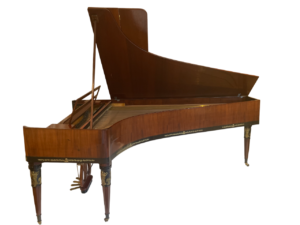
Fortepiano made by Heinrich Janssen, Vienna c. 1815 – Eric Feller Collection
The piano stands on 4 original legs with fire-gilded bronzes. The keyboard is made of ivory and ebony, the hammers are covered with deerskin and the piano is double and triple strung. The compass of the keyboard is 6 octaves + fourth (CC – f4). The nameboard bears the inscription on a ceramic label:
“Heinrich Janssen /
in Wien”.
The designation “in Wien” on the nameboard was only allowed to be used by instrument makers who themselves were “ordinary citizens” of the city.
Today there is nothing known about Heinrich Janssen. In some sources Janssen is still reported as a maker of giraffe and lyre pianos.
Till today there are no other known surviving instruments by him. The instrument was restored by Rudolf Haase, Switzerland.
This fortepiano is on permanent display at the Kellinghusen Museum “betont – Ton und Tasten Museum”!
Der Beitrag Heinrich Janssen c. 1810 – 1815 erschien zuerst auf Eric Feller Early Keyboard Instruments Collection.
]]>Der Beitrag John Broadwood and Son 1803 erschien zuerst auf Eric Feller Early Keyboard Instruments Collection.
]]>The piano rests on the original trestle stand with two integrated wooden pedals on both sides for lifting up the dampers (right) and due corde / una corda (left). At the end of the right side of the keyboard is a small stop which allows changing between due corde and una corda when pressing the pedal. The compass is 5 ½ octaves (FF – c4).
The serial number (2741) is written in ink on the left side of the wrest plank
The nameboard bears the inscription:
“1803
John Broadwood and Son
Makers to His Majesty
and the Princesses
Great Pulteney Street Golden Square
London“
The signature on the nameboard “John Broadwood and Son” was used from 1794 after John Broadwood’s son James Shudi Broadwood (1772 – 1851) entered the company. Previously all instruments were always signed with “Johannes Broadwood Londini fecit” (see the nameboard of the square piano from 1790 in the Eric Feller Collection).
The compass of 5 ½ octaves (FF – c4) was introduced by Broadwood in 1791 – before that all instruments (grand and square pianos) had only 5 octaves (one of the first fine examples with a 5 ½ octaves compass is the 1792 grand piano also in the Eric Feller Collection).
In a letter from James Shudi Broadwood to Thomas Bradford on 13th November 1793 he wrote that they had started in 1791 (following the advice of the composer Johann Ladislaus Dussek (1760 – 1812) who was in London at the time) with building pianos of 5 ½ octaves compass.
Today it is known that John Broadwood sold his first two grand pianos in January 1785. One was sold to Tyler of Bath (a music dealer) and the other to Count Brühl, Saxon ambassador and music patron. Both pianos were sold at a price of 55 pounds each.
Today the oldest surviving grand piano by John Broadwood was build in 1787. (see: Michael Cole)
This grand piano of 1803 is identical to the second fortepiano of John Broadwood also from 1803 in the Collection. Compared to the other grand piano it is obvious from the serial number that this instrument was made towards the end of 1803 since (according to Michael Cole) the production of grand pianos was around 200-250 per year.
So far 3 fortepiano from the year 1803 are known:
- Serial number 2526 – Collection Jörg Demus
- Serial number 2624 – Eric Feller Collection
- Serial number 2741 – Eric Feller Collection
John Broadwood was born on 6th October 1732 in Oldhamstocks near Cockburnspath in Scotland. He learned the profession of being a cabinetmaker like his father before.
In 1761 he started working for Burkat Shudi (1702 – 1773) in London and in 1770 became his business partner. In 1771 he opened his own shop on Great Pulteney Street in London. In 1769 he married Burkat Shudi’s daughter Barbara in her first marriage and had four children with her. After his wife’s death in 1776 he married Mary Kitson in 1781 and had six children with her. He died on 17th July 1812 in London.
Other surviving instruments by John Broadwood and Son:
- 1787 grand piano (No. 208) – Collection Charles Colt, Bethersdes UK
- 1792 grand piano (No. 452) – Metropolitan Museum, New York USA
- 1800 grand piano (No. 1835) – Collection Charles Colt, Bethersdes UK
- 1806 grand piano (No. 3500) – Museum of Art, Columbia USA

John Broadwood and Son, London 1803 – Eric Feller Collection – Nameboard
Der Beitrag John Broadwood and Son 1803 erschien zuerst auf Eric Feller Early Keyboard Instruments Collection.
]]>