Der Beitrag Fredericus Beck 1778 erschien zuerst auf Eric Feller Early Keyboard Instruments Collection.
]]>Beck specialized in the construction of square pianos, incorporating innovative mechanical solutions into his instruments. These developments were influenced by contemporary advancements made by Johann Christoph Zumpe and other leading piano makers of the time. However, Beck’s particular skill lay in refining these techniques and crafting instruments that were not only technically precise but also acoustically outstanding. His square pianos set new benchmarks in terms of tonal clarity and dynamic responsiveness. The design of his instruments was not only functional but also aesthetically sophisticated. Beck placed great emphasis on the selection of high-quality materials and meticulous craftsmanship. These details elevated his pianos beyond mere musical instruments to works of art, which held a prestigious place in the homes of the affluent bourgeoisie.
The instrument presented here is a rare example of Frederick Beck’s craftsmanship. This square piano, built in London in 1778, is one of only three surviving Beck instruments featuring an exceptionally rare stand with cabriole legs. Among these three, it is the oldest known example. This type of stand is not only unique among Beck’s surviving instruments but also represents an exceptional feature in the broader context of late 18th-century English square pianos, as it is collapsible. To date, only five other English instruments with foldable legs are known:
- Charles Trute, ca. 1771?
- Ferdinand Weber, 1772
- Frederick Beck, London, 1780/86? – known as the first piano arrived in Australia
- Frederick Beck, 1789
- Ferdinand Weber, undated
- Longman & Broderip, ca. 1790
(see Lancaster, G.: The First Fleet Piano, A Musician’s View, The Australian National University Press, 2015; and Cole, Michael: Frederick Beck Piano Maker).
The instrument and stand are crafted from mahogany, adorned with multi-coloured banded inlays in a simplified version of Tunbridgeware, a design typical of Beck’s early instruments. It features a five-octave range (FF – f3), and the keyboard is made of ivory and ebony. To the left of the keyboard, three hand-operated stops control divided dampers and a lute stop. The nameboard bears an elongated cartouche inscribed with:
“Fredericus Beck Londini Fecit 1778
No. 1 and 10 Broad Street Golden Square”
On either side of the cartouche, three filled holes are visible, indicating that the instrument was originally equipped with a pair of candle holders, which are no longer present (see Cole, Michael: Frederick Beck Piano Maker).

Tafelklavier Fredericus Beck, London 1778 – Eric Feller Collection (Nameboard)
The square piano is double-strung with a simple single action after Zumpe. It features single dampers, though a notable characteristic is that damping extends only up to c3. This distinctive feature is a hallmark of Beck’s instruments, as it deviates significantly from the conventional damping systems employed by other piano makers of the time. This innovation allows the undamped strings to vibrate freely, producing a resonance rich in overtones, which enhances the instrument’s tonal depth and brilliance.
Frederick Beck’s decision to exclude dampers from the highest five notes of his square pianos represents a unique innovation, likely inspired by the contemporary English aesthetic preference for a tone that was resonant and overtone-rich.
Arnold Frederick Beck was presumably born in 1738 in Württemberg and was baptized in the same region on May 30, 1738. After 1756, he left Germany and travelled via France to London. Between 1756 and approximately 1762, Beck settled in Paris, where he established a workshop at 364 Rue Saint-Denis. During this period, he maintained business relations with the renowned harpsichord maker Pascal Taskin (1723–1793), who sold instruments made by Beck. According to Frank Hubbard, Taskin was indebted to Beck for 660 livres in 1777 (see Hubbard, F.: Three Centuries of Harpsichord Making, Harvard University Press, 1965).
During this time, Beck left the European continent and relocated to London. From 1763 onward, he began manufacturing guitars there. In that same year, his residential and business address was recorded as Glassonbury Court, near Covent Garden Market. In the 1760s, Beck entered into a business partnership with Charles Pinto († 1791), about whom little information is available. Only one surviving guitar from 1764 bears the inscription “Pinto and Beck.”
On November 20, 1765, Beck was documented as serving as a juror at the Westminster Coroner’s Court, with his address still listed at Glassonbury Court. Between 1769 and 1773, he collaborated with the firm Longman, Lukey & Co., one of the most prestigious companies in the London musical instrument trade. On September 23, 1770, he married Mary Coles in London. By mid-1771, Beck had relocated his residence and workshop to 4 Broad Street, Carnaby Market.
In the late 1770s, the house number of his property on Broad Street was changed from 4 to 10. On September 7, 1779, Beck entered into a second marriage with Rose Ann Shudi. Between 1782 and 1791, they had six children, including three sons.
Between 1780 and 1789, Beck manufactured an average of 222 pianos per year, indicating both a substantial production capacity and high demand for his instruments. Toward the end of 1790, he began collaborating with piano maker George Corrie. Beck remained active in piano production at 10 Broad Street as late as 1794. It is assumed that he passed away around 1798.
His instruments are still regarded as outstanding examples of 18th-century musical instrument craftsmanship and continue to be of great interest to collectors, museum collections, and musicians alike.
Other Surviving Instruments by Arnold Frederick Beck:
- 1769 Square Piano – McLean Museum, Inverclyde, Scotland
- 1778 Square Piano – Royal Museums of Art and History, Brussels, Belgium
- c. 1785 Square Piano – Hamamatsu Museum of Musical Instruments, Hamamatsu, Japan
Der Beitrag Fredericus Beck 1778 erschien zuerst auf Eric Feller Early Keyboard Instruments Collection.
]]>Der Beitrag Joseph Kirckman 1805 erschien zuerst auf Eric Feller Early Keyboard Instruments Collection.
]]>Kirckman’s instruments were characterized by fine craftsmanship, precise mechanics, and clarity of sound. A distinctive feature of Kirckman’s pianos was the elaborate workmanship of the case, often adorned with fine inlays. He also placed great importance on technical innovations to improve the playability and longevity of the instruments.
The square piano presented here dates from 1805 and was made in London. The case of the instrument is crafted from mahogany and features surrounding multi-colored inlays made from different types of wood. The instrument itself stands on a French stand with a music shelf. The lower keys are covered with ivory, and the upper keys with ebony. The nameboard is made of various types of wood and decorated with fretwork on the sides. In the center, there is an oval cartouche with the signature:
“Joseph Kirckman
Piano Forte Maker
to Her Majesty
London 1805”
The instrument has a pedal to control the dampers. The action operates on the double-action principle, with hammers covered in leather, and the square piano is double-strung. Instruments from the Kirckman workshop are very rare and characterized by excellent craftsmanship and an exceptional sound aesthetic, valued for its warm, sustained, and clearly defined tone quality.

Square Piano by Joseph Kirckman, London 1805 – Eric Feller Collection (nameboard)
Other surviving instruments by Joseph Kirckman:
- c. 1830 Cabinet Piano – Glasgow Museums & Art Galleries, Glasgow England
- c. 1835 Cabinet Piano – Western Australian Academy of Performing Arts, Edith Cowan University, Perth Australia
- Grand Fortepiano – Royal Palace Mafra, Portugal
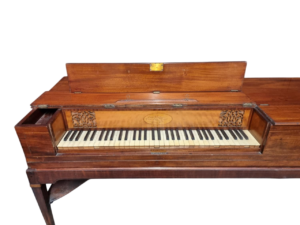
Square Piano by Joseph Kirckman, London 1805 – Eric Feller Collection (Keyboard)
Der Beitrag Joseph Kirckman 1805 erschien zuerst auf Eric Feller Early Keyboard Instruments Collection.
]]>Der Beitrag John Broadwood and Son 1799 erschien zuerst auf Eric Feller Early Keyboard Instruments Collection.
]]>In the late 18th century, music was an essential element of education and cultural life in England, especially for the affluent middle class. The square piano became the preferred instrument of the middle and upper-middle classes. Smaller and more affordable than the grand piano or harpsichord, it increasingly found a place in bourgeois households. Piano music was primarily learned by women, as it was considered an indispensable skill for social education and cultural participation. As an accessible yet respected instrument, the square piano was ideal for domestic music-making, serving not only as a tool for musical education but also as an instrument for private concerts, where families and guests gathered to enjoy music.
One example of such an instrument is this square piano built in 1799 by the renowned company John Broadwood and Son. A similar instrument from the same year is also part of the Eric Feller Collection (click here for further information).
The case of this instrument is made of mahogany with surrounding inlays of various woods. The piano rests on a “French stand” with four brass castors and features an integrated “music shelf” underneath. Round brass appliqués cover the screws of the stand on either side.
The natural keys are covered with ivory, and the sharps are made of ebony. The nameboard is crafted from different woods and is signed in a cartouche with the following inscription:
“John Broadwood and Son.
Makers to his Majesty and the Princesses
Great Pulteney Street London Golden Square.”
The instrument includes a damper lift and is double-strung. The action is a simple single action with leathered hammers and Broadwood’s characteristic underdampers, a mechanism patented by John Broadwood in 1783.
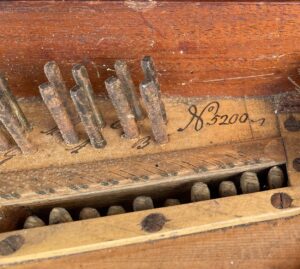
Square Piano by John Broadwood and Son, London 1799 – Serial number – Eric Feller Collection
Interestingly, the date on this square piano has been overpainted. This practice was common in the early 19th century due to a thriving market for used instruments, where demand for “new and modern pianos” was high. Used instruments were more affordable than new ones, and sellers sometimes removed or altered the manufacturing date to make the instrument appear newer, thus fetching a higher price. Another example of this practice is a square piano by Ferdinand Weber of Dublin, also part of the Eric Feller Collection (click here for more information on the instrument – Ferdinand Weber, Dublin, circa 1775).
John Broadwood was born on October 6, 1732, in Oldhamstocks near Cockburnspath, Scotland. Like his father, he trained as a cabinetmaker. In 1761, he began working for Burkat Shudi (1702 – 1773) in London and became his business partner in 1770. In 1771, Broadwood established his own workshop on Great Pulteney Street in London.
John Broadwood married Shudi’s daughter, Barbara, in 1769 and had four children with her. After Barbara’s early death in 1776, he married Mary Kitson in 1781, with whom he had six more children. John Broadwood passed away on July 17, 1812, in London.
Other Surviving Instruments by John Broadwood and Son:
- 1798 square piano (No. 4200), National Museum of American History, Washington, USA
- 1791 square piano (No. 1552), Kenwood House, Hampstead, UK
- 1795 square piano (No. 2844), Richard Burnett Collection, Finchcocks, Goudhurst, UK
Der Beitrag John Broadwood and Son 1799 erschien zuerst auf Eric Feller Early Keyboard Instruments Collection.
]]>Der Beitrag Joseph Dale & Son 1806 – 1809 erschien zuerst auf Eric Feller Early Keyboard Instruments Collection.
]]>
The case and stand of the instrument are made of mahogany and adorned with multi-coloured inlays. The action features a single action with underdampers, double-stringing, and a pedal for lifting the dampers, which is missing. The lower keys are covered with ivory, while the upper keys are made of ebony. The nameboard of the instrument shows the following inscription within an oval cartouche:
“Joseph Dale & Son
Piano Forte Makers
(By Appointment) To His Royal Highness
The Prince of Wales
Cornhill, Oxford Street & New Bond Street
London.”
This square piano is dated between 1806 and 1809. In 1805, Joseph Dale entered into a partnership with his son, William Dale, and both were granted the privilege of supplying instruments to the English royal family (“By Appointment To His Royal Highness / The Prince of Wales“). This distinction was prominently advertised by the company, as evidenced by the Prince of Wales’ heraldic badge—a green-painted emblem of three ostrich feathers—located above the inscription on the nameboard. Between 1806 and 1809, the Prince of Wales was George Augustus Frederick, the future King George IV. He was the eldest son of King George III and held the title of Prince of Wales from 1762 until his accession to the throne in 1820. In 1809, William Dale left his father’s company and established his own business under his own name.
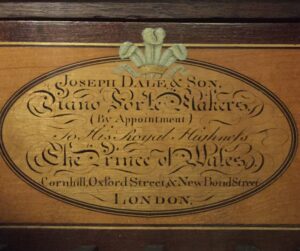
Square Piano Joseph Dale & Son, London 1806 – 1809 – nameboard – Eric Feller Collection
During the examination, the monogram “J D” of Joseph Dale was found handwritten in ink beneath the action. Additionally, the serial number 304 was inscribed in ink on the wrest plank. A historical metal quill pen was also discovered inside the instrument.
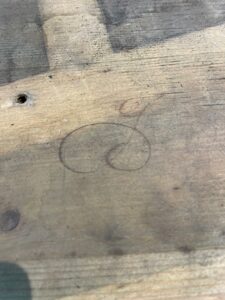
Joseph Dale & Son, London 1806 – 1809 – Signature by J. Dale – Eric Feller Collection
Joseph Dale was born in 1750 and worked as an instrument maker and music publisher. In 1783, he opened his business at 132 Oxford Street, and shortly thereafter, at 19 Cornhill Street. In 1805, he entered into a partnership with his son William Dale (born circa 1780–1785, died circa 1827). The following year, their business received significant recognition by being appointed as instrument makers to the Prince of Wales and the royal family.
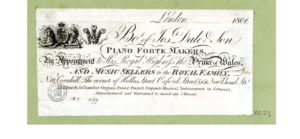
Trade Card 1806 Joseph Dale and Son – The British Museum
In 1809, William decided to establish his own business, while Joseph continued to work independently from 1808 until his death in 1821. William Dale passed away in 1827, and his wife Elspeth Dale continued to run the business until 1832.
Other Surviving Instruments by Joseph Dale & Son:
- Circa 1805 square piano – Sigal Music Museum, Greenville, USA
- Circa 1805 square piano – Private Collection, Haxby, England
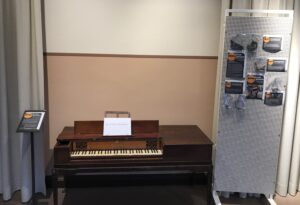
Workshop Results 1 – Museum betont – Eric Feller Collection
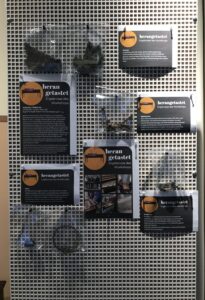
Workshop Results 2 – Museum betont – Eric Feller Collection
Workshops of this kind will be held regularly at the “betont – Ton und Tasten Museum” in Kellinghusen. Further dates can be found on the museum’s website.
https://www.kellinghusen.de/museum
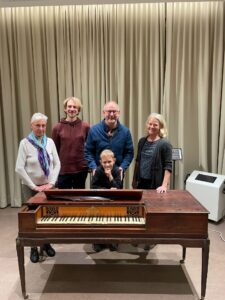
Workshop – Eric Feller Collection
Der Beitrag Joseph Dale & Son 1806 – 1809 erschien zuerst auf Eric Feller Early Keyboard Instruments Collection.
]]>Der Beitrag Joshua Done 1795 erschien zuerst auf Eric Feller Early Keyboard Instruments Collection.
]]>The case of the instrument and the matching original French stand are made of mahogany and decorated with multi-coloured inlays set in a cassette-like manner. The action is a single action with single dampers, double-strung strings, and two hand levers for divided dampers. The hammers are covered with leather. The lower keys are covered with ivory and the upper keys with ebony. The nameboard is decorated with garlands and flowers in inlays and signed in an oval cartouche with:
“Joshua Done Londini Fecit 1795
Chancery Lane”
The square piano, with its single action and divided damper stops follows the tradition of early instruments by Zumpe. However, from an external appearance, it seems modern for its time. Joshua Done, matching the taste of the 1790s, built a french stand for this instrument. One of the first piano makers to build french stands for his square pianos was Christopher Ganer. As early as 1777/78, he initiated the new trend that only truly took hold in the 1790s and replaced the trestle stands.

Square Piano by Joshua Done, London 1795 – Eric Feller Collection (2)
Joshua Done was active in London from around 1780 and quickly established himself as a respected piano maker. Little is known about him to date. From 1792 to 1814, his workshop was located on Chancery Lane, and from 1793 there was also a branch on Great James Street, Bedford Row.
Further surviving instruments by Joshua Done:
- 1780 square piano – National Museum of American History, Washington, USA
- 1789 square piano – Private Collection, Oxford, England
- ca. 1795 square piano – Collection of Mr. and Mrs. Wilson Cotton, London, England
- 1796 square piano – Monart Piano Collection, Colm O’Leary, Enniscorthy, Ireland
- ca. 1805 – 1814 square piano – Collection of June Funk, Orinda, USA
Der Beitrag Joshua Done 1795 erschien zuerst auf Eric Feller Early Keyboard Instruments Collection.
]]>Der Beitrag Augustus Leukfeld c. 1803 erschien zuerst auf Eric Feller Early Keyboard Instruments Collection.
]]>The case of the square piano is made of solid mahogany and richly decorated with inlaid decorative bands and oval cartouches on the keyboard flap and in the extensions of the light wooden legs. The front two corners of the case are rounded. The instrument stands on four turned legs and the lid has two locks decorated with ivory, one of which is only attached for symmetry and has no function. When the lid is half opened, exquisite fretwork covered with green silk is inserted above the strings.

Square Piano by Augustus Leukfeld, London c. 1803 – Eric Feller Collection (Fretwork above the strings)
The keyboard has a compass of 5 ½ octaves (FF – c4), the lower keys are covered with ivory and the upper keys with ebony. The square piano is double strung and has a double action. The hammers are covered with leather. A pedal is used to control the dampers. The nameboard also has exquisite fretwork covered with green silk and bears in a cartouche the signature:
“Leukfeld
Piano Forte Maker
27
Tottenham Street
Fitzroy Square
London”
The entire instrument is made of excellent quality and is characterized by precision craftsmanship, high-quality materials and individual elegant design options.
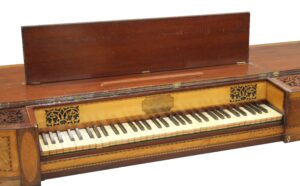
Square Piano by Augustus Leukfeld, London c. 1803 – Eric Feller Collection (Keyboard)
Little is known about Ludwig Augustus Leukfeld. He can be traced back to around 1790 as a piano maker and worked until 1810. Until 1796, he was in a partnership with John Geib (1744 – 1818) for some time. His successor, who took over the company, was Thomas Holmyard, who died in 1841. It can be assumed that Leukfeld was already in a partnership with him in his later lifetime or that Holmyard worked for him. The factory was located at No. 1 Tottenham Street. 27 Fitzroy Square in London.
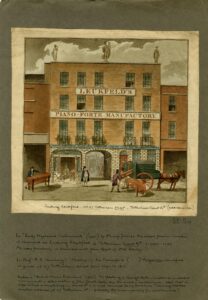
Trade card of the Piano Factory of Augustus Leukfeld c. 1790 – © The Trustees of the British Museum
In the collection of the British Museum in London is a trade card from the company. It shows the factory building and sales rooms. In the front we can see workers loading a square piano into a horse-drawn cart for delivery. Looking closely at the instrument, we can see that it has the same shape and inlays as the square piano presented here. Leukfeld’s factory was known for the production of exquisite and elegant square pianos, which could be ordered – like this instrument – with rounded corners. He also built grand and upright pianos, harps and organs, of which none have survived. In addition to the instruments, he also produced oval tables and sideboards (also shown in the picture) for the wealthy London aristocracy. His instruments and furniture had the best reputation and were of excellent quality.

Square Piano by Augustus Leukfeld, London c. 1803 – Eric Feller Collection (case with inlays)
In “The Gentleman’s Magazine and Historical Chronicle from July to December 1810” (Volume 108) and in “The Monthly Magazine or British Register” are entries that Augustus Leukfeld died in 1810 (from further announcements in “The London Gazette” probably around November 22, 1810).
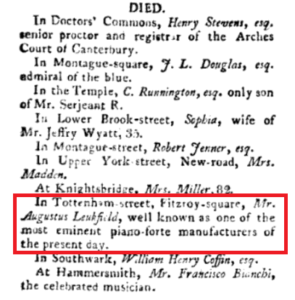
Death notice of Augustus Leukfeld in “The Monthly Magazine 1810“
Other surviving instruments from Augustus Leukfeld:
- c. 1805 (No. 334) – formerly Dr. Andreas Beurmann Collection, Hamburg, Germany
- 1806 Square Piano (No. 530) – Monart Piano Collection, Colm O’Leary, Enniscorthy, County Wexford, Ireland
Der Beitrag Augustus Leukfeld c. 1803 erschien zuerst auf Eric Feller Early Keyboard Instruments Collection.
]]>Der Beitrag Christopher Ganer c. 1785 erschien zuerst auf Eric Feller Early Keyboard Instruments Collection.
]]>
Christopher Ganer, London ca. 1785 – Eric Feller Collection
The case of this delicate and elegant instrument is made of solid mahogany and richly decorated with inlaid decorative ribbons (also at the inside of the lid). It rests on its original trestle stand. The lower keys are covered with ivory and the upper keys with ebony. There are two small decorative notches on each lower key which were coloured with iron gall ink. This detail was very common as a decorative element on harpsichord keys and can be found here as a decorative remnant. It is mainly found on very early instruments.
Inside there are two hand stops on the left side for dampers and lute. The hammers are covered with leather and the instrument is double strung. The action is an English Single Action according to Zumpe.

Christopher Ganer, London ca. 1785 – Eric Feller Collection (Inscription on nameboard)
The nameboard is painted with flowers and garlands and bears the signature in an oval cartouche:
“C. Ganer
Grand and Small Forte Piano Manufacturer
Broad Street, Golden Square
London”
The number 1070 is handwritten on the soundboard. Whether this is the serial number has not yet been clarified with certainty, as Ganer did not usually sign his instruments with a serial number. The square piano originally comes from Birtles Hall in Cheshire and was sold at Sotheby’s in 1994 (catalogue number 137).

Christopher Ganer, London ca. 1785 – Eric Feller Collection (serial number (?) on soundboard)
Christopher Ganer was born in Leipzig around 1750. Like many instrument makers, he left the continent and immigrated to England where he worked as a harpsichord and piano maker from 1774 onwards (as well as a harp maker from around the mid-1780s). At that time, his workshop was at No. 22 Broad Street, Golden Square, later at No. 47 Broad Street. Until around 1784, Ganer always dated his instruments with the Latin inscription “Christopher Ganer Londini Fecit”. In 1774 he married Lydia Willey and had four daughters and a son, who died in infancy. According to different sources, he died in 1811 (in some sources also in 1818).
Principally special about Christopher Ganer’s instruments is that, in addition to the typical “trestle stands“, he also built the “French stands“, which became fashionable from 1777/78. Such an instrument with a “French stand” can also be seen in the Eric Feller Collection. His skills as an excellent cabinetmaker allowed him to build particularly elegant instruments decorated with exquisite inlays. All of his instruments are individually designed and all are different.
Other surviving instruments by Christopher Ganer:
- ca. 1785 square piano (No. ?) – Fondazione Cassa di Risparmio, Bologna Italy
- ca. 1785 square piano (No. ?) – Eric Feller Early Keyboard Instruments Collection, Germany
- ca. 1785 square piano (No. 456) – National Museum of American History, Smithsonian Institution, Washington USA

Christopher Ganer, London ca. 1785 – Eric Feller Collection (5)
Der Beitrag Christopher Ganer c. 1785 erschien zuerst auf Eric Feller Early Keyboard Instruments Collection.
]]>Der Beitrag August Kulmbach 1828 – 1835 erschien zuerst auf Eric Feller Early Keyboard Instruments Collection.
]]>The growing middle-class society of the 19th century also contributed to the popularity of the square piano. Music became an important part of middle-class life, and the piano found its place in many middle-class households.
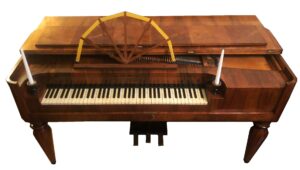
August Kulmbach, Heilbronn c. 1828 – 1830 – Eric Feller Collection (music stand)
The square piano presented here is a testimony to German piano making in the first half of the 19th century. The instrument was made between 1828 – 1835 in Heilbronn by the German piano maker August Kulmbach. The case and original legs are made of cherrywood and painted with shellac. The lyre is painted black and decorated with bronze applications. Two candle holders with bronze grommets are attached to each side of the keyboard. Behind the damper system is a dustcover that is fixed with a screw. The music stand can be opened and has a fan shape. The individual wooden elements of the fan are connected with a yellow ribbon. This type of music stand is typical for Kulmbach instruments.
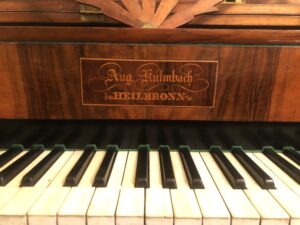
August Kulmbach, Heilbronn c. 1828 – 1830 – Eric Feller Collection (nameboard)
On the nameboard there is an inlaid cartouche with the inscription:
“Aug. Kulmbach
in Heilbronn A/N”
The square piano has a range of 6 octaves plus 2 keys (FF – g4) and has a Viennese action with leather-covered hammers. The keys are covered with bone plates. The instrument also has 3 pedals (dampers, moderato, bassoon). It has been restored twice in its past, as shown by a paper note stuck inside the instrument (1980, 1990). The serial number 200 is handwritten on the bottom of the case, under the action. The instrument is in playable condition and impresses with its great sonority and light touch of the keyboard, which makes it a perfect instrument of the classical and early romantic eras.

August Kulmbach, Heilbronn c. 1828 – 1830 – Eric Feller Collection (dampers and dust cover)
The square piano was provided in December 2023 by the city of Hilchenbach, which I would like to thank at this point!
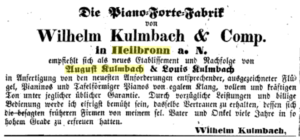
Wilhelm Kulmbach Advert – Regensburger Tageblatt No. 20, 1859
(Friedrich) August Kulmbach was born in 1803 and comes from a family of instrument makers that was founded in 1818 by his brother (Martin Friedrich) Ludwig Kulmbach (1790 – 1855). Ludwig Kulmbach lived at Schelengasse 256 and had his workshop behind the Nicolaikirche. His brother August Kulmbach worked with him from the first years of the company’s existence. Around 1826/27 August Kulmbach became self-employed and made his own instruments. Towards the middle of the century, Ludwig’s son Wilhelm Kulmbach (1833 – 1879) took over management of his brother’s Kulmbach factory. It is not yet known how long August Kulmbach made instruments. He died in 1856.
Other surviving instruments by August Kulmbach:
- c. 1835 square piano – Gemeentemuseum, The Hague, Netherlands
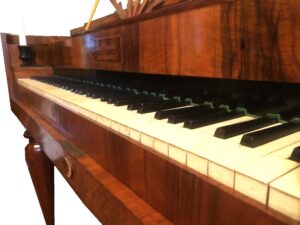
August Kulmbach, Heilbronn c. 1828 – 1830 – Eric Feller Collection (Keyboard)
Der Beitrag August Kulmbach 1828 – 1835 erschien zuerst auf Eric Feller Early Keyboard Instruments Collection.
]]>Der Beitrag Érard Frères & Compagnie 1796 erschien zuerst auf Eric Feller Early Keyboard Instruments Collection.
]]>This early square piano was made by Érard Frères & Compagnie in Paris in 1796. The case of the instrument and the fluted legs are made of fine mahogany. The instrument is decorated with band inlays all around the case. The nameboard is signed with:
“Érard Frères & Compagnie
Rue du Mail No. 37
à Paris 1796″
The keyboard has a compass of 5 ½ octaves (FF – c4). The lower keys are covered with ivory and the upper keys with ebony. Above the Second Action is the two-parted dust cover and on the right edge of the case is a second foldable music stand.
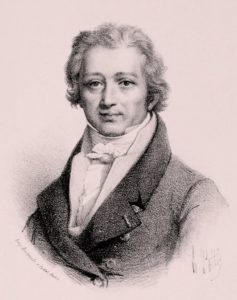
Sébastien Erard (1752 – 1831)
On the soundboard next to the bridge is the original handwritten signature with the serial number 3346 and the year of manufacture 1796. The square piano has four wooden pedals, which are inserted in a bar between the two rear legs. The functions are: dampers, moderator, lute and nag’s head swell.
The instrument was found in Brittany/France in December 2022 and was in absolutely original condition. Also present were the original tuning hammer and the key for the lock.

Square Piano Erard, Paris 1796 – Eric Feller Collection (original tuning hammer)
According to the original production books from the Érard company, the instrument was delivered to Monsieur Lefort in Orléans. Further research to the provenance of the instrument are ongoing.
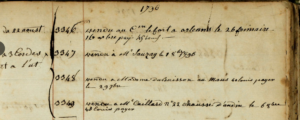
Square Piano Erard, Paris 1796 – Eric Feller Collection (2)
For detailed information about the company Érard click here!
Other surviving instruments by Érard Frères & Compagnie:
- 1805 Square Piano (No. 6447) – MKG – Museum für Kunst und Gewerbe Hamburg, Germany
- 1808 Square Piano (No. 7488) – Cité de la Musique Paris, France
Der Beitrag Érard Frères & Compagnie 1796 erschien zuerst auf Eric Feller Early Keyboard Instruments Collection.
]]>Der Beitrag Joseph Kirkman c. 1806 erschien zuerst auf Eric Feller Early Keyboard Instruments Collection.
]]>The oldest surviving fortepiano built by Abraham & Josephus Kirckman in 1789 is also part of the Eric Feller Collection.
Detailed information about this instrument can be found here – click here!
The square piano described here dates from around 1806. The case of the instrument is made of mahogany with surrounding band inlays made of different woods. The instrument stands on 6 fluted legs. The lower keys are covered with ivory and the upper keys with ebony. The nameboard is made of different woods and decorated with fretwork on the sides and signed in an oval cartouche:
“Joseph Kirkman
Grand Piano Forte Maker
To Her Majesty
No.19 Broad Street, Golden Square
London”
The instrument has a pedal for controlling the dampers, a Double Action and leather-covered hammers. Furthermore, it has two strings per key and the action is covered with the original dust cover. Kirkman instruments are characterized by very high-quality workmanship and a particularly beautiful sound.
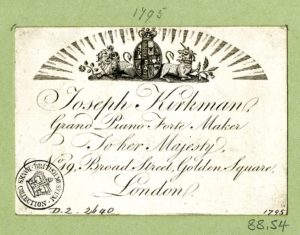
Trade Card Joseph Kirkman c. 1795 – The British Museum
Other surviving instruments by Joseph Kirkman:
- c. 1830 Cabinet Piano – Glasgow Museums & Art Galleries, Glasgow England
- c. 1835 Cabinet Piano – Western Australian Academy of Performing Arts, Edith Cowan University, Perth Australia
- Grand Fortepiano – Royal Palace Mafra, Portugal
Der Beitrag Joseph Kirkman c. 1806 erschien zuerst auf Eric Feller Early Keyboard Instruments Collection.
]]>Der Beitrag Bland & Weller 1794 erschien zuerst auf Eric Feller Early Keyboard Instruments Collection.
]]>The instrument presented here was built in London in 1794 and is a partnership between Anne Bland and E. Weller. It is not yet clear whether E. Weller is also a woman.
The case of the square piano and the original stand are made of mahogany and decorated with multi-coloured inlays. The action is a single action with single dampers, double strung and there are two hand stops for dampers and lute stop. The keyboard is made of ivory and ebony. The nameboard is decorated with garlands of marquetry and bears in an oval cartouche the inscription:
“Bland & Weller
No. 23 Oxford Street London.”
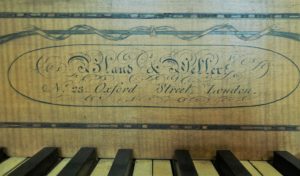
Square Piano by Bland & Weller, London 1794 – Nameboard – Eric Feller Collection
There is also a signature in pencil under the action with the year of manufacture 1794. The decorations on the inside of the keyboard are interesting: the heraldic badge of the Prince of Wales, symbolized by three ostrich feathers, is embedded in multi-coloured inlays on the left and right. It can be assumed that Bland & Weller wanted to suggest a certain closeness to the Royal Family in order to strengthen sales of the business. So far it is not known that they had this privilege to supply the Royal Family. Other piano builders who held this privilege, such as Joseph Dale or John Broadwood, also mentioned it on the nameboard. Additionally, it can be assumed that Anne Bland as a woman did not easy assert herself in a male-dominated society.
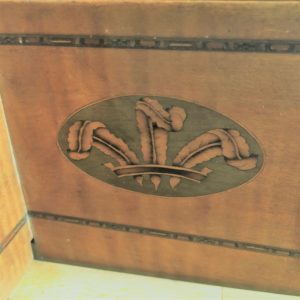
Square Piano by Bland & Weller, London 1794 – Inlays – Eric Feller Collection
In 1784, Anne Bland set up her music shop in the Oxford Street, London, dealing in sheet music and instruments. Her date of birth is not yet known. In addition to many well-known compositions by various composers, she published an annual collection of sheet music with dances from around 1790.
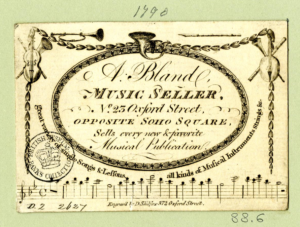
Trade Card Bland & Weller, London 1790 – The British Museum
In 1793 she entered into a partnership with E. Weller and the firm was renamed Bland & Weller. In 1818 she retired from the business. From 1819 to 1821 the name listed in trade directories is Weller & Co. In particular the compositions of James Hook (1746 – 1827) were published from 1793 until at least 1800. The first English edition of three Mozart piano sonatas (KV 280, 282, 283) was also published.

Trade Card Bland & Weller, London c. 1810 – The British Museum
In 1805 the company bought the copyrights of 360 songs from the composer, musician and writer Charles Dibdin (1745 – 1814) along with the musical stock from his publishing business, which he had to give up due to financial difficulties. They bought the copyright for £1,800 plus an annual fee of £100 for the next three years.
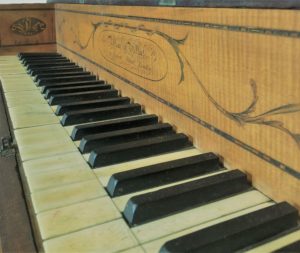
Square Piano by Bland & Weller, London 1794 – Keyboard – Eric Feller Collection
Other surviving Bland & Weller instruments:
- 1792 – 1818 square piano – Japan/Tokyo: Musashino Academia Musicae, Museum of Musical Instruments, Tokyo Japan
Der Beitrag Bland & Weller 1794 erschien zuerst auf Eric Feller Early Keyboard Instruments Collection.
]]>Der Beitrag Robert Wales c. 1810 owned by Carolina Oliphant – Lady Nairne erschien zuerst auf Eric Feller Early Keyboard Instruments Collection.
]]>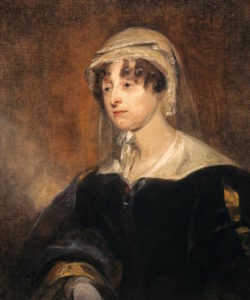
Carolina Oliphant, Baroness Nairne, Portrait by John Watson Gordon, c. 1818 – National Galleries of Scotland
London was one of the main locations of piano manufacturing in the late 18th and early 19th century. Accordingly, many piano makers settled there and produced a large quantity of the newly, fashionable Pianofortes. The demand was enormous, since the upper middle class and the nobility showed a huge interest in these instruments. In addition to the well-known piano makers such as John Broadwood (1732 – 1812) or Muzio Clementi (1752 – 1832), there were also a large number of instrument makers who are less well known today, but whose instruments are in no way inferior to the more well-known manufacturer’s instruments. Among these was Robert Wales. As a favourable addition, the here presented instrument has a very interesting history. It was owned by Carolina Oliphant – Lady Nairne (1766 – 1845), known in music history as a collector and composer of many Scottish songs and ballads.
The case of this square piano is made of mahogany with surrounding multi-coloured inlays made of different woods. The instrument stands on six turned legs with brass rollers and bronze applications. The keyboard is made of ivory and ebony and it has a wooden pedal for controlling the dampers. Inside it has a double action with leather-covered hammers and single dampers and it is double-strung. The nameboard is nicely painted and bears the signature in a rectangular cartouche:
„Royal Patent
Robt. Wales
Maker
London”

Robert Wales, London ca. 1810 owned by Carolina Oliphant – Nameboard – Eric Feller Collection
It shows a handwritten serial number on the wrestplank: No. 2300, stamped underneath: R – Wales Maker. There is also a handwritten signature in ink on the soundboard:
„Sold by Rob. Purdie
70 Princes Street
Edinburgh“
Robert Purdie came from a music publishing family that was very active in London and Edinburgh. His Scottish music shop had earned a high reputation through musical instruments and sheet music.
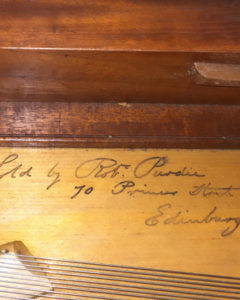
Robert Wales, London ca. 1810 owned by Carolina Oliphant – Signature – Eric Feller Collection
Furthermore, there is a handwritten signature in pencil on the back of the nameboard:
“Carolina Oliphant’s Piano”
Carolina Oliphant – Lady Nairne, Baroness Nairne in the Peerage of Scotland and Baroness Keith of the United Kingdom was a Scottish collector and composer of songs and ballads. Many of her songs are still very popular in England and Scotland today. Like her contemporary Robert Burns (1759 – 1796), Carolina Nairne was strongly influenced by the Jacobean heritage, although both had different approaches to their composition and poetry. Nairne focused on an earlier romanticized version of the Scottish way of life, tinged with sadness about the past. Robert Burns, on the other hand, was more optimistic about a brighter future.
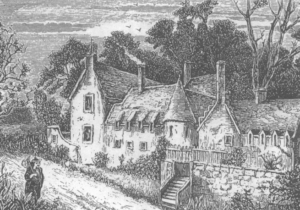
The auld hoose of Gask, Perthshire – Birthplace of Carolina Oliphant
Carolina Oliphant was born on 16th August 1766 at Auld Hoose, Gask, Perthshire (the ancestral home of her father’s family). She was the fourth child of the three sons and four daughters of Laurence Oliphant (1724 – 1792), Laird of Gask, and his wife Margaret Robertson (1739 – 1774). Her mother was the eldest daughter of Duncan Robertson of Struan, chief of the Donnachie clan who fought on the side of the Jacobins in the rebellions of 1715 and 1745. Her father was also a Jacobin and she received a high education, which also included music and art. Carolina grew into a charming young lady who received much praise and encouragement in the respected circles.

Birthregister for Carolina Oliphant Old Parish Register (OPR) – National Records of Scotland
As a young girl, Carolina was engaged to William Murray Nairne, one of Lord Nairne’s grandsons, who became 5th Lord Nairne in 1824. After he was promoted to Deputy Inspector-General of a Scottish barracks, they married on 2nd June 1806. The couple settled in Edinburgh, where their only son, William Murray Nairne (1808 – 1837), was born two years later.

Birth entry of William Nairne – National Records of Scotland
In 1830 Carolina’s husband died and she lived with her son in Ireland and on the Continent for a time. Her son’s poor health worsened and he died in Brussels in December 1837. Carolina then returned to Gask in 1843. After suffering a stroke, her health deteriorated and she died on October 26, 1845.
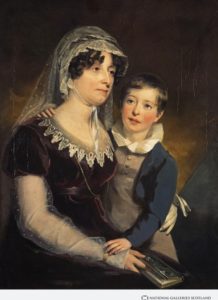
Carolina Oliphant, Lady Nairne with her son William Murray Nairne, later 6th Lord Nairne by Sir John Watson Gordon – National Galleries of Scotland
Carolina Nairne began composing songs shortly after her father’s death in 1792. According to her high education, she was able to read music and she played the harpsichord and the pianoforte. From an early age she was involved with folk songs and provided well-known melodies with her own lyrics. After the couple moved to Edinburgh in 1806, contact was made with Robert Purdie’s music store, where Carolina most likely also acquired Robert Wales’ square piano. Due to the social conventions of that time, which made it difficult for a woman in a male-dominated society, Carolina spent considerable efforts to hide her identity. She even hid her activities from her husband. In the 1820s she wrote to a friend: “I didn’t even tell Nairne, lest he babble.”
In order to make her compositions available to a larger audience, she began using the pseudonym “Mrs. Bogan of Bogan” or later only under the gender-neutral initials “B. B.” or “S. M.” to publish her work. Much of her work was published in Robert Purdie’s The Scottish Minstrel (1821-24; in six volumes). Once, at the urging of her publisher Purdie, she appeared dressed up as an elderly country lady. She managed to convince Purdie that she was just a collector for the songs she had collected from common country folk. However, the entire editors of The Scottish Minstrel (which consisted only of women) was aware of her identity, as were her sisters, nieces and great-niece. During her official visits to the publishing house of Purdie, she always wore an old, veiled cloak, hoping not to be recognized. She also veiled her handwriting in her submitted works.

„To the Land of the Leal“, composed 1797 – 1798
Lady Carolina Nairne’s musical and literary work is still immanent. Her songs are part of Scottish and English folklore and they are identity-forming for many people.
Unfortunately, very little is known about the instrument maker Robert Wales. Certain is that he was working at Charles Street No. 33, Hampstead Road, Edinburgh. In 1819 he was partner of John Whitaker and had the address Paul`s Churchyard No. 75, which is proved by a single surviving instrument. It is also known that he built pianos for William Hodsoll. Based on the serial number (No. 2300) on this instrument, it can be concluded that he was very active and built many instruments. It is highly probable, however, that these instruments were not only sold under his name, but he also supplied other dealers with them.
Other surviving instruments by Robert Wales:
- 1819 square piano Wales, Robert, & John Whitaker (No. ?) – Western Australian Academy of Performing Arts, Edith Cowan University, Perth Australia
- c.1820 square piano (No. ?) – Patricia Theodorou Collection, England
- 1819 – 1823 square piano by Robert Wales for John Monro (No. ?) – Peter Owen Collection, Blagdon England
- c.1830 Cabinet Piano by R. Wales for William Hodsoll (No. ?) – Leipzig University Collection, Musikinstrumenten-Museum, Leipzig Germany – destroyed in WWII
References:
- Bold, Valentina (2006), Ewan, Elizabeth; Innes, Sue; Reynolds, Siân (eds.), “The Biographical Dictionary of Scottish Women: From the Earliest Times to 2004”, Edinburgh University Press, ISBN 978-0-7486-1713-5
- Fry, Michael (2014), “A Higher World: Scotland 1707–1815”, Birlinn, ISBN 978-0-85790-832-2
- McGuirk, Carol (2006), “Jacobite History to National Song: Robert Burns and Carolina Oliphant (Baroness Nairn)”, The Eighteenth Century, University of Pennsylvania Press
- Rogers, Charles (1869), “Life and Songs of the Baroness Nairne; with a memoir and poems of Caroline Oliphant the younger”, Charles Griffin
- Thomson, Thomas (1875), “Nairn, Carolina”, Biographical Dictionary of Eminent Scotsmen, vol. 2, Blackie & Sons
- Tytler, Sarah; Watson, J. L. (1871), “The Songstresses of Scotland”, vol. 2, Strahan
Der Beitrag Robert Wales c. 1810 owned by Carolina Oliphant – Lady Nairne erschien zuerst auf Eric Feller Early Keyboard Instruments Collection.
]]>Der Beitrag Muzio Clementi 1801 erschien zuerst auf Eric Feller Early Keyboard Instruments Collection.
]]>The case of the instrument is made of mahogany with encircling multicolour ribbon inlays of different woods and brass. The instrument rests on six fluted legs with brass castors. The keyboard is made from ivory and ebony. The instrument has a wooden pedal for controlling the dampers. The action is a double action with leather covered hammers, double strung and single dampers. It originally had a dust cover above the action which is missing. The nameboard is painted with garlands of flowers and tendrils and is signed in a white enamel cartouche with:
“New Patent
Muzio Clementi & Comp.
No. 26 Cheapside
London”
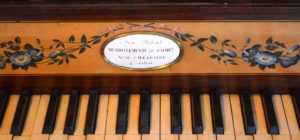
Muzio Clementi, London 1801 – Eric Feller Collection (Nameboard)
The white enamel nameplates on the satinwood nameboard goes back to the instruments made by Longman & Broderip, which signed their instruments this way and which Clementi also used in the early years (also under Longman & Clementi).
Square pianos by Clementi were always provided with two serial numbers: one stamped on the left and one handwritten with ink on the wrest plank (stamped: 1845 – inked: 1481).
The system used by Clementi counts with the inked number the general production of pianos since the acquisition of the company “Longman & Broderip” in 1798. The stamped numbers, however, continue the production of square pianos of the acquired company “Longman & Broderip”, but only instruments with the 1794 introduced “New Patent“. Other instruments (for example single action instruments, grand pianos or cabinet pianos) were added together in other groups.
Based on these serial numbers, the year of construction of this instrument can be derived to 1801. (see: Clementi & Co 1798-1830 Pianoforte Manufacture in London, Leif Sahlqvist 2013)
For more information about the company Muzio Clementi & Co. – click here!
Other preserved instruments by Muzio Clementi & Co.:
- 1803 square piano (No. 3468) – Newton Centre: Marlowe A. Sigal Collection, USA
- 1803 square piano (No. 2335) – Museu da Musica Lisbon, Portugal
- 1806 square piano (No. 4095) – German Museum Munich, Germany
Der Beitrag Muzio Clementi 1801 erschien zuerst auf Eric Feller Early Keyboard Instruments Collection.
]]>Der Beitrag John Broadwood and Sons 1815 – Compensator erschien zuerst auf Eric Feller Early Keyboard Instruments Collection.
]]>The case of the instrument is made of mahogany and rosewood with revolving band inlays in brass. The instrument stands on 6 original turned legs with fire-gilt bronze rings. The entire instrument is made in the typical “Regency-Style“. At the front there are two drawers. The keyboard is made of ivory and ebony. The instrument has a wooden pedal for the dampers. The action is a double action with leathered hammers, single dampers and is double strung. The instrument has the original dust cover, which is located above the strings and inscribed with the number 157 on the back. The same number is also found on the wrest plank. The nameboard is made from different woods and signed in a cartouche:
“John Broadwood and Sons.
Makers to His Majesty and the Princesses
Great Pulteney Street London Golden Square.”
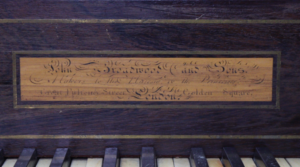
Nameboard John Broadwood & Sons 1815 Compensator Square Piano – Eric Feller Collection
The serial number is located on the inside of the instrument and reads 19968. Based on this serial number, the instrument was made in 1815.
The company John Broadwood produced various models of square pianos. Depending on the design and the used woods the prices varied. This piano has to be one of the expensive models. The standard models were mostly held in mahogany and simpler decorated with some ribbon inlays. The use of rosewood and brass inlays is a clear sign of a high-priced instrument.
Interesting at this instrument is the embedded metal bar above the soundboard. Occasionally, there have been repeated attempts to improve the entire case construction and tuning through reinforcements. The constantly growing range of the compass and the associated increasing tension resulted in many twisted instruments and damaged cases. Looking at grand pianos, these reinforcements prevailed from 1820 onwards. Exceptional examples of these reinforcements are the “Compensator Frame” fortepianos made by Stodart (for more information on these instruments – click here).
Another important factor and a prerequisite for these innovations were the improvements of manufacturing and production processes, which led to higher material quality.
John Broadwood was born on 6th October 1732 in Oldhamstocks near Cockburnspath in Scotland. He learned the profession of being a cabinetmaker like his father before.
In 1761 he started working for Burkat Shudi (1702 – 1773) in London and in 1770 became his business partner. In 1771 he opened his own shop on Great Pulteney Street in London. In 1769 he married Burkat Shudi’s daughter Barbara in her first marriage and had four children with her. After his wife’s death in 1776 he married Mary Kitson in 1781 and had six children with her. He died on 17th July 1812 in London.
Other surviving square pianos by John Broadwood and Sons:
- 1814 square piano (No. 8666) – Stanford University Department of Music, Stanford USA
- 1816 square piano (No. 20108) – Banchory Crathes Castle, The National Trust for Scotland, UK
- 1816 square piano (No. 20953) – Tredegar House, Newport UK
Der Beitrag John Broadwood and Sons 1815 – Compensator erschien zuerst auf Eric Feller Early Keyboard Instruments Collection.
]]>Der Beitrag Muzio Clementi 1809 erschien zuerst auf Eric Feller Early Keyboard Instruments Collection.
]]>The case of this square piano is made of fine mahogany with surrounding multi-coloured inlays made of different woods. The instrument rests on four turned legs with brass castors and the keyboard is made from ivory and ebony.
The square piano also has a wooden pedal for controlling the dampers. It further has a double action with leather-covered hammers and single dampers and is double strung. The nameboard is painted and bears the signature in a rectangular cartouche:
“New Patent
Muzio Clementi & Co.
Cheapside, London”
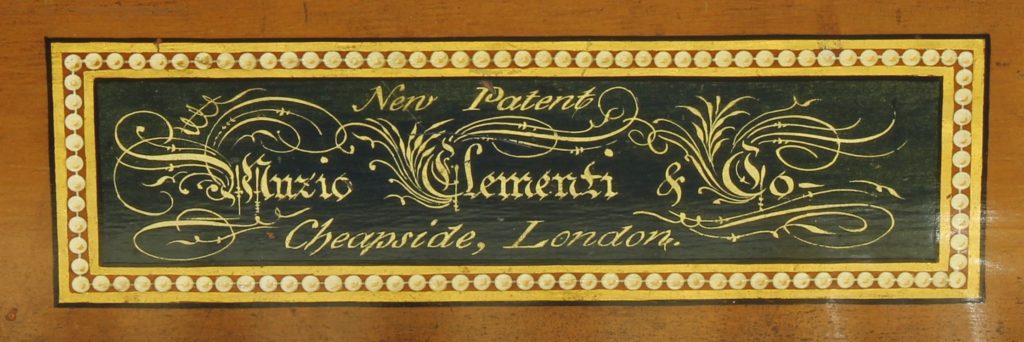
Muzio Clementi, London 1809 – Eric Feller Collection (Nameboard)
Clementi’s square pianos always had two serial numbers: one stamped on the left side and one handwritten in ink on the wrest plank (stamped: 6738 – inked: 7710).
The system used by Clementi uses the handwritten number to count the general production of pianos since the acquisition of Longman & Broderip in 1798. The stamped numbers, however, continue the production of square pianos of the acquired company “Longman & Broderip”, but only instruments with the 1794 introduced “New Patent“. Other instruments (for example single action instruments, grand pianos or cabinet pianos) were added together in other groups.
Based on these serial numbers, the year of construction of this instrument can be derived to 1809. (See: Clementi & Co 1798-1830 Pianoforte Manufacture in London, Leif Sahlqvist 2013)
For more information about the company Muzio Clementi & Co. – click here!
Other preserved instruments by Muzio Clementi & Co.:
- 1803 square piano (No. 3468) – Newton Centre: Marlowe A. Sigal Collection, USA
- 1803 square piano (No. 2335) – Museu da Musica Lisbon, Portugal
- 1806 square piano (No. 4095) – Deutsche Museum Munich, Germany
Der Beitrag Muzio Clementi 1809 erschien zuerst auf Eric Feller Early Keyboard Instruments Collection.
]]>Der Beitrag Longman and Broderip 1782 – Travel Piano erschien zuerst auf Eric Feller Early Keyboard Instruments Collection.
]]>In the history of instrument making, travel instruments have been documented as early as the 17th century. They were rarely made and mostly on explicit request of a customer. For more information on the history of travel instruments, please click here.
The case of the instrument is made of mahogany with different inlays. It rests on a simple mahogany frame and each the four legs have brass castors at the ends. To the left of the keyboard is a small hand stop for controlling the dampers.
The instrument has a Single Action, single damper and is double strung. The nameboard is decorated with multi-coloured, inlaid garlands and bears the inscription in an oval cartridge:
“Longman and Broderip
Musical Instrument Makers
No. 26 Cheapside and No. 13 Haymarket
London”
The keys are made of ivory and ebony, and the lower keys are each decorated with an additional notch that has been coloured with iron gall ink. This detail was very common as a decorative element on harpsichord keyboards and can be found here as a decorative remnant.
Longman and Broderip, London c. 1782 Travel Piano – Eric Feller Collection (2)
For detailed information about Longman & Broderip here!
So far, only one other travel piano with similar specifications by Longman and Broderip has survived and is now in the Metropolitan Museum in New York. The instrument there has a smaller range of only 3 octaves and has even smaller dimensions.

Portable Square Piano by Longman & Broderip c. 1790 – Metropolitan Museum New York (1)
Portable Square Piano by Longman & Broderip c. 1790 – Metropolitan Museum New York (2)
Der Beitrag Longman and Broderip 1782 – Travel Piano erschien zuerst auf Eric Feller Early Keyboard Instruments Collection.
]]>Der Beitrag Broderip & Wilkinson 1798 erschien zuerst auf Eric Feller Early Keyboard Instruments Collection.
]]>This square piano is similar in almost every detail to instruments from the late period of the Longman & Broderip company. The case is made of mahogany with surrounding, multi-coloured inlays made of different woods and rests on a French stand with brass castors. On each side around the stand are brass applications that cover the screws of the frame. The keys are covered with ivory and ebony. Interesting is that the ivory coverings are of less quality than those from instruments of the earlier production period under Longman & Broderip. It can be assumed that the supplier for the ivory changed and / or that Broderip & Wilkinson purchased cheaper materials in order to reduce costs. It is proved that Longman & Broderip had their instruments built by different well-known instrument makers and then provided them with their label. Broderip & Wilkinson continued this practice. This leads to the question of whether the company was now supplying their instrument makers with components in order to reduce the costs? Further research on this is currently ongoing.
There are two stops for dampers and lute and the piano is double strung. The stamped serial number 450 is located on the left inner side near the hand levers. The nameboard is also stamped with the number 54 and is decorated with an oval cartouche made of enamel. It bears the inscription:
“Broderip & Wilkinson
No. 13 Haymarket
London”

Tafelklavier Broderip & Wilkinson, London 1798 – Eric Feller Collection (Nameboard)
The square piano has a single action with leather-covered hammers, single dampers and has a compass of 5 octaves (FF – f3). The original dust cover, which is covered with dark green silk, is preserved.
At the time of purchase, it was in absolute original condition and was never been revised or restored before. By examining the piano, a one penny coin from 1863 was found under the keyboard.
For more information about Longman & Broderip, click here.
George Wilkinson was born on November 5, 1785. After entering into a business relationship with Francis Broderip, his eldest brother Charles Wilkinson joined the company in 1805. After the death of Francis Broderip in 1807 he produced instruments under the name Wilkinson & Co. On September 23 1809, he married Elizabeth Cecilia Mary Broadhurst. The marriage was announced in the “Gentleman’s Magazine” of 1809. Together they had 7 children (Ann (1814 – 1814), Emma (1815 – 1889), Matilda (1817 – 1876), Oriana (1818 – 1853), Louisa (1820 – ?), Alfred Broadhurst Wilkinson (1822 – 1854), and Henry Broadhurst Wilkinson (1824 – ?).
In 1809, Wilkinson commissioned Augustus Leukfeld and George Astor to produce licensed pianos under William Southwell’s patent (EN 3029, 1807). In 1810 he sold the publishing business to Thomas Preston (1789 – 1834) and entered into a new business relationship with Robert Wornum (1780 – 1852), having borrowed £ 12,000 from his father. The Wilkinson & Wornum company now produced improved upright pianos and the factory and showrooms were located near Hanover Square at 315 Oxford Street and 11 Princes Street. The warehouse and factory were destroyed by fire in 1812, with up to 70 workers were laid off and debts over 16.500 pounds were left. In 1813 the partnership broke up and the company was transferred to Wilkinson’s father, who paid the debts.
Towards the end of 1813 Wilkinson rented a house on Howland Street No. 32 and founded a piano factory in Oxford Street No.315. In 1816 he added showrooms on New Bond Street. Instruments from this period were highly commended by Pleyel.
Together with Ferdinand Hirschfeld, he entered into a new partnership after 1830. Both produced special patented candles. However, this partnership also ended in bankruptcy in 1835.
In 1854, George Wilkinson left London and went to Milford Haven to escape the cholera in London. There he died in 1855 from a stroke.

Portrait of George Wilkinson, in pencil, by Haughton, 1847
Other surviving instruments by Broderip & Wilkinson:
- 1798 – 1807 square piano – Musikhistorisk Museum & Carl Claudius’ Samling, Copenhagen Denmark
- 1798 – 1807 square piano – Geoff Watson, Barnard Castle, England
Der Beitrag Broderip & Wilkinson 1798 erschien zuerst auf Eric Feller Early Keyboard Instruments Collection.
]]>Der Beitrag Thomas Tomkison c. 1815 erschien zuerst auf Eric Feller Early Keyboard Instruments Collection.
]]>
The case of the instrument is made of mahogany and rosewood with surrounding inlays in brass. The instrument rests on 4 turned legs. The keyboard is made of ivory and ebony and it has a compass of 5 ½ octaves (FF – c4) with a double action and single dampers. The hammers are covered with leather.
There is also a wooden pedal for controlling the dampers. The nameboard is made of rosewood with brass inlays and is signed in a cartouche with:
“Thomas Tomkison
London.”
There are two serial numbers. One is stamped on the left with: 4672 and the other handwritten number is: 1274. This numbers show that the piano was made around 1815.
Like other companies Thomas Tomkison produced different models of instruments. The prices varied depending on the version and the used materials and decoration. Using rosewood and brass inlays are clear signs of a high-priced instrument. The instrument impresses with an absolutely high-quality craftsmanship and a clear and charming sound.
For the time being very little is known about Thomas Tomkison. He was actively detectable from 1799 to 1851 and had his workshop in Dean Street Soho 55/77 in London. From 1778 he began his apprenticeship as a piano maker. Recent research shows that Tomkison emerged in late 1798 / early 1799 as the successor to bankrupt piano maker James Henry Houston and that there are remarkable similarities between the first pianos of Tomkison’s workshop and the surviving instruments from Houston. Within a few years, Tomkison became a serious competitor to the many major piano factories in London and his instruments were highly valued. Because of Tomkisons’ outstanding craftsmanship and business skills, a large number of his instruments have been exported to America, Australia and India. He died on November 10, 1853.
Further surviving instruments by Thomas Tomkison:
- 1808 grand piano (No. 317) – University of Leipzig, Musical Instrument Museum, Leipzig Germany
- c. 1816 square piano (No. 4202) – John R. Watson, Williamsburg, USA
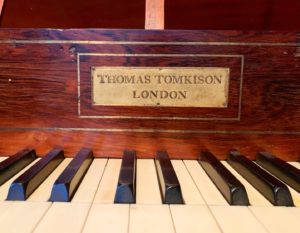
Thomas Tomkison, London ca. 1815 (nameboard) – Eric Feller Collection
Der Beitrag Thomas Tomkison c. 1815 erschien zuerst auf Eric Feller Early Keyboard Instruments Collection.
]]>Der Beitrag Broderip & Wilkinson 1802 erschien zuerst auf Eric Feller Early Keyboard Instruments Collection.
]]>An exquisite instrument from that period is shown here. It was made in 1802 and is in almost all details equal as instruments from the late time of Longman & Broderip. The case is made of mahogany with circumferential and multi-coloured ribbon inlays of different wood. The instrument rests on a French stand with brass castors. The keys are covered with ivory and ebony. Furthermore, it has a wooden pedal for controlling the dampers and it is double strung. The nameboard is decorated with an oval enamel cartridge and bears the signature:
“New patent
Broderip & Wilkinson
Haymarket
London“
On the first key is handwritten signature with the year “1802.” The instrument has a double action with leather covered hammers and single dampers. The compass is 5 ½ octaves (FF – c4). Above the action is the original dust-cover, which is covered with green silk.
For more information about Francis Fane Broderip and the company Longman & Broderip click here.
George Wilkinson was born on November 5, 1785. After entering into a business relationship with Francis Broderip, his eldest brother Charles Wilkinson joined the company in 1805. After the death of Francis Broderip in 1807 he produced instruments under the name Wilkinson & Co.
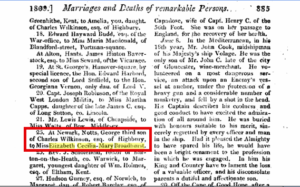
Announcement of George Wilkinson and Elizabeth Broadhurst in The Gentleman’s Magazine of 1809
On September 23 1809, he married Elizabeth Cecilia Mary Broadhurst. The marriage was announced in the “Gentleman’s Magazine” of 1809. Together they had 7 children (Ann (1814 – 1814), Emma (1815 – 1889), Matilda (1817 – 1876), Oriana (1818 – 1853), Louisa (1820 – ?), Alfred Broadhurst Wilkinson (1822 – 1854), and Henry Broadhurst Wilkinson (1824 – ?).
In 1809, Wilkinson commissioned Augustus Leukfeld and George Astor to produce licensed pianos under William Southwell’s patent (EN 3029, 1807). In 1810 he sold the publishing business to Thomas Preston (1789 – 1834) and entered into a new business relationship with Robert Wornum (1780 – 1852), having borrowed £ 12,000 from his father. The Wilkinson & Wornum company now produced improved upright pianos and the factory and showrooms were located near Hanover Square at 315 Oxford Street and 11 Princes Street. The warehouse and factory were destroyed by fire in 1812, with up to 70 workers were laid off and debts over 16.500 pounds were left. In 1813 the partnership broke up and the company was transferred to Wilkinson’s father, who paid the debts.
Towards the end of 1813 Wilkinson rented a house on Howland Street No. 32 and founded a piano factory in Oxford Street No.315. In 1816 he added showrooms on New Bond Street. Instruments from this period were highly commended by Pleyel.
Together with Ferdinand Hirschfeld, he entered into a new partnership after 1830. Both produced special patented candles. However, this partnership also ended in bankruptcy in 1835.
Portrait of George Wilkinson, in pencil, by Haughton, 1847
In 1854, George Wilkinson left London and went to Milford Haven to escape the cholera in London. There he died in 1855 from a stroke.
Other surviving instruments by Broderip & Wilkinson:
- 1798 – 1807 square piano – Musikhistorisk Museum & Carl Claudius’ Samling, Copenhagen Denmark
- 1798 – 1807 square piano – Geoff Watson, Barnard Castle, England
Der Beitrag Broderip & Wilkinson 1802 erschien zuerst auf Eric Feller Early Keyboard Instruments Collection.
]]>Der Beitrag Gabriel Buntebart for James & John Simpson 1779 erschien zuerst auf Eric Feller Early Keyboard Instruments Collection.
]]>This interesting instrument shows the relationship between the renowned instrument maker Gabriel Buntebart and the James & John Simpson company, who in the late 18th century in London acted with musical instruments and various instruments. So far only three other instruments have been survived from Simpson.
The case is made in mahogany and has no inlays. To the left of the keyboard are three hand stops for dampers and lute. The instrument has a simple English single action and is double strung. It rests on the original trestle stand. The keys are made of ivory and ebony. The nameboard bears the inscription:
“Simpson Fecit No 15 Sweetings Alley Royal Exchange London”
Furthermore, there are several handwritten signatures inside, which appeared during the cleaning and examination. A signature behind the nameboard and in the inner case bears the inscription:
“Gabriel Buntebart 1779”
and shows the maker and the year of manufacture. Furthermore, several signatures show that the instrument was around 1840 in the possession of Lady Joyce and was repaired. Further research is ongoing. The instrument has a small size and is simple but very well made.
In 1732 John Simpson founded a music store and sold sheet music and instruments (mainly violins and flutes). These instruments were subcontracted to various instrument makers and were sold under their own name “Simpson.”
After John Simpson’s death (around 1750/51) his wife Ann took over the business together with her new husband John Cox, whom she married in 1751. John Cox was also a music publisher and had his own business. Furthermore he was a singer and was a regular member of the G. F. Handel choir. He sang the Habdonah in Handel’s oratorio Esther in 1751. He also sang in Handel’s Messiah in the performances of 1754, 1758 and 1759 (see: Philip H. Highfill, Jr., Kalman A. Burnim, Edward A. Langhans: A Biographical Dictionary of Actors, Actresses, Musicians, Dancers, Managers, and Other Stage Personnel in London, 1660 – 1800).
Later Ann’s son James joins the company and then from 1767 his son John. Old records indicate that in 1769 the company’s entire inventory was insured for £ 1,000, which was one of the highest sums insured at that time. This shows that the business flourished (see: David Barnett: The structure of Industry in London 1775 – 1825). The business was continued until 1795.
Gabriel Buntebart was one of the most renowned instrument makers in the late 18th century in England. He came 1761 during the Seven Years’ War (1756 – 1763) from Strelitz (Mecklenburg Germany) to England. The hope for a better life and a regular income was the motivation to immigrate. He was in business relationship with Johann Christian Bach (1735 – 1782). Together with Johannes Zumpe (1726 – 1790) he built from 1769 to 24 September 1778 instruments. After the end of this partnership Buntebart entered into a new partnership with Christopher Sievers from 1783 to 1792, while Zumpe entered into a partnership with the two brothers Frederick and Christian Schoene. An instrument from this period is also in the Eric Feller Collection (square piano by Schoene & Co. 1788). Gabriel Buntebart died in 1794.
This instrument, signed by James & John Simpson, was built by Buntebart in 1779, exactly one year after he ended his partnership with Johannes Zumpe. Interesting is another preserved instrument owned by David Hackett, which is also attributed to Gabriel Buntebart.
Other surviving instruments by James & John Simpson:
- 1775 square piano – John Hobsen, Wellesbourne England
- 1780 square piano – formerly in the Colt Collection, Bethersden England
- 1780/85 square piano – David Hackett, Chelveston England
Der Beitrag Gabriel Buntebart for James & John Simpson 1779 erschien zuerst auf Eric Feller Early Keyboard Instruments Collection.
]]>Der Beitrag Clementi & Co. 1804 erschien zuerst auf Eric Feller Early Keyboard Instruments Collection.
]]>The case of the instrument is made of mahogany with encircling multicolour ribbon inlays of different woods. The keyboard is made from ivory and ebony. It has a single action with leather covered hammers, double strung and single dampers. The nameboard bears the inscription:
„Clementi & Co.
Manufactures of Musical Instruments
And Music Sellers
26 Cheapside & Tottenham Court Road
London”
Square pianos by Clementi were always provided with two serial numbers: one stamped on the left and one handwritten with ink on the wrest plank (stamped: 236 – inked: 3742).
The system used by Clementi counts with the inked number the general production of pianos since the acquisition of the company “Longman & Broderip” in 1798. The stamped numbers, however, continue the production of square pianos of the acquired company “Longman & Broderip”, but only instruments with the 1794 introduced “New Patent“. Other instruments (for example single action instruments, grand pianos or cabinet pianos) were added together in other groups.
Based on these serial numbers, the year of construction of this instrument can be derived to 1804. (See: Clementi & Co 1798-1830 Pianoforte Manufacture in London, Leif Sahlqvist 2013)
Why did the company still build quite a few instruments around 1804 that were already old-fashioned when the developments to a larger compass already existed and the improved Double Action? It can be assumed that there was still a small demand for these instruments. There was, of course, a flourishing trade in second-hand instruments, but by then these instruments could have been around 20-30 years old. It can be assumed that this instrument was built as a kind of a “practising-instrument” for a private school or piano teacher to complete the musical education of rich daughters.
I would like to thank Michael Cole for his support in researching this instrument.
For more information about the company Muzio Clementi & Co. – click here!
Other preserved instruments by Muzio Clementi & Co.:
- 1803 square piano (No. 3468) – Newton Centre: Marlowe A. Sigal Collection, USA
- 1803 square piano (No. 2335) – Museu da Musica Lisbon, Portugal
- 1806 square piano (No. 4095) – German Museum Munich, Germany
Der Beitrag Clementi & Co. 1804 erschien zuerst auf Eric Feller Early Keyboard Instruments Collection.
]]>Der Beitrag John Broadwood and Son 1807 erschien zuerst auf Eric Feller Early Keyboard Instruments Collection.
]]>The case of the instrument is made of mahogany with revolving band inlays in different woods and it stands on 6 legs. The keyboard is made from ivory and ebony and there is a pedal for controlling the dampers. It as a double action with leather covered hammers and single dampers. The instrument is double strung and above the action is the original dust-cover, which is covered with blue fabric.
The nameboard is made in different woods and signed in an oval with:
„1807
John Broadwood and Son.
Makers to his Majesty
and the Princesses
Great Pulteney Street Golden Square
London.”
The signature John Broadwood and Son shows still clearly the period in which only the eldest son James Broadwood worked in the company of his father. The second son Thomas did not join the company until 1808. After this all instruments were signed with John Broadwood and Sons.
On the wrestplank is the handwritten serial number: 10567. The case of the instrument is structurally similar to the square piano made in 1800 (Square Piano by John Broadwood & Son 1800 – click here), but features the more modern double action, like the instrument of 1814 in the Eric Feller Collection (Square Piano by John Broadwood & Sons 1814 – click here).
John Broadwood was born on 6th October 1732 in Oldhamstocks near Cockburnspath in Scotland. He learned the profession of being a cabinetmaker like his father before.
In 1761 he started working for Burkat Shudi (1702 – 1773) in London and in 1770 became his business partner. In 1771 he opened his own shop on Great Pulteney Street in London. In 1769 he married Burkat Shudi’s daughter Barbara in her first marriage and had four children with her. After his wife’s death in 1776 he married Mary Kitson in 1781 and had six children with her. He died on 17th July 1812 in London.
Other preserved instruments by John Broadwood and Son:
- 1798 square piano (No. 4200) – National Museum of American History, Washington USA
- 1791 square piano (No. 1552) – Kenwood House, Hampstead UK
- 1807 square piano (No. 10250) – Western Australian Academy of Performing Arts, Edith Cowan University, Perth
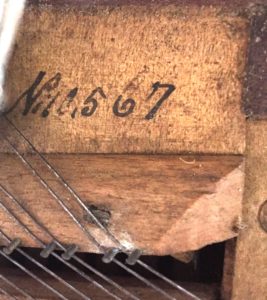
John Broadwood and Son, London 1807 – Eric Feller Collection – serial number
Der Beitrag John Broadwood and Son 1807 erschien zuerst auf Eric Feller Early Keyboard Instruments Collection.
]]>Der Beitrag Meincke & Pieter Meyer 1811 – 1818 erschien zuerst auf Eric Feller Early Keyboard Instruments Collection.
]]>The piano is made of mahogany and stands on four, tapering legs with ormolu ornaments. The front edges are chamfered and the case is decorated all around with brass inlays and a veneered backside. It has a second action and a pedal for controlling the dampers.
The dark nameboard bears the signature with gold-plated letters in an oval blue cartouche:
“M. & P. Meyer
Rokin No. 175
Amsterdam“
With a compass of 6 octaves (FF – f4) and leather covered hammers the instruments keyboard is made of ivory and ebony. It is double strung and has single dampers. The whole instrument is extremely well made and the sound is strong and more like a grand fortepiano than other square pianos from that period.
Meincke Meyer was born around 1740; an exact year of birth is unknown. He worked with the Saxonian piano maker Johann Zumpe until 1779 in London. From that cooperation in London two instruments made in 1776 and 1778 are preserved. In 1779 Meincke went back to Amsterdam and opened together with his brother Pieter (the year of birth is also unknown) a piano factory. The newspaper “Amsterdamsche Courant” of 10 June 1779 reports that the two brothers have returned from London and opened a piano business:
„MEINCKE MEYER, geweezene Compagnon van JOHANNES ZUMPI, beroemde Muziek-Instrumentenmaker tot Londen, neemt de vrijheid, lieden van Distinctie en verdere Kenners der Muziek te berigten, dat hy zig te Amsterdam gestabileerd heeft, in Compagnieschap met zyn Broeder PIETER MEYER, tot voortzetten van dezelfde Affaires, in ‘t maaken van allerhande soorten van FORTEPIANO INSTRUMENTEN, door hem veel verbeterd, en verre overtreffende alle andere tot nog toe bekend; zy verzoeken ieders Gunst en Recommandatie. Hunne Woonplaats is op de Kolk, op den hoek van de Voorburgwal, by de Brug, te Amsterdam.“
The tremendous demand for the new Pianofortes made by Johannes Zumpe in England quickly reached the continent, allowing the two brothers to build a flourishing business in a short period. Their instruments were highly prized and enjoyed ever-increasing popularity. For some time the company held the privilege of court piano makers (Piano forte Fabrikeurs van hunne Majesteiten).
In 1796 the company expanded and a branch office was opened in Hamburg. It was located at Grosse Bleichen Nr. 304 and was operated there until 1813.
Meincke died around 1800 and his sons, as well as other relatives of the two brothers, worked in the company and became partial partners:
- Meincke (Michael) Andries Meyer (born: London 1767)
- Jan Lodewijk Meyer (born: London 1771)
- Hilmer (Hilmar) Meyer (born: January 1773 – died: Amsterdam August 20, 1816)
- Andreas Meyer (born: Hittfeld October 15, 1775 – died: Hamburg August 21, 1845) – from 1813 to 1850 Andreas Meyer’s own piano factory was listed at Neustadt’s Fuhlentwiete No. 121 in Hamburg, after remaining at the Hamburg location. His son joined this company around 1830.
Due to the high demand, the company needed larger premises and moved several times:
- 1781 • Op de hoek van de Kolk en N.Z. Voorburgwal
- 1781 • te May op den N. Dijk, het 14de huis van den Dam
- 1782 – 1786 • Op de Nieuwendijk, ‘t 14de huis van den Dam
- 1787 – 1788 • Op de Nieuwendijk, ‘t 13de huis van den Dam
- 1789 – 1806 • Op ‘t Rockin ‘t 4de huis van de Nauwe Kapelsteeg, 156.
- 1809 – 1810 • Op ‘t Rokin bij de Naauwe Kapelsteeg, 156.
- 1811 – 1818 • Op ‘t Rokin, bij het Valbruggetje, 175.
- 1819 • Op de Keizersgragt bij de Huidenstraat, 205.
- 1821 • M.A. Meyer, Keizersgr. bij de Leydschegr. 205.
- 1823 – 1831 • Rockin over de Nieuwezijdskapel No 50.
- 1835 – 1836 • Kerkstr. bij de Spiegelstr., 814.
Further preserved instruments by Meincke & Pieter Meyer:
- 1810 Tafelklavier – Rijksmuseum, Amsterdam
- 1815 Tafelklavier – Royal Palace (Gemeentemuseum, The Hague) Amsterdam
Der Beitrag Meincke & Pieter Meyer 1811 – 1818 erschien zuerst auf Eric Feller Early Keyboard Instruments Collection.
]]>Der Beitrag William Rolfe 1803 erschien zuerst auf Eric Feller Early Keyboard Instruments Collection.
]]>The case is made of mahogany with surrounding and multi-colour ribbon inlays of different woods. The instrument rests on a French stand with brass castors. The keyboard is made from ivory and ebony, it has a wooden pedal for controlling the dampers and is double strung. Garlands of flowers, tendrils and fruits are painted on the nameboard. In a cartouche is the slightly faded signature:
“William Rolfe
No. 112 Cheapside London”
The stamped serial number reads 4490 on the wrestplank. Furthermore the instrument has a double action with leathered hammers and single dampers. The compass of the keyboard is 5 ½ octaves (FF – c4).
The dating (if none is found) of many instruments is often difficult and is then based only on the structural characteristics and on the basis of the little information the signature on the nameboard can give. Unfortunately no documents about the production by Rolfe are known, so dating is difficult. For this instrument however the exact production date could be determined, since the instrument with the serial number 4480 (thus only 10 serial numbers earlier – a combination instrument from square piano and organ) is signed with the year 1803. It is located in the Colonial Williamsburg Foundation in Williamsburg / USA.
William Rolfe worked as a piano maker from 1785 to about 1828. His exact dates of birth and death are not known yet. From 1785 he worked with Samuel Davis and the company was run under the name Rolfe & Davis. In 1797 both developed a patent for a “Turkish-Music-Stop” with cymbals and drums. According to R. Harding, this patent is the oldest testimony to such a change in the form of a janissary stop, which was very popular in the 1820s (especially by Viennese instruments) and then disappeared very quickly.
At the same time William Rolfe worked as an instrument maker and music publisher and was a partner of Thomas Culliford with whom he produced instruments for the company Longman & Broderip. He also sold his instruments under his name. After the bankruptcy of Longman & Broderip in 1796, he worked only under his name.
In 1807, his two sons Nicholas and Thomas became partners in the father’s company. From 1814, the company was renamed to William Rolfe & Sons and there were additional premises in the London Wall Street no. 32 added. The main address was since its founding in Cheapside 112. From about 1820 instruments were made under the name William Rolfe and Compy. The company existed until 1889.
Other preserved instruments by William Rolfe:
- 1803 square piano & organ (No.4480) – Colonial Williamsburg Foundation, Williamsburg / USA
- 1803 square piano (No. 4481) – Cambridge University, Cambridge England
Der Beitrag William Rolfe 1803 erschien zuerst auf Eric Feller Early Keyboard Instruments Collection.
]]>Der Beitrag Christian Müller 1784 erschien zuerst auf Eric Feller Early Keyboard Instruments Collection.
]]>The case of the instrument and the original legs are made of cherry wood and mahogany and decorated with inlays. The lower keys are covered with black ebony and the upper keys with bone. The nameboard is signed in an oval with:
“Christian Müller
in Bern”
Furthermore, there is a signature in the inside of the piano with the year of manufacture “1784“. The hammers are covered with leather and the instrument is double strung. It has a simple single action and 4 wooden pedals for dampers, lute, moderator and “harmonic swell“. This “harmonic swell” represents an absolute novelty, which does not exist so far in other pianos of the time. By pressing the pedal, a second bridge presses on the normal bridge and thus changes the sound dramatically. The result is a sound that is completely free of Bass frequencies and a kind of crescendo decrescendo effect can be generated. There are no other instruments known with this system yet except for a few instruments by Muzio Clementi from the 1820s. With high probability Christian Müller is the inventor of this system.
Muzio Clementi spent the summer of 1784 in Bern. (see.: Cramer, Carl Friedrich: „Nachricht von dem Clavierspieler Clementi, Bern im October 1784. IN „Magazin der Musik“ Bd. II. Hamburg: Musicalische Niederlage 1784 – 1785, 365-373; pp: 366, 368 und 371.)
Little is known about his visit to Bern, but it can be assumed that he must have met Christian Müller and see instrument with a “harmonic swell” made by him.
Clementi, who was an excellent businessman, copied the system and built it into his own instruments with the name: “Harmonic Swell – Bridge of Reverberation” in 1821. (see: harmonic swell 1821, patent no. 4542, R. Harding, p. 342, R. Burnett pp. 169-170.)
Muzio Clementi – Harmonic swell – Bridge of Reverberation – Eric Feller Collection (2)
It can be assumed that Christian Müller was dead in 1821. This enabled Clementi to completely “reinvent” the system (especially without any patent rights). Probably the system was nit successful in the Swiss area and only a few instruments existed. Muzio Clementi as a businessman had the chance with his company to generate larger sales as Müller could.
For more information about the company Muzio Clementi & Co. – click here!
Unfortunately, there are no documents about Christian Müller. Otto Rindlisbacher could not find any biographical information about him. Only one instrument in the Historical Museum in Basel – collection of old musical instruments is preserved. It is dated 1801 and bears the signature on the soundboard: “ Christian Müller / Orgel Instrumentmacher / in Bühler 1801“. It can be assumed that it is the same instrument maker and he was active in his early years in the Bern area and then later in Bühler. Another possibility is that the instrument from 1801 was made by his son who had the same name.
Sources:
- Burnett, Richard: „Company of pianos”, Finchcocks Press 2004.
- Cramer, Carl Friedrich: „Nachricht von dem Clavierspieler Clementi, Bern im October 1784. IN „Magazin der Musik“ Bd. II. Hamburg: Musicalische Niederlage 1784 – 1785, 365-373; hier: 366, 368 und 371.
- Harding Rosamond E. M.: „The Pianoforte ― its history traced to the Great Industrial Exhibition of 1851”, Gresham Books 1978.
- Rindlisbacher, Otto: „Das Klavier in der Schweiz. Klavichord – Spinett – Cembalo – Pianoforte. Geschichte des schweizerischen Klavierbaus 1700-1900“, Bern Francke 1972.
© Eric Feller – Early Keyboard Collection – January 2019
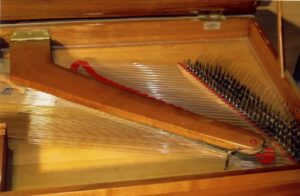
Christian Müller, Bern 1784 – “Harmonic Swell” – Eric Feller Collection (4)
Der Beitrag Christian Müller 1784 erschien zuerst auf Eric Feller Early Keyboard Instruments Collection.
]]>Der Beitrag Jean-Henri Pape 1824 erschien zuerst auf Eric Feller Early Keyboard Instruments Collection.
]]>“Pape /
Facteur de Piano /
Cour des Fontaines /
à Paris”
The instrument has a compass of 6 octaves (FF – f4) and the keyboard is made from ivory and ebony. The action is a French version of a double action.
The piano has a lyre with three pedals for dampers, lute and moderator. Above the action and soundboard is the original dust cover (divided into two parts).
The entire instrument captivates with its outstanding craftsmanship and elegance!
Jean-Henri Pape (originally Johann-Heinrich) was born on July 1, 1789 in Sarstedt. From 1811 he is detectable in Paris and learned piano making at the workshop of Pleyel. From 1815 – 1817 he established his own shop. According to preserved instruments and documents his shop was from 1819 – 1820 in Rue Montesquieu no. 7 and also until 1824 in Cour des Fontaines. In later years the address Rue Croix-des-Petits-Champs no. 23 was added. Jean-Henri Pape was famous for his many inventions and patents. He received various awards such as the silver medals of the Paris Exhibition of 1823 and 1827 and the gold medals of the years 1834, 1839 and 1844. One of his special patents was the down striking action and the introduction of hammers covered with felt. He is also famous for his “Console Pianos” invented in 1828, an upright piano with very small dimensions. Furthermore, he built pianos in unusual shapes (hexagonal or oval). Carl Bechstein (1826 – 1900) and Frederick Mathushek (1814 – 1891) were among Pape’s students. On 2 February 1875 he died in Asnières-sur-Seine near Paris.
Other preserved instruments by Jean-Henri Pape:
- 1823 square piano (No. 516) – Collection Cité de la Musique Paris, France
- 1827 square piano (No. 1252) – Collezione Fernanda Giulini in Briosco, Italy
Der Beitrag Jean-Henri Pape 1824 erschien zuerst auf Eric Feller Early Keyboard Instruments Collection.
]]>Der Beitrag Shoehs 1790 erschien zuerst auf Eric Feller Early Keyboard Instruments Collection.
]]>The case and legs are made of mahogany and framed with simple inlays. The instrument has a single action and is double strung. The nameboard is intricately decorated and contains the handwritten signature in a square cartouche:
“Shoehs
A. Paria
Rue St. Honnoré
1790″
Compared to other instruments (e.g. Erard) it shows the typical features of the construction period around 1790. The keys are made of ivory and ebony. The entire instrument shows the very high craftsmanship skills of its builder. In all literature the name of Shoehs does not appear. It can be assumed that it comes from an instrument maker who has produced only in a few numbers.
So far no other instruments of Shoehs are known!
Der Beitrag Shoehs 1790 erschien zuerst auf Eric Feller Early Keyboard Instruments Collection.
]]>Der Beitrag Érard Frères 1811 owned by Jean-Jérôme Imbault erschien zuerst auf Eric Feller Early Keyboard Instruments Collection.
]]>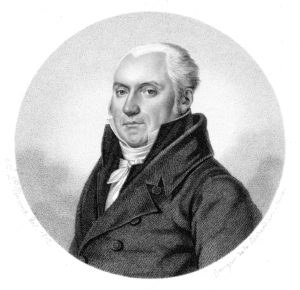
Jean-Jérôme Imbault – Engraving, 1812, after Antoine-Paul Vincent – Eric Feller Collection
This extraordinary square piano is an important historic instrument in music history, as it comes from the possession of the violinist and well-known publisher Jean-Jérôme Imbault.
The instrument by Érard Frères was made in 1811 in Paris. The case and original legs are made of mahogany. The nameboard is signed with:
“Érard Frères
Facteurs de Forte-Piano & Harpes de L.L.M.M. Imperiales & Royales
Rue du Mail No. 13 et 21 à Paris 1811″
The original keyboard has a compass of 5 ½ octaves (FF – c4) and the instrument has a “second-action” with single dampers. The keys are made from ivory and ebony. Furthermore the piano has two pedals for dampers and lute stop.
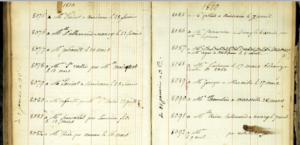
Sebastien Érard, Paris 1811, No. 8077 – Eric Feller Collection (1)
On the soundboard next to the bridge is the original handwritten signature with the serial number. The serial number is 8077. According to the original Érard production books, the instrument was sold to the violinist and well known publisher Jean-Jérôme Imbault.
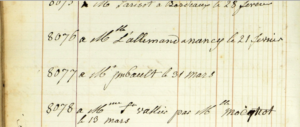
Sebastien Érard, Paris 1811, No. 8077 – Eric Feller Collection (2)
Jean-Jérôme Imbault was born on March 9, 1753. As a child he studied violin by the famous Pierre Gaviniès (1728 – 1800). At the age of 17 Imbault debuted in a public concert and on April 1, 1770, the “Mercure de France” praised him “as a talent full of hope.” Several concerts followed and he began a career as a celebrated instrumentalist. However, this success did not last long and ten years later in April 1781 the “Mercure de France” wrote less enthusiastically about him, which brought a quick end to his career. From then on, he concentrated on teaching and played in various orchestras and as a soloist (Concert Spirituel, Concert Olympique and from 1810 in the Chapelle impériale). From the beginning of the 1780s he founded a music publishing company and sold sheet music in Paris. With the help of Jean-Georges Sieber (the other great music publisher of the time), who founded his own company called “à la règle d’or” in 1771, Imbault quickly built his business up to one of the leading companies. Starting on 2 August 1783 with the publication of the second Flute Concerto by François Devienne (1759 – 1803), he worked alone since November 1784 by first publishing works by Jean-Baptiste Cartier (1765 – 1841) and André Ernest Modeste Grétry (1741 – 1813).

François Devienne – Title page of the 2. Flute Concerto – published by Jean-Jérôme Imbault in 1783
His company was called “Mont d’or” and was located in the Rue Saint-Honoré. In the beginning he described himself as “marchand de musique et de cordes d’instrument” and later, from 1811, as a “teacher and music publisher“.
His catalogs printed between 1786 and 1803 (but especially the catalogs from the years 1791 and 1792) contained a large number of nearly 200 instrumental works. This enormous number shows the importance he had as a publisher at that time. Among the published works were composers such as Haydn (including the Paris Symphonies), Clementi, Mozart, Viotti, Pleyel, Boccherini, Gyrowetz, Paul Wranitzky, Daniel Steibelt, Alessandro Rolla and many others. During the French Revolution he published around 100 patriotic songs. Between 1798 and 1799 he bought the business of music retailer Leblanc to have another branch which was located at Rue Favart No. 461.
Imbault had close contact with Joseph Haydn and published the Paris Symphonies, commissioned by Claude-Francois-Marie Rigoley for the Parisian “Le Concert de la Loge Olympique“. Since 1781 the “Concert de la Loge Olympique” was one of the most important and fashionable concert series in Paris (in addition to the “Concert spiritual“). It was organized by the Masonic Lodge “de la Parfaite Estime & Société Olympique” and the concerts took place at the Salle des Cent-Suisses in the Tuileries. By Symphony No. 85 Imbault wrote to the part of the first violin “La Reine de France“, which gave this symphony the nickname “La Reine“. Originally it is believed that the French Queen Marie Antoinette (who was the protector of the concert series of the “Loge Olympique“) should have particularly appreciated the symphony.
Romance “Le Baiser” by Félix Blangini (1781-1841) – Published 1811 by Jean-Jérôme Imbault
In July 1812 he sold his company to his former employees Pierre-Honoré Janet and Alexandre Cotelle and retired at Rue Saint-Honoré no. 125 where he lived off his royalties. He had no children with his wife and died on April 15th 1832.
Portrait of Jean-Jérôme Imbault after F. Dumont
Here are some plate numbers from the printed sheet music by Imbault (Source: https://imslp.org/wiki/Imbault):
| Plate | Composer | Work | Year |
| 10 | Piccinni | Didon | 1784 |
| 57 | Janiewicz | 6 Trios | 1785 |
| 64 | Dussek | 3 Grand Sonatas, Op.35 | 1785 |
| 67 | Pleyel | 12 String Quartets, B.331-342 (première livraison) | |
| 87 | Pleyel | Symphony in B-flat major, B.127 | 1786 |
| 88 | Pleyel | 12 String Quartets, B.331-342 (deuxième livraison) | |
| 89 | Pleyel | Symphony in C minor, B.121 | 1786 |
| 90 | Pleyel | Symphony in B-flat major, B.125 | 1786 |
| 91 | Pleyel | 12 String Quartets, B.331-342 (troisième livraison) | 1787 |
| 93 | Pleyel | 12 String Quartets, B.331-342 (quatrième livraison) | 1787 |
| 102 | Clementi | 2 Symphonies, Op.18 (No.1, parts) | |
| 103 | Pleyel | Symphony in C major, B.128 | 1786 |
| 114 | Clementi | 2 Symphonies, Op.18 (No.2, parts) | |
| 127 | Salieri | Tarare | 1789 |
| 128 | Pleyel | Symphony in D major, B.133 | 1786 |
| 129 | Pleyel | Symphony in E-flat major, B.134 | 1786 |
| 130 | Pleyel | Symphony in B-flat major, B.135 | 1786 |
| 130 | Devienne | 6 Violin Sonatas | 1789 |
| 133 | Pleyel | Symphony in A major, B.137 | 1787 |
| 134 | Boccherini | 12 String Quartets, Op.39 (deuxième livraison) | |
| 137 | Rolla | 3 Concertant String Trios, Op.2 (BI 346, 341, 347) | |
| 153 | Haydn | Symphony No.87 in A major, Hob.I:87 | |
| 156 | Haydn | Symphony No.86 in D major, Hob.I:86 | |
| 157 | Haydn | Symphony No.84 in E-flat major, Hob.I:84 | |
| 158 | Aubert | 3 Duos, Op.6 | 1789 |
| 159 | Aubert | 3 Duos, Op.7 | |
| 171 | Pleyel | Symphony in G major, B.130 | 1786 |
| 215 | Boccherini | 6 String Trios, G.77-82 (Op.1) | 1790 |
| 259 | Pleyel | Nocturne in D major, B.201A | 1787 |
| 279 | Boccherini | 6 String Quartets, G.183-188 (Op.22) | 1800 |
| 308 | Pleyel | Petits airs et rondos d’une exécution facile (book 1) | 1791 |
| 309 | Wranitzky | Sinfonie Périodique No.2 in C minor | 1791 |
| 310 | Pleyel | Petits airs et rondos d’une exécution facile (book 2) | 1791 |
| 311 | Wranitzky | Sinfonie Périodique No.3 in F major | 1791 |
| 312 | Wranitzky | Sinfonie Périodique No.4 in A major | 1791 |
| 313 | Pleyel | Petits airs et rondos d’une exécution facile (book 3) | 1791 |
| 316 | Pleyel | Petits airs et rondos d’une exécution facile (book 4) | |
| 324 | Pleyel | Petits airs et rondos d’une exécution facile (book 5) | |
| 328 | Pleyel | Petits airs et rondos d’une exécution facile (book 6) | |
| 374 | Pleyel | Petits airs et rondos d’une exécution facile (book 7) | |
| 404 | Pleyel | Petits airs et rondos d’une exécution facile (book 8) | |
| 420 | Reicha | 12 Fugues for Piano | |
| 440 | Gaviniès | 24 Matinées | |
| 461 | Jadin | Duo for Piano Four Hands | 1796 |
| 469 | Aubert | 25 Studies, 3 Duets and 3 Sonatas, Op.8 | |
| 481 | Demar | Clarinet Concerto in E-flat major | |
| 483 | Pleyel | Petits airs et rondos d’une exécution facile (book 9) | |
| 486 | Pleyel | Petits airs et rondos d’une exécution facile (book 10) | |
| 487 | Pleyel | Petits airs et rondos d’une exécution facile (book 11) | |
| 495 | Devienne | Symphony in D major ‘La Bataille de Gemmapp’ (parts) | 1794 |
| 573 | Hoffmeister | 6 String Quartets, Op.7 (parts) | 1785 |
| 578 | Bréval | Cello Concerto No.6, Op.26 | |
| 591 | Bréval | 3 String Trios, Op.39 | |
| 608 | Demar | Horn Concerto in D major | |
| 670 | Janiewicz | Violin Concerto No.4 in A major | 1797 |
| 672 | Demar | 6 Clarinet Duos | |
| 680 | Devienne | 6 Flute Quartets, Op.66 (part 1) | 1799 |
| 687 | Cherubini | Médée | 1798 |
| 704 | Devienne | 6 Flute Quartets, Op.66 (part 2) | 1799 |
| 711 | Demar | Méthode abrégée pour le violon | |
| 718 | Demar | 40 Violin Duos d’airs choisis | |
| 738 | Cimarosa | Il matrimonio segreto | 1799 |
| 751 | Fuchs | 6 Duos formant vingt quatre morceaux, Op.36 | 1799 |
| 752 | Fuchs | 3 Quartets for Horn and Strings, Op.31 | 1799 |
| 759 | Punto | Horn Concerto No.11 | 1799 |
| 837 | Davaux | 3 String Quartets, Op.17 | 1807 |
Detailed information about the company Erard Frères can be found in our publications here!
Further preserved instruments by Erard Freres:
- 1805 square piano (No. 6447) – Museum für Kunst und Gewerbe Hamburg, Germany
- 1823 square piano (No. 11492) – Cité de la Musique Paris, France
Sources:
- Benton Rita : “J.-J. Imbault (1753–1832), violoniste et éditeur de musique à Paris”, Revue de Musicologie, vol. 62, No 1, 1976, pp. 86–103.
- Benton Rita: The New Grove Dictionary of Music and Musicians (edited by Stanley Sadie): “Imbault, Jean-Jérôme”, London, Macmillan, second edition, 2001.
- Devriès Anik and Lesure François: Dictionnaire des éditeurs de musique français. Vol. 1. Genève, Éditions Minkoff, 1979.
- Gribenski J.: Un métier difficile: éditeur de musique à Paris sous la Révolution, Le tambour et la harpe, Lyon, 1989. Éd. J.-R. Julien et J.-R. Mongrédien, Paris, 1991.
- Guiomar Paule : “J.J. Imbault”, Fontes Artis Musicae, vol. 13, no 1, 1966.
- Konold Wulf: Sinfonie Nr. 85 B-Dur (Hob. I:85) „La Reine“ In: Wulf Konold (Hrsg.): Lexikon Orchestermusik Klassik A – K. B. Schott´s Söhne, Mainz 1992.
- Nakano Hiroshi: Pariser Sinfonien Folge 1. In: Joseph Haydn-Institut Köln (Hrsg.): Joseph Haydn Werke. Reihe 1, Band 12. G. Henle – Verlag, München 1971.
- Vanhulst Henri: Un catalogue manuscrit de Jean-Jérôme Imbault postérieur à 1812, in “Noter, annoter, éditer la musique : mélanges offerts à Catherine Massip” (Paris: BnF ; (coll. “Hautes études médiévales et modernes” (no 103) Genève, Droz, 2012) pp. 429 – 446.
- Walter Michael: Haydns Sinfonien. Ein musikalischer Werkführer. C. H. Beck-Verlag, München 2007.
© Eric Feller – Early Keyboard Collection – December 2018
Der Beitrag Érard Frères 1811 owned by Jean-Jérôme Imbault erschien zuerst auf Eric Feller Early Keyboard Instruments Collection.
]]>Der Beitrag Érard Frères 1822 erschien zuerst auf Eric Feller Early Keyboard Instruments Collection.
]]>“Èrard Frères
Facteurs de Forte-piano et Harpes du Roi
de ses menus plaisirs,
de la cour impériale de Russie,
de S.A.S. Monseigneur le Duc d’Orléans et de sa famille
Rue du Mail No. 13 et 21 à Paris 1822″
The instrument has a compass of 6 octaves (FF – f4) and the keyboard is made from ivory and ebony. It has two pedals controlling dampers and lute.
On the soundboard, next to the bridge, is the original handwritten signature with the serial number. This instrument convinces (beside its sound) by its small size and the elegant column-legs in the Empire style with brass ornaments.
Detailed information about the company Érard Frères can be found in our publications here!
Further preserved instruments by Érard Frères:
- 1805 square piano (No. 6447) – Museum für Kunst und Gewerbe Hamburg, Germany
- 1823 square piano (No. 11492) – Cité de la Musique Paris, France
Der Beitrag Érard Frères 1822 erschien zuerst auf Eric Feller Early Keyboard Instruments Collection.
]]>Der Beitrag Johannes Pohlman 1767 (1780) erschien zuerst auf Eric Feller Early Keyboard Instruments Collection.
]]>The instruments of Pohlman are characterized by a very elegant sound and are similar to those made by Johannes Zumpe. In a letter from 1774, Charles Burney praised the sound of Pohlman’s instruments and bought several instruments for himself and his students.
The delicate and elegant instrument is based on the original frame (trestle-stand), which is made of mahogany with encircling inlays in different woods. The instrument has a single action, three stops for a split damping (bass and treble) and a lute.
The nameboard bears the signature in an oval cartouche:
“Johannes Pohlman Londini Fecit 1767
Great Russel Street Bloomsbury”
The compass of the instrument has 5 octaves (FF – f3), double strung and the keyboard is made of ivory and ebony.
Interesting is the date on the instrument. The nameboard bears as year of construction 1767 but on a closer look you can see that this year has been changed in the last two digits and has been rewritten to make the instrument older. Due to the design and the address written on the nameboard, the instrument must have made around 1780. Furthermore Pohlman is detectable only from 1767/68 on in London. Old insurance records indicate he was sharing business with Adam & Lorence Beyer at Compton Street in Soho at the time. On top of that, the signature “Great Russel Street Bloomsbury” was used by Pohlman only after his move there in 1777. Previously, he did not sign his instruments with an address.
Such changes in dates for making them older can sometimes be found at instruments. On the other way around in changing a date to “rejuvenate” instruments, is extremely rare, but also occurred sometimes. To see such an example of changing a date feel free to look at the instrument made by Ferdinand Weber in the Eric Feller Collection (click here).
Due to the unusual date signature, the history of the instrument could be partially revealed. The instrument belonged to the 3rd Marquess of Exeter, William Cecil (1825 – 1895) and was part of the inventory of Burghley House near Stamford in Lincolnshire. It was exhibited in London in 1872 at the Kensington Museum’s Special Exhibition of Ancient Musical Instruments as the earliest preserved instrument by Johannes Pohlman.

Catalog Kensington Museum Exhibition 1872
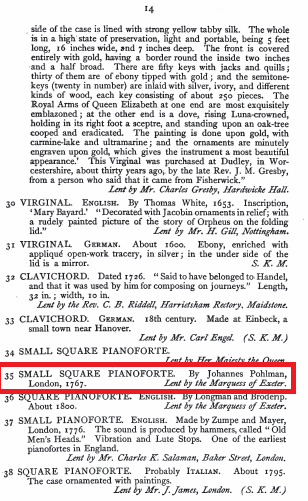
Catalog Kensington Museum Exhibition 1872 – Pohlman square piano 1767
Johannes Pohlmann was born in Germany (the exact year of birth is not yet known) and immigrated to England during or after the Seven Years’ War (1756 – 1763) in Germany. He is detectable from 1767/68 in London and made pianos and harpsichords in Compton Street, Soho and later from 1777 in No. 113 Great Russell Street, Bloomsbury.
In 1769 he married Dorothea Ludewigen. Both had a son named John George Pohlman, who was born in 1774/75.
In December 1792 Johannes Pohlman died and was buried in Whitefield’s Chapel, at Tottenham Court Road.
Further preserved instruments by Johannes Pohlman:
- 1773 square piano – Victoria and Albert Museum, London England
- 1778 square piano – Staatliches Institut für Musikforschung, Preussischer Kulturbesitz, Berlin Germany
- c.1780 square piano – Museum für Kunst und Gewerbe, Hamburg Germany
Der Beitrag Johannes Pohlman 1767 (1780) erschien zuerst auf Eric Feller Early Keyboard Instruments Collection.
]]>Der Beitrag Johann Christoph Jeckel and Christian Jeckel 1789 erschien zuerst auf Eric Feller Early Keyboard Instruments Collection.
]]>The case of the instrument is made in various fruit woods (mainly plum and sycamore) and is decorated with inlays and frames and fillings. The lid edges, as well as the lower part of the instrument are decorated with a wooden profiled strip that runs around the entire instrument, without the back. The keyboard is made from ebony and bone. The fronts are held in two different woods and each shows a rhombus (two keys together). Below the keyboard are 4 hand stops arranged in pairs in a niche. They serve the following modifications:
- Pantalon (no stops switched): The sound is similar to a Dulcimer (Pantalon) or tangent piano, as the strings are struck with the wood of the hammer and without damping.
- Harp: The split damping suspension has been lowered to the strings. The effect imitates a harp.
- Fortepiano: A small piece of cloth is pushed between hammer and string (moderator). The sound is like an early piano.
- Lute: The Fortepiano and Harp tabs are switched at the same time to produce a fine soft tone.
The action is a primitive Prellmechanik without escapement, the hammers are not covered with leather and the instrument is double strung. Below the soundboard is a glued paper label containing the handwritten signature:
„Dieses (r ?) Bandlong haben verfertigt
Johann Christoph Jeckel, und dessen
Sohn Christian Jeckel, beyde Bürger
Orgel und Instrumentenmacher
zu Worms den 19. August 1789.”
The term Bandlong goes back to the word Pantalon or Pantaleon. Accordingly Bandlong is a variation or dialect of the word Pantalon/Pantaleon.
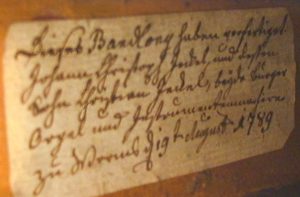
Signature – Johann Christoph Jeckel und Christian Jeckel 1789 – Eric Feller Collection
Johann Christoph Jeckel was born in 1731 in Gondetz (today Poland) and worked from 1750 to 1754 as a carpenter’s assistant in Poznan. From 1763 he was in Worms where he applied for citizenship and probably had previously worked for the organ maker Johann Georg Linck (1724 – 1762). After Jeckel had married his widow he worked from 1763 to 1767 for an organ maker in Frankfurt. This was probably Philipp Ernst Wegmann (1734 – 1778) to which a special connection existed: The organ builder Johann Christian Köhler (1714 – 1761) in Frankfurt, whose own son died young, trained his stepson Philipp Ernst Wegmann to be a workshop successor, and in the years around 1747 – 1758 Johann Georg Linck was his most important employee. Jeckel received only 1767 citizenship in Worms. His son (Johann) Christian Jeckel (1763 – 1820) worked and signed from 1789 together with his father, who died in 1813.
Jeckel signed his instruments twice: Once beneath the soundboard, before the soundboard was glued in and in the small box left from the keyboard probably when finishing his work. Between the two dates there are mostly five months past. Between 1779 and 1784 he signed his instruments with “Clavier” and from 1789 on he used the word “Bandlong”. (See M. Clinkscale: “Makers of the Piano 1700-1820“)
Jeckel’s preserved instruments are very similar to the pianos made by Boos and Mahr. He made instruments with and without dampers. They always have hand stops separated for bass and treble below the keyboard in an identical manner as instruments made by Mahr. If he built instruments with dampers then always uses underdampers. The case of Jeckel’s earliest preserved piano from 1779/80 is marketed in a similar, elaborate way as instruments made by Boos. The similarity in decoration and construction with instruments by Boos’ or Mahrs suggest that Jeckel had worked there, but perhaps he received his knowledge in Frankfurt at the organ workshop from Philipp Ernst Wegmann where Johann Andres Mahr also worked at his time as a journeyman (Note: Many thanks to M. Günther for the information regarding Jeckel.)
Further preserved instruments by Johann Christoph Jeckel u. Christian Jeckel:
- 1783 Clavier – Yale Collection of Musical Instruments, New Haven USA
- 1785 Clavier – Handel Haus, Halle an der Saale Germany
- 1785 Clavier – Kurpfälzisches Museum, Heidelberg Germany
- 1785 Clavier – Town Archive of the City of Worms, Worms Germany
- 1790 Bandlong – Metropolitan Museum, New York USA (click here)
Der Beitrag Johann Christoph Jeckel and Christian Jeckel 1789 erschien zuerst auf Eric Feller Early Keyboard Instruments Collection.
]]>Der Beitrag Muzio Clementi 1803 erschien zuerst auf Eric Feller Early Keyboard Instruments Collection.
]]>The case of the instrument is made of mahogany with encircling multicolour ribbon inlays of different woods. The instrument stands on a French stand with “music-shelf” and brass castors. The keyboard is made from ivory and ebony. The instrument has a wooden pedal for controlling the dampers. The action is a double action with leather covered hammers, double strung and single dampers. The nameboard is painted with garlands of flowers and tendrils and signed in a cartouche with:
“New patent
Muzio Clementi & Co.
Cheapside London”
Square pianos by Clementi were always provided with two serial numbers: one stamped on the left and one handwritten with ink on the wrest plank (stamped: 2697 – inked: 2644).
The system used by Clementi counts with the inked number the general production of pianos since the acquisition of the company “Longman & Broderip” in 1798. The stamped numbers, however, continue the production of square pianos of the acquired company “Longman & Broderip”, but only instruments with the 1794 introduced “New Patent“. Other instruments (for example single action instruments, grand pianos or cabinet pianos) were added together in other groups.
Based on these serial numbers, the year of construction of this instrument can be derived to January 1803. (See: Clementi & Co 1798-1830 Pianoforte Manufacture in London, Leif Sahlqvist 2013)
For more information about the company Muzio Clementi & Co. – click here!
Other preserved instruments by Muzio Clementi & Co .:
- 1803 square piano (No. 3468) – Newton Centre: Marlowe A. Sigal Collection, USA
- 1803 square piano (No. 2335) – Museu da Musica Lisbon, Portugal
- 1806 square piano (No. 4095) – German Museum Munich, Germany
Der Beitrag Muzio Clementi 1803 erschien zuerst auf Eric Feller Early Keyboard Instruments Collection.
]]>Der Beitrag Jacobus et Abraham Kirckman 1783 erschien zuerst auf Eric Feller Early Keyboard Instruments Collection.
]]>The case of the small and elegant instrument is made of solid mahogany and richly decorated with inlaid ribbons of different woods. All around is a decorative profile strip made of bronze as can be also found on instruments from the “Regency Period“. The original stand on which the instrument rests is decorated on the sides with bronze applications.
The keyboard is made from ivory and ebony.
There are three stops for divided dampers and lute stop. The hammers are covered with leather and the instrument is double strung. The action is an English single action after Zumpe. The compass is 5 octaves FF, GG – f3 (without f-sharp in the bass).
The nameboard bears the signature in Latin:
“Jacobus et Abraham Kirckman Londini Fecerunt 1783”
This instrument is an example of the work of company founder Jacob Kirckman and his nephew Abraham Kirckman. The entire instrument is characterized by its exact and high quality craftsmanship. It was in absolute original condition and showed no previous restoration.
Kirckman (Kirkman) was one of the most famous companies in harpsichord building in the late 18th century. The company was founded by Jacob Kirchmann (later anglicised in Kirckman / Kirkman) who was born on March 4th 1710 in Bischweiler in Alsace. The family originally came from Aargau in Switzerland. Jacob Kirchmann become a carpenter and went to England in the early 1730s. There he learned and worked for the famous harpsichord maker Hermann Tabel whose widow he married in 1738. In 1755 he became a British citizen. He died June 9th 1792 in Greenwich and was buried in the St. Alfege Church.
Abraham Kirckman, who was also born in Bischweiler on June 2nd 1737, was the nephew of Jacob Kirckman. He followed his uncle to London and in 1772 became his business partner. He died in April 1794 in Hammersmith.
Joseph Kirkman I. (1763 – 1830) was the son of Abraham Kirckman and followed his father in the family business, became a partner in 1789 and took over the company after the death of his father. (see: M. Clinkscale, “Makers of the Piano 1700 – 1820“)
The company’s oldest surviving harpsichord was made in 1744. Later, as the harpsichord slowly went out of fashion, the company specialized in pianos. (see: Grand Piano by Abraham et Josephus Kirckman 1789)
The last harpsichord by Kirkman was built in 1809.
All instruments were very well made and of extraordinary quality and craftsmanship. The writer Frances “Fanny” Burney (1752 – 1840), daughter of the well-known music historian and composer Charles Burney (1726 – 1814), described Jacob Kirkman as the best harpsichord maker of all time. For example in 1779 John Joseph Merlin expands a harpsichord by Jacob Kirckman with a down striking hammer action (now in the Museum of Fine Arts in Boston, USA).
Here you will find a more detailed description of the company’s history Kirkman.
Other preserved instruments by Jacob & Abraham Kirckman:
- 1778 Square Piano – Oberlin Conservatory of Music: Frederick R. Selch Center for American Music, Oberlin USA
- 1779 Square Piano – Collection Susanne Shapiro, Los Angeles USA
Der Beitrag Jacobus et Abraham Kirckman 1783 erschien zuerst auf Eric Feller Early Keyboard Instruments Collection.
]]>Der Beitrag Georgius Pether c. 1775 erschien zuerst auf Eric Feller Early Keyboard Instruments Collection.
]]>The instrument rests on the original stand (trestle-stand). Both are made of mahogany with encircling inlays in different woods. The instrument has a single action and two stops for controlling the dampers.
The nameboard bears the signature in an oval cartouche:
“Georgius Pether Londini Fecit
No. 9, Berner Street, Oxford – Street”
The compass of the instrument is 5 octaves (FF – f3) and is double strung. The keyboard is made of ivory and ebony.
Unusual is that the tuning pins are arranged semicircular and not straight on the wrestplank. Furthermore the hammers are made extremely thin.
So far only a few instruments have been preserved. Interesting is that Pether signs his instruments with two different signatures on the nameboard. On some instruments there is the signature:
“Georgius Pether / from Mr Kirkman Londini Fecit / No. 61 Oxford Street”
“Mr. Kirkman” shows the connection to the workshop of Kirkman for which he must have worked earlier or possibly had learned there. It can be assumed that Pether used this type of the signature in order to be able to sell a larger amount of his instruments by advertising with Kirkman. The company Kirkman was considered one of the best companies with a long tradition in harpsichord and piano making. A similar form of advertising can be found in the instruments of the company Schoene & Co. who advertised with Johannes Zumpe. (see Square Piano by Schoene & Co. 1788)
About George Pether is only very little known. Because of his name it can be assumed that he had German-speaking roots like many instrument makers in the 18th century. He was active as an instrument maker from about 1775 until his death in 1794. He had his workshop in John Street No. 16 and Oxford Street No. 61. According to M. Clinkscale he invented a down striking action which he did not patent.
Other preserved instruments by George Pether:
- 1779 square piano – Western Australian Academy of Performing Arts, Edith Cowan University, Perth Australia
- 1785 square piano – Private Collection, Buckinghamshire England
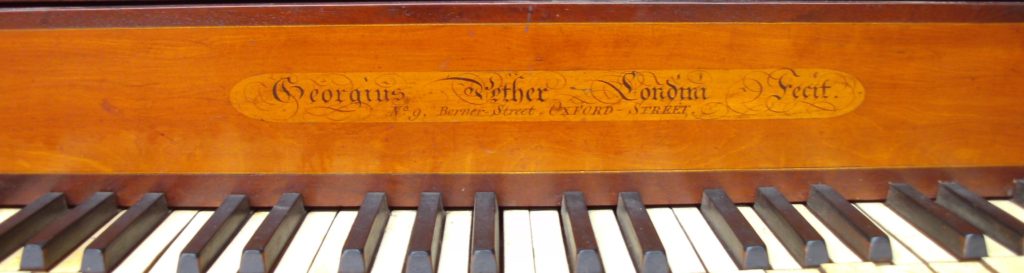
Georgius Pether, London ca. 1775 – Collection Eric Feller
Der Beitrag Georgius Pether c. 1775 erschien zuerst auf Eric Feller Early Keyboard Instruments Collection.
]]>Der Beitrag Léonard Systermans 1829 erschien zuerst auf Eric Feller Early Keyboard Instruments Collection.
]]>The case and columnar legs are made of mahogany. The nameboard is slightly rounded and bears the inscription:
“Leonard Systerman /
Rue Notredame de Nazareth no. 26 Paris /
1829″
On the soundboard is a handwritten signature with the serial number “Leonard Systermans No. 2187 a Paris 1829“.
The original keyboard has a compass of 6 octaves (FF – f4) and is made from with ivory and ebony. The action is a French version of the double action.
The piano has two pedals (dampers, lute) and a knee lever (moderator). Above the action and soundboard is the original dust cover which is divided into two parts.
The instrument was purchased in absolute original condition (no parts were missing) and was restored by Rudolf Haase, Switzerland.
Jean Léonard Systermans was born in 1764 and was of Alsatian origin. Around 1780 he was an apprentice of Fessard in Paris. From about c. 1785 he had his own workshop in Rue Denis Maison Chaumont no. 18 (see: square piano from 1797, collection M. Cole and square piano made in 1800 (current owner unknown)).
On June 12, 1821, Léonard Systermans died and the business was continued by one of his sons under the name of his father. The address from about 1817 was in the Rue Notre Dame de Nazareth no. 26 in Paris.
From about 1840, the company Systermans et Frères with the same address is detectable (see: Martha Clinkscale “Makers of the Piano“)
Claude Montal describes in his book “L’art d’accorder soi-même son piano” that Systermans’ instruments “although inferior to those of Erard, nevertheless had a good reputation” (see. Claude Montal “L’art d ‘accorder soi-même son piano“, 1836, p. 212)
Other preserved instruments by Léonard Systermans:
- 1797 square piano (No. 130) – Collection Michael Cole Cheltenham, England
- 1824 square piano – Western Australian Academy of Performing Arts Collection, Edith Cowan University Perth, Australia
- 1825 square piano – private collection Amsterdam, Netherlands

Leonard Systermans, Paris 1829 – Collection Eric Feller
Leonard Systermans, Paris 1829 – Collection Eric Feller
This square piano is on permanent display at the Kellinghusen Museum “betont – Ton und Tasten Museum”!
Der Beitrag Léonard Systermans 1829 erschien zuerst auf Eric Feller Early Keyboard Instruments Collection.
]]>Der Beitrag Lambertij 1801 erschien zuerst auf Eric Feller Early Keyboard Instruments Collection.
]]>The case is decorated with inlays and is (as well as the legs) made of mahogany. Unusual is that the legs are made as columns and thus anticipate the later empire forms of the younger instruments from the 1820s.
The keyboard has a compass of 5 octaves (FF – f3), the keys are made from bone, ivory and ebony. The back if the instrument is not veneered.
The nameboard is made of different woods and bears the signature in an oval:
“Lambertij
Rue des Vieux Augustins no. 16
à Paris 1801″
It has four pedals for lute, dampers, sordine and lid swell. The action is a simple single action and it is double strung.
About the maker Lambertij is so far nothing known, only that he had his workshop in the “Rue des Vieux Augustins no. 16” as the signature on the nameboard shows. The name Lambertij is not found in any literature and no other surviving instruments are known. Thus, this square piano is probably the only known instrument by this instrument maker worldwide. The name may lead to conclusions about a maker of Italian origin.

Lambertij, Paris 1801 – Sammlung Eric Feller
Der Beitrag Lambertij 1801 erschien zuerst auf Eric Feller Early Keyboard Instruments Collection.
]]>Der Beitrag Wilhelm Braschoss c. 1830 erschien zuerst auf Eric Feller Early Keyboard Instruments Collection.
]]>The instrument was built around 1830 and has a very overtone-rich sound. The case and legs are made of mahogany. The typical fluted legs are reminiscent of the leg shape of the English Regency instruments (see: Square Piano by John Broadwood and Sons 1814).
The keyboard has 6 octaves in ivory and ebony. The nameboard (with the semicircular shape, which is typical for French instruments) is made from different woods and is signed with:
“Braschoss
Facteur de Pianos
A Genève”
The instrument has two pedals (dampers and sordine), Viennese action and is double strung. On the right front (next to the keyboard) a second integrated music stand can be opened. This additional music stand was used for chamber music.
Johann Wilhelm Braschoss was born on October 11, 1796 in Gräfrath / Wald near Solingen. To escape military service he left his family at the age of 19 and worked in the region on the Rhine. In 1820 he worked as a carpenter and cabinetmaker in Munich and went to Vienna in summer 1821. There he worked for the piano maker Cyrill Demian.
In November 1822 he went to Geneva as a carpenter and applied for the citizenship of the city which he received in 1825.
His workshop was based in the Rue de Coutance 140 and later in the Rue du Rhone 29. In December 1828 he obtained Swiss citizenship but also retained his German citizenship. He married Isaline Antoinette Henry and converted from Catholicism to Protestantism.
The business flourished very well and he lived with his wife a house in the Chemin de Mail 14, where he also died on May 5 1871.
Further preserved instruments by Wilhelm Braschoss:
- 1835 square piano – Musée d’Instances Anciens de Musique, Geneva Switzerland
This square piano is on permanent display at the Kellinghusen Museum “betont – Ton und Tasten Museum”!
Der Beitrag Wilhelm Braschoss c. 1830 erschien zuerst auf Eric Feller Early Keyboard Instruments Collection.
]]>Der Beitrag Thomas Bates & Co. 1793 erschien zuerst auf Eric Feller Early Keyboard Instruments Collection.
]]>The case of the instrument is made of solid mahogany and decorated with decorative ribbons. The original trestle stand on which the instrument rests is also made of mahogany. Inside there are two hand stops for controlling the dampers and lute. The keyboard is made in ivory and ebony and the instrument is double strung with leather covered hammers and has a single action.
The nameboard is signed with:
“Bates and Co. Londini Fecit
Corner of Edward Street Wardour Street 1793″
The handwritten serial number 178 is behind the nameboard and also on the action. Another handwritten signature is on the last key.
Thomas Bates was an apprentice with John Geib and was later one of the most renowned instrument makers in the 18th century in London and was mainly known for building harpsichords.
In January 1793 he took over the business of George Garcka and worked with Longman and Housten together. Housten took over the company after the bankruptcy of Bates.
Other preserved instruments by Thomas Bates:
- 1793 square piano (No.?) – Finchcocks Collection Richard Burnett, Goudhurst UK
- 1793 square piano (No. 163) – Private Collection England
Der Beitrag Thomas Bates & Co. 1793 erschien zuerst auf Eric Feller Early Keyboard Instruments Collection.
]]>Der Beitrag Joseph Hauert c. 1785 erschien zuerst auf Eric Feller Early Keyboard Instruments Collection.
]]>The elegant instrument and the original legs with floral carvings are made of walnut. On the front of the lid are an inlaid oval which is made in a darker wood and a bronze application at the lock.
The nameboard is divided into three cassettes. The signature is unfortunately faded but due to the complete design the instrument is clearly attributed to Joseph Hauert.
With a compass of 5 octaves (FF,GG – f 4) the original keyboard is made from ivory and ebony. There are two knee levers for divided dampers, one stop for a lute and the instrument has a second action. It is double strung and the hammers are covered with leather.
A further instrument made by the son Charles Louis Howard from about 1825 is also in the Eric Feller Collection. Click here for further information: Square Piano by Charles Louis Howard c. 1825
The instrument was completely restored in 2019 by Andrew Durand.
Joseph Hauert was born in Wengi near Büren / Bern in August 1749 as the son of Bendicht Hauert and Magdalena Berger.
Presumably is that he was educated as a carpenter and then later turned to instrument making.
On 2.10.1772 he married Elisabeth Wyss and moved to Bern. His son Carl Ludwig, born on October 1, 1785 in Bern, was the fifth child of the Hauert family.
Joseph Hauert died in 1824.
Further preserved instruments by Joseph Hauert:
- 1796 square piano – Museum Schlössli, Aarau, Switzerland
- 1798 square piano – Germanisches Nationalmuseum, Nuremberg, Germany
Der Beitrag Joseph Hauert c. 1785 erschien zuerst auf Eric Feller Early Keyboard Instruments Collection.
]]>Der Beitrag Johann Christian Schreiber 1745 (1770) erschien zuerst auf Eric Feller Early Keyboard Instruments Collection.
]]>The rectangular shaped mahogany case is decorated with boxwood inlays. The instrument has a single action and is double strung.
The keyboard is made of ivory and ebony with dark wood fronts. The nameboard is simply decorated and contains the signature:
“Johannes Christian Schreiber
A Amsterdam
1745″
The date 1745 on the nameboard is obviously added later and the instrument can be dated to about 1770 due to the structural features. Interesting is the small compass of only 4 ½ octaves.
The instrument formerly belonged to the University of California – Department of Music and was then acquired by Bjarne Dahl.
The piano is listed in the book “Makers of the Piano 1700 – 1820” by Martha Novak Clinkscale.
So far no further instruments have been survived by Johannes Christian Schreiber!
Der Beitrag Johann Christian Schreiber 1745 (1770) erschien zuerst auf Eric Feller Early Keyboard Instruments Collection.
]]>Der Beitrag John Broadwood and Son 1799 erschien zuerst auf Eric Feller Early Keyboard Instruments Collection.
]]>The case of the instrument is made of mahogany with revolving band inlays in different woods. The instrument itself rests on a “french stand” and “music-shelf” under the instrument. On the sides are brass applications for covering the screws of the frame.
The keyboard is made in ivory and ebony. The nameboard is made of different woods and is signed in a cartouche with:
“John Broadwood and Son.
Makers to His Majesty and the Princeses
Great Pulteney Street London 1799 Golden Square.”
The instrument has a pedal for using the dampers and is double strung. The action is a simple single action with leather covered hammers and the typical Broadwood underdampers (these dampers were patented by Broadwood in 1783).
John Broadwood was born on 6th October 1732 in Oldhamstocks near Cockburnspath in Scotland. He learned the profession of being a cabinetmaker like his father before.
In 1761 he started working for Burkat Shudi (1702 – 1773) in London and in 1770 became his business partner. In 1771 he opened his own shop on Great Pulteney Street in London. In 1769 he married Burkat Shudi’s daughter Barbara in her first marriage and had four children with her. After his wife’s death in 1776 he married Mary Kitson in 1781 and had six children with her. He died on 17th July 1812 in London.
Other surviving instruments by John Broadwood and Son:
- 1798 square piano (No. 4200) – National Museum of American History, Washington USA
- 1791 square piano (No. 1552) – Kenwood House, Hampstead UK
- 1795 square piano (No. 2844) – Collection Richard Burnett Finchcocks, Goudhurst UK
Der Beitrag John Broadwood and Son 1799 erschien zuerst auf Eric Feller Early Keyboard Instruments Collection.
]]>Der Beitrag John Crang Hancock c. 1790 erschien zuerst auf Eric Feller Early Keyboard Instruments Collection.
]]>The case is made of mahogany with inlays of boxwood and ebony. The instruments rests on a trestle stand and the signature on the nameboard reads:
“By Royal Patent Crang Hancock London”
Based on the patent of the “spring key touch“, Hancock managed to soften the touch by a spring force while pressing a key. There is a spring on the back of each key which pushes the key back to its original position. Additionally, a round wooden plunger rod is sitting on the key which acts as a trigger and is pressed upwards with a spring (moveable in a leather hinge). The hammers are caught on relapse by a felt strip.
John Crang Hancock worked in London from 1777 to 1792 (see: Boalch 3, p. 78). He had his first workshop in No. 32 Parliament Street in Westminster, later working in No. 82 Wych Street, St. Clement Danes.
The London Patent Trial number 1743 dated 10th May 1790 calls John Crang Hancock as the inventor of a mechanism with two springs on the key called “spring key touch“.
An action with the “spring key touch” can be found in a transverse grand piano by Hancock from 1782 (see: Harding 1978, p. 60).
On 4th December 1791 Hancock advertises his instruments in the “Observer“:
“The Ladys are respectfully informed, that a most capital collection of grand and portable pianofortes possessing unequalled brilliancy and sweetness of tone, are on sale as above, price from twenty to eighty guineas each“.
John Crang Hancock built several pianos in the shape of a transverse grand. Two of these transverse grands were exhibited in 1885 at the International Inventions Exhibition in London: one dated from 1779 (owner: A. M. Lawrence), the other from 1787 (owner: Broadwood).
Till today there are no other square shaped pianos survived.
Other surviving instruments by John Crang Hancock:
- 1790 grand piano – Cobbe Collection Trust Hatchlands Park, England
- 1782 transverse grand piano – Colt Clavier Collection Bethersden, England
John Crang Hancock, London ca. 1790 – Eric Feller Collection – Action
This square piano is on permanent display at the Kellinghusen Museum “betont – Ton und Tasten Museum”!
Der Beitrag John Crang Hancock c. 1790 erschien zuerst auf Eric Feller Early Keyboard Instruments Collection.
]]>Der Beitrag Joseph Grus c. 1820 erschien zuerst auf Eric Feller Early Keyboard Instruments Collection.
]]>The case is made of mahogany and decorated with bronze applications on the pillar legs.
The keyboard has 6 octaves and is made in ivory and ebony. The nameboard is made of different woods and is signed in a cartouche with:
“Joseph Grus
Rue St. Louis no. 60 au Marais
á Paris.”
The instrument has got four pedals (dampers, lute, Sordine and double Sordine). The action is a second action and it is double strung- Above the action is the original dust cover.
There is a handwritten signature on the soundboard next to the bridge.
Little is known about Joseph Grus. According to R. Harding the company was founded in Paris in 1805. In 1823 Grus presented an upright piano at the Paris exhibition and in 1832 he received a patent (No. 3462) for an enlarged soundboard.
Other surviving instruments by Joseph Grus:
- So far no other instruments are known.
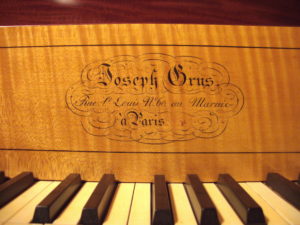
Square Piano Joseph Grus, Paris ca. 1820
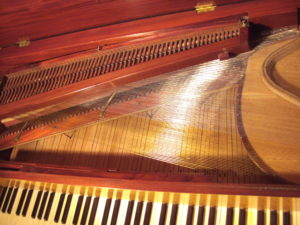
Square Piano Joseph Grus, Paris ca. 1820
Der Beitrag Joseph Grus c. 1820 erschien zuerst auf Eric Feller Early Keyboard Instruments Collection.
]]>Der Beitrag Longman, Lukey and Co. 1769 – 1773 erschien zuerst auf Eric Feller Early Keyboard Instruments Collection.
]]>The instrument has a simple English single action and is double strung.
The keyboard is made of ivory and ebony. There is usually a scribe line in this case two lines on the key near the point that the key head joins the tail. This is a holdover from harpsichord days where this ornament was common. These lines are made after the keyboard is assembled and will line-up down the key frame.
The nameboard bears the inscription:
„Longman and Lukey & Co. Cheapside London”
Furthermore there is a signature in the inside, which appeared during the cleaning and examination:
“Tuned & Cleaned by me /
this 7th of Febry 1814 /
Ro Ellis
Organist Beaumont “
With “Beaumont” the village Beaumont in the county Cumbria in England is meant. It can be assumed that the instrument belonged to an organist named R. Ellis. Further research is required and in progress.

For more information about the company Longman & Broderip – click here!
Other surviving instruments by Longman and Lukey & Co.:
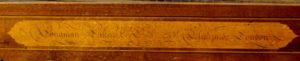
Longman, Lukey and Co. 1769 – 1773 – Nameboard
Der Beitrag Longman, Lukey and Co. 1769 – 1773 erschien zuerst auf Eric Feller Early Keyboard Instruments Collection.
]]>Der Beitrag John Broadwood and Son 1800 erschien zuerst auf Eric Feller Early Keyboard Instruments Collection.
]]>The case of the instrument is made of mahogany with revolving band inlays in different woods. The instrument itself rests on a “french stand” and “music-shelf” under the instrument. On the sides are brass applications for covering the screws of the frame. The keyboard is made in ivory and ebony.
The instrument has a pedal for using the dampers. The action is a simple single action with leather covered hammers and the typical Broadwood underdampers (these dampers were patented by Broadwood in 1783). The instrument is double strung and above the action and soundboard is the original dust-cover (covered with green silk). On the underside of the dust-cover are different handwritten entries. There are poems and small diary entries about everyday life in the countryside. The name “Betsy Ellis” appears more often. It is likely that the instrument comes from her possession and has been described over the years by her.
The nameboard is made of different woods and is signed in a cartouche with:
“John Broadwood and Son.
Makers to His Majesty and the Princeses
Great Pulteney Street London 1800 Golden Square.”
Under the dust cover is the serial number: 5507.
On the right side of the case are the initials “B. L.” imprinted. The 58th key is handwritten signed with a “B“.
John Broadwood was born on 6th October 1732 in Oldhamstocks near Cockburnspath in Scotland. He learned the profession of being a cabinetmaker like his father before.
In 1761 he started working for Burkat Shudi (1702 – 1773) in London and in 1770 became his business partner. In 1771 he opened his own shop on Great Pulteney Street in London. In 1769 he married Burkat Shudi’s daughter Barbara in her first marriage and had four children with her. After his wife’s death in 1776 he married Mary Kitson in 1781 and had six children with her. He died on 17th July 1812 in London.
Other surviving instruments by Johannes Broadwood and Son:
- 1798 square piano (No. 4200) – National Museum of American History, Washington USA
- 1791 square piano (No. 1552) – Kenwood House, Hampstead UK
- 1795 square piano (No. 2844) – Collection Richard Burnett Finchcocks, Goudhurst UK

Dust-Cover John Broadwood and Son, London 1800 – Eric Feller Collection
Der Beitrag John Broadwood and Son 1800 erschien zuerst auf Eric Feller Early Keyboard Instruments Collection.
]]>Der Beitrag Christopher Ganer c. 1785 erschien zuerst auf Eric Feller Early Keyboard Instruments Collection.
]]>The case of this instrument is made of solid mahogany with inlaid ribbons. The original stand is decorated on the sides with bronze applications. The nameboard bears the inscription:
“Christopher Ganer
Grand and Small Forte-Piano and Harp Maker
Broad Street Golden Square
London.”
The first key is also stamped with “M“ and “5”. The keyboard is made ivory and ebony. Inside the piano there are two stops for dampers and lute. The hammers are covered with leather and the action is a second action.

Square Piano by Christopher Ganer c. 1785 – Inscription on Nameboard – Eric Feller Collection
Christopher Ganer was born around 1750 in Leipzig. Like many other instrument makers he left the continent and is from 1774 in England as a harpsichord and piano maker (as well as a harp maker from about the mid-1780s – see the signature on the nameboard “Harp Maker”) detectable. At that time, his workshop was at Broad Street No. 22, Golden Square, and later at Broad Street No. 47.
In 1774 he married Lydia Willey and had four daughters and a son who died in childhood.
Special by all instruments of Christopher Ganer is that he built the typical “trestle-stands” as well as from 1777/78 in fashion coming “French-stands“. His skills as an excellent cabinet maker made him build particularly elegant instruments with high quality inlays. All his instruments are individually designed and none are alike.
Until about 1784 Ganer always dated his instruments with the Latin inscription “Christopher Ganer Londini Fecit“.
According to different sources, he died in 1811 (in some sources also in 1818).
Other surviving instruments by Christopher Ganer:
- c. 1785 square piano (No.?) – Fondazione Cassa di Risparmio, Bologna Italy
- 1780 square piano (No.?) – Eric Feller Early Keyboard Instruments Collection, Germany
Der Beitrag Christopher Ganer c. 1785 erschien zuerst auf Eric Feller Early Keyboard Instruments Collection.
]]>Der Beitrag Charles Louis Howard c. 1825 erschien zuerst auf Eric Feller Early Keyboard Instruments Collection.
]]>“Charles Louis
Howard
Facteur de Forte Piano
A Berne”
Hauert followed the new fashion and signed his pianos in French. The original keyboard in ivory and ebony has a compass of 6 octaves.
There are two pedals controlling dampers and Sordine.
Charles Louis Howard was born on 1st October 1785 in Bern. He was the fifth child of Joseph Hauert, a member of the important Swiss piano maker family.
On 22th June 1826 he married Maria Catharina Huber (1801 – 1829) who died at birth with her first son. On 22th October 1831 he married Rosina Catharina Kannkamp (1801 – 1847). After her death he married Elise Borle (1826 – 1869) on 10th July 1849. This marriage also remained childless.
Together with Carl Christoph Kützing he founded the company Howard & Kützing. He died on 27th March 1863.
Other surviving instruments by Charles Louis Howard:
- c. 1830 square piano (No. 1166) – Händel-Haus, Halle an der Saale, Germany
Der Beitrag Charles Louis Howard c. 1825 erschien zuerst auf Eric Feller Early Keyboard Instruments Collection.
]]>Der Beitrag John Broadwood and Sons 1814 erschien zuerst auf Eric Feller Early Keyboard Instruments Collection.
]]>The case of the instrument is made of mahogany and rosewood with revolving band inlays in brass. The instrument stands on 6 original turned legs with fire-gilt bronze rings. The entire instrument is made in typical “Regency-Style“. The keyboard is made of ivory and ebony. The instrument has a wooden pedal for the dampers. The action is a double action with leathered hammers and single dampers. The instrument is double strung.
The nameboard is made in different woods and signed in a cartouche:
“John Broadwood and Sons.
Makers to His Majesty and the Princesses
Great Pulteney Street London Golden Square.”
The serial number is located on the inside of the instrument and reads 18242. Based on this serial number the instrument was made in 1814.
The company John Broadwood produced various models of square pianos. Depending on the design and the used woods the prices varied. This piano has to be one of the expensive models. The standard versions were mostly held in mahogany and simply decorated with some ribbon inlays. The uses of rosewood and brass inlays are clear signs of a high-priced instrument.
John Broadwood was born on 6th October 1732 in Oldhamstocks near Cockburnspath in Scotland. He learned the profession of being a cabinetmaker like his father before.
In 1761 he started working for Burkat Shudi (1702 – 1773) in London and in 1770 became his business partner. In 1771 he opened his own shop on Great Pulteney Street in London. In 1769 he married Burkat Shudi’s daughter Barbara in her first marriage and had four children with her. After his wife’s death in 1776 he married Mary Kitson in 1781 and had six children with her. He died on 17th July 1812 in London.
Other surviving instruments by Johannes Broadwood and Sons:
- 1814 square piano (No. 8666) – Stanford University Department of Music, Stanford USA
- 1816 square piano (No. 20108) – Banchory Crathes Castle, The National Trust for Scotland, UK
- 1816 square piano (No. 20953) – Tredegar House, Newport UK
Der Beitrag John Broadwood and Sons 1814 erschien zuerst auf Eric Feller Early Keyboard Instruments Collection.
]]>Der Beitrag Johannes Zumpe for Longman and Lukey & Co. 1769 erschien zuerst auf Eric Feller Early Keyboard Instruments Collection.
]]>The case is made of mahogany and framed with ribbon inlays. Left of the keyboard are three hand stops for divided dampers and lute. The instrument has a simple English single action and is double strung.
The keyboard is made of ivory and ebony. There is usually a scribe line in this case two lines on the key near the point that the key head joins the tail. This is a holdover from harpsichord days where this ornament was common. These lines are made after the keyboard is assembled and will line-up down the key frame.
The instrument was made in 1769 – in the inside is a signature made by Zumpe and dated 1769.
The nameboard bears the inscription:
„Longman and Lukey & Co. Cheapside London”
It has often been suggested that possibly also Zumpe should have worked for Longman. For example records show that Christopher Ganer worked for the company. This square piano proves that Zumpe not only built and sold instruments through his own company but also supplied Longman. There are several ways in which such cooperation has come about. It can be assumed that Zumpe promised greater profits through cooperation, but also a greater possibility for advertising the “new pianoforte” which at the time was very popular. Another possibility suggests that this collaboration was only for a short time as Zumpes own workshop was quickly successful. Since piano production was still in the beginning in 1769 the demand for instruments was growing. It could also be that Zumpe supplied in individual cases to Longman or they bought these instruments from Zumpe on a case-by-case basis sold. There is no record of Zumpe receiving regular payments such as Christopher Ganer.
For more information about the company Longman & Broderip – click here!
Other surviving instruments by Longman and Lukey & Co.:
Der Beitrag Johannes Zumpe for Longman and Lukey & Co. 1769 erschien zuerst auf Eric Feller Early Keyboard Instruments Collection.
]]>Der Beitrag Longman and Broderip 1776 – 1782 erschien zuerst auf Eric Feller Early Keyboard Instruments Collection.
]]>The case and the original stand are made of mahogany and framed with ribbon inlays. On the left side of the stand a curved wooden pedal for the lute stop is integrated. Left of the keyboard are two hand stops for divided dampers.
The instrument has a simple English single action and is double strung. The keyboard is made of ivory and ebony,.There is usually a scribe line, in this case two lines, on the key near the point that the key head joins the tail. This is a holdover from harpsichord days where this ornament was common. These lines are made after the keyboard is assembled, and will line-up down the key frame.
The date of this instrument is between 1776 and December 1782.
The nameboard bears the inscription:
“Longman and Broderip Musical Instrument Makers /
No 26 Cheapside London”
After 1782 the company signed their instruments on the nameboard with the second address (“No. 13 Haymarket London” – December 1782 branch opened)
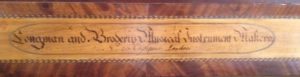
The condition of the entire instrument was very good. It was in absolute original condition and was apparently never been before restored.
For more information about the company Longman & Broderip – click here!
Other surviving instruments by Longman & Broderip:
- c. 1780 square piano – Richard Burnett, Finchcocks, UK
- c. 1795 square piano – Victoria and Albert Museum, London UK
Der Beitrag Longman and Broderip 1776 – 1782 erschien zuerst auf Eric Feller Early Keyboard Instruments Collection.
]]>Der Beitrag Johannes Broadwood 1790 erschien zuerst auf Eric Feller Early Keyboard Instruments Collection.
]]>The case of the instrument is made of mahogany with encircling inlays in different woods. The instrument rests on the original trestle stand which has been made in mahogany too.
Inside is the original dust cover which is above the action and the soundboard. It is signed with many handwritten entries in ink and pencil. As shown the instrument has been sold several times in Liverpool. At that time the trade in used instruments was very flourishing and instruments were sold different times.
At the wrest plank there is the serial number 1331. The instrument has a single action and the typical Broadwood underdampers (this damper action was patented by Broadwood in 1783 – see “patent” on the nameboard).
The signature and shape of the nameboard with reads:
“John Broadwood Londini fecit 1790 Patent
Great Pulteney Street Golden Square”
was used from 1783 to 1793 (see also the grand piano made by Johannes Broadwood in 1792 in the Eric Feller Collection – click here).
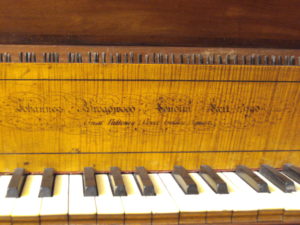
Nameboard Johannes Broadwood Square Piano 1790 – Eric Feller Collection
The signature “John Broadwood and Son” was used from 1794 after John Broadwood’s son James Shudi Broadwood (1772 – 1851) entered the company.
In the inside there is the original maintenance information. It is written in English and French and contains the following text:
“If any of the steamers should rattle, put
a little oil in the center. And if any Ham
mer should stick, press the pin that guides
it on one side or the other, till it plays free. “
The simultaneous use of French shows that the continental export market was an important branch in the company.
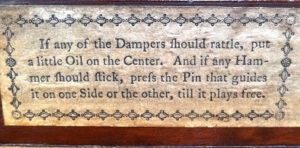
Johannes Broadwood 1790 Instructions – Eric Feller Collection
This square piano was in perfect original condition and is an early example of the excellent instruments made by John Broadwood.
John Broadwood was born on 6th October 1732 in Oldhamstocks near Cockburnspath in Scotland. He learned the profession of being a cabinetmaker like his father before.
In 1761 he started working for Burkat Shudi (1702 – 1773) in London and in 1770 became his business partner. In 1771 he opened his own shop on Great Pulteney Street in London. In 1769 he married Burkat Shudi’s daughter Barbara in her first marriage and had four children with her. After his wife’s death in 1776 he married Mary Kitson in 1781 and had six children with her. He died on 17th July 1812 in London.
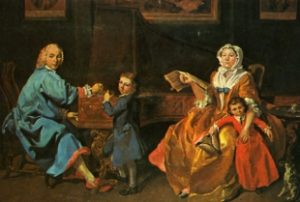
Other surviving instruments by Johannes Broadwood:
- 1790 square piano (No. 1185) – Castle Museum York, UK
- 1795 square piano – Monart Piano Collection, Colm O’Leary, Ireland
Der Beitrag Johannes Broadwood 1790 erschien zuerst auf Eric Feller Early Keyboard Instruments Collection.
]]>Der Beitrag Thomas Haxby 1774 erschien zuerst auf Eric Feller Early Keyboard Instruments Collection.
]]>The case of the instrument is made of mahogany with inlays in different woods. The instrument rests on the original trestle stand which has also been made in mahogany. The lock at the front is decorated with a filigree brass front.
The keyboard is made in ivory and ebony. The small hammers are covered with leather and the instrument is double strung.
On the left side are three stops for divided dampers and lute. On the nameboard is the signature in an elongated cartouche:
“Thomas Haxby – York 1774”
On the last key an inscription can be found that the instrument 1948/49 was restored by Charles F. Colt. It is also listed in the book by Charles F. Colt “The Early Piano“.
This early (currently the third oldest surviving) square piano by Thomas Haxby is an outstanding example of the excellent work of an instrument maker who was not working in London but in York. The oldest dated instrument dates back to 1772.
Thomas Haxby was born on 25th. January 1729 and died on 31th. October 1796. He was the son of Robert Haxby (a carpenter) and later had a son named John.
After serving as a sexton at the St Michael-le-Belfry Church in York and as a singer in the York Cathedral he opened his own store on Blake Street on 20th June 1756, promoting it in the Yorkshire Courant with “Musical Instruments at T. Haxby’s warehouse Blake Street are made and sold “.
His works included mainly keyboard instruments (spinets, harpsichords, pianos, organs) but also tremors, guitars and violins. He also worked as a music publisher.
On 28th December 1770 he patented a new harpsichord action by adjusting the registers on pedals for single-manual and double-manual harpsichords (Patent No. 977).
In 1760 and 1778 he worked on the organ in York Minster and in 1767 on the organ in the Leeds Parish Church.
In 1787 the annual production of square pianos was 24 instruments and reached 36 instruments in 1790. (The New Grove Musical Instruments Series – Early Keyboard Instruments)
After his death the business in Blake Street was taken over by Samuel Knapton and continued. From 1798 until about 1840 the business was taken over by Thomas Tomlinson, who married into the Haxby family. ( D. H. Boalch, Makers of the Harpsichord and Clavichord 1440 to 1840)
During his lifetime Haxby was considered one of the best instrument makers and was highly respected by contemporaries.
Other surviving instruments by Thomas Haxby:
- 1772 square piano – Private collection Lord Hotham, Yorkshire England
- 1772 square piano – Städtisches Museum, Brunswick Germany
- 1792 square piano (No. 325) – Fairfax House, UK
Der Beitrag Thomas Haxby 1774 erschien zuerst auf Eric Feller Early Keyboard Instruments Collection.
]]>Der Beitrag Jacobus Ball c. 1775/80 erschien zuerst auf Eric Feller Early Keyboard Instruments Collection.
]]>The keyboard is made in ivory and ebony. Two stops controlling dampers and lute. All the hammers are covered with leather and it has the simple single action.
The nameboard is decorated with an oval cartridge in which is the signature:
“Jacobus Ball Londini Fecit
Grosvenor Square”
On the back of the nameboard is a handwritten signature in ink:
“Jacob Ball No. Pat.”
It looks like that this signature is made by him. Furthermore there is a handwritten signature with pencil under the soundboard:
“Wilm. 1818 “
It is highly probable that the first handwritten signature is made of Ball himself. The designation “No. Pat.” could perhaps be the prototype of a particularly new small instrument made by him. Other instruments by Ball like this one are not known yet.
In different books we often find the statement that Ball first came to England in the 1790s or shortly before (1790 application for British citizenship). However this instrument shows clear structural features of an earlier type. Also the signature on the nameboard (“Londini Fecit“) is an evidence for an earlier date than 1790. It is therefore likely that Ball was much earlier active as an instrument maker in England than previously thought.
About Jacob (James) Ball is very little known. In 1790 he submitted the application for British citizenship. He originally came from the continent (Germany?) immigrated to England. Also this year he had some innovations patented. This included a new piano action and an exceptional music stand, which was similar to the ones from grand pianos but when unfolded it looked as if it was part of the nameboard. (see Michael Cole)
Furthermore, he maintained a business relationship with the composer Domenico Motta in 1794.
According to Rosamond Harding, Ball was active in London from around 1780 to 1834. In newspapers he advertised the construction of grand pianos, square pianos and cabinet pianos. Several addresses are known: 26 Duke Street, Grosvenor Square, in 1806 and 27 Duke Street from 1808.
“J. Ball and Son” is from 1819 and “Edward Ball and Son” from 1824 detectable. In 1827/28 “To His Majesty” is detectable.
Other surviving instruments by Jacobus / James Ball:
- c. 1780 square piano – Eric Feller Early Keyboard Instruments Collection, Germany
- 1790 square piano – Musical Instruments Museum Berlin, Germany
- 1791 square piano – Colonial Williamsburg Foundation, Williamsburg USA

Nameboard (Backside) – Jacobus Ball, London 1775 – Collection Eric Feller
Der Beitrag Jacobus Ball c. 1775/80 erschien zuerst auf Eric Feller Early Keyboard Instruments Collection.
]]>Der Beitrag Ferdinand Weber c. 1775 erschien zuerst auf Eric Feller Early Keyboard Instruments Collection.
]]>The case and the original stand are made of solid mahogany and framed with ribbon inlays. The stand has a small shelf (“music shelf”) and is decorated with oval brass fittings. The lid is completely divided and above the soundboard it has a rare “Venetian swell” with five lamellas made from mahogany. These “Venetian Swells” are originally found in a few English harpsichords but they are extremely rare in square pianos. The dynamic changes that are possible via the action is reinforced by the swell.
The instrument has an English single action and is double strung. The keys are made of ivory and ebony. The nameboard is divided into cassettes, each decorated with garlands, flowers and tendrils. In the centre is the signature:
„Ferdinand Weber/
17 Fecit 98/
Dublin“
When dating the instrument it is clear that the date on the nameboard was subsequently changed and received a younger dating, which can not be correct, since Ferdinand Weber died in 1784. The original right year number has been painted over.
Altering the dates of instruments to make them older was often find in later years when the interest for these instruments arose (see the Pohlman square piano 1767 in the Eric Feller Collection – click here). A dating to “rejuvenate” the instruments is extremely rare, but also occurred. It can be assumed that this “new date” was made in very early days. One reason could be that the instrument was probably sold again in the late 1790s. It is known that there was already flourishing sales of used instruments. In order to increase the chances of a quick sale instruments were dated newer.
The small shape of the piano as well as the compass of 5 octaves (FF,GG – f3) are clear evidences to date the instrument to the mid 1770’s.
The state of preservation was very good and the entire instrument was in absolute original condition and apparently never touched before.
Ferdinand Weber (originally Ferdinand Webber) was born on May 6, 1715 in Borstendorf, Saxony and learned from 1728 to 1735 organ building with Johann Ernst Hähnel, who was the royal organ builder of the King of Poland and Duke of Saxony.
Weber moved to Dublin in 1739, after spending several years in London. In Dublin he built organs for several churches and was also active as an organ tuner (Christ Church Cathedral and Trinity College). Furthermore, he built harpsichords, spinets and from 1772 (the increasingly popular in those days) pianos after the model of Zumpe. His reputation as an organ and harpsichord maker was so great that he attracted the interest of Georg Friedrich Händel during his visit in 1741 in Dublin.
It is known that Weber made 1773 newly built harpsichords from £ 22-15-0 to £ 34-2-6 and 1775 new grand pianos for £ 14-15-9 sold. (See: Flood, W.H. Grattan, ‘The Account Book of a Dublin Harpsichord Maker, Ferdinand Weber’, The Journal of the Royal Society of Antiquarians of Ireland, 6th Ser., 4.4 (31 December 1914), 338-47)
His workshop was initially at 1739-1749 in the Werburgh Street, later from 1749 to 1755 in the Marlborough Street and last from 1776 until his death in 1784 in additional rooms in the Marlborough Street 71. After his death, the company was continued for a short time by his son Thomas Ferdinand Weber, before being taken over by William Southwell in 1787. (see Grattan F / DUBLIN, 139 ff, James / EARLY, 78)
Further preserved instruments by Ferdinand Weber:
- 1772 square piano – Metropolitan Museum, New York USA
Der Beitrag Ferdinand Weber c. 1775 erschien zuerst auf Eric Feller Early Keyboard Instruments Collection.
]]>Der Beitrag Schoene & Vinsen 1799 erschien zuerst auf Eric Feller Early Keyboard Instruments Collection.
]]>These charming instruments are all well made and show a high quality of cabinet works.
The case and the original stand are made in mahogany with inlays in different woods. The stand has got a cross brace on the floor with pedals and is decorated with oval brass fittings.
The instrument has a second action and is double strung.
Very unusual is the exquisite veneered back of this instrument. Normally square pianos where not veneered at the back due to the fact that they stand near a wall in a room. This feature came mostly in fashion in the 1810s where square pianos where placed as a decorative item in the middle of a room.
The cabinet works on this instrument are on a much higher level than on the other two square pianos in the collection.
The keys are made of ivory and ebony and the nameboard is decorated with garlands, flowers and tendrils. In the middle is an oval cartridge containing the signature:
„Schoene and Vinsen / Successors to Johannes Zumpe Makers / 1799
No. 45 Paddington Street Mary le Bone /
London”
The instrument has a nag-heads swell, dampers and lute stop controlling by wooden pedals.
Schoene & Co. is closely associated with Johannes Zumpe (1726 – 1790), who built the first pianos in England in the 1760s. The company was founded by the two brothers Frederick and Christian Schoene, who immigrated to England and were in business relations with Zumpe. Interesting is that the name “Johannes Zumpe” is written much thicker and set in the centre of the nameboard then the makers name “Schoene & Co.” or “Schoene & Vinsen”. Due to the great reputation that the instruments of Johannes Zumpe enjoyed, the two brothers wanted to advertise with his name in order for a better selling of their instruments. It can be assumed that the two brothers paid Zumpe an annual license fee for that.
The oldest instrument of the two Schoene brothers dates back to 1781 and bears too the inscription of Zumpe.
The company achieved great success with its instruments until 1789 – with the French Revolution, success abruptly ended. The great success of the company was due to the export of instruments to France and other countries on the continent. Sebastien Erard and other French instrument makers copied and improved the Schoene Brothers’ instruments.
This competition and the failure of the continental market almost led to the bankruptcy of the company. In order to counteract the growing financial difficulties, Thomas Vinsen joined the company in 1794 as a new partner (and with new money…).
1795 Christian Schoene died and Thomas Vinsen continued from 1799 along with Frederick Schoenes son, George Frederick the company. At the same time they moved into Paddington Street no. 45 in London.
The last known instrument bears the inscription “Georgius Fredericus Schoene / no. 45 Paddington Street, Marylebone / London 1805 “. It now belongs to the “Easton Historical Society” in Pennsylvania USA.
George Frederick Schoene soon turned his back on the piano-building business and worked as an artist and engraver.
Further surviving instruments by Schoene & Vinsen:
- 1798 square piano – Woodlawn Plantation, Fairfax County USA
- 1798 square piano – David Leigh, Oxford England
Der Beitrag Schoene & Vinsen 1799 erschien zuerst auf Eric Feller Early Keyboard Instruments Collection.
]]>Der Beitrag Schoene & Co. 1792 erschien zuerst auf Eric Feller Early Keyboard Instruments Collection.
]]>“Schoene and Co. Successors to /
Johannes Zumpe Londini Fecerunt 1792 /
Princess Street Cavendish Square “
The instrument has a nag-heads swell, dampers and lute stop controlling by wooden pedals.
This is currently the second oldest of 3 square pianos made by Schoene in the Eric Feller Early Keyboard Collection. All three instruments feature identically designed nameboards and signatures. Also action, dampers and swell are the same.
These charming instruments are all well made and show a high quality of cabinet works.
Schoene & Co. is closely associated with Johannes Zumpe (1726 – 1790), who built the first pianos in England in the 1760s. The company was founded by the two brothers Frederick and Christian Schoene, who immigrated to England and were in business relations with Zumpe. Interesting is that the name “Johannes Zumpe” is written much thicker and set in the centre of the nameboard then the makers name “Schoene & Co.” or “Schoene & Vinsen”. Due to the great reputation that the instruments of Johannes Zumpe enjoyed, the two brothers wanted to advertise with his name in order for a better selling of their instruments. It can be assumed that the two brothers paid Zumpe an annual license fee for that.
The oldest instrument of the two Schoene brothers dates back to 1781 and bears too the inscription of Zumpe.
The company achieved great success with its instruments until 1789 – with the French Revolution, success abruptly ended. The great success of the company was due to the export of instruments to France and other countries on the continent. Sebastien Erard and other French instrument makers copied and improved the Schoene Brothers’ instruments.
This competition and the failure of the continental market almost led to the bankruptcy of the company. In order to counteract the growing financial difficulties, Thomas Vinsen joined the company in 1794 as a new partner (and with new money…).
1795 Christian Schoene died and Thomas Vinsen continued from 1799 along with Frederick Schoenes son, George Frederick the company. At the same time they moved into Paddington Street no. 45 in London.
The last known instrument bears the inscription “Georgius Fredericus Schoene / no. 45 Paddington Street, Marylebone / London 1805 “. It now belongs to the “Easton Historical Society” in Pennsylvania USA.
George Frederick Schoene soon turned his back on the piano-building business and worked as an artist and engraver.
Further surviving instruments by Schoene & Co .:
- 1781 square piano – Cité de la Musique; Musée de la Musique, Paris France
- 1784 square piano – Historiska Museet (Stadsmuseum), Gothenburg Sweden
- 1785 square piano – Real Academia de Bellas Artes de San Fernando, Madrid Spain

Der Beitrag Schoene & Co. 1792 erschien zuerst auf Eric Feller Early Keyboard Instruments Collection.
]]>Der Beitrag Schoene & Co. 1788 erschien zuerst auf Eric Feller Early Keyboard Instruments Collection.
]]>“Schoene and Co. Successors to
Johannes Zumpe Londini Fecerunt 1788
Princess Street Cavendish Square “
The instrument has a nag-heads swell, dampers and lute stop controlling by wooden pedals.
This is currently the oldest of 3 square pianos made by Schoene in the Eric Feller Collection. All three instruments feature identically designed nameboards and signatures. Also action, dampers and swell are the same.
These charming instruments are all well made and show a high quality of cabinet making.
Schoene & Co. is closely associated with Johannes Zumpe (1726 – 1790), who built the first pianos in England in the 1760s. The company was founded by the two brothers Frederick and Christian Schoene, who immigrated to England and were in business relations with Zumpe. Interesting is that the name “Johannes Zumpe” is written much thicker and set in the centre of the nameboard then the makers name “Schoene & Co.” or “Schoene & Vinsen”. Due to the great reputation that the instruments of Johannes Zumpe enjoyed, the two brothers wanted to advertise with his name in order for a better selling of their instruments. It can be assumed that the two brothers paid Zumpe an annual license fee for that.
The oldest instrument of the two Schoene brothers dates back to 1781 and bears too the inscription of Zumpe.
The company achieved great success with its instruments until 1789 – with the French Revolution, success abruptly ended. The great success of the company was due to the export of instruments to France and other countries on the continent. Sebastien Erard and other French instrument makers copied and improved the Schoene Brothers’ instruments.
This competition and the failure of the continental market almost led to the bankruptcy of the company. In order to counteract the growing financial difficulties, Thomas Vinsen joined the company in 1794 as a new partner (and with new money…).
1795 Christian Schoene died and Thomas Vinsen continued from 1799 along with Frederick Schoenes son, George Frederick the company. At the same time they moved into Paddington Street no. 45 in London.
The last known instrument bears the inscription “Georgius Fredericus Schoene / no. 45 Paddington Street, Marylebone / London 1805 “. It now belongs to the “Easton Historical Society” in Pennsylvania USA.
George Frederick Schoene soon turned his back on the piano-building business and worked as an artist and engraver.
Further surviving instruments by Schoene & Co .:
- 1781 square piano – Cité de la Musique; Musée de la Musique, Paris France
- 1784 square piano – Historiska Museet (Stadsmuseum), Gothenburg Sweden
- 1785 square piano – Real Academia de Bellas Artes de San Fernando, Madrid Spain
Der Beitrag Schoene & Co. 1788 erschien zuerst auf Eric Feller Early Keyboard Instruments Collection.
]]>Der Beitrag Jacobus Ball c. 1780 erschien zuerst auf Eric Feller Early Keyboard Instruments Collection.
]]>The keyboard is made in ivory and ebony. Inside there is one handstop for controlling the dampers. The hammers are leather-covered and the instrument is double strung. The action is an english single action.
The elegant nameboard is signed with:
“Jacobus Ball Londini
Grosvenor Square”
Behind the nameboard is a handwritten signature which reads:
“Repaired by
Gray (?) Bros. (?)
Decem. 27 – 1905 “
Exceptional at this instrument is the original frame which 6 legs. It is likely that it was built on the basis of German instruments of the time, which points to the continental descent of Ball, who knew the work from his homeland. A currently comparable piano is not yet known by Ball. This instrument has undergone only minimal restoration and remains in a highly original state.
About Jacob (James) Ball is very little known. In 1790 he submitted the application for British citizenship. He originally came from the continent (Germany?) immigrated to England. Also this year he had some innovations patented. This included a new piano action and an exceptional music stand, which was similar to the ones from grand pianos but when unfolded it looked as if it was part of the nameboard. (see Michael Cole)
Furthermore, he maintained a business relationship with the composer Domenico Motta in 1794.
According to Rosamond Harding, Ball was active in London from around 1780 to 1834. In newspapers he advertised the construction of grand pianos, square pianos and cabinet pianos. Several addresses are known: 26 Duke Street, Grosvenor Square, in 1806 and 27 Duke Street from 1808.
“J. Ball and Son” is from 1819 and “Edward Ball and Son” from 1824 detectable. In 1827/28 “To His Majesty” is detectable.
Other surviving instruments by Jacobus / James Ball:
- c. 1775 square piano – Eric Feller Early Keyboard Instruments Collection, Germany
- 1790 square piano – Musical Instruments Museum Berlin, Germany
- 1791 square piano – Colonial Williamsburg Foundation, Williamsburg USA
Der Beitrag Jacobus Ball c. 1780 erschien zuerst auf Eric Feller Early Keyboard Instruments Collection.
]]>Der Beitrag Christopher Ganer 1780 erschien zuerst auf Eric Feller Early Keyboard Instruments Collection.
]]>The keyboard is made ivory and ebony. Inside the piano are three stops for bass dampers, treble dampers and lute. The hammers are covered with leather. The action is an english single action after Zumpe. The compass is 5 octaves (FF/GG – f3; without f-sharp).
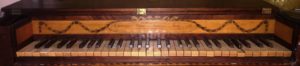
Square Piano by Christopher Ganer, London 1780 – Eric Feller Collection (Keyboard)
The nameboard is of light wood with inlaid ribbon, swags, and geometric stringing, all surrounded by diagonal mahogany cross banding richly painted with flowers and garlands and bears the signature:
“Christopher Ganer Londini fecit 1780
No 47 Broad Street Soho”
Christopher Ganer was born around 1750 in Leipzig. Like many other instrument makers he left the continent and is from 1774 in England as a harpsichord and piano maker (as well as a harp maker from about the mid-1780s) detectable. At that time, his workshop was at Broad Street 22, Golden Square, and later at Broad Street no. 47.
In 1774 he married Lydia Willey and had four daughters and a son who died in childhood.
Special by all instruments of Christopher Ganer is that he built the typical “trestle-stands” as well as from 1777/78 in fashion coming “french-stands“. His skills as an excellent cabinet maker made him build particularly elegant instruments with high quality inlays. In 1782 he built an instrument for Princess Amelia. All his instruments are individually designed and none are alike.
Until about 1784 Ganer always dated his instruments with the Latin inscription “Christopher Ganer Londini Fecit“.
According to different sources, he died in 1811 (in some sources also in 1818).
Other surviving instruments by Christopher Ganer:
- 1785 square piano (No.?) Fondazione Cassa di Risparmio, Bologna Italy
- 1785 square piano (No.?) Eric Feller Early Keyboard Instruments Collection, Germany
Der Beitrag Christopher Ganer 1780 erschien zuerst auf Eric Feller Early Keyboard Instruments Collection.
]]>Der Beitrag Érard Frères et Co. 1800 erschien zuerst auf Eric Feller Early Keyboard Instruments Collection.
]]>The instrument presented here was manufactured by the company Érard Frères et Co. in Paris in 1800. It is a very simply designed instrument. The case and the corresponding original legs are made of mahogany and adorned with a modest bronze trim. The nameboard is signed with:
“Érard Frères et Co.
Rue du Mail No. 37
à Paris 1800.”

Érard Frères et Co. 1800 – Eric Feller Collection
The original keyboard spans 5 octaves (FF – f3), with the lower keys covered in ivory and the upper keys made of ebony. The instrument is double-strung and has two pedals, integrated into the rear left leg, for dampers and Lute (Jeu de Luth).
On the soundboard, next to the bridge, the original handwritten signature with the serial number 4343 can be found.
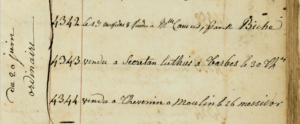
Square Piano Érard Frères et Co. 1800 No. 4343 – Eric Feller Collection (Erard production books 1)
According to the production books of the company Érard, the instrument was delivered to Monsieur Secrétan, a violin maker from Tarbes. It is currently only known that Monsieur Secrétan was both a violin maker and a carpenter. In the city archives of Tarbes, there is a handwritten document, dated May 15, 1807, in which he is named and listed with his profession as a violin maker. In this document, he was commissioned to prepare a report on the significance of the organ in the community.
Additionally, there are four other entries in the city archives of Tarbes from the years 1802, 1804, and 1828, in which the name Secrétan is mentioned. However, these entries refer to the head of the local fire department. It remains unclear whether Secrétan was a member of the fire department and volunteered, or whether there were two separate individuals, likely related, who shared the same surname.
Square Piano Érard Frères et Co. 1800 No. 4343 – Eric Feller Collection (Erard production books 2)
A second reference to Monsieur Secrétan appears in a rather unusual context during the French Revolution. On May 30, 1793, the National Convention decreed the establishment of a cannon foundry in Tarbes. A few days earlier, a decree had ordered the confiscation of most of the bells in the department. The chosen location for the foundry was the monastery of the Franciscan Brothers, which had served as a “Maison nationale” since December 20, 1792. Prior to this, it had been the seat of the States of the Province of Bigorre and hosted the final sessions of the assemblies of the Clergy and the Nobility in April 1789. The violin maker Monsieur Secrétan agreed to oversee the foundry. The foundry lasted only a short time and was auctioned on June 1, 1796, for 6400 Francs to François Dassieu, a doctor in Tarbes.
(via “Trois canons anciens à Tarbes” in: La Nouvelle République des Pyrénées, March 28, 2020)
Manuscript Municipal Archive of the City of Tarbes from May 15, 1807 (Page 33)
Detailed information about the company Érard Frères can be found in the publications – click here!
Other surviving instruments by the company Érard Frères et Co.:
- 1800 Square Piano (No. 4475), Metropolitan Museum of Art, New York, USA
- 1808 Square Piano (No. 7488), Cité de la Musique, Paris, France
Der Beitrag Érard Frères et Co. 1800 erschien zuerst auf Eric Feller Early Keyboard Instruments Collection.
]]>Der Beitrag Érard Frères 1805 erschien zuerst auf Eric Feller Early Keyboard Instruments Collection.
]]>The nameboard is signed with:
“Érard Frères
Rue du Mail No. 37 à Paris 1805.”
The original keyboard with a compass of 5 ½ octaves (FF – c4) is made in ivory and the instrument has got 4 pedals.
On the soundboard is the typical handwritten signature from Érard with the serial number 6115. By doing the research about the history of the instrument I found out that it was made for the family Cochu.
A very rare and early instrument made by one of the famous instrument builders in the world.
The instrument has undergone only minimal restoration and remains in a highly original state.
Further information about the company Érard Frères can be found here!
Other surviving instruments made by Érard & Frères:
- 1805 square piano (No. 6447) Museum für Kunst und Gewerbe Hamburg, Germany
- 1808 square piano (No. 7488) Cité de la Musique Paris, France


Der Beitrag Érard Frères 1805 erschien zuerst auf Eric Feller Early Keyboard Instruments Collection.
]]>