Der Beitrag J. G. Irmler 1924 erschien zuerst auf Eric Feller Early Keyboard Instruments Collection.
]]>“J. G. Irmler
Leipzig”
The hammers of the piano are covered with felt, triple strung (double strung in the bass) and single dampers. The instrument is cross-stringed over a steel frame and has two pedals for dampers and due corde. The keyboard has a compass of 7 ¼ octaves, AAA – c5. The soundboard shows the serial number 24883.
This grand piano is impressive with its warm sound and excellent craftsmanship.
The instrument is currently on permanent loan in the Old Pastorate in Stellau/Wrist.

Art Déco Grand Piano by J. G. Irmler, Leipzig 1924 (2) – Eric Feller Collection
Johann Christian Gottlieb Irmler was born on February 11th in Obergrumbach, near Dresden. He learnt to play the piano and violin in his youth and was considered very musical. He later learnt a profession in carpentry and travelled through Saxony, Thuringia and Bavaria. He studied piano making in Vienna but settled in Leipzig and worked for Breitkopf & Härtel for some time. He then became self-employed in Leipzig and, at the age of 28 and founded his own piano making house on April 8, 1818, based in the Barfußmühle. Irmler’s instruments had a very good reputation and the company quickly expanded due to growing demand. In 1828 the company moved to larger premises on Leplaystrasse. The company also distinguished itself through new inventions in piano construction. In 1842, Johann Christian Irmler received the Great Golden Saxon Royal State Medal from the King of Saxony for a new type of repeating action.

J. G. Irmler Pianoforte Company – Eckert & Pflug, Leipzig 1893
Johann Christian Irmler died on December 10, 1857 and the company was continued by his sons Otto (1820 – 1861) and Oswald (1835 – 1905). In 1861 the company was modernised by using steam engines. Due to Otto’s early death at the age of just 41, Oswald, then only 26 years old, continued to run the company alone until his death. Oswald’s son then continued to run the company. During the Second World War, the company on Leplaystrasse and the warehouse on Turnerstrasse were completely destroyed in 1943. Instruments were then manufactured until the 1950s.

Art Déco Grand Piano by J. G. Irmler, Leipzig 1924 (3) – Eric Feller Collection
Der Beitrag J. G. Irmler 1924 erschien zuerst auf Eric Feller Early Keyboard Instruments Collection.
]]>Der Beitrag Joseph Fritz c. 1835 erschien zuerst auf Eric Feller Early Keyboard Instruments Collection.
]]>“Joseph Fritz
Wien”

Joseph Fritz, Vienna c. 1835 – Eric Feller Collection (3)
The hammers are covered with leather, Viennese action, straight string with a divided bridge and two pedals (dampers and una corda). The compass is 6 octaves + sixth, CC – a4. The music stand is attached above the wrest plank and has two pivoting candle holders on each side.

Joseph Fritz, Vienna c. 1835 – Eric Feller Collection (4)
Little is known about Joseph Fritz. He was born in Vienna in 1808 and is the son of Johann Fritz (born 1772 – died in Vienna 1834). After his father’s death, he continued to run the workshop and continued the successes of his father, who previously had the reputation of being one of the best piano makers in Vienna. From about 1837 he moved his workshop to Graz and built instruments there.
Other surviving instruments by Joseph Fritz:
- c. 1840 Grand Fortepiano – Collection Cristofori, Historical Keyboard Instruments B.V., Amsterdam / The Netherlands

Joseph Fritz, Vienna c. 1835 – Eric Feller Collection (2)
Der Beitrag Joseph Fritz c. 1835 erschien zuerst auf Eric Feller Early Keyboard Instruments Collection.
]]>Der Beitrag Ignace Pleyel 1863 owned by Charles Albert d’Arnoux – Bertall erschien zuerst auf Eric Feller Early Keyboard Instruments Collection.
]]>
Charles Albert d’Arnoux – Bertall (1820 – 1882) by A. Disdéri
This extraordinary French fortepiano is an important historic instrument in music history, as it comes from the possession of the famous French caricaturist, draftsman and etcher Charles Albert d’Arnoux, or better known as Bertall. He is also known as one of the pioneers of photography. The Pleyel company in Paris was one of the leading piano manufacturers in Europe in the 19th century. Their clients included leading personalities, artists, musicians and composers.
The case of the instrument is made of rosewood with elaborate carvings on the sides near the keyboard. The keyboard is made of ivory and ebony, the hammers are covered with felt and the piano has single dampers. The lyre has two pedals for dampers and una corda. The keyboard has 7 octaves (AAA – a4).

Ignace Pleyel, Paris 1863 owned by Bertall – Eric Feller Collection
The serial number (35351) can be found on the right side of the instrument. The version is the “Petit Patron” model with a total length of 215 cm. The front bears the inscription:
“Ignace Pleyel & Comp.
Paris”

Ignace Pleyel, Paris 1863 owend by Bertall (serial number) – Eric Feller Collection
Inside the piano there are three metal bars. Entries in Pleyel’s original company books indicate that the instrument was completed in 1863 and then sold for 1400 Franc on February 15, 1867 to Charles Albert d’Arnoux – Bertall in Paris. This provenance and the marvellous and beautiful sound make this fortepiano to a special highlight in the collection.

Fortepiano Pleyel 1863 No. 35351 – Eric Feller Collection
Charles Constant Albert Nicolas d’Arnoux de Limoges Saint-Saens (his full birth name) was born on December 18, 1820 in Paris. He was the son of Daniel d’Arnoux de Limoges Saint-Saens (born September 9, 1780 in Grenoble) and his wife Louise-Elisabeth de Limoges (the dates of her life are not yet known), who married in Paris on February 16, 1819. A year later Charles Albert d’Arnoux was born. He was the only child from this marriage. Nothing is known about his childhood so far. Around 1844 he married Albertine Pellapra and together they had 7 children:
- Gabrielle Louise Henriette d’ARNOUX 1845 – 1912
- Georges Noël Adrien d’ARNOUX 1848 – 1917
- Louis Eugene Joseph d’ARNOUX 1859 – 1864
- Daniel Ernest Albert d’ARNOUX 1862 – 1915
- Emilie Albertine d’ARNOUX 1866 – 1949
- Elisabeth Albertine d’ARNOUX 1866 – 1956
- Marie Albertine d’ARNOUX 1866 – 1908

Elisabeth Pellapra de Lolle
On March 18, 1877, his wife Albertine died in Paris at the age of 55. Two years later (on January 12, 1879) Bertall married the sister of his late wife Hortense Pellapra in Paris. They had no children together.
Bertall’s parents intended their son to study at the École Polytechnique, but he devoted himself to painting. He spent the first years in the studio of Michel Martin Drolling (1786 – 1851) and then decided on illustrative drawings and caricatures as his artistic focus.

Michel-Martin Drolling, Self-Portrait (1804)
On advice of Honoré de Balzac (1799 – 1850), he only signed his works with Bertall, an anagram of his first name Albert. On February 3, 1875 he was made a Knight of the Legion of Honour. He drew for various magazines and newspapers and illustrated books, including his own texts. He also showed an interest in photography from an early age and from 1855 worked together with the famous photographer Hippolyte Bayard (1801 – 1887). In the early 1860s, both Bayard and Bertall opened a photo studio at Rue de la Madeleine No. 15 in Paris. In 1866 they separated and Bertall opened his own photo studio. There he specialized in portraits. Shaped by his artistic environment, music was also an important point in his life and family. On March 24, 1882, Bertall died in Soyons.

Hippolyte Bayard – Self-Portrait 1863
Publications by Bertall:
- Les Omnibus, pérégrinations burlesques à travers tous chemins, avec Lefix, 1843
- Les Buses-Graves, prospectus publicitaire, 1843 : parodie des Burgraves de Victor Hugo, Tortu Goth (which was also a pseudonym of Bertall)
- Les Guêpes à la Bourse, 1847
- Cahier des charges des chemins de fer, 1847
- Les Enfants d’aujourd’hui, album de caricatures, 1848
- La Revue comique à l’usage des gens sérieux, novembre 1848 – avril 1849
- Les Infortunes de Touche-à-tout, 1861
- Mlle Marie sans-soin, 1867
- M. Hurluberlu et ses déplorables aventures, 1869
- Les Communeux, 1871. Types, caractères, costumes, 1871
- Le Grelot au Salon. Le Salon de 1872 dépeint et dessiné par Bertall, 1872
- La Comédie de notre temps : études au crayon et à la plume. I. La civilité, les habitudes, les mœurs, les coutumes, les manières et les manies de notre époque. II. Les enfants, les jeunes, les mûrs, les vieux. III. La vie hors de chez soi : l’hiver, le printemps, l’été, l’automne, 3 volumes, 1874-1876
- Les Contes de ma mère, recueillis et illustrés par Bertall, 1877
- La Vigne, voyage autour des vins de France : étude physiologique, anecdotique, historique, humoristique et même scientifique, 1878
- Mademoiselle Jacasse, 1879
- Les Plages de France, 1886
- Georges le distrait, 1889
Illustrated books by Bertall:
- Honoré de Balzac : Œuvres complètes, 20 volumes, 1842-1855
- Eugène Briffault : Paris dans l’eau, 1843
- Pierre-Jules Hetzel : Nouvelles et Véritables Aventures de Tom Pouce, 1844
- Collectif : Le Diable à Paris. Paris et les Parisiens. Mœurs et coutumes, caractères et portraits des habitants de Paris, tableau complet de leur vie privée, publique, politique, artistique, littéraire, industrielle, etc., 2 volumes, 1845-1846
- Honoré de Balzac : Petites Misères de la vie conjugale, 1845
- Alexandre Dumas : La Bouillie de la comtesse Berthe, 1845
- Alexandre Dumas : Histoire d’un casse-noisette, 1845
- Paul Féval : Contes de nos pères, 1845
- Maurice Alhoy : Les Bagnes, 1845
- Maurice Alhoy et Louis Lurine : Les Prisons de Paris, 1846
- Octave Feuillet : Vie de Polichinelle et ses nombreuses aventures, 1846
- Léon Gozlan : Aventures du prince Chènevis, 1846
- Émile Souvestre : Le Monde tel qu’il sera, 1846
- Eugène Briffault : Paris à table, 1846
- Jean Anthelme Brillat-Savarin : Physiologie du goût, 1848
- Nicolas Boileau : Œuvres poétiques, 1846
- Bernardin de Saint-Pierre : Paul et Virginie, 1849
- James Fenimore Cooper : Le Dernier des Mohicans, 1849
- Charles Perrault : Contes, 1852
- Georges Bonnefons : Les Hôtels historiques de Paris, 1852
- Hoffmann : Contes fantastiques, 1856
- Jacques Porchat : Contes merveilleux, 1858
- Paul Boiteau : Légendes pour les enfants, 1861
- Comtesse de Ségur : Les Vacances, Les Petites Filles modèles, 1863
- Wilhelm Hauff : L’Auberge du Spessart, contes allemands, 1863
- Arthur de Gravillon : La Malice des choses, 1867
- Edmond Auguste Texier : Le Journal et le journaliste, 1868
- Miguel de Cervantes : Don Quichotte, 1870
- Alphonse Daudet : Les Petits Robinsons des caves ou le siège de Paris, 1872
- Jean Macé, Contes du petit château, 1876
- Paul de Kock : La Laitière de Montfermeil. Le Muletier, 1878
- Arthur de Rothschild : Histoire de la poste aux lettres et du timbre-poste depuis leurs origines jusqu’à nos jours, 1880

Ignaz Josef Pleyel (1793) after Thomas Hardy
The Pleyel company was founded in 1807 by the Austrian composer and music publisher Ignaz Josef Pleyel (born in Ruppersthal 1757 – died 1831 in Paris) under the name Ignace Pleyel & Comp. Before that, in 1797, he founded a music publishing company in Paris and established himself in the musical life of the French metropolis. In 1802 he designed his first piano (the patent application was made in 1807). Together with the instrument maker Charles Lemme, he founds the piano factory. With the support of various patrons, he was able to establish his business.
He was soon joined by his son (Joseph-Étienne-) Camille Pleyel (born 1788 in Strasbourg – died 1855 in Paris), who became a full partner in 1815. Camille Pleyel studied composition with his father and piano with Johann Ladislaus Dussek (born 1760 in Čáslav / Central Bohemia – died 1812 in Saint-Germain-en-Laye). He spent most of his youth in London but returned to Paris in 1824 to take charge of the firm that year.

Camille Pleyel c. 1840
In the 1820s, the Pleyel factory was located in Saint-Denis. During this time, about twenty workers made about fifty pianos a year. At its first exhibition in Paris in 1827, the firm won a gold medal, awarded for its inventions and for a three-string grand piano that was ranked on a par with the best English pianos. At the Paris Exhibitions in 1839 and 1844 the firm triumphed again by winning more gold medals. The acclaim was an excellent spur to business and by 1844 production had increased to 900 pianos a year.
Camille Pleyel established the first Salon/Salle Pleyel and had many friendly relationships with the most famous people of musical life of the time. Great composers such as Frédéric Chopin (1810 – 1849) or Franz Liszt (1811 – 1886) played instruments made by Pleyel. The Salle Pleyel, one of the earliest concert halls in France and was built on Rue Rochechouart in the late 1820s. Chopin played his last concert there on February 16, 1848.
After Camille’s death in 1855, his son-in-law Auguste Wolff (1821 – 1887) took over the management of the company. He changed the name to Pleyel, Wolff & Cie. and continued the success of the company.
His son-in-law Gustave Lyon (1857 – 1936), who took over the company in 1887, continued the success. In 1971, ten years after the merger of Pleyel with Érard and Gaveau, Schimmel from Braunschweig acquired all three companies.
Other surviving instruments by Ignace Pleyel & Comp. can be found in many museums and private collections worldwide.

Ignace Pleyel, Paris 1863 owend by Bertall (4) – Eric Feller Collection
References:
- René Beaupain: Chronologie des pianos de la maison Pleyel. Éditions L’Harmattan, Paris 2000
- Henri Beraldi, Les Graveurs du XIXe siècle, vol. II, 1885
- Jean-Jacques Eigeldinger: Chopin et Pleyel. Fayard, Paris 2010
- John Grand-Carteret: Les moeurs et la caricature en France. Paris 1888
- Jean-Jacques Trinques: Le piano Pleyel d’un millénaire à l’autre. Éditions L’Harmattan, Paris 2003
- Arnaud Marion: Pleyel. Une histoire tournée vers l’avenir. Éditions de la Martinière, Paris 2005
- Arnaud Marion: La Salle Pleyel: Lieu de Modernité. Éditions de la Martinière, Paris 2006
- Arnaud Marion: La Salle Pleyel. In: Connaissance des Arts, Hors série. 5. November 2006
- Daniel Mason. Der Klavierstimmer Ihrer Majestät. Roman. Blessing 2003
- J. Rousseau, Histoire d’une résurrection: pianissime Pleyel. In: Classica-Répertoire. September 2007, S. 46–47
- Jean Jude: Pleyel 1757–1857. La passion d’un siècle. Imprimerie du Centre Loire, Fondettes 2008
- Gustave Vapereau, Dictionnaire universel des contemporains, vol. 1, 1858
© Eric Feller – Early Keyboard Collection – December 2022
Der Beitrag Ignace Pleyel 1863 owned by Charles Albert d’Arnoux – Bertall erschien zuerst auf Eric Feller Early Keyboard Instruments Collection.
]]>Der Beitrag Rousselot Freres ca. 1834 erschien zuerst auf Eric Feller Early Keyboard Instruments Collection.
]]>The case is made of rosewood and decorated with inlays and brass applications. The keyboard is made of ivory and ebony. The instrument is straight strung, two small metal bars in the treble, Stoßzungenmechanik and two pedals for dampers and due corde. The bridge is divided. The nameboard bears the inscription in a cartouche:
“Rousselot Frères
Facteurs Brevetés à Nîmes
Moitessier a Montpellier”
In the middle of the soundboard is a handwritten signature with the serial number:
“No. 903 Louis Rousselot à Nîmes”
Inside is the original dust cover above the strings, a feature that was only built for a short time on grand fortepianos and has its origins in the early square pianos of the 18th century. The compass is 6 ½ octaves (CC – g4). In addition to the music stand, there are two smaller music stands on either side, which can be lift up to make playing music with others easier.
From this instrument should be emphasised the absolutely high-skilled production as well as the sound. In terms of sound, this fortepiano surpasses also the instruments by Erard and Pleyel which were played by Chopin, Liszt and Schumann. Only a few instruments by Rousselot have survived. A note from the “Journal de Toulouse” of July 23, 1845 shows that Rousselot manufactured all parts for his instruments in his own factory and did not purchase any parts from external suppliers.
This grand piano was found in Marseille / France in autumn 2022 and is in completely original condition.

Fortepiano by Rousselot Frères, Nimes c. 1834 – Eric Feller Collection (Nameboard)
Little is known about the Rousselot company. There were probably three brothers: Louis Rousselot (the life dates are not yet known), who was active as a piano builder, Joseph-François Rousselot (born February 6, 1803 in Nîmes, died September 4, 1880 in Argenteuil), composer and horn player and Scipion Rousselot (born 20 July 1804, died c. 1880), who was also a composer and cellist.
(see Joël-Marie Fauquet, «Rousselot, Scipion», in Joël-Marie Fauquet (dir.), Dictionnaire de la musique en France au xixe siècle, Fayard, 2003, xviii-1406 (ISBN 2-213-59316-7 , BNF 39052242))
The piano factory in Nîmes can be traced back to around 1833, but it is highly probable that instruments were made before that. The signature on the nameboard shows that Louis worked with at least one of his brothers. Whether it is Joseph-Francois, Scipion or another brother has not been clarified yet. Also, no information is known about his apprenticeship years. Further research is currently undergoing! During his active period, Louis Rousselot entered into various partnerships with other instrument makers. Instruments from a collaboration with Decombes and Moitessier in Montpellier have been preserved.
Little is known about the history of the company. An article from 1840 informs that a fire broke out in the factory:
“L’incendie de la fabrique de pianos de MM. Rousselot frères : “L’incendie de la fabrique de pianos de MM. Rousselot frères (1840) fut aussi l’occasion d’une de ces manifestations, où une partie de notre troupe masculine, groupée autour d’une cantatrice de grand talent (Mme Lernoule), se transporta au Grand Théâtre devant un auditoire considérable, accouru pour soulager les malheureux ouvriers de l’établissement détruit. […] Enfin, cette année (1841) fut marquée par un beau concert donné au Théâtre par Mne Lemoule et quelques amateurs (quorum pars. fui), pour aider a la reconstitution de ta fabrique de pianos de MM. Rousselot frères, détruite par un incendie.”
(from „Mémoires de l’Académie de Nîmes“, 1881, Gallica)
Another fire broke out in the factory in 1842:
“Nîmes, 6 septembre – dans la nuit du 4 au 5 de ce mois il y a eu en ville trois incendies ou tentatives d’incendies. […] Chez le sieur Rousselot, fabricant de pianos, place Balore, le feu s’est manifesté dans le magasin où sont renfermés, pour une somme considérable, des bois précieux; heureusement on a pu s’en apercevoir assez à temps pour arrêter les progrès d’un incendie qui pouvait devenir très-considérable. […]”
(from „Le Journal de Toulouse“, 07/09/1842, Rosalis)
At the “Exposition des Produits des Beaux-Arts et de l’Industrie: Dans les galeries du Capitole à Toulouse” in 1840, instruments by Rousselot (and Boisselot) were exhibited and evaluated by a jury. As a result, these were highly acclaimed and placed on par with the Paris-based instruments by Pleyel and Erard:
“M. Rousselot, de Nimes, est également inventeur de quelques nouveaux procédés. Ainsi il peut, au moyen d’une mécanique bien simple appliquée au piano, rendre le clavier doux ou dur au toucher. Mais cet effet ne peut se faire progressivement comme sur les pianos de M. Martin. M. Rousselot a également substitué des ressorts, à boudin à ceux à frottement; ce qui donne plus de force l’échappement, et de grandes garanties pour la solidité.
Boisselot présente plusieurs innovations. Il a imaginé un mécanisme pour les marteaux du piano, à axe fixe et à vis de rappel, qui sert de régulateur. Cette combinaison permet, en cas d’accident, de réparer les marteaux isolément, au lieuque dans les mécanismes anglais, francais ou allemands, pour la moindre réparation, il est indispensable de démonter une série de douze marteaux. Ces derniers peuvent encore attaquer, par une oscillation contraire, des notes qui ne leur sont point destinées.
Boisselot a encore inventé un piano à petite queue, avec barrage par dessous. Ce barrage a été reconnu excellent par la commission de l’industrie, parce que ce système donnait une grande solidité à l’instrument, puisque le sommier des pointes et celui des chevilles ne fesaient plus qu’un seul corps avec la barre de dessous.
Cette construction donne en outre au son beaucoup d’intensité. Mais ce qui mérite les plus grands éloges, et ce qui peut être considéré comme un progrès et une invention éminemment utile, c’est le piano clédiharmonique. Tout le monde sait que le piano offre de grandes difficultés pourmonter deux cordes à la fois en leur fesant tenir un parfait accord.
Cette difficulté semblait devoir rester inhérente à la fabrication du piano; cependant M. Boisselot, par de grandes études et des épreuves réitérées, vient de remédier à cet inconvénient en inventant le clédiharmènique. Cette invention n’a d’autre but que de simplifier l’opération de l’accord en la mettant à la portée de chaque pianiste, et lui permette demonter à la fois et avec la plus grande facilité les deux cordes, en les maintenant à l’unisson parfait aumoyende clés à vis sans fin, de roue d’engrenage, vis de pression, poulies, ovales, etc, etc., le tout formant un mécanisme des plus ingénieux et desmieux combinés, et par lequel toutes les chances d’un’ bon accord sont prévues. Un tel résultat est un pas immense dans l’art de la facture des pianos, parce qu’il résout un problème qui jusqu’à ce jour n’avait point été résolu,malgré toutes les recherches des facteurs.
Après avoir constaté et jugé ces différentes inventions, nous avions à prononcer sur lemérite de chacun des instruments des exposans.
La besogne devenait rude, parce que le nombre de ces instrumens était considérable, et que l’industrie de chacun des fabricans pouvait se ressentir de notre décision. Cependant nous n’avons reculé devant aucune de ces corisidérations. Forts de notre mandat, pénétrés. de nos devoirs de jurés, nous avons jugé tous ces pianos, et nous allons avoir l’honneur de rendre compte de nos jugemens.
Après avoir établi des catégories, les pianos carrés à deux cordes ensemble, ceux à trois cordes, les pianinos, les pianos à petite queue et ceux à grande queue; après les avoir essayés de toutes les manières; après les avoir comparés entr’eux, pesé le fort et le faible des uns et des autres, le juri a trouvé qu’en première ligne se présentaient MM. Pleyel et Pape, facteurs de Paris, dont la réputation est européenne.
Mais ces artistes sont si haut placés, ils ont un mérite si incontestable, ils ont été couronnés si souvent pour l’excellence de leurs produits, que le juri pas cru devoir faire entrer leurs instrumens en lutte avec ceux des différens facteurs du midi de la France.
Mazel, qui est leur 1e présentant à Toulouse, a dans ses magasins les meilleurs pianos qui soient sortis de leurs ateliers, et tout ce que nous pourrions dire n’ajouterait rien à leur réputation. Nos pays méridionaux possèdent deux facteurs de pianos qui peuvent rivaliser avec les premiers de Paris pour quelques-uns de leurs instrumens: ce sont MM. Boisselot de Marseille, et Rousselot de Nîmes.
Ces artistes ont exposé des pianos à queue qui réunissent à une grande élégance, à une solidité à toute épreuve, les qualités si essentielles de la sonorité, de l’égalité dans le clavier, et de la perfection dans le mécanisme.
Une discussion très vive s’est engagée au sein du juri sur le mérite de ces instrumens; il a déclaré à l’unanimité que MM. Boisselot et Rousselot ne le cédaient en rien aux plus habiles facteurs de la capitale pour la fabrication des pianos à queue, et qu’ils pouvaient rivaliser avec eux, si même ils n’établissaient à de meilleures conditions et à des prix moins élevés.
Les instrumens de ces messieurs possèdent des qualités du premier ordre ; tous deux ont établi de ces pianos à deux et à trois cordes qui ne laissent rien à désirer dans aucune partie de leur facture.
Il était donc impossible d’établir la supériorité de l’un sur l’autre : cela devenait d’autant plus difficile, que les instrumens n’était pas identiques dans leur ensemble.
Ainsi, les pianos à petite queue de M. Rousselot ont quatre pouces de longueur en plus que ceux de M. Boisselot, et la qualité du son pouvait avoir, par cette raison, plus d’éclat çependant la différence est peu sensible.
De même que dans les pianos à grande queue, ceux de M. Rousselot ne sont armés que de deux cordes jusqu’au fa, cinquième ligne, clé de sol, tandis que ceux de M. Boisselot ont trois cordes dans toute l’étendue dit clavier.
Quoique ces derniers aient plus de son par cette cause, les instrumens de M. Rousselot ont un mérite bien grand aussi, puisque avec une corde demoins ils produisent de fort beaux effets de sonorité, et peuvent rivaliser avec ceux de M. Boisselot.
Cependant l’importance de l’industrie devant entrer en lutte avec l’excellence des instrumens, le juri a reconnu que M. Boisselot l’emportait sur MM. Rousselot et Moitessier, de Nîmes, et il a décidé que M. Boisselot aurait une médaille d’or pour la bonté de ses pianos à queue, son piano clédiharmonique, ses inventions diverses et l’importance de son industrie.
Il a encore arrêté que MM. Rousselot et Moitessier, de Nîmes, auraient une médaille d’argent avec éloges pour l’excellente facture de leurs pianos à queue. Nous avons à rendre compte de notre jugement sur les pianos carrés à trois et à deux cordes, de MM. Boisselot, Rousselot, Cropet et Martin.
Les pianos carrés à trois cordes ont présenté au juri de grands défauts; chez les uns, le son était sec et le clavier dur ou empâté ; chez d’autres, les sons graves écrasaient ceux du médium ; d’autres encore paraissaient être couverts d’une sourdine; enfin ces instrumens offraient des défectuosités si patentes, que le juri les amis hors de concours, donnant ainsi une leçon sévère aux facteurs, et les avertissant qu’ils avaient de grandes améliorations à introduire dans ce genre d’instrument.
Les pianos à deux cordes ont offert dés résultats satisfaisans, et ceux d’un petit format ont mérité les éloges du juri. La bonté de ces petites instrumens, la modicité de leur prix, qui les met à la portée des plus minces fortunes, ce qui permettra à l’art de se répandre chez les classes les moins aisées de la société, tout faisait un devoir au juri d’encourager ces produits de notre industrie.
ll a été très satisfait de voir que ces instrumens étaient soignés, que le son en était d’une excellente qualité et lamécanique très solidement établie. Les facteurs qui méritent des encouragemens pour ces instrumens sont MM. Martin, de Toulouse, et M. Rousselot, de Nîmes.
Ce dernier avait envoyé un piano de meilleure qualité que ceux de M. Martin ; mais cet instrument étant arrivé après que le jugement avait été rendu, il a été écarté du concours, et la préférence est restée aux pianos de M. Martin.
Il a été accordé à ce facteur, pour ses pianos carrés à deux cordes, son gymnase digital, instrument dès plus recommandables pour le développement et la souplesse des doigts, etc., ses différentes inventions, a fin de l’encourager dans les efforts qu’il fait journellement pour le perfectionnement de ses instrumens, une médaille d’argent.
Boisselot, Martin et Cropet ont exposé chacun un piano droit. Celui de M. Boisselot est un meuble en palissandre, forme moyen-âge, du style le plus gracieux et le plus élégant. Celui de M. Martin est un secrétaire-piano qui sert à la fois de bureau; l’invention en est fort ingénieuse et lemeuble aussi des plus élégans et des plus riches.
Le piano droit de M. Cropet est tout simplement un piano droit fort gracieux et surtout fort bon. Ce piano a lutté avec avantage contre ceux de M. Martin et Boisselot, qui sont cependant fort remarquables.
Le juri a trouvé l’instrument de M. Cropet supérieur, et lui a accordé une médaille d’argent en récompense du laient et des soins qu’il a déployés dans la confection de cet instrument.”
(from “Exposition des Produits des Beaux-Arts et de l’Industrie: Dans les galeries du Capitole à Toulouse en 1840”, p. 106-107)

Rousselot & Decombes – Piano label c. 1840
At the renewed exhibition in Toulouse in 1845, Rousselot was honoured with the gold medal for his excellent instruments. The purity of the sound and the evenness and lightness of the keyboard were emphasized. The silvery timbre and the powerful bass of the grand pianos was also praised. The report says:
“Médailles d’Or. MM. ROUSSELOT et Comp.e, à Nîmes (Gard), Ont exposé des pianos droits, des pianos carrés et un piano à queue petit format.
Ces instruments se recommandent en général par la pureté du son, l’égalité et la facilité de leurs claviers. Les pianos carrés ont été jugés préférables aux pianos droits. MM. Rousselot n’ont exposé qu’un piano à queue petit format. Cet instrument a paru fort bien établi, la qualité de son en est belle, le timbre des notes supérieures est argentin, lemilieu sonore, et les basses ont une grande puissance. Cet instrument a été comparé par le juri à un piano du même format de Pleyel; il a soutenu la comparaison avec honneur; c’est lui faire une belle part d’éloges.
Le juri a reconnu dans les oeuvres de ces facteurs des qualités essentielles; ils occupent un nombreux personnel d’ouvriers et ils confectionnent dans leurs ateliers tout ce qui a rapport aumécanisme du piano, soit en ouvrage de fonte, fer, cuivre, etc., ce qui leur permet d’établir leurs instruments à des prix modérés, tout eu les rendant solides et durables. Par toutes ces considérations, le juri décerne à MM. Rousselot et Comp.e une médaille d’or.”
(from “Exposition des Produits des Beaux-Arts et de l’industrie : A Toulouse dans les galeries du Capitole“, 1845, Rosalis)
Other surviving instruments by Rousselot Frères:
- Grand Fortepiano no. 954 – Musée de Piano, Ville de Limoux
- Grand Fortepiano no. 1299—Eric Feller Collection
Der Beitrag Rousselot Freres ca. 1834 erschien zuerst auf Eric Feller Early Keyboard Instruments Collection.
]]>Der Beitrag Collard & Collard c. 1843 erschien zuerst auf Eric Feller Early Keyboard Instruments Collection.
]]>
Frederick William Collard by Charles Turner, after James Lonsdale – National Portrait Gallery London
The case of this elegant instrument is made of walnut with elaborate carvings on the sides and the three legs. Two wooden applications for closing the lid are attached around the case. The music stand is elaborately decorated and covered with light green silk on the back. The keyboard is made of ivory and ebony, the hammers are covered with felt, double strung and the instrument has got single dampers. The lyre has two wooden pedals for controlling the dampers and una corda. The keyboard range is 6 octaves plus two tones (FF – g4).

Hammerflügel Collard & Collard, London c. 1843 – serial number – Eric Feller Collection
The serial number (45423) is written in ink on the left side of the pin block. There is also a signature that the fortepiano was sold in Leeds. The nameboard bears the inscription:
“Patent Repeater
Collard & Collard
late
Clementi, Collard & Collard
London”

Hammerflügel Collard & Collard, London c. 1843 – Eric Feller Collection (2)
The instrument has a metal plate and three metal bars inside. Overall, this fortepiano impresses with its extremely precise manufacture, the elegant appearance and the very dark sound. Collard & Collard had various instruments on offer. Grand and square pianos were available in mahogany, rosewood, and walnut. At that time, they also offered different sizes in terms of length and number of octaves. The company continued to produced instruments till the early 20th century, but was sold to the Chappell Piano Company of London in 1929. The Collard & Collard name lasted until about 1960. Unfortunately, a fire in 1963 destroyed all of Collard and Clementi’s recordings, which became the property of Chappell Pianos when the company took over in 1929. This makes it extremely difficult today to accurately date the surviving instruments.
For detailed information on the history of Collard & Collard click here!

Hammerflügel Collard & Collard, London c. 1843 – Eric Feller Collection (7)
Other surviving instruments by Collard & Collard:
- 1840 Grand Fortepiano (No. 42573) – Thomas Strange, Easley USA
- 1840 Grand Fortepiano (No. 41978) – formerly Richard Burnett Collection, Finchcocks Musical Museum, England
Der Beitrag Collard & Collard c. 1843 erschien zuerst auf Eric Feller Early Keyboard Instruments Collection.
]]>Der Beitrag Maximilian Heilinger 1832 – 1835 erschien zuerst auf Eric Feller Early Keyboard Instruments Collection.
]]>
Concert programm by Franz Liszt 25. Oktober 1846 in Pecs
This fortepiano was built around 1832 – 1835 and still shows the angular shape. It is made entirely of wood, without metal bars. The case is made of walnut and stands on three baluster legs. The keyboard is made of ivory and ebony and the hammers are covered with leather. It has a Viennese Action, is straight string with a divided bridge and two pedals (controlling dampers and una corda). The compass is 6 octaves + fifth (CC – g4). The nameboard is decorated with brass inlays and bears the inscription:
“M. Heilinger “
There is also a second signature that can be found on a decorated paper label on the soundboard:
“Max Heilinger
Fünfkirchen”

Maximilian Heilinger, Fünfkirchen c. 1832-35 (Soundboard Signature) – Eric Feller Collection
The entire fortepiano is made extremely precisely and shows a high level of craftsmanship.
So far, relatively little research has been carried out into piano building in Hungary in the 19th century and unfortunately there are only very few sources that have been examined. Due to the influence by the piano manufacturer in Vienna, piano construction in Hungary developed in a structurally similar way. Far fewer instruments were made, but most with a high standard of craftsmanship. The new developed pianoforte had established itself in Hungary since the 1790s and the demand for these instruments increased constantly. Despite the high acquisition costs and the resulting follow-up costs for tuning and repairs, the demand (especially from the aristocracy) was immensely high.
In the early years, instruments from Vienna served as prototypes and were copied by local carpenters and organ builders. From around 1810 onwards, the company’s own production of the instruments was hardly sufficient and so many pianos were imported and sold from Vienna. The explanations of the Hungarian piano maker Lajos Beregszászy (1817 – 1891) are an interesting source of this development in the first half of the 19th century.
„Von 1825 bis 1848 befanden sich in Ungarn fortwahrend 20-25 Klaviermacher und manche Firma arbeitete mit so vorzüglichem Erfolge, dass sie, angemessen der damaligen Zeit, mit welchem ausländischen Erzeugnis immer die Konkurrenz bestehen konnte. […] Im Jahre 1846 begann ich [Beregszászy] in Pest die Klavierfabrikation, 1847 Balassowits und Weiss; die beiden letzteren erzeugten bis 1848 jährlich 5-10 Klaviere. Aus diesen Daten ist also ersichtlich, dass bis 1848 in Ungarn ungefähr 20-25 Klavier-Fabrikanten existierten, die zusammen 250-300 Klaviere erzeugten und da den damaligen Verhältnissen entsprechend in Ungarn ein Bedarf von 600 Klavieren bestand, so war die Hälfte mit heimischen Erzeugnissen gedeckt, während heute, wo das Klavier so verbreitet ist, dass kaum eine Haushaltung ohne dasselbe existiert, und jährlich 1800 Stück kaum zur Deckung des Bedarfes genügen, – außer meiner Fabrik, in der jährlich 50-60 höchstens 70 erzeugt werden und außer dem Pressburger Karl Schmidt, der jährlich kaum 10-15 herstellt, kein Klavier-Fabrikant existiert und so ist kaum der zwanzigste Theil des Bedarfes durch heimische Produkte gedeckt“
From: L. Beregszászy, The Situation of Piano Manufacturing in Hungary. Budapest 1874. pp. 3 and 5-6.
The main cities of Hungarian piano building were Pest, Buda and Bratislava. In addition, instruments were also produced in other cities. Furthermore, the local manufactured instruments were cheaper to buy and without high transport costs and customs duties, as by imported instruments from Vienna. As a result more piano builders appeared in Hungary from the 1820s onwards. Many piano makers who settled in Hungary in the 1780s, 1790s and the beginning of the 19th century came from Germany.
So far, very little is known about Maximilian (Miksa) Heilinger. A letter kept in the archive of the Janus Pannonius Museum in Pécs shows that he worked in Pécs in 1832.
„Tekintetes Nemes Tanács!
1832-dik Évtől, ugy mint attól az időtől, hogy a Tekéntetes Tanács hozott végzése következtében megengedni kegyeskedett, hogy mesterségemet e nemes városban folytathassam – folytonos fáradozásom után csak ugyann sikerült, – hogy a zongorán, annak nagyobb és biztosabb tökéletessége elnyerésére új találmányomul hozzá járulok – és ezen új találmányomra á Nagy Méltóságú Magyar Királyi Helytartó Tanácshoz elnyerendő magányos kiváltság levél végett folyamodásomat béadandok – melly kiváltságlevél elnyerésére a többek között felmutatni szüksége*. hogy több évek olta számos legényekkel a tisztelt közönségnek tellyes megelégedésével mesterségemet folytattam – Hogy számos legényekkel évről évre dolgoztam, közönségessen tudva vagyon, de különben is az esztendei Popularis Conscriptio annak tanuja.
Továbbá, hogy a tisztelt Közönség tellyes megelégedésével az 1832 Évtől mesterségemet folytattam, ennek nyilvános tanúja az – hogy 15 évek alatt bár melly munkámért Tekéntetes Tanács elébe mint bépanaszolat nem idéztettem -.
Midőn Kegyes pártfogásért alázattal esedeznék a szükséges Bizonyítványt kiadattni kérem, megkülönböző tisztelettel maradván A Tekéntetes Nemes Tanácsnak
legalázatosabb szolgája Heilinger Miksa Zongora készítő“
From: Yearbook of the Janus Pannonius Museum Pécs, No. 32, 1987, published in 1988 Janus Pannonius Museum
It is still unclear where his workshop was located from 1832 to 1845. In 1845 he bought a warehouse at the Déryné Street 5 for 4,500 guilders from Anna and Borbála Bittó. In 1849, however, he sold the building again at a price of 4,000 guilders. (See: József Madas: Grundstücke und Häuser der Innenstadt von Pécs, Pécs, p. 101, 1918.) He probably left Pécs or moved again.

Fehér kereszt, Arad 1880
In November 1846 Franz Liszt played one of his instruments in the Hotel Weißes Kreuz (today Hotel Ardealul) in Arad. Only three other instruments from his workshop are known yet.
Other preserved fortepiano by Maximilian Heilinger:
- 18?? Fortepiano – Arad
- 18?? Fortepiano – Historical Museum of the City of Pécs, Hungary
- 1860/70 fortepiano – Hangszermúzeum (Museum of Musical Instruments), Budapest, Hungary
Der Beitrag Maximilian Heilinger 1832 – 1835 erschien zuerst auf Eric Feller Early Keyboard Instruments Collection.
]]>Der Beitrag Friedrich Hoxa 1839 erschien zuerst auf Eric Feller Early Keyboard Instruments Collection.
]]>
Franz Liszt 1856 – Painting by Wilhelm von Kaulbach (1805 – 1874)
This fortepiano was built around 1839 and still shows the angular shape. At that time, metal bars and metal frames to reinforce the case and structure were already common, which this piano does not have. It is still made entirely of wood according to the traditional construction method. The case is made of walnut and rests on three baluster legs. The keyboard is made of ivory and ebony and the hammers are covered with leather. Viennese action, straight strung with a divided bridge and two pedals (dampers and una corda) the piano has a compass of 6 octaves + fifth (CC – g4). Above the strings there was a second soundboard (similar to the dust / soundboards on French grand pianos or early English square pianos) that was missing. Hoxa received a patent for this in 1826, in which an additional soundboard was attached to the strings.
For more information on additional resonance / dust covers, click here.
The nameboard bears the inscription:
„F. Hoxa
in
Wien
Silberne Medaille Ausstellung 1839“
There is also a second signature that can be found on a paper label to the soundboard:
„Johann Gugl
Klavier – Verkauf
Leih – Etablissement
Hauptgeschäft
Wien“
This signature comes from the workshop of Johann Gugl, who was a piano dealer in the 19th century and who ran an instrument shop at Bauernmarkt No. 588 inside the Gundelhof in Vienna.

Friedrich Hoxa, Wien 1839 – Eric Feller Collection (Nameboard)
Friedrich Hoxa was born in 1793 and it is believed that he was of Bohemian descent. In 1824 he received the citizenship of the city of Vienna and official permission to work as a piano maker. In April 1826 he received a five-year privilege and patent for the invention of a grand piano with a double soundboard, one above and one below the strings. In 1828 he suffered severe strokes of fate: his wife Aloysia Teschmayer (born 1785 in Vienna) died on May 19th and his son Rudolph (born 1826) on August 8th, 1828. She left him two more children: Karolina (born 1819) and Friedrich (born 1821), who also died in the following years. At that time the family lived in Altlerchenfeld No. 73. From 1825 on he was President of the “Corporation of Piano Builders Vienna”. In this position he was highly respected. He was very committed to ensure that only official piano makers with citizenship of the City of Vienna should built instruments. In an article dated March 12, 1843 in the Vereinigte Ofner-Pester-Zeitung, he openly advocated this together with Anton Tomaschek (1806 – 1860).

Newspaper article from 12.3.1843 in “Vereinigte Ofner-Pester-Zeitung”
Hoxa was highly recognized for his commitment and so an article appeared in the magazine “Der Wanderer” on March 8, 1845 about a public honour for his work.

Article 8.3.1845 from the magazine “Der Wanderer”
At the Dritten Allgemeinen Österreichische Gewerbeausstellung in Wien in 1845, Hoxa’s instruments were highly recommended and he received the gold medal as an award for his work.

Report from the 3. Allgemeine Österreichische Gewerbeausstellung in Wien, 1845
Very interesting in this report is the statement that Hoxa’s sales of instruments mostly went to distant countries like Constantinople (now Istanbul), Smyrna (now Izmir) or Egypt. It is very likely that his new innovations in piano building with metal frames, plates and bars were the reason why his instruments were so successful, especially in these warm climatic latitudes.
In 1851, at the London exhibition, Hoxa exhibited a 7-octave grand piano made of Hungarian poplar with metal bars and a brass string plate. Friedrich Hoxa probably died around 1858.
Other preserved instruments by Friedrich Hoxa:
- ca.1830 fortepiano – Conservatorio di Musica Perugia, Italy
- 1840/44 fortepiano – Technical Museum Vienna, Austria
Der Beitrag Friedrich Hoxa 1839 erschien zuerst auf Eric Feller Early Keyboard Instruments Collection.
]]>Der Beitrag Ernst Irmler 1852 – 1854, signed “F. Liszt 1856” erschien zuerst auf Eric Feller Early Keyboard Instruments Collection.
]]>Franz Liszt 1856, after Wilhelm von Kaulbach (1805 – 1874)
The harpsichord-shaped case of the instrument is made of rosewood and rests on three turned legs. A decorative strip with an egg stick pattern is attached around it. The nameboard is signed with:
“Ernst Irmler jun.
Leipzig”
The keyboard is made of ivory and ebony, the hammers are covered with leather and the fortepiano has 3 metal bars that are painted black with floral ornaments. The compass is 6 octaves plus sixth (CC – a4), Viennese Action, the serial number: 2464. The instrument is triple strung (bass double strung). It also has got two pedals for controlling the dampers and una corda.

Ernst Irmler, Leipzig 1852 – 1854 – Eric Feller Collection (Nameboard)
There is a handwritten signature by the composer and pianist Franz Liszt, which came to light during the cleaning process – “F. Liszt 1856”. In the 19th century it was sometimes common for pianists to immortalize themselves on the instrument they played after a concert. So, there are some surviving instruments that are signed, for example, by Franz Liszt, Sigismund Thalberg (1812 – 1871) or Ignaz Moscheles (1794 – 1870). In 1856 Franz Liszt stayed in Weimar. It can be assumed that he played the instrument there.

Ernst Irmler, Leipzig 1852 – 1854 – Eric Feller Collection (Signature: “F. Liszt 1856”)
The I. G. Irmler company manufactured square and upright pianos and also grands from their beginning in1818 and enjoyed a high reputation. The instruments were excellently crafted and were very much appreciated. Far less known (but no less qualitative) are the instruments of Ernst Irmler, a close relative who manufactured instruments under his name in Leipzig from around 1850.
Little is known about Ernst Irmler so far. He first worked in the family business to become a piano maker. He later sat up his own business and made pianos in Leipzig under his own name. He was active from around 1850 to 1879.
Other preserved instruments made by Ernst Irmler:
- 1852 – 1854 Grand Piano – Michaelstein Monastery Collection, Blankenburg Germany
- 1853 Square Piano – Deutsches Museum, Munich Germany

Ernst Irmler, Leipzig 1852 – 1854 – Eric Feller Collection (Soundboard)
Der Beitrag Ernst Irmler 1852 – 1854, signed “F. Liszt 1856” erschien zuerst auf Eric Feller Early Keyboard Instruments Collection.
]]>Der Beitrag Giovanni Crudeli c. 1830 – 1835 erschien zuerst auf Eric Feller Early Keyboard Instruments Collection.
]]>The case is made of walnut and rests on three baluster legs. The keyboard is made of ivory and ebony. There are two brass pinecone on each side at the end of the keyboard as part of the elegant decoration. The hammers are covered with leather.
The nameboard is signed with a ceramic label framed in brass with:
“Giovanni Crudeli
in
Livorno“
The instrument has a Viennese action and two pedals (dampers and una corda). The compass is 6 octaves + fifth (CC – g4).

Giovanni Crudeli c. 1830 – Nameboard – Eric Feller Collection
In the early 19th century Italian fortepianos were very much influenced by Viennese instruments.
Very little is known about Giovanni Crudeli. Certain are that he comes from a dynasty of organ builders. An entry about the company can be found in the “Guida di Livorno ossia Almanacco commerciale per l’anno 1831”.

Giovanni Crudeli in Livorno 1831 – Eric Feller Collection
No other surviving fortepianos by Giovanni Crudeli are known yet.
Der Beitrag Giovanni Crudeli c. 1830 – 1835 erschien zuerst auf Eric Feller Early Keyboard Instruments Collection.
]]>Der Beitrag Franz Xaver Christoph c. 1780 – 1785 erschien zuerst auf Eric Feller Early Keyboard Instruments Collection.
]]>This fortepiano is decorated in Rococo style and has various rocailles fields with richly floral paintings. The case is flat without plastic decorative elements. The filigree frame construction has carved ornaments on the sides, which lead over five curved legs. The five legs are connected 6-9 cm above the ground with filigree curved footbridges. In the centre of the bridge, it has an attached oval ornamental element, edged with carved acanthus leaves. The hinged three-leaf lid is attached to the back of the case with three hinges. The lid itself consists of six grooved fillings, which are slightly recessed on the inside, and through the raised frieze, the surface is divided; this in contrast to the outer surface, which forms a smooth surface. The instrument was not originally painted and had no frame base, but five legs, which were screwed into the case.
Before the piano was painted in two different stages, the surface was treated dark brown.
1st version:
There was a red basic colour with gilded bands and tendril ornaments on the case and frame.
2nd version:
About the red version came a chalk foundation for the following tempera painting with green colour base around the 15 gilded rocailles fields with filigree internal drawing. In that area it has floral motifs in colourful colours on a white background. The lid is painted green on the inside; in the six fields it has analogous outside floral motifs, which are also bordered in the two largest fields with line and acanthus tendrils. Over the cover friezes are leaves. On the green frame, the carved decoration in different shades yellow, red, blue and set with gilding.
The entire painting and decoration is of outstanding quality and made with highest artistic skills and taste and has been restored by a professional restorer for painting in Switzerland.

Fortepiano by Franz Xaver Christoph, Vienna c. 1780 (closed lid) – Eric Feller Collection
The instrument is unsigned but shows in all structural details features that it is clearly attributed to Franz Xaver Christoph. The piano has a compass of 5 octaves (FF – f3) and the keyboard is made of ebony and bone. The instrument features a Viennese Stoßzungenmechanik with forward facing hammers, Stiefeldämpfung and non divided bridge. On the underside of the keys are brass capsules with wire eyelets (in older instruments, these eyelets are made of gut string loops). A knee lever is controlling the dampers and in the middle of the nameboard is a hand stop for controlling a moderator stop.

Fortepiano by Franz Xaver Christoph, Vienna c. 1780 (Keyboard) – Eric Feller Collection
About Franz Xaver Christoph is only little known. He was born in Vienna in 1733 and was christened on 1 December 1733. He is today known as one of the best organ and piano makers in Austria in the 18th century. It is likely that he spent part of his education abroad. The first proven organ dates from 1768. It is the organ of the parish church Oberlaa / Vienna.
In 1776 one of his most important baroque organs was completed, the organ in the pilgrimage church Sonntagberg at Ybbs. His business was at Wieden No. 59 in Vienna. From 1777 to 1793 he received money for maintenance of the organs in the cathedral of St. Stephen in Vienna. 1784/85 he took over repairs to the Füchsel-Baldachin-Organ. From 1785 to 1788 he supervised the organ in the church of St. Michael in Wieden, which was also renovated by him in 1785. His pupil was Ignaz Kober (1755 – 1813). He continued Christoph’s work and brought it to perfection. On April 18th 1793 Franz Xaver Christoph died in Windmühle. After his death, Franz Hubert (around 1770 – 1810), who came from Bratislava, took over the business after he had married Christoph’s second wife Cäcilie Geill (1751 – 1807).
Further research to this instrument is still ongoing!
Further preserved instruments by Franz Xaver Christoph:
- 1785/90 combination instrument organ & square piano – Kunsthistorisches Museum, collection of old musical instruments, Vienna, Austria (click here)
- 1790 square piano -Muzej za umjetnost i obrt, Zagre, Croatia
Der Beitrag Franz Xaver Christoph c. 1780 – 1785 erschien zuerst auf Eric Feller Early Keyboard Instruments Collection.
]]>Der Beitrag Karl Benedict c. 1785 erschien zuerst auf Eric Feller Early Keyboard Instruments Collection.
]]>The case (in angular shape) is made of veneered cherry with frame and fillings and is inlaid with various woods on the sides. The instrument stands on 4 tapering legs. A white enamel plaque on the nameboard bears the inscription:
„Karl Benedict
Instrumentenmacher
in Gratz”
Behind the nameboard is the handwritten serial number “1“. The compass is 5 octaves + 2 tones (FF – g3) and the keyboard is made of ebony and bone. The instrument has a Viennese action with single dampers and a continuous bridge. A knee lever controls the dampers and in the middle of the nameboard is a hand stop for controlling a moderator.
Today little is known about Karl Benedict. He was active in Graz around 1785/90. However, the few surviving instruments by him show clear parallels to the instruments of Ferdinand Hofmann (1756 – 1829). It is highly probable that Benedict knew the instruments of his colleague well or even was an apprentice of him. Yet there is no more information. Further research to the instrument is still ongoing!
Other preserved instruments by Karl Benedict:
- 1785 Fortepiano (No. 2) – Museum Ptuj, Slovenia
- 1790 Fortepiano – The Frederick Collection, Ashburnham, Massachusetts USA
Der Beitrag Karl Benedict c. 1785 erschien zuerst auf Eric Feller Early Keyboard Instruments Collection.
]]>Der Beitrag Joseph Simon c. 1827 – 1830 erschien zuerst auf Eric Feller Early Keyboard Instruments Collection.
]]>The walnut case with angular shape stands on 3 baluster legs and has a lyre with 4 pedals.
The nameboard is decorated with a ceramic plate in a brass frame and bears the signature:
“Joseph Simon in Wien
Schüler von Conrad Graf”
The bridge of the piano is divided into two parts and it has a Viennese action. The keyboard is made from bone and ebony and the hammers are covered with leather. The compass is 6 ½ octaves (CC – g4). Overall this piano impresses with its excellent workmanship and sound.
Interesting is the inscription “Schüler von Conrad Graf” on the nameboard. It shows (in addition to the high reputation that Graf’s instruments had) the business sense of Joseph Simon. He wanted to generate more sales for his instruments with that addition.
Similar examples can be found in England in the 1780s. The pianos made by “Schoene & Co.” used the additional signature “Johannes Zumpe” on their nameboards. Zumpes instruments had an enormous reputation and the Schoene brothers wanted to generate more sales with that addition (see the three instruments made by “Schoene & Co.” in the Eric Feller Collection from: 1788, 1792 and 1799).
So far, there is little information about Joseph Simon. He is was active from 1817 to 1860. Around 1817 he worked as a journeyman with Franz Werle. In 1827 he received his degree as a piano maker and became self-employed. (See M. Clinkscale: Makers of the Piano 1820-1860, Oxford University Press 1999)
In “ Gemeinnütziger und erheiternder H a u s = K a l e n d e r für das österreichische Kaiserthum, vorzüglich für Freunde des Vaterlandes, oder Geschäfts=, Unterhaltungs= und Lesebuch auf das Schaltjahr (von 366 Tagen)” of 1832, his address is given as Wieden No. 597.
Later in the “ Adressen-Buch der Handlungs-Gremien und Fabriken der kaiserl. königl. Residenz- und Hauptstadt Wien” from 1851 he is listed by V. F. Gottfried as “Clavier- und Fortepianomacher” with the address bgl, Laimgrube, an der Wien 68, zum weißen Ochsen, 2. Stiege, 1. Stock.
Other preserved instruments by Joseph Simon:
- c.1825 Fortepiano – Christoph Kern, Staufen i. Brsg., Germany
- c.1835 Fortepiano – Edward Swenson, Trumansburg, USA
Der Beitrag Joseph Simon c. 1827 – 1830 erschien zuerst auf Eric Feller Early Keyboard Instruments Collection.
]]>Der Beitrag Gabriel Gaveau 1911 – Art Case erschien zuerst auf Eric Feller Early Keyboard Instruments Collection.
]]>The instrument, built in form of a French harpsichord from the 18th century, stands on 6 fluted legs and is richly fine painted with flowers, angels and rocailles. In different frames, subjects of angels are depicted with musical instruments or votive offerings. The nameboard bears the inscription:
“Gabriel Gaveau
Paris
Maison fondée en 1911″
The piano is cross-strung, has a nicely decorated lyre with 2 pedals (dampers & due corde) and has a modern action. The year 1911 and the serial number 1442 are embedded inside the richly decorated cast plate.

Gabriel Gaveau Art Case 1911 – Eric Feller Collection

Gabriel Gaveau, Paris 1911 – Eric Feller Collection
This grand piano is “Modèle No. 2“. Gabriel Gaveau made different models in different sizes:
Models Compass Dimensions
Modèle K 7 ¼ octaves smaller than 1.50 m
Modèle I 7 ¼ octaves 1.50 m x 1.48 m x 0.33 m
Modèle II 7 ¼ octaves 1.80 m x 1.48 m x 0.33 m
Modèle III 7 ¼ octaves 2.25 m x 1.47 m x 0.33 m
Modèle IV 7 ½ octaves 2.80 m x 1.60 m x 0.35 m
This Art Case piano impresses with its high elegance and art design as well as the extraordinary vocal sound.

Gabriel Gaveau, Art Case, Paris 1911 – Eric Feller Collection (3)
Joseph Gabriel Gaveau was the founder of the Gaveau Dynasty. He was born in Paris in 1824. In 1847 he founded his company and was in direct competition with the already established companies Pleyel and Erard. After his death in 1903 his eldest son Étienne took over the company. In 1911, two of his 5 brothers, Gabriel and Augustin, started their own business and also built pianos. In 1960, the company Gaveau merged with Erard. In 1971, the piano company Schimmel in Braunschweig took over the rights and built Gaveau pianos until 1994.

Gabriel Gaveau, Art Case, Paris 1911 – Eric Feller Collection (4)
Der Beitrag Gabriel Gaveau 1911 – Art Case erschien zuerst auf Eric Feller Early Keyboard Instruments Collection.
]]>Der Beitrag John Broadwood and Sons 1889 – Art Case erschien zuerst auf Eric Feller Early Keyboard Instruments Collection.
]]>
The case is made of mahogany with revolving cassettes and carvings. The keyboard is made from ivory and ebony, the hammers are covered with felt, underdampers, triple and straight strung strings and the instrument has a steel frame.
The piano stands on three legs, which are lavishly decorated with carvings and has a richly decorated wooden lyre with the Broadwood typical two duck-feet pedals for lifting the dampers and due corde. The compass of the keyboard is 7 octaves (AAA – a4) and the serial number is 22386. The nameboard bears the inscription:
“John Broadwood & Sons
London“
The Gothic design is typical of the Victorian period in England in the late 19th century. Many other piano builders built grand pianos in elaborate and expensive designs to suit the contemporary tastes. Another example of an Art Case instrument is the grand piano made by Gabriel Gaveau from 1911 in the Eric Feller Collection – click here for more information.
Originally from Ireland, this grand piano was used in the movie “Far and Away” made in 1992 with starring Nicole Kidman and Tom Cruise. After finished filming the piano was sold by the production company and was then completely restored in 1994 by Martin Robertson (Oxfordshire).
Der Beitrag John Broadwood and Sons 1889 – Art Case erschien zuerst auf Eric Feller Early Keyboard Instruments Collection.
]]>Der Beitrag John Broadwood and Sons 1830 erschien zuerst auf Eric Feller Early Keyboard Instruments Collection.
]]>
The case is made in mahogany in the style of George IV. The keyboard is made of ivory and ebony, the hammers are covered with felt, triple strings (except the last 6 notes in the bass, which are double strung) and the instrument has got single dampers.
The piano stands on four small baluster legs and has a wooden lyre with the typical two Broadwood duckfeet pedals for controlling the dampers and due corde / una corda. The compass of the keyboard is 6 ½ octaves (CC – f4).
The serial number (12231) is written in ink on the left side of the wrest plank . On the right side there are the initials “A. D.” and the year of construction “1830” written in ink.
The nameboard bears the inscription in a brass decorated cartouche:
“Patent
John Broadwood & Sons
Makers to His Majesty and the Princesses
Great Pulteney Street Golden Square
London“
Due to the large length of 241 cm and the triple strings, a larger volume of sound can be generated. To increase the sound, Broadwood experimented with metal reinforcements in the 1820s. In 1827 they patented a small hitchpin plate – a single metal plate into which were set all of the hitchpins. The longitudinal metal bars above the strings were fastened to the metal hitchpin plate, which was screwed into the wooden block beneath. This invention was similarly quickly copied by other companies such as Pleyel (1828) or Pape (1828). Furthermore, the piano has four metal struts in the treble.
This rare fortepiano shows an absolutely authentic sound of early romantic period in England, which is very different from the ideal on the continent, such as in France or Austria.

Nameboard – John Broadwood and Sons, London 1830 – Eric Feller Collection
John Broadwood was born on 6th October 1732 in Oldhamstocks near Cockburnspath in Scotland. He learned the profession of being a cabinetmaker like his father before.
In 1761 he started working for Burkat Shudi (1702 – 1773) in London and in 1770 became his business partner. In 1771 he opened his own shop on Great Pulteney Street in London. In 1769 he married Burkat Shudi’s daughter Barbara in her first marriage and had four children with her. After his wife’s death in 1776 he married Mary Kitson in 1781 and had six children with her. He died on 17th July 1812 in London. Controling
Other surviving instruments by John Broadwood and Sons:
- c.1830 grand piano – Gargunnock: Stirling family, Stirlingshire Scotland
- c.1830 grand piano – Detroit Institute of Arts Museum, Detroit USA
Der Beitrag John Broadwood and Sons 1830 erschien zuerst auf Eric Feller Early Keyboard Instruments Collection.
]]>Der Beitrag Carl Bechstein 1877 erschien zuerst auf Eric Feller Early Keyboard Instruments Collection.
]]>The case with the angular shape is made in black shellac and stands on three legs with brass castors. The nameboard is signed with:
„C. Bechstein
Hof – Lieferant Sr.Maj. des Kaisers und Königs”
The keyboard is made of ivory and ebony, the hammers are covered with felt, single dampers. The piano is cross-stringed over a steel frame and has two pedals for dampers and due corde. The compass is 7 ¼ octaves, AAA – c5. The serial number (9377) can be read along with the signature on the soundboard:
„Pianoforte – Fabrik von C. Bechstein
Hoflieferant Sr. Majestät des Kaisers u. Königs
Sr. K. Hoheit d. Prinzen
Friedrich Carl von Preußen und Ihrer K. u. K. Hoh. der Frau Kronprinzessin,
Prinzess Royal v. Großbrit. u. Irland.
Berlin
Johannisstraße 4 u. 5.
No. 9377“
Based on the serial number, the instrument can be dated to the year 1877. This year, Carl Bechstein made a total of 672 instruments and made a turnover of about one million marks, with an annual income of about 80.000 marks.
Carl Bechstein was born on 1 June 1826 in Gotha. In 1840 he was sent by his stepfather to Erfurt for an apprenticeship as piano maker by Johann Gleitz. After completing his apprenticeship he worked with various piano makers and finally moved at the end to Berlin. In 1849 he went to London and Paris to expand his education. Back in Berlin he founded his own workshop on 1 October 1853 and began to build pianos. In 1856 he married Louise Döring. Both had three sons. The contact with famous contemporaries such as Hans von Bülow, Franz Liszt or Richard Wagner gives his instruments the highest reputation and the business expanded. In 1885 he opened a branch office in London and also produced instruments there. Carl Bechstein died on 6 March 1900 and was buried at the Sophien cemetery in Berlin-Mitte.

Carl Bechstein
Further preserved instruments by Carl Bechstein:
- 1859 grand piano (No. 168) – Staatliches Institut für Musikforschung, Preussischer Kulturbesitz, Berlin Germany
- 1860 grand piano (No. 247) – Piano of Franz Liszt in Weimar
Der Beitrag Carl Bechstein 1877 erschien zuerst auf Eric Feller Early Keyboard Instruments Collection.
]]>Der Beitrag Érard Frères 1802 owned by Anne Angélique de Mackau, Comtesse de Saint-Alphonse erschien zuerst auf Eric Feller Early Keyboard Instruments Collection.
]]>

Ludwig van Beethoven (1804 – 1805) by Willibrord Joseph Mähler (1778 – 1860) – Beethoven Pasqualatihaus Museum Wien
The “Forte-Piano en forme de Clavecin” has a harpsichord shaped case. The case is made of solid mahogany with revolving fire-gilt bronze in the Empire style. The bronzes show laurel wreaths, lyres and bells. The three tapering legs are also decorated with bronze ornaments at the upper ends. The keyboard is made of ivory and ebony, the hammers are covered with leather, triple strung, split bridge and the instrument has a single damping. In the middle there are 4 wooden pedals for: dampers, lute, moderator and una corda / due corde. The compass of the keyboard is 5 ½ octaves (FF – c4).
The nameboard bears the inscription:
“Érard Frères
Rue du Mail No.37 à Paris 1803″
Furthermore, there is a signature with the serial number and the production year on the soundboard:
“Érard Frères a Paris 1802
No. 107”
Erard was sending a grand piano to Ludwig van Beethoven in August 1803. However, according to the latest research, the instrument was not a gift from the company to the composer, as it was long believed. Beethoven ordered the fortepiano at a price of 1.500 francs without decoration (bronzes) (see Skowroneck T .: Beethoven the Pianist, Cambridge University Press; 1. edition: May 2010).
Beethoven’s grand piano has the serial number 133 and is absolutely identical to the piano in the Eric Feller Collection. The exact date when the grand piano was delivered to Beethoven is not documented (however, the instrument must have arrived by October 22nd). The new Erard piano in Beethoven’s possession was the composer’s first instrument, which was not made in the Viennese style and had an immense influence on the composer’s work. Beethoven became aware of Erard by the instrument of his teacher Joseph Haydn (1732 – 1809). He had received a piano from Erard in 1801. An absolute novelty was the una corda pedal, which at that time was not available for Viennese instruments (in English instruments the una corda pedal has been used since the 1780s – the earliest evidence of such a pedal in an instrument by Streicher is from 1807 (see the instrument in the Germanisches Nationalmuseum inventory number: MINe 135) and from Walter from approx. 1810). The expanded keyboard range to 5 ½ octaves also offered the composer more options.
After the arrival of Beethoven’s new piano we can see how highly the composer was influenced by the new instrument. The “Waldstein Sonata” (No. 21, Opus 53), which was created in December 1803, is a testimony to this.
But not only Beethoven was inspired by the new instrument. So did other piano makers, such as Nannette Streicher, with whom Beethoven had a friendly relationship and who saw in the Erard grand piano new ideas for improving and developing their own instruments.
Beethoven left the instrument to his brother Nikolaus Johann in 1824/1825 who finally gave it in 1845 to the Oberösterreichisches Landesmuseum in Linz.
Alongside Beethoven and other composers and musicians, the art-loving aristocracy belonged to the clients of Érard. For example, the grand piano with the serial number 97 was delivered to the famous Madame Julie Récamier (1777 – 1849).

Portrait of Madame Julie Récamier (1800) by Jacques-Louis David (1748 – 1825) – Musée du Louvre Paris
According to the company’s original production books, now in the Conservatoire de Musique in Paris, the piano costs 2,700 francs, made in three payments of 900 francs each. Furthermore, the register shows the famous provenance of the instrument: it was made for the Mackau family.

Erard 1802 – Piano en forme de clavecin – Eric Feller Collection (original production books by Erard 1)

Erard 1802 – Piano en forme de clavecin – Eric Feller Collection (original production books by Erard 2)
The instrument was commissioned by Armand – Louis de Mackau, who was born on 29 May 1759 in Vitry-sur-Seine. He was an army officer and ambassador of Louis XVI. in Stuttgart and Naples. His sister was Angélique Charlotte de Mackau, Lady de Compagnie (1762 – 1800), known as the Marquise de Bombelles. She was a governess of the royal family and took over in part the education of the children of Louis XVI. and his wife Marie Antoinette in Versailles. She was also the closest friend of Élisabeth Philippine Marie Hélène de Bourbon, called Madame Élisabeth, who in 1764 as the youngest sister of Louis XVI. was born in Versailles and executed in the French Revolution in 1794 by the guillotine.
His wife Angélique Madeleine Félicité Alissan de Chazet was born in 1765 and died at the age of 29 in 1794 from tuberculosis. Both married on October 17, 1780 and had two children:
- Anne René Armand L’Amiral de Mackau, Baron de Mackau (1788 – 1855),
- Anne Angélique de Mackau, Dame du Palais de l’Impératrice Joséphine (1790 – 1870)
Ange René Armand de Mackau was a French admiral and politician. He was born on 19 February 1788 in Paris and christened the same day. At the age of 17 he entered the navy. On October 7 1830, he married in Paris Albine Muguet de Varanges (1806 – 1875). Both had two children together:
- Frédéric Armand de Mackau, Baron de Mackau (1832 – 1918)
- Félixine Anne Annette de Mackau, La Baule (1837 – 1921)
From 1836 to 1838 he was the Governor of Martinique and from July 1843 to May 1847 French colonial and naval minister.
Annette de Mackau married on March 2, 1857 in Paris Jules Joseph Hennecart, Comte Hennecart (1832 – 1884).

Anne Angélique de Mackau, Dame du Palais de l’Impératrice Joséphine (1790 – 1870)
Ange René Armands sister Anne Angélique de Mackau, for whom the grand piano was bought in 1803, was a court lady of Empress Joséphine de Beauharnais (1763 – 1814), the wife of Emperor Napoleon Bonaparte (1769 – 1821). She married on January 20, 1812 General Pierre Watier, Comte de Saint- Alphonse (1770 – 1846) and became Comtesse de Saint-Alphonse. Pierre Watier completed a successful military career. After some successes, Napoleon promoted him to an adjutant and due to his merit in the Battle of Austerlitz he was promoted on December 24 1805 the Général de brigade. On August 8 1811 Watier was promoted to Général de division and appointed “Comte de l’Empire“. During the First Restoration King Louis XVIII. gave him the medal Ordre royal et militaire de Saint-Louis. After the return of Napoleon during the reign of the Hundred Days Napoleon gave him the command of the “5edivision de cavalerie” (5th Cavalry Division) of the Northern Army for the Battle of Waterloo. In recognition of his services he is immortalized on the Arc de Triomphe in Paris.

Pierre Watier, Comte de Saint-Alphonse (1770 – 1846)
His wife, the Comtesse de Saint-Alphonse was very well educated and led a musical-literary salon at their home at Château de Vimer in the Orne Department of Normandy, where she lived with her husband, who retired after his military career there. He died there and was buried in the church of Guerquesalles near Vimoutiers (Orne department No. 61).

Jeanne Louise Henriette Campan (1752 – 1822) – Portrait by Joseph Bozes made in 1786 – Portrait Gallery Castle of Versailles
Anne Angélique de Mackau, Comtesse de Saint-Alphonse had an intense relationship with Jeanne Louise Henriette Campan (1752 – 1822) “première femme de chambre” of Marie Antoinette, who later founded a school in Saint-Germain-en-Laye (Napoleon’s stepdaughter Hortense de Beauharnais (1783 – 1837) was educated there). At the intercession of Hortense, Henriette Campan was appointed by Napoleon in 1807 to the director of the school in Écouen. This school was intended for daughters of members of the Legion of Honor.
At this time music was largely a field for the female aristocracy. The piano was considered as a modern and elegant instrument for the ladies.
Anne Angélique de Mackau, Comtesse de Saint-Alphonse used the 1802 Érard grand for learning the piano and pleasure herself and of course to entertain their guests at their salon. For example, Napoleon’s wife, Empress Joséphine de Beauharnais, is known to have ordered three grand pianos at the Dulcken workshop. The piano (as well as the harp) was one of the essential instruments in salon culture at the beginning of the 19th century.

Marie Catherine Céleste Érard (1790 – 1878) and Gaspare Spontini (1774 – 1851)
The composer Gaspare Spontini (1774 – 1851) was the favourite composer of Empress Joséphine. In 1807 he composed his most famous opera “La vestale” which he wrote with the support of the Empress. On 3 August 1811 Spontini married Marie Catherine Céleste Érard (1790 – 1878) a niece of Sébastien Érard. Later dedicated his opera “Agnes von Hohenstaufen” to her.

Portrait of Josephine de Beauharnais-Bonaparte at Malmaison (1801) by François Gérard (1770 – 1837)
It can be assumed that Empress Joséphine also played the 1802 Érard grand at her visits to Anne Angélique de Mackau, Comtesse de Saint-Alphonse.
Further information about the company Érard Frères can be found here!
Other preserved instruments by Érard Frères:
- 1792 grand piano (No. 452) – Metropolitan Museum, New York USA
- 1801 grand piano (No. 55) – Cité de la Musique, Musée de la Musique Paris, France (click here)
- 1802 grand piano (No. 86) – Cité de la Musique, Musée de la Musique Paris, France (click here)
- 1803 grand piano (No. 133) – Oberösterreichisches Landesmuseum Linz, Austria (click here)
Sources:
- Chantal de Tourtier-Bonazzi (Hrsg.), Annette de Mackau Watier comtesse de Saint-Alphonse: Correspondance d’Annette de Mackau: comtesse de Saint-Alphonse, dame du palais de l’impératrice Joséphine, 1790-1870 – S. E. V. P. E. N. Verlag 1967
- Ch. Mullié: Biographie des célébrités militaires des armées de terre et de mer de 1789 à 1850 – Poignavant et Cie 1852
- Ch. Egli, D. Gügel: Hortense de Beauharnais. Face à son destin – Labhards, Konstanz 2012
- M. N. Clinkscale: Makers of the Piano 1820-1860 – Oxford University Press 1999
- J. Hugentobler: Die Briefe der Königin Hortense an die Effinger von Wildegg – in: Schriften des Vereins für Geschichte des Bodensees und seiner Umgebung, 66. Jg. 1939
- F. Schaltegger: Am Hofe einer Exkönigin. Aus dem Tagebuch einer Ehrendame der Königin Hortense – in: Schriften des Vereins für Geschichte des Bodensees und seiner Umgebung, 45. Jg. 1916
- A. Lux (Hrsg.): Große Frauen der Weltgeschichte. Tausend Biographien in Wort und Bild – Sebastian Lux Verlag, München 1963
© Eric Feller – Early Keyboard Collection – January 2020
Der Beitrag Érard Frères 1802 owned by Anne Angélique de Mackau, Comtesse de Saint-Alphonse erschien zuerst auf Eric Feller Early Keyboard Instruments Collection.
]]>Der Beitrag Anton Zierer c. 1820 erschien zuerst auf Eric Feller Early Keyboard Instruments Collection.
]]>The instrument was built around 1820 in Vienna. The triple bent side case is made of walnut rests on 3 baluster-shaped legs, which are probably some later additions. It can be assumed that there were originally Empire style three legs.
The nameboard is decorated with a wooden frame paper tag and bears the signature:
“Anton Zierer in Vienna”
Interesting is that the piano does not yet bear the inscription “Bürger in Wien” on the nameboard. Zierer received this civil rights in 1821. It can be concluded that the piano was made in the time before.
The instrument has a Viennese action. The keyboard is made of ox bone and ebony, the hammers are covered with leather and the compass is 6 octaves (FF – f4). Inside is a metal bar which is original.
Grand pianos of this type were built mainly in the 1820s. Typical features are the many different pedals for changing the sound. At that time there were some instruments with even more pedals. The instrument has 6 pedals which controls damping, una corda, moderator, janissary, bassoon and Tschinelle and impresses with its excellent workmanship and marvellous sound.
Anton Zierer was born in Alsace in 1765 (location and date are unknown). His wife Barbara Helldacher was born in 1762 in Vortloys. It is possible that he comes from there too. It is certain that he has been a piano maker in Vienna since 1816 and was probably already working as an instrument maker in other cities before. In 1821 he was granted the citizenship of the city of Vienna and lived at that time in No. 238 Landstraße. In 1833 the family moved to No. 280 Hauptstraße, where he lived from then on until his death. However, the exact year of his death is also difficult to identify because he has left no will. He probably died around 1835. (See M. Clinkscale: Makers of the Piano 1820-1860, Oxford University Press 1999)
Further preserved instruments by Anton Zierer:
- 1825 grand piano – Muzeum Universytetu Jagiellonskiego, Krakow Poland

Anton Zierer, Wien ca. 1820 – Eric Feller Collection
Der Beitrag Anton Zierer c. 1820 erschien zuerst auf Eric Feller Early Keyboard Instruments Collection.
]]>Der Beitrag Wilhelm Neumann c. 1820 erschien zuerst auf Eric Feller Early Keyboard Instruments Collection.
]]>The elegant walnut triple bent side case stands on 3 Empire style legs with a small ornamental lyre and 5 pedals.
The nameboard is decorated with a porcelain label enclosed in brass frame and bears the handwritten signature:
“Wilhelm Neumann in Wien”
The instrument has a 6 octaves (FF – f4) compass with a divided bridge and a Viennese action. The keyboard is made from ox bone and ebony and the hammers are covered with leather.
Pianos of this type were mainly built in the 1820s. Typical features are the many different pedals for changing the sound. At that time there were some instruments with even more pedals.
In addition to the modern time triple bent side shape like this piano, there were also instruments in grader construction. An extremely elegant model is the concert grand piano by Nannette Streicher from 1821 in the collection.
About Wilhelm Neumann is so far only known that he was active between 1820 and 1827 in Vienna. His address was Neulerchenfeld No. 141 in 1820 and later from 1827 Zum schwarzen Bären No. 66. (see: Lieve Verbeeck)
Till today there are no other known surviving instruments by him.
Der Beitrag Wilhelm Neumann c. 1820 erschien zuerst auf Eric Feller Early Keyboard Instruments Collection.
]]>Der Beitrag Nannette Streicher neé Stein 1822 erschien zuerst auf Eric Feller Early Keyboard Instruments Collection.
]]>The case is made in mahogany and decorated around the keyboard and on the lyre with original fire-gilded bronzes. The keyboard is made of bone and ebony. The compass is 6 octaves + fourth (CC-f4) and the instrument has a Viennese action with 5 pedals (dampers, una corda, moderator, double moderator, bassoon).

Fortepiano by Nannette Streicher, Vienna 1822 – Signature – Eric Feller Collection
Above the keyboard is the signature on a ceramic plate with brass frame:
“Nannette Streicher neé Stein a Vienne”
Furthermore, there is a signature on the soundboard which bears the serial number 1651. Inside the piano is the original dust cover which is covered with yellow silk.

Ludwig Krones – Nannette Streicher, ink drawing, 1836
Nannette Anna Maria Streicher was born on January 2, 1769 in Augsburg. She was the daughter of the famous piano maker Johann Andreas Stein (May 6, 1728 – February 29, 1792). Their instruments were among the best of the time and were played and highly valued by greats such as Ludwig van Beethoven (1770 – 1827).
Willibrord Joseph Mähler (1778 – 1860) Ludwig van Beethoven (1804 – 1805) – Beethoven Pasqualatihaus Museum Wien
At the age of 7 she worked at her parents’ workshop and at the age of 10 she worked on piano actions and made regulation work. Besides her early occupation with instruments, she was also a very good pianist. So she played in 1777 for Wolfgang Amadeus Mozart (1756 – 1791) during a visit of the composer.

Maximilian Stieler (1825 – 1897) – Schiller on the run with his friend Andreas Streicher c. 1850 – Schillerhaus Weimar
Together with her brothers Matthäus and André Stein she worked together in the family business and all took over after the death of their father in 1792. In 1794 she married Johann Andreas Streicher (1761 – 1833) and moved to Vienna with her brother André. In 1802, the two ended their professional partnership and both started a business alone. Under the good leadership of Johann Streicher and the outstanding instruments, the company flourished and instruments were shipped all over Europe. Ludwig van Beethoven became a good friend of the family.

Adolf Dauthage (1825 – 1883) Johann Baptist Streicher, 1862
In 1823 Nannette took her son Johann Baptist Streicher (1796 – 1871) as a business partner into the company, which he continued to run after the death of his parents.
Nannette Streicher died on January 16, 1833 in Vienna. (See M. Clinkscale – Makers of the Piano)
Other preserved instruments by Nannette Streicher née Stein:
- 1819 grand piano (No. 1415) – Historical Museum, Oberhofen Castle, Berne Switzerland
- 1820 grand piano (No.?) – Händelhaus Halle, Halle an der Saale Germany
- 1823 grand piano (No. 1756) – Hatchlands Park: Cobbe Collection England (Her Majesty The Queen to the National Trust)
Der Beitrag Nannette Streicher neé Stein 1822 erschien zuerst auf Eric Feller Early Keyboard Instruments Collection.
]]>Der Beitrag Abraham & Josephus Kirckman 1789 erschien zuerst auf Eric Feller Early Keyboard Instruments Collection.
]]>The case and the original stand is made in mahogany with encircling inlays in different woods. Three brass applications are around the body.
The keyboard is made of ivory and ebony. Two small ornamental lines coloured with iron gall ink are applied at the keyboard. This decorative element was very popular by harpsichords.
The nameboard bears in a cartouche the inscription in Latin:
“Abraham et Josephus Kirckman Londini Fecerunt 1789”
The hammers are covered with leather and the instrument has two wooden pedals for controlling the dampers (right) and due corde / una corda (left). The compass of the keyboard is 5 octaves (FF – f3) and the bridge is not divided.
Kirckman (Kirkman) was one of the most famous companies in harpsichord building in the late 18th century. The company was founded by Jacob Kirchmann (later anglicised in Kirckman / Kirkman) who was born on March 4th 1710 in Bischweiler in Alsace. The family originally came from Aargau in Switzerland. Jacob Kirchmann become a carpenter and went to England in the early 1730s. There he learned and worked for the famous harpsichord maker Hermann Tabel whose widow he married in 1738. In 1755 he became a British citizen. He died June 9th 1792 in Greenwich and was buried in the St. Alfege Church.
Abraham Kirckman who was also born in Bischweiler on June 2th 1737,was the nephew of Jacob Kirckman. He followed his uncle to London and in 1772 became his business partner. He died in April 1794 in Hammersmith.
Joseph Kirkman I. (1763 – 1830) was the son of Abraham Kirckman and followed his father in the family business, became a partner in 1789 and took over the company after the death of his father. (see: M. Clinkscale, “Makers of the Piano 1700 – 1820“)
The company’s oldest surviving harpsichord was made in 1744. Later, as the harpsichord slowly went out of fashion, the company specialized in pianos. (see: Square Piano by Jacobus et Abraham Kirckman 1783)
The last harpsichord by Kirkman was built in 1809.
All instruments were very well made and of extraordinary quality and craftsmanship. The writer Frances “Fanny” Burney (1752 – 1840), daughter of the well-known music historian and composer Charles Burney (1726 – 1814), described Jacob Kirkman as the best harpsichord maker of all time. For example in 1779 John Joseph Merlin expands a harpsichord by Jacob Kirckman with a down striking hammer action (now in the Museum of Fine Arts in Boston, USA).
Here you will find a more detailed description of the company’s history Kirkman.
Other preserved instruments by Kirkman:
- 1758/1779 grand piano and harpsichord – Museum of Fine Arts, Boston USA
- 1775 square piano – Collection Dr. A. Beurmann, Hamburg Germany
- 1778 square piano – Oberlin Conservatory of Music: Frederick R. Selch Center for American Music, Oberlin USA
Der Beitrag Abraham & Josephus Kirckman 1789 erschien zuerst auf Eric Feller Early Keyboard Instruments Collection.
]]>Der Beitrag William Stodart c. 1823 – Compensator Frame erschien zuerst auf Eric Feller Early Keyboard Instruments Collection.
]]>The case, still in the harpsichord shape, is made of mahogany and rosewood and decorated with bronzes (stylized Medusa heads). It stands on 2 central legs with columns. The nameboard is inlaid with brass and signed with:
“Patent.
William Stodart
Maker
to His Majesty & theRoyal Family
Golden Square
London”
The keyboard is made of ivory and ebony, the hammers are covered with leather. The instrument is triple straight strung with the “Compensation Frame” and has an English Action. There are two wooden pedals for controlling the dampers and due corde / una corda. At the end of the right side of the keyboard is a small stop which allows changing between due corde and una corda when pressing the pedal.
The compass of the keyboard is 6 octaves + fourth (CC – f4). The serial number (6551) is stamped on the right side of the wrestplank.
This fortepiano (compared to the 1828 grand in the collection) captivates with its exquisite workmanship, the unusually designed frame and the size of just over 240 cm. Special attentions should be also paid to the signature of the grand piano. Here, Stodart still signed without his son, whereas in the piano of 1828 he writes “& Son” on the nameboard.
The further examination of this instrument is still ongoing.
At the end of the 18th century and well into the early 19th century, Stodart was one of the leading and most innovative piano companies in England alongside Broadwood and Longman & Broderip.
The company was founded around 1775/76 by Robert Stodart (1748 – 1831) in Wardour Street.
Stodart was an apprentice by Burkat Shudi and worked in his company as a piano tuner.
In 1777 he received a patent for a swell to change the volume and a patent for a mechanism to switch between a piano and harpsichord in the same instrument. After the premises became too small, he bought the house next to his workshop and expanded his business.
In 1787 his son William joined the company. Instruments from this period bear the signature “Robertus Stodart et Co.”
William Stodart becomes an equal business partner at around 1790 and four years later his brother Matthew joined the company. From 1795 the instruments were signed with the inscription “Golden Square“.
Robert Stodart retired from the business around 1795/96. From then on the two brothers continued the business. The company was given the privilege to manufacture instruments for the Royal Family in 1807. From this time the instruments were signed with the inscription “Makers to Her Majesties and Royal Family“. (see.: Martha Novak Clinkscale: Makers of the Pianos, 1700-1820)
In 1820 the two collaborators William Allen and James Thom invented the so-called “compensation frame” for grand pianos (patented January 15 in 1820; patent number 4431). This new invention was designed to ensure that the instrument did not detune when the temperature fluctuated. Thus a tube construction was used inside the instrument above the strings which were made in the same material as the strings.
Stodart acquired the exclusive right from Allen and Thom to use the patent in his instruments. He produced two different models. The more expensive system had a 10 tube system (and was made with a larger compass of 6 octaves + fourth (CC – f4) and more expensive woods (mostly rosewood)) and the cheaper system included 6 tubes (usually only 6 octaves (FF – f4) and was designed only in mahogany).
Other surviving instruments by William Stodart:
- 1821 / 1822 grand piano (No. 6163) – Collection Christopher Bradshaw, London UK

Fortepiano by William Stodart, London c. 1823 Compensator Frame – Eric Feller Collection
Der Beitrag William Stodart c. 1823 – Compensator Frame erschien zuerst auf Eric Feller Early Keyboard Instruments Collection.
]]>Der Beitrag William Stodart & Son c. 1828 – Compensator Frame erschien zuerst auf Eric Feller Early Keyboard Instruments Collection.
]]>The case, still in the harpsichord shape, is made of mahogany and rosewood and decorated with bronzes (stylized Medusa heads). It stands on 4 twisted legs. The nameboard is inlaid with brass and signed with:
“Patent.
William Stodart & Son.
Maker to His Majesty & the
Royal Family
Golden Square
London”
The keyboard is made of ivory and ebony, the hammers are covered with leather. The instrument is triple straight strung with the “Compensation Frame” and has an English Action. There are two wooden pedals for controlling the dampers and due corde / una corda.
The compass of the keyboard is 6 octaves + fourth (CC – f4). The serial number (8070) is stamped on the right side of the wrestplank.
At the end of the 18th century and well into the early 19th century, Stodart was one of the leading and most innovative piano companies in England alongside Broadwood and Longman & Broderip.
The company was founded around 1775/76 by Robert Stodart (1748 – 1831) in Wardour Street. Stodart was an apprentice by Burkat Shudi and worked in his company as a piano tuner.
In 1777 he received a patent for a swell to change the volume and a patent for a mechanism to switch between a piano and harpsichord in the same instrument. After the premises became too small, he bought the house next to his workshop and expanded his business.
In 1787 his son William joined the company. Instruments from this period bear the signature “Robertus Stodart et Co.”
William Stodart becomes an equal business partner at around 1790 and four years later his brother Matthew joined the company. From 1795 the instruments were signed with the inscription “Golden Square“.
Robert Stodart retired from the business around 1795/96. From then on the two brothers continued the business. The company was given the privilege to manufacture instruments for the Royal Family in 1807. From this time the instruments were signed with the inscription “Makers to Her Majesties and Royal Family“. (see.: Martha Novak Clinkscale: Makers of the Pianos, 1700-1820)
In 1820 the two collaborators William Allen and James Thom invented the so-called “compensation frame” for grand pianos (patented January 15 in 1820; patent number 4431). This new invention was designed to ensure that the instrument did not detune when the temperature fluctuated. Thus a tube construction was used inside the instrument above the strings which were made in the same material as the strings.
Stodart acquired the exclusive right from Allen and Thom to use the patent in his instruments. He produced two different models. The more expensive system had a 10 tube system (and was made with a larger compass of 6 octaves + fourth (CC – f4) and more expensive woods (mostly rosewood)) and the cheaper system included 6 tubes (usually only 6 octaves (FF – f4) and was designed only in mahogany).
Other surviving instruments by William Stodart & Son:
- 1828 grand piano (No. 8066) – Private Collection in Somerset, UK
- 1828 grand piano (No. 7575) – Private Collection of Margaret Cranmer, Cambridge UK
- 1830 grand piano (No. 8976) – Frederick Historic Piano Collection, Ashburnham USA

William Stodart, London ca. 1828 – Eric Feller Collection

William Stodart, London ca. 1828 – Eric Feller Collection
Der Beitrag William Stodart & Son c. 1828 – Compensator Frame erschien zuerst auf Eric Feller Early Keyboard Instruments Collection.
]]>Der Beitrag Friedrich Kuhlbörs c. 1805 erschien zuerst auf Eric Feller Early Keyboard Instruments Collection.
]]>The case of the piano is made of walnut with inlays around the case and stands on four down-tapering legs decorated with a leather inlay. Two iron hinges hold the lid and at the front is a small bone inlay at the lock. The keyboard is made of ox bone and ebony, the hammers are covered with leather and the instrument is double and triple strung.
There are three knee levers for dampers, una corda and moderator. On the wrest plank are two original candle holders.
The nameboard is inlaid with different woods and bears the inscription:
„Friedr. Kuhlbörs sen.
Instrumentenmacher
in
Breslau“
Inside the piano is an original paper label with the serial number and the inscription:
„No. 382
Friedr. Kuhlbörs sen:
Orgel
und Instrumentenmacher
in
Breslau“
By the examination of the instrument the original tuning key with the burnt-in initials “W. v B.” was found in the inside. Further research on the instrument is still ongoing.
The style of this piano is in many parts similar to early Viennese instruments from around 1790. The keyboard is not protruding and has bevelled edges. The case is made in harpsichord shape and has four legs. Only the large compass of 6 octaves (FF – f4) allows a dating to around 1805.
The oldest surviving fortepiano by Friedrich Kuhlbörs is now in the collection of “St Cecilia’s Hall of Musical Instruments” in Edinburgh. According to Martha Novak Clinkscale that grand piano is dated to 1800. However, this dating can not be correct. The instrument bears the serial number 69. Since Kuhlbörs was active in his workshop from 1790, it can be assumed that the piano was built before 1800. The instrument in Edinburgh also shows further features like the light design and the compass of the keyboard that indicates a date to be built before 1800.
About Friedrich Kuhlbörs is so only little known. He lived from 1765 to 1832 and was active since 1790 in Breslau as a piano maker. His son Friedrich Wilhelm Kuhlbörs was also an instrument maker and received his master’s certificate in 1828. It can be assumed that he then worked in his father’s company and continued it after his death.
Other surviving instruments by Friedrich Kuhlbörs:
- 1790 grand piano (No. 69) – University of Edinburgh, St Ceciia’s Hall of Musical Instruments, Edinburgh UK
- 1805 grand piano (No. 388) – Kultur- und Forschungsstätte Kloster Michaelstein, Blankenburg Germany
- 1830 upright / giraffe (No. ?) – Museum Narodowe, Warsaw Poland

Friedrich Kuhlbörs, Breslau ca. 1805 – Eric Feller Collection – Nameboard
Der Beitrag Friedrich Kuhlbörs c. 1805 erschien zuerst auf Eric Feller Early Keyboard Instruments Collection.
]]>Der Beitrag Johannes Broadwood 1792 erschien zuerst auf Eric Feller Early Keyboard Instruments Collection.
]]>The keyboard is made of ivory and ebony, the hammers are covered with leather, triple strung and the instrument has single dampers.
The piano rests on a trestle stand with two integrated wooden pedals on both sides for lifting up the dampers (right) and due corde / una corda (left). At the end of the right side of the keyboard is a small stop which allows changing between due corde and una corda when pressing the pedal. The compass is 5 ½ octaves (FF – c4).
The nameboard bears the fine inscription:
„Johannes Broadwood Londini Fecit 1792 /
Great Pulteney Street Golden Square”
The signature on the nameboard “John Broadwood and Son” was used from 1794 after John Broadwood’s son James Shudi Broadwood (1772 – 1851) entered the company. Previously all instruments like this one were always signed with “Johannes Broadwood Londini fecit” (see also the square piano from 1790 in the Eric Feller Collection – click here).
The compass of 5 ½ octaves (FF – c4) was introduced by Broadwood in 1791 – before that all instruments (grand and square pianos) had only 5 octaves.
In a letter from James Shudi Broadwood to Thomas Bradford on 13th November 1793 he wrote that they had started in 1791 (following the advice of the composer Johann Ladislaus Dussek (1760 – 1812) who was in London at the time) with building pianos of 5 ½ octaves compass.
Today it is known that John Broadwood sold his first two grand pianos in January 1785. One was sold to Tyler of Bath (a music dealer) and the other to Count Brühl, Saxon ambassador and music patron. Both pianos were sold at a price of 55 pounds each.
Today the oldest surviving grand piano by John Broadwood was build in 1787. (see: Michael Cole)

Johannes Broadwood, London 1792 (1) – Eric Feller Collection
John Broadwood was born on 6th October 1732 in Oldhamstocks near Cockburnspath in Scotland. He learned the profession of being a cabinetmaker like his father before.
In 1761 he started working for Burkat Shudi (1702 – 1773) in London and in 1770 became his business partner. In 1771 he opened his own shop on Great Pulteney Street in London. In 1769 he married Burkat Shudi’s daughter Barbara in her first marriage and had four children with her. After his wife’s death in 1776 he married Mary Kitson in 1781 and had six children with her. He died on 17th July 1812 in London.

Other surviving instruments by John Broadwood and Son:
- 1787 grand piano (No. 208) – Collection Charles Colt, Bethersdes UK
- 1792 grand piano (No. 452) – Metropolitan Museum, New York USA
- 1800 grand piano (No. 1835) – Collection Charles Colt, Bethersdes UK
- 1806 grand piano (No. 3500) – Museum of Art, Columbia USA
Der Beitrag Johannes Broadwood 1792 erschien zuerst auf Eric Feller Early Keyboard Instruments Collection.
]]>Der Beitrag John Broadwood and Son 1799 erschien zuerst auf Eric Feller Early Keyboard Instruments Collection.
]]>The piano rests on the original trestle stand with two integrated wooden pedals on both sides for lifting up the dampers (right) and due corde / una corda (left). At the end of the right side of the keyboard is a small stop which allows changing between due corde and una corde when pressing the pedal. The compass is 5 ½ octaves (FF – c4).
The nameboard bears the inscription:
“John Broadwood and Son /
Great Pulteney Street Golden Square /
London 1799″
The signature on the nameboard “John Broadwood and Son” was used from 1794 after John Broadwood’s son James Shudi Broadwood (1772 – 1851) entered the company. Previously all instruments were always signed with “Johannes Broadwood Londini fecit” (see the nameboard of the square piano from 1790 in the Eric Feller collection).
The compass of 5 ½ octaves (FF – c4) was introduced by Broadwood in 1791 – before that all instruments (grand and square pianos) had only 5 octaves (one of the first fine examples with a 5 ½ octaves compass is the 1792 grand piano also in the Eric Feller collection).
In a letter from James Shudi Broadwood to Thomas Bradford on 13th November 1793 he wrote that they had started in 1791 (following the advice of the composer Johann Ladislaus Dussek (1760 – 1812) who was in London at the time) with building pianos of 5 ½ octaves compass.
Today it is known that John Broadwood sold his first two grand pianos in January 1785. One was sold to Tyler of Bath (a music dealer) and the other to Count Brühl, Saxon ambassador and music patron. Both pianos were sold at a price of 55 pounds each.
Today the oldest surviving grand piano by John Broadwood was build in 1787. (see: Michael Cole)
John Broadwood was born on 6th October 1732 in Oldhamstocks near Cockburnspath in Scotland. He learned the profession of being a cabinetmaker like his father before.
In 1761 he started working for Burkat Shudi (1702 – 1773) in London and in 1770 became his business partner. In 1771 he opened his own shop on Great Pulteney Street in London. In 1769 he married Burkat Shudi’s daughter Barbara in her first marriage and had four children with her. After his wife’s death in 1776 he married Mary Kitson in 1781 and had six children with her. He died on 17th July 1812 in London.
Other surviving instruments by John Broadwood and Son:
- 1787 grand piano (No. 208) – Collection Charles Colt, Bethersdes UK
- 1792 grand piano (No. 452) – Metropolitan Museum, New York USA
- 1800 grand piano (No. 1835) – Collection Charles Colt, Bethersdes UK
- 1806 grand piano (No. 3500) – Museum of Art, Columbia USA
Der Beitrag John Broadwood and Son 1799 erschien zuerst auf Eric Feller Early Keyboard Instruments Collection.
]]>Der Beitrag Rousselot c. 1830 erschien zuerst auf Eric Feller Early Keyboard Instruments Collection.
]]>The instrument is straight stung and with a compass of 6 ½ octaves (CC – g4) and has an English action. Inside there are 4 metal bars and the original dust cover (“faux table”). Two pedals control the dampers and due corde.
Right now there is only little known about the company Rousselot. It was one if the companies that where not based in Paris like Pleyel or Erard (there is also the company Boisselot which was located in Marseilles).
Tonal this instrument outperforms the instruments from Pleyel and Erard and gives a high quality opportunity to hear the music of the romantic period.
There is another instrument in the Musée de la musique in Paris.
This fortepiano was restored in 2009 by Renée Geoffrion in Paris and was reviewed one year later by Rudolf Haase in Switzerland.


Der Beitrag Rousselot c. 1830 erschien zuerst auf Eric Feller Early Keyboard Instruments Collection.
]]>Der Beitrag Heinrich Janssen c. 1810 – 1815 erschien zuerst auf Eric Feller Early Keyboard Instruments Collection.
]]>The Viennese fortepianos were characterized by a finely tuned hammer mechanism that allowed for variable volume control and immediate feedback between the performer and the instrument. This action was based on a direct connection between the keyboard and the hammers, ensuring a highly responsive touch. These technical innovations laid the foundation for later advancements in tonal development and modern piano construction.
Vienna, as the cultural centre of the time, played a crucial role in the rapid evolution of the fortepiano through its rich musical heritage and the close collaboration between composers, performers, and instrument makers. The expanded expressive possibilities offered by these instruments were reflected in the compositions and performances of figures such as Mozart, Beethoven, and Schubert. The Viennese fortepiano thus contributed not only to the technical evolution of keyboard instruments but also significantly influenced artistic expression and the transition from the Classical to the Romantic period.
The pioneering work surrounding the Viennese fortepiano laid the foundation for the later development of the modern piano. Early experiments with hammer mechanisms and resonance structures led to a continuous refinement of playing mechanics and sound quality, shaping the instrument into what would become the standard for keyboard music in the following centuries.
This charming grand fortepiano made by Heinrich Janssen is a testimony to the elegant and perfect craftsmanship of Viennese piano making in the early 19th century. The case is made of nut and polished with shellac. On the sides and around the keyboard it is decorated with the original fire-gilt bronzes. These bronzes were often lost over the centuries. They were mostly dismantled and sold because of the high value of the artwork or used as fittings for furniture.
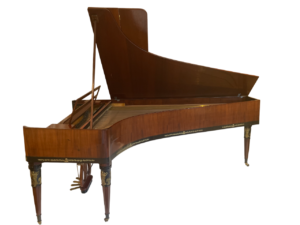
Fortepiano made by Heinrich Janssen, Vienna c. 1815 – Eric Feller Collection
The piano stands on 4 original legs with fire-gilded bronzes. The keyboard is made of ivory and ebony, the hammers are covered with deerskin and the piano is double and triple strung. The compass of the keyboard is 6 octaves + fourth (CC – f4). The nameboard bears the inscription on a ceramic label:
“Heinrich Janssen /
in Wien”.
The designation “in Wien” on the nameboard was only allowed to be used by instrument makers who themselves were “ordinary citizens” of the city.
Today there is nothing known about Heinrich Janssen. In some sources Janssen is still reported as a maker of giraffe and lyre pianos.
Till today there are no other known surviving instruments by him. The instrument was restored by Rudolf Haase, Switzerland.
This fortepiano is on permanent display at the Kellinghusen Museum “betont – Ton und Tasten Museum”!
Der Beitrag Heinrich Janssen c. 1810 – 1815 erschien zuerst auf Eric Feller Early Keyboard Instruments Collection.
]]>Der Beitrag John Broadwood and Son 1803 erschien zuerst auf Eric Feller Early Keyboard Instruments Collection.
]]>The piano rests on the original trestle stand with two integrated wooden pedals on both sides for lifting up the dampers (right) and due corde / una corda (left). At the end of the right side of the keyboard is a small stop which allows changing between due corde and una corda when pressing the pedal. The compass is 5 ½ octaves (FF – c4).
The serial number (2741) is written in ink on the left side of the wrest plank
The nameboard bears the inscription:
“1803
John Broadwood and Son
Makers to His Majesty
and the Princesses
Great Pulteney Street Golden Square
London“
The signature on the nameboard “John Broadwood and Son” was used from 1794 after John Broadwood’s son James Shudi Broadwood (1772 – 1851) entered the company. Previously all instruments were always signed with “Johannes Broadwood Londini fecit” (see the nameboard of the square piano from 1790 in the Eric Feller Collection).
The compass of 5 ½ octaves (FF – c4) was introduced by Broadwood in 1791 – before that all instruments (grand and square pianos) had only 5 octaves (one of the first fine examples with a 5 ½ octaves compass is the 1792 grand piano also in the Eric Feller Collection).
In a letter from James Shudi Broadwood to Thomas Bradford on 13th November 1793 he wrote that they had started in 1791 (following the advice of the composer Johann Ladislaus Dussek (1760 – 1812) who was in London at the time) with building pianos of 5 ½ octaves compass.
Today it is known that John Broadwood sold his first two grand pianos in January 1785. One was sold to Tyler of Bath (a music dealer) and the other to Count Brühl, Saxon ambassador and music patron. Both pianos were sold at a price of 55 pounds each.
Today the oldest surviving grand piano by John Broadwood was build in 1787. (see: Michael Cole)
This grand piano of 1803 is identical to the second fortepiano of John Broadwood also from 1803 in the Collection. Compared to the other grand piano it is obvious from the serial number that this instrument was made towards the end of 1803 since (according to Michael Cole) the production of grand pianos was around 200-250 per year.
So far 3 fortepiano from the year 1803 are known:
- Serial number 2526 – Collection Jörg Demus
- Serial number 2624 – Eric Feller Collection
- Serial number 2741 – Eric Feller Collection
John Broadwood was born on 6th October 1732 in Oldhamstocks near Cockburnspath in Scotland. He learned the profession of being a cabinetmaker like his father before.
In 1761 he started working for Burkat Shudi (1702 – 1773) in London and in 1770 became his business partner. In 1771 he opened his own shop on Great Pulteney Street in London. In 1769 he married Burkat Shudi’s daughter Barbara in her first marriage and had four children with her. After his wife’s death in 1776 he married Mary Kitson in 1781 and had six children with her. He died on 17th July 1812 in London.
Other surviving instruments by John Broadwood and Son:
- 1787 grand piano (No. 208) – Collection Charles Colt, Bethersdes UK
- 1792 grand piano (No. 452) – Metropolitan Museum, New York USA
- 1800 grand piano (No. 1835) – Collection Charles Colt, Bethersdes UK
- 1806 grand piano (No. 3500) – Museum of Art, Columbia USA

John Broadwood and Son, London 1803 – Eric Feller Collection – Nameboard
Der Beitrag John Broadwood and Son 1803 erschien zuerst auf Eric Feller Early Keyboard Instruments Collection.
]]>