Der Beitrag Michael Schütte – Zuckermann after Flemish models 1984 erschien zuerst auf Eric Feller Early Keyboard Instruments Collection.
]]>From the late 16th century well into the 18th century, Flanders played a central role in the development of harpsichord building and keyboard music. In particular, the workshops of the Ruckers family in Antwerp established a building tradition whose tonal and structural principles had an enduring impact far beyond the region itself. Their instruments were distinguished by a clear, resonant tone, precise articulation and a balanced overtone spectrum – characteristics that came to define the so-called “Flemish sound” and served as a benchmark for subsequent generations of harpsichord makers.
The Ruckers harpsichords, often conceived as single-manual instruments with 4′ and 8′ or 8’ and 8’ registers, were also noted for their robust construction, linear scaling, and their striking, architecturally austere aesthetic. Their richly decorated lids, featuring emblematic imagery, floral arabesques and Latin mottoes, were an expression of both humanist learning and Baroque culture of representation. During the 17th century, many of these instruments were modified through so-called ravalements – particularly in France – to meet evolving tonal and technical demands.
Parallel to this flourishing of instrument making, a distinctive repertoire also emerged. Composers such as Pieter Cornet, Jan Pieterszoon Sweelinck, and later Jacques Duphly (whose family originated from Flanders) combined contrapuntal heritage with idiomatic keyboard writing. The influence of Franco-Flemish vocal polyphony remained noticeable for a long time, though it was increasingly overlaid by French ornamentation and dance forms. The toccatas, fantasias and variation cycles of Flemish origin, in particular, demonstrate a deep understanding of the harpsichord as an independent artistic medium.
The Flemish harpsichord tradition is therefore not only a milestone in the history of instrument making, but also a key to the aesthetic and stylistic diversity of European keyboard music before 1750.
An Instrument after Flemish Models
This single-manual harpsichord, based on Flemish models, comes from the workshop of Wolfgang Zuckermann and was built in 1984 by Michael Schütte with great craftsmanship. It was constructed following historical principles. The case, in a square wing form, is made of cedarwood and features ornate brass hinges and contrasting panels in various shades of red. The interior is lined with Flemish-style wallpaper, and the inside of the lid bears the inscription:
“Sine scientia ars nihil est”
(Without knowledge, art is nothing)
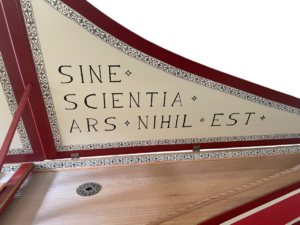
Harpsichord made by Michael Schütte in 1984 after Flemish Models (4) – Eric Feller Collection
Above the keyboard is the signature:
“Michael Schütte me fecit A.D. 1984”
The keyboard is made of ivory and rosewood, the soundboard of spruce, with a carved rose in the centre. The instrument has two 8′ registers, a lute stop, two sets of jacks and Delrin plectra. It rests on a Flemish-style wooden stand with decorative elements. The sound of the instrument is dark and lyrical, offering a rich palette of tonal colours.
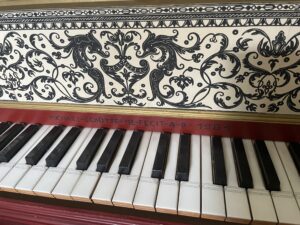
Harpsichord made by Michael Schütte in 1984 after Flemish Models (3) – Eric Feller Collection
With the rise of the historical performance movement, the demand for harpsichords increased. Firms such as Neupert and Sperrhake produced instruments largely built in the modern “Rastenbauweise” (frame construction method), incorporating many elements of modern piano making – though they had little in common with historical harpsichords in terms of tone and construction. Historically accurate copies were rare and expensive. Wolfgang Zuckermann recognised this gap in the market and, in the late 1950s, began offering affordable kits for harpsichords built along historical lines in the United States. These kits were (and still are) available in different levels of completeness, allowing customers to build their own harpsichord at relatively low cost. However, these self-built harpsichords have always reflected the abilities of their individual makers.
Wolfgang Zuckermann (1922–2018)
Wolfgang Zuckermann was born in Berlin on 11 October 1922. Due to the family’s Jewish faith, he fled with his parents to the United States in 1938. After training as a child psychologist, he turned his attention to harpsichord building and, in the 1950s, began selling harpsichord kits based on historical models. In 1969, he sold his company (which continues to operate internationally under different ownership) and moved to England. In 1995, he settled in Avignon, France. He authored two books on harpsichord building:
- The Modern Harpsichord. October House, 1969
- The Modern Harpsichord: Twentieth Century Instruments and Their Makers. Reprint Services Corp, 1986
Wolfgang Zuckermann passed away on 3 November 2018.
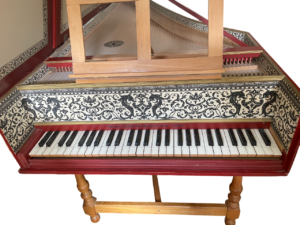
Harpsichord made by Michael Schütte in 1984 after Flemish Models (2) – Eric Feller Collection
Der Beitrag Michael Schütte – Zuckermann after Flemish models 1984 erschien zuerst auf Eric Feller Early Keyboard Instruments Collection.
]]>Der Beitrag Pleyel „Grand Modèle de Concert” – Wanda Landowska 1928 erschien zuerst auf Eric Feller Early Keyboard Instruments Collection.
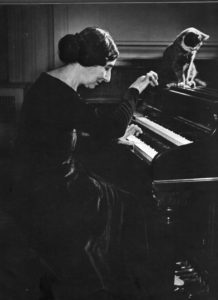
]]>
The History of Pleyel Harpsichords
The 1889 World Exhibition in Paris marked a significant milestone in the rediscovery of the harpsichord, as instruments of this type were presented there for the first time in many years (historical original instruments such as harpsichords, spinets, clavichords and square pianos were exhibited, including an original instrument by Henri Hemsch from 1755). The Exhibition took place from 6 May to 31 October 1889 on the occasion of the centenary of the French Revolution. Three renowned firms—Pleyel, Erard, and Tomasini—showcased harpsichords whose construction was inspired by a historical instrument built by Pascal Taskin (1723 – 1793).
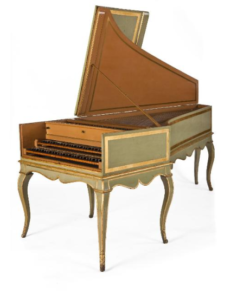
Harpsichord by Pascal Taskin, Paris 1769 St. Cecilias’s Hall Edinburgh
This harpsichord, made in Paris in 1769 and now housed in St Cecilia’s Hall in Edinburgh, was acquired by the Paris Museum around 1880 and restored in 1882 by Louis Tomasini. As part of this restoration, Tomasini produced a copy, which is now displayed at the Berlin Museum of Musical Instruments. Despite certain “improvements” introduced by Tomasini, this reproduction is considered one of the first historical reconstructions.
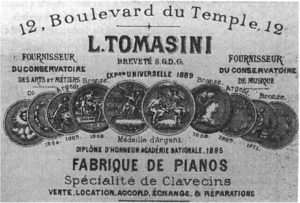
Business Card of Louis Tomasini, c. 1889
The original Taskin harpsichord was also extensively studied by Pleyel. Based on these studies and the examination of other historical instruments, Pleyel developed a new harpsichord that integrated elements of modern piano construction. These included increased string tension and a reinforced structure, featuring additional transverse ribs in the soundboard — similar to those found in contemporary grand pianos. The instruments produced by Pleyel, Erard, and Tomasini followed Taskin’s original construction and dimensions: they had two manuals, a compass of F’–f”’ (five octaves), and were equipped with two 8′ stops and a 4′ stop. However, Pleyel extended its model by adding six pedals, allowing performers to change registers quickly. Additionally, the case was reinforced, though the earliest harpsichords of this period did not yet feature a metal frame.
A review of the new harpsichord exhibited by Pleyel at the 1889 World Exhibtion appeared in the “Revue des arts décoratifs”, page 16:
- „C’est là un progrès d’une extrême importance. J’allais oublier de dire que la maison Pleyel expose aussi un superbe clavecin moderne, dont la valeur bénéficie naturellement de la supériorité de la facture actuelle sur celle du temps passé. Car on revient au clavecin, qui peut vivre en bon voisinage avec le piano, et qui reste fort utile, ainsi que l’ont prouvé les séances si intéressantes de M. Diéner, la musique écrite jadis par de grands maîtres pour cet instrument ne produisant nullement sur le piano, instrument au son ample et prolongé, l’effet cherché par le compositeur pour un instrument à sonorité sèche et douce à la fois. Ce clavecin est superbe et d’une sonorité exquise. Enfin, j’ajoute que la fabrication de la maison Pleyel a dépassé aujourd’hui le quatre-vingt-dix-septième mille, et qu’elle compte, avant un an, fêter la naissance de son cent millième piano ! Elle sera la première, dans le monde, à pouvoir célébrer un tel résultat.“
- “I almost forgot to mention that the Pleyel company is also exhibiting an excellent modern harpsichord, whose value naturally benefits from the superiority of today’s craftsmanship over that of the past. Let us now return to the harpsichord, which serves as a valuable complement to the piano and, as the highly interesting sessions of Mr. Diéner have demonstrated, remains very useful. The music written by great masters of the past for this instrument does not achieve the intended effect on the piano—a sonorous instrument with broad and sustained tone—since the composers envisioned a sound that is both crisp and delicate. This harpsichord is outstanding and has an exquisite tone.” (Revue des arts décoratifs, 1889, p. 16)
Accompanying the Paris World Exhibition, the pianist and composer Louis Diémier (1843 – 1919) played concerts on the newly introduced harpsichord for the first time.
Wanda Landowska’s interest in the harpsichord led her, from 1903/04 onwards, to actively incorporate Pleyel harpsichords into her concert performances, thereby significantly increasing public interest in the instrument. In close collaboration with Pleyel, she contributed to the development of a harpsichord that would meet both her tonal ideals and the demands of historical performance practice, while also accommodating the requirements of modern concert settings.
This collaboration between Landowska, Pleyel’s chief engineer Monsieur Lamy, and the company’s director and acoustician Gustave Lyon (1857 – 1936) culminated in the creation of an innovative harpsichord model. The result of their joint efforts was publicly unveiled at the VI. German Bach Festival of the Neue Bachgesellschaft in Breslau from 15–17 June 1912: the Pleyel harpsichord “Grand Modèle de Concert,” which prominently bore Landowska’s name on the jack rail.
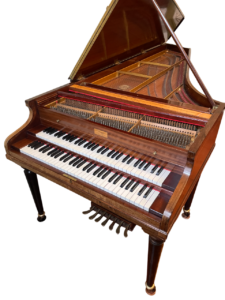
Pleyel Cembalo – Wanda Landowska – Grand Modèle de Concert, Paris 1828 – Eric Feller Collection (9)
The new Pleyel harpsichord combined traditional craftsmanship with innovative mechanical improvements, designed to enhance the instrument’s stability, volume, and versatility. This newly developed model differed significantly from its Baroque predecessors, as well as from the early Pleyel harpsichords introduced at the 1889 Paris Exhibtion, particularly through the introduction of a metal frame from 1923 onwards. Such a structural innovation had previously been absent from harpsichords of this type, and it greatly improved the instrument’s stability, enabling higher string tension, which resulted in a more powerful and resonant tone.
Furthermore, the harpsichord’s mechanism was carefully refined, allowing for a more consistent key response and greater precision in sound control. The tuning pins were improved, leading to the development of double tuning pins, which ensured exceptional tuning stability. The registers were activated via pedals, facilitating ease of use for performers.
One of the most striking features of the new Pleyel harpsichord was the introduction of a 16′ register, which, at Landowska’s request, was incorporated into all instruments from 1912 onwards, adding depth and richness to the sound spectrum.
Pleyel produced two variations of this harpsichord:
- “Modèle Réduit” – 6 pedals, compass: AA–f³, without a 16′ register
- “Grand Modèle de Concert” – 7 pedals, compass: FF–f³, with a 16′ register
In 1968, Pleyel produced another model called the “Modèle Trianon.” Only three instruments were built. The instruments were crafted in a modern style, no longer featuring a metal frame, and lacked the 16′ register.
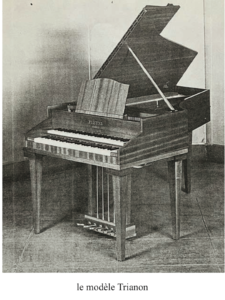
Harpsichord Pleyel “Modèle Trianon“
The instrument’s design and acoustics were largely the work of Gustave Lyon, the chief acoustician and head of Pleyel. One of his key innovations was the damping system, which became a defining characteristic of Pleyel harpsichords. When a performer played an 8′ register on one manual, the corresponding 8′ register on the second manual vibrated sympathetically, provided it was perfectly in tune. This unique acoustic effect contributed significantly to the distinctive and unparalleled sound of Pleyel harpsichords, solidifying their reputation in both historical performance and modern concert practice.
The Pleyel harpsichord in the Eric Feller Collection
The harpsichord presented here was made in 1928 by the Pleyel company in Paris and is the “Grand Modèle de Concert“. The case of the instrument is made of the finest rosewood, which is decorated with charming inlays all around. While the majority of the harpsichords made by Pleyel were made of mahogany, only a few examples were made of rosewood. It has five legs with gilded bases and a lyre with seven pedals to control the registers.
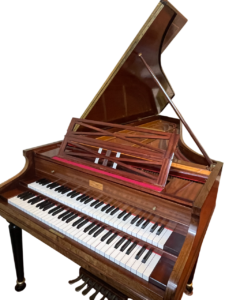
Pleyel Cembalo – Wanda Landowska – Grand Modèle de Concert, Paris 1828 – Eric Feller Collection (5)
The instrument has two manuals and is equipped with five different registers that allow for a wide variety of sound designs:
- lower manual: 8′, 16′, 4′
- upper manual: 8′, 8′-nasal, lute stop for both registers
- Manual coupler
The registers are distributed over the pedals from left to right as follows:
| Pedal 1 | Pedal 2 | Pedal 3 | Pedal 4 | Pedal 5 | Pedal 6 | Pedal 7 |
| lower manual 16‘ – register | lower manual
4‘ – register |
lower manual
8‘ – register |
Lute stop for both
8‘ – registers (upper manual) |
manual coupler | upper manual
8‘ – register nasal |
upper manual
8‘ – register |
The registers are switched on when the pedals are pressed down, others switch when they are released.
Due to the disposition, there are up to 55 different registration options. The following combinations of registers are possible:
Step 1: Individual manuals
Lower manual: 8′, 16′, 4′
→ Can be used individually or in combinations:
- 8′
- 16′
- 4′
- 8′ + 16′
- 8′ + 4′
- 16′ + 4′
- 8′ + 16′ + 4′
- → 7 combinations
Upper manual: 8′, 8′-nasal, lute stop
→ Can be used individually or in combinations:
- 8′
- 8′-nasal
- 8′ + 8′-nasal
- 8′ + lute stop
- 8′-nasal + lute stop
- 8′ + 8′-nasal + lute stop
- → 6 combinations
Step 2: Taking the manual coupler into account
If the manual coupler is activated, both manuals can sound at the same time. This means that any of the 7 combinations of the lower manual can be combined with any of the 6 combinations of the upper manual.
Total number of registration possibilities
The combinations without coupling are:
- 7 (lower manual only) + 6 (upper manual only) = 13 possibilities
With coupling:
- 7 (lower manual) × 6 (upper manual) = 42 possibilities
Total number of possible registrations:
13 + 42 = 55 different combinations
All registration possibilities are listed below:
- Registrations without manual coupling
Lower manual only (7 combinations)
- 8′
- 16′
- 4′
- 8′ + 16′
- 8′ + 4′
- 16′ + 4′
- 8′ + 16′ + 4′
Upper manual only (6 combinations)
- 8′
- 8′-nasal
- 8′ + 8′-nasal
- 8′ + lute stop
- 8′-nasal + lute stop
- 8′ + 8′-nasal + lute stop
- Registrations with manual coupler (42 combinations)
Each of the 7 combinations of the lower manual can be combined with each of the 6 combinations of the upper manual:
- (8′) + (8′)
- (8′) + (8′-nasal)
- (8′) + (8′ + 8′-nasal)
- (8′) + (8′ + lute stop)
- (8′) + (8′-nasal + lute stop)
- (8′) + (8′ + 8′-nasal + lute stop)
- (16′) + (8′)
- (16′) + (8′-nasal)
- (16′) + (8′ + 8′-nasal)
- (16′) + (8′ + lute stop)
- (16′) + (8′-nasal + lute stop)
- (16′) + (8′ + 8′-nasal + lute stop)
- (4′) + (8′)
- (4′) + (8′-nasal)
- (4′) + (8′ + 8′-nasal)
- (4′) + (8′ + lute stop)
- (4′) + (8′-nasal + lute stop)
- (4′) + (8′ + 8′-nasal + lute stop)
- (4′) + (8′ + 8′-nasal + lute stop)
- (8′ + 16′) + (8′)
- (8′ + 16′) + (8′ + 8′-nasal)
- (8′ + 16′) + (8′ + lute stop)
- (8′ + 16′) + (8′ + 8′-nasal + lute line)
- (8′ + 4′) + (8′)
- (8′ + 4′) + (8′-nasal)
- (8′ + 4′) + (8′ + 8′-nasal)
- (8′ + 4′) + (8′ + lute stop)
- (8′ + 4′) + (8′-nasal + lute stop)
- (8′ + 4′) + (8′ + 8′-nasal + lute stop)
- (16′ + 4′) + (8′)
- (16′ + 4′) + (8′-nasal)
- (16′ + 4′) + (8′ + 8′-nasal)
- (16′ + 4′) + (8′ + lute stop)
- (16′ + 4′) + (8′ + lute stop)
- (8′ + 16′ + 4′) + (8′)
- (8′ + 16′ + 4′) + (8′-nasal)
- (8′ + 16′ + 4′) + (8′ + 8′-nasal)
- (8′ + 16′ + 4′) + (8′ + lute stop)
- (8′ + 16′ + 4′) + (8′-nasal + lute stop)
- (8′ + 16′ + 4′) + (8′ + 8′-nasal + lute stop)
The case of the instrument is open at the bottom and the construction is based on a solid steel frame similar to the modern grand pianos of the time. In the soundboard there is a gilded rosette with the initials “P” and “C“, which further accentuates the aesthetic design of the harpsichord and is reminiscent of the historical harpsichords. The bass strings are wound, which significantly amplifies the sound. The jacks are made of wood and covered with leather.
A notable feature of this harpsichord are the tuning pins: each string is equipped with a double pin. The first pin is used for coarse adjustment and this is made possible by a ratchet mechanism located on a joint on the sound post. Behind this ratchet pin protrudes a small wing, which has a two-pronged fork shape. Between these prongs is positioned a second pin, which is firmly screwed into the sound post. By precisely screwing and unscrewing this second pin, the ratchet assembly is set in a back and forth swinging motion on its joint, which allows for extremely fine adjustment of the string. Although the ratchet mechanism is rarely used directly in practical tuning work, this system enables an exact adjustment of the pitch that would be very difficult to achieve with traditional tuning pins.
These so-called micrometer tuning pins or “Alibert-pins” as they were called by Pleyel, were developed by the inventor Jean-Pierre Alibert and patented in 1875 by Auguste Wolff (1821 – 1887).
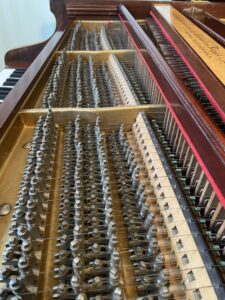
Pleyel Harpsichord – Wanda Landowska – Grand Modèle de Concert, Paris 1828 – Eric Feller Collection (“Alibert-pins”)
The entire construction of the instrument is characterized by remarkable precision and reflects the high production standards and the brilliant construction system that Pleyel used in the manufacture of this harpsichord. The nameboard is signed:
“Pleyel
Facteur à Paris
Fondé en 1807“
A further signature is on the jack rail:
“Le Jeu grave dit par les Anciens “de 16 Pieds” fut introduit dans les
Clavecins Pleyel à partir de l’année 1912, sur la demande & les suggestions de
Wanda Landowska.”
The instrument has the serial numbers 73F432 and 185.600, which are noted on the wrest plank. Based on these numbers, it can be seen from Pleyel’s production books that the harpsichord was sold to Amsterdam on October 12, 1928 for a price of 33,536 francs. Taking inflation and the stable exchange rate into account, this amount would correspond to a purchasing power of around 83,400 Euros today (2025). In addition, the Pleyel company charged an additional fee of 1,225 francs for packaging the instrument. According to Pleyel’s original delivery books, the buyer was a music store in Amsterdam.
The shop in Amsterdam lent out the instrument for various concerts and recordings. An interesting recording of the song “I’ve Found A New Baby” was made in 1954 by the “Dutch Swing College Band“, founded in 1945, with this harpsichord. The harpsichordist on this unusual recording was the Dutchman Joop Schrier (1918 – 1995). To hear the recording, click here!
The importance of the Pleyel harpsichords today and the “reduced Rastenbauweise“
Pleyel’s “Grand Modèle de Concert” was the decisive pioneer for the revival of harpsichord construction at the beginning of the 20th century and formed the starting point for numerous developments in harpsichord construction in Europe. The model designed established itself as the decisive prototype for the construction of modern harpsichords and served as a reference model that was replicated many times, but whose qualitative standards were never achieved again. At this point I would like to introduce the term “reduced Rastenbauweise” into my explanations in order to be able to make a more precise distinction between the other instruments and Pleyel. Instrument makers such as Maendler-Schramm, Neupert and Dolmetsch began to design instruments based on Pleyel’s harpsichords or were significantly inspired by them. In the early stages of development, these instruments exhibited a strong resemblance to the harpsichords by Pleyel, with their structural design, particularly the raster construction, being almost identically adopted. In an effort to reduce costs, simplify the construction process, be able to produce a large number of instruments in a short time or to experiment with sound, the so-called harpsichords in a “reduced Rastenbauweise” were created. However, these had very few similarities with the original Pleyel design (and of course hardly anything in common with the later historical copies). This type of instrument lacks a steel frame, the scale lengths are different, strings are not wound, the body construction is lighter, the base is partially closed, etc. The aforementioned changes led to a significant change in the sound character, which is clearly different from Pleyel’s instruments.
These instruments (also because they were produced in large numbers to meet growing demand) shaped the idea of sound until the 1970s. It was not until the 1970s that historical copies of original instruments began to be made, which have now become established as the standard in historical performance practice.
Pleyel’s construction is impressive due to its precise execution, which not only reflects high production standards, but also a sophisticated manufacturing system that was used in the manufacture of these instruments. Almost 100 years after production, as in the example of the Pleyel harpsichord in the collection described here, the exceptional craftsmanship remains intact. This well-thought-out production ensures an acoustic performance that massively distinguishes the Pleyel harpsichord from other harpsichords. The ingenious construction creates a richness of sound and versatility that is absolutely unique and cannot be compared to any other instrument. The Pleyel harpsichords are based on historical principles, but use modern materials, construction methods and experience from modern piano construction to achieve greater tonal assertiveness. Compared to other harpsichords of the “reduced Rastenbauweise“, the sound can certainly be seen as more “historical”, but due to the construction it is louder and more brilliant.
So why did the “reduced Rastenbauweise” prevail for so long in the 20th century and shape the sound of this first generation in historical performance practice, while Pleyel’s designs were no longer built or produced in large numbers?
To answer this question, several factors must be considered. A central aspect is the economic dimension. Considering the production costs of a Pleyel harpsichord at the time and the high demand for this rediscovered instrument, it became economically necessary to provide cheaper alternatives for the expanding market. This led to a reduction in the construction effort, which made cheaper production possible.
Another relevant factor is the historical framework of the Second World War. During the war years and in the immediate post-war period, the availability of high-quality materials was severely limited, so that instrument makers were forced to resort to lower quality materials or use other solutions.
In addition, harpsichord construction was in a continuous development process, during which both sound optimization and adaptation to historical originals were sought. A notable example of this is the harpsichord made by Kurt Hutzelmann in 1967, which is also in the collection. (Click here for more information on this instrument!) Hutzelmann developed a mechanism that made it possible to raise the dampers using a pedal – analogous to the damper release on a piano. However, this design does not establish a historical reference to the harpsichords of the 17th and 18th centuries, but rather reflects the attempt to make sound modifications in the sense of a subjective improvement.
With the onset of the 1970s, a fundamental paradigm shift took place in harpsichord construction. While previously the focus was on the gradual improvement of the sound potential and the economically adapted construction, the aim increasingly shifted to the exact replication of historical instruments. This development was closely linked to the growing interest in authentic performance practice and historical sound research, which did not yet exist to this extent at the beginning of the 20th century. Cultural and educational impulses encouraged this trend. The promotion of historical performance practice at universities and by cultural institutions increased awareness of the importance of authentic instruments. This gave harpsichord construction an idealistic and educational impulse, which led to increased research and innovation in this area.
The new approaches aimed to faithfully reconstruct the construction principles and sound properties of the instruments of the 17th and 18th centuries, whereby the “reduced Rastenbauweise”, which dominated harpsichord construction for over 50 years, faded into the background and is now considered obsolete.
With his harpsichords, Pleyel created masterpieces of instrument making that build a bridge between the past and the modern. They are well thought out, sophisticated, innovative and forward-looking! They were also the trigger and inspiration for composers of the 20th century to compose pieces for this type of instrument (for example the “Concert champêtre” by Francis Poulenc (1899 – 1963), which he wrote for Wanda Landowska in 1927/28).
Pleyel used historical instruments as an opportunity to improve the construction of the harpsichord. The aim was not to simply copy a historical instrument, but to further develop the harpsichord!
The company wrote in the “Catalogue Pleyel, Wolff & Cie.” from 1892, page 11:
- « Pleyel, Wolff et Cie dans leur facture courante et, de plus, M. Lyon avait très habilement reconstitué le clavecin et le dotant de qualités que n’avaient pas les meilleurs instruments des siècles passés. Aussi, il faillait récompenser à la fois le mérite des inventions attachées au nom de Pleyel, les qualités de ses instruments et le goût artistique qui présidait à leur construction. A l’unanimité des mebres du jury international de la classe 13, un Grand Prix, la plus haute récompense mise à la dispension des jurys, a été décerné à la maison Pleyel, Wolff et Cie. »
- “… and in addition, Mr. Lyon had reconstructed the harpsichord extremely skillfully and given it properties that even the best instruments of past centuries did not possess. It was therefore important to appreciate both the merits of the inventions associated with the name Pleyel and the quality of his instruments and the artistic taste that underlay their construction.”
A new instrument was created with distinctive features compared to all other types of harpsichords and this is how these instruments must be viewed and classified! Today, Pleyel harpsichords are repeatedly compared with other instruments. However, a comparison would be similar to trying to compare two fundamentally different objects whose properties do not correlate in a way that allows a fair or informative comparison.
Sources:
- Anthony, James R. Landowska: The Life and Work of the Great Harpsichordist. Amadeus Press, 2003.
- de Vries, Willem „Sonderstab Musik: Organisierte Plünderungen in Westeuropa 1940-45“.
- Di Stefano, G.P. (2012). Pleyel after Pleyel. The instruments of Auguste Wolff and Gustave Lyon at Universal Exhibitions (1855-c.1905). MUSIQUE, IMAGES, INSTRUMENTS, XIII(XIII), 77-99.
- Elste, Martin: Die Dame mit dem Cembalo. Wanda Landowska und die Alte Musik. Katalog zur Sonderausstellung im Berliner Musikinstrumenten-Museum, Berlin 2009
- Glendon, Frank: Remembering Hilda Jonas. In: The Diapason – Harpsichord News. Dezember 2014.
- Gutmann, Peter. “Wanda Landowska: Revolutionary and Traditionalist.” New England Review and Bread Loaf Quarterly, vol. 26, no. 4, 2005, pp. 143-152.
- Heyer, John Hajdu. “Wanda Landowska and Early Music: A Personal View.” Early Music, vol. 14, no. 3, 1986, pp. 301-305.
- Hsu, Samuel. Wanda Landowska: The Woman and the Artist. Westport, CT: Greenwood Press, 1979.
- Jonas, Hilda: Harpsichord Festival Scheduled. In: The Harpsichord. Vol. III, No 4, 1970.
- Joseph, Charles M. Wanda Landowska: The Search for Authenticity. Ithaca, NY: Cornell University Press, 1991.
- Kallberg, Jeffrey. “Landowska and Her Circle: The Shared Aesthetics of Music and Art.” In The Cambridge Companion to Wanda Landowska, edited by Mark Kroll, pp. 100-118. Cambridge University Press, 2021.
- Kroll, Mark. “The Artistry of Wanda Landowska.” Early Music America, vol. 6, no. 1, 2000, pp. 30-35.
- Landowska, Wanda. Landowska on Music. London: Gerald Duckworth & Co Ltd, 1964.
- Lawrence, D.H. “Wanda Landowska: The Pianist Who Made the Harpsichord Sing.” The Adelphi, June 1932, 148-156.
- Lubitz, Andrea. “Wanda Landowska and Her Collaborators in Interwar France.” In The Cambridge Companion to Wanda Landowska, edited by Mark Kroll, pp. 82-99. Cambridge University Press, 2021.
- McAllister, Alastair: “Talking Harpsichords”, The Rhykane Press 2014.
- Mould, Charles (Hrsg.): Amendments and additions to clavichord-related information in the Third Edition of Donald Boalch’s Makers of the Harpsichord and Clavichord 1440–1840. 1995.
- Neupert, Hanns: Das Klavichord. Bärenreiter Verlag, Kassel 1977.
- Schmidt, Martin-Christian: Das 16’-Register im deutschen Cembalobau des 18. Jahrhunderts. Groteske oder beachtenswerte Erscheinung mit aufführungspraktischer Relevanz? In: Eszter Fontana (Hrsg.): Festschrift für Rainer Weber. Halle 1999, ISBN 3-932863-98-4. S. 63–72. (= Scripta Artium, Bd. 1. Schriftenreihe der Kunstsammlungen der Universität Leipzig).
- Oja, Carol J. Making Music Modern: New York in the 1920s. Oxford University Press, 2000.
- Owen, Barbara. “Wanda Landowska: A Pianist of the Harpsichord.” Early Music, vol. 4, no. 4, 1976, pp. 469-478.
- Piekarska-Duraj, Jolanta. Wanda Landowska: A Biography. Krakow: Polskie Wydawnictwo Muzyczne, 2012.
- Restout, Denise. Wanda Landowska: A Life in Music. New York: W.W. Norton & Company, 1981.
- Rosand, Ellen. “Wanda Landowska’s Aesthetic of Early Music.” Early Music, vol. 14, no. 3, 1986, pp. 306-312.
- Rosenblum, Sandra P. Landowska: Wanda Landowska Remembered. Hillsdale, NY: Pendragon Press, 2000.
- Rubin, Ruth J. “Wanda Landowska and the Harpsichord Revival.” In Women Making Music: The Western Art Tradition, 1150-1950, edited by Jane Bowers and Judith Tick, pp. 225-238. University of Illinois Press, 1986.
- Rosati, Vincent J. Wanda Landowska and Early Music: The Quest for Authenticity. Bloomington: Indiana University Press, 1998.
- Sauer, Theresa. “Wanda Landowska’s Contributions to the Early Music Revival.” The Musical Quarterly, vol. 81, no. 2, 1997, pp. 201-224.
- Wolfgang Zuckermann: The modern harpsichord, twentieth century instruments and their makers. October House, New York 1969.
© Eric Feller – Early Keyboard Collection – March 2025
Der Beitrag Pleyel „Grand Modèle de Concert” – Wanda Landowska 1928 erschien zuerst auf Eric Feller Early Keyboard Instruments Collection.
]]>Der Beitrag Zuckermann after Flemish Models, 1990 erschien zuerst auf Eric Feller Early Keyboard Instruments Collection.
]]>- Soundboard: Typically made of spruce, the soundboard is crucial for tonal quality.
- Double manual design: Many Flemish harpsichords feature double manuals, allowing performers to switch between different tonal colours or dynamics.
- String length: Flemish harpsichords often have longer string lengths, contributing to their powerful sound.
Flemish harpsichords are also famous for their rich decoration and painting. The outer casings were often adorned with intricate paintings or marbling, while the inner lid was decorated with floral patterns or biblical scenes. The interior of the instruments was frequently lined with fine wallpaper.
The instruments crafted by Flemish builders significantly influenced music and harpsichord construction throughout Europe. Many Baroque composers valued these instruments for their balanced and clear tone. Furthermore, Flemish harpsichords served as models for later French instruments, which developed these designs further.
Today, Flemish harpsichords are often used as templates for reproductions, as they are considered quintessential Baroque harpsichords.

Flemish Harpsichord by W. Zuckermann – Eric Feller Collection
This double–manual harpsichord, based on Flemish models, comes from the Wolfgang Zuckermann workshop and was built in 1990. It is constructed in a historically authentic manner. The case, in a rectangular grand-piano shape, is made of cedarwood and features ornate brass hinges. It is painted green with gilded panels and leather inlays on both the outer and inner lid. The keyboard is made of rosewood, and Flemish wallpaper is affixed around the keyboard and the interior casing. The spruce soundboard is painted and features a carved central rose. The instrument has three registers (8’, 8’, 4’), a double lute stop, a coupler, three rows of plastic jacks, and Delrin plectra. It also includes a manual register stop for engaging the 4’ register and a lute stop, which can be activated for both 8’ registers on both manuals. The harpsichord rests on a decorated stand. Its sound is dark, resonant, and lyrical, with a wide range of tonal colours.

Keyboard and Flemish decoration – Eric Feller Collection
With the rise of historical performance practice, the demand for such instruments increased. Companies like Neupert and Sperrhake predominantly produced harpsichords using the modern “Rastenbauweise” (frame construction method), which combined many elements of modern piano construction but had little in common with historical harpsichords or their sound. Authentic copies were relatively rare and very expensive. Wolfgang Zuckermann identified this gap in the market and began offering affordable harpsichord kits constructed in a historically accurate manner in the late 1950s in the United States. These kits were available in various levels of completion, allowing customers to build their own harpsichord at a relatively low cost. However, these self-built harpsichords always reflected the skill of their builders.
Wolfgang Zuckermann was born on October 11, 1922, in Berlin. Due to his family’s Jewish faith, he fled to the United States with his parents in 1938. After training as a child psychologist, he became involved in harpsichord construction and began selling harpsichord kits inspired by historical originals in the 1950s. In 1969, he sold his company (which still operates worldwide today under various names) and moved to England. In 1995, he relocated to France and lived in Avignon. He authored two books on harpsichord construction:
- The Modern Harpsichord (1969, October House)
- The Modern Harpsichord: Twentieth Century Instruments and Their Makers (1986, Reprint Services Corp)
Wolfgang Zuckermann passed away on November 3, 2018.
Der Beitrag Zuckermann after Flemish Models, 1990 erschien zuerst auf Eric Feller Early Keyboard Instruments Collection.
]]>Der Beitrag Johannes Morley 1970 erschien zuerst auf Eric Feller Early Keyboard Instruments Collection.
]]>
Harpsichord by Johannes Morley, London 1970 – Eric Feller Collection (Keyboard)
The instrument presented here comes from the workshop of John Morley and was built in London in 1970. The case is made of walnut and has a rounded wing shape with a soundboard that opens downwards. The instrument stands on 4 legs and has 2 rows of jacks with plastic jacks, Delrin quills and a range of 5 octaves (GG – g3).
The nameboard bears the inscription:
“Johannes Morley Londini Fecit”

Harpsichord by Johannes Morley, London 1970 – Eric Feller Collection (Nameboard)
The harpsichord has 2 registers (8′, 4′), which can be switched via two pedals, and a lute stop for the 8′ register, which can be switched via a hand register. On the left side of the wrest plank is the serial number 2135. The signature “John Morley London” can also be found on the soundboard.

Harpsichord by Johannes Morley, London 1970 – Eric Feller Collection (serial number)
The instrument is in perfect and playable condition. The sound is very voluminous, percussive and clear.
The Morley factory in London has a long tradition of instrument building. An overview of the history of the company can be found on their website (click here).

Harpsichord by Johannes Morley, London 1970 – Eric Feller Collection (soundboard)
Der Beitrag Johannes Morley 1970 erschien zuerst auf Eric Feller Early Keyboard Instruments Collection.
]]>Der Beitrag Anonymous 1716 erschien zuerst auf Eric Feller Early Keyboard Instruments Collection.
]]>Harpsichords from the Iberian Peninsula are still rare. So far, research has largely focused on Italian, French or English harpsichords because of the greater number of survived instruments from these regions.

Harpsichord Anonymous Fr. Ant. L. Fec., 1716 – Eric Feller Collection (1)
This single manual harpsichord made by an unknown maker impresses with its excellent sound and the painting on the case and stand. The delicate instrument rests on a richly decorated, two-part frame and has a length of 195 cm. Inside are three sets of jacks. The jacks are made of pear wood and Delrin. The harpsichord also has 3 registers (8′, 8′, 8′ nasal) and a compass of 4 only octaves (C/E – c3) with short octave. The nameboard bears the signature:
“Fr. Ant. L. Fec. / Gloria Deo / Año D. 1716”

Harpsichord Anonymous Fr. Ant. L. Fec., 1716 – Eric Feller Collection (2)
The keyboard is richly decorated and made of pear and boxwood, the soundboard of spruce wood.

Harpsichord Anonymous Fr. Ant. L. Fec., 1716 – Eric Feller Collection (3)
The instrument could not be attributed to any instrument maker yet. Further research is currently in progress. This harpsichord was formerly part of the collection of Richard Burnett, Finchcocks and was acquired for the Eric Feller Collection in 2017. It has been carefully restored and it is in fully playable condition. The sound is very rich in overtones and it is a rare example of instruments from the Iberian Peninsula.

Harpsichord Anonymous Fr. Ant. L. Fec., 1716 – Eric Feller Collection (4)
Der Beitrag Anonymous 1716 erschien zuerst auf Eric Feller Early Keyboard Instruments Collection.
]]>Der Beitrag Neupert 1949 erschien zuerst auf Eric Feller Early Keyboard Instruments Collection.
]]>
Harpsichord by Neupert, Bamberg 1949 – Eric Feller Collection (soundboard, strings and music stand)
The harpsichord described here dates from 1949 and was made by Neupert in Bamberg. It is perfectly preserved and all parts are original and playable. The case is made of dark walnut with an open bottom and stands on 3 decorated legs. The inner lid is veneered with light wood. The harpsichord has 1 manual with 2 rows of jumpers (so-called “Troho jumpers” – Trolon plastic-wood jacks), which consist of a wooden core and framed with plastic on each side. The quills are made of leather, two registers (8′ and 4′) and a lute slide for the 8′ register, which is divided. The compass is 4 ½ octaves (CC – f3). The keyboard is decorated with plastic coverings and the soundboard has a wooden rose to strengthen the sound.

Harpsichord by Neupert, Bamberg 1949 – Eric Feller Collection (nameboard)
The signature
“Neupert Bamberg”
is located in the middle of the nameboard. The serial number is 17584 and is stamped on the right of the wrest plank.

Cembalo Neupert, Bamberg 1949 – Eric Feller Collection (serial number)
The sound of the instrument is very clear and strong. However, it must be clearly stated here that the sound is not at all comparable with a historical harpsichord. It is a completely new instrument due to its modern construction, which only has the sound generation in common with the old harpsichords. In comparison to instruments built from the 1960s and 1970s, however, the sound is many times more convincing and beautiful.

Harpsichord by Neupert, Bamberg 1949 – Eric Feller Collection (keyboard)
Der Beitrag Neupert 1949 erschien zuerst auf Eric Feller Early Keyboard Instruments Collection.
]]>Der Beitrag Virginal Alec Hodsdon 1961 erschien zuerst auf Eric Feller Early Keyboard Instruments Collection.
]]>
Virginal Alec Hodsdon, Lavenham 1961 – Eric Feller Collection (2)
The virginal presented here was made by Alec Hodsdon in Lavenham/England in 1961. The case is made of walnut and decorated with beautiful inlays all around (also the inside of the lid). The virginal stands on a trestle-stand. The nameboard bears the signature in an inlaid cartouche:
“Alec Hodsdon Lavenham Suffolk fecit anno 1961”
The soundboard is made of spruce with two bridges, wooden jacks and Delrin plectra. The keys are made of ebony and sycamore maple.

Virginal Alec Hodsdon, Lavenham 1961 – Eric Feller Collection (3)
The sound is very rich in overtones and the instrument has a variety of timbres. These timbres are due to the construction, as the instrument has two bridges that rest on the soundboard.

Virginal Alec Hodsdon, Lavenham 1961 – Eric Feller Collection (5)
Unfortunately, little is known about Alec Hodsdon. He was born in Sidcup, Kent in 1900 and studied chemistry. In 1916 he met Margaret Fletcher in Brighton, the niece of Major George Henry Benton Fletcher (1866 – 1944), who became famous for his collection of historical instruments (which are on display and can be seen at Fenton House, National Trust, Hampstead). Margaret and Alec married and moved into an old timber-framed house in Lavenham in Suffolk. Due to the good financial situation resulting from his marriage to Margaret Fletcher, who came from a wealthy family, Alec Hodsdon stopped working as a chemist. Among his most important hobbies were steam-driven cars and model railways. Through his own interest but especially from his wife’s musical background, he began to build historical keyboard instruments and opened a workshop.

Advert by Alec Hodsdon in The Musical Times 1944
In his early days Hodsdon was very experimental and produced a wide range of instruments of all kinds, including a number of highly complex harpsichords and other period instruments. Some of his harpsichords had metal constructions to guarantee better tuning. However, he did not follow the continental trend and increasingly built instruments with 16′ stops (in tradition of the so-called “Bach harpsichord“, which was usually used as a model for new instruments at the beginning of the 20th century), like his colleague Arnold Dolmetsch (1858 – 1940). Through his wife’s reference and access to original historical instruments in the Fletcher Collection, Hodsdon later oriented himself towards original instruments. In his workshop he worked together with Fred Sykes and other employees. Fred Sykes came from nearby Sudbury and worked as a furniture maker after his former company went bankrupt and he had to give up his job as a harmonium maker. In addition to building new instruments, Hodsdon’s workshop also restored historic instruments.

Advert by Alec Hodsdon in The Musical Times 1947
Often his clavichords and harpsichords turned out to have structural defects. His virginals, on the other hand, were characterised by solid workmanship and a particularly beautiful sound and quickly advanced to become popular instruments with musicians and composers. As one of the first builders of period keyboard instruments in England, Hodsdon is of great importance. Through him, the revival of the construction of historical keyboard instruments and historical performance practice in Great Britain was strongly influenced. Alec Hodsdon retired from his business in the late 1960s while Fred Sykes continued to produce instruments under Hodsdon’s brand. He soon discontinued this and built instruments under his own name.
Alec Hodsdon died in Lavenham on 11 December 1986.
Der Beitrag Virginal Alec Hodsdon 1961 erschien zuerst auf Eric Feller Early Keyboard Instruments Collection.
]]>Der Beitrag Walther Ebeloe 1939 erschien zuerst auf Eric Feller Early Keyboard Instruments Collection.
]]>An important pioneer in this revival was the harpsichordist Wanda Landowska (1879 – 1959), who began playing the harpsichord and popularizing it again on concert stages in the 1920s.
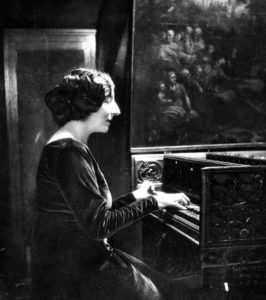
Wanda Landowska 1937
As there was only a limited number of playable historical instruments available at that time, the demand for new instruments grew and many instrument makers had interest in the “new” harpsichord.
The first instrument maker in Hamburg who built harpsichords was Walther Ebeloe. He made the first harpsichords in Hamburg in the 20th century. Since the harpsichord was hardly a major research object at the time, there were less sources and many instrument makers used modern piano construction methods and thus constructed new instruments that represent a kind of hybrid: the sound generation of the harpsichord with jacks and quills in combination with experience and innovations in modern piano construction, as well as modern materials. Partly motivated to build a reliable and perhaps also “improved” instrument, instruments were created that sound little in common with a historical instrument, but in terms of music history they play an important role in preparing the way for today’s historical performance practice.

Harpsichord by Walther Ebeloe, Hamburg 1939 – Eric Feller Collection (2)
The harpsichord described here was completed on December 22nd, 1939 by Walther Ebeloe in Hamburg. It is perfectly preserved and in playable condition.
The case is made of walnut with a shellac polish, has a curved shape and stands on 3 legs. From the outside, the instrument looks like a modern, small grand piano. It has 2 manuals with 3 registers (8′, 8′, 4′), lute and manual coupler. The registers can be operated by hand stops on the left and right side. Below the instrument is a knee lever that operates the manual coupler. The quills were originally made of leather and were changed to Delrin. The compass is 5 octaves (FF – f3). The lower keys are covered with plastic and the upper keys are made of ivory.

Harpsichord by Walther Ebeloe, Hamburg 1939 – Eric Feller Collection (4)
The signature is inlaid in the centre of the nameboard:
“W. Ebeloe
Hamburg”
The serial number is A232 and is stamped on the first key of the upper manual. The date of manufacture can also be found there with “22 DEZ. 1939”.

Harpsichord by Walther Ebeloe, Hamburg 1939 – Eric Feller Collection (7)
In many details, the entire instrument shows a construction and structure that comes from modern piano construction (soundboard, keyboard structure, arrangement of the bridge, case…). Ebeloe probably only had a few construction drawings of historical harpsichords so he developed his own action, in which he adapted parts of a modern piano action for the needs of the sound production of the harpsichord. The result is a hybrid instrument with an extraordinary sound, which clearly stands out from the instruments of other instrument makers of the time. It is more similar to the instruments made by the French company of Pleyel.

Harpsichord by Walther Ebeloe, Hamburg 1939 – Eric Feller Collection (8)
The sound of the instrument is very strong, but a little reserved in the bass due to the length of the instrument.

Harpsichord by Walther Ebeloe, Hamburg 1939 – Eric Feller Collection (5)
Walther Ebeloe was born in 1896 and opened his workshop in 1923, where he worked as the first harpsichord maker in the 20th century in Hamburg. During the Second World War, his workshop was completely destroyed by the bombing raids and it was very difficult for him to start again in the late 1940s. Due to a shortage of materials, it was very difficult for him to rebuild his workshop and establish himself again as an instrument maker. He worked primarily as a piano tuner. In the 1950s, Ebeloe entered into a partnership with Wolfgang Wegener (1918 – 1984) in Braunschweig. Both were influenced by anthroposophical ideas and incorporated them into their work. Ebeloe sold the last harpsichord he had built to the composer, pianist and harpsichordist Yngve Jan Trede (1933 – 2010) for DM 12,000.
Walther Ebeloe died in 1982.

Harpsichord by Walther Ebeloe, Hamburg 1939 – Eric Feller Collection (6)
Sources:
- Hilda Jonas: Harpsichord Festival Scheduled. In: The Harpsichord. Vol. III, No 4, 1970.
- Glendon Frank: Remembering Hilda Jonas. In: The Diapason – Harpsichord News. Dezember 2014.
- Wolfgang Zuckermann: The modern harpsichord, twentieth century instruments and their makers. October House, New York 1969.
- Charles Mould (Hrsg.): Amendments and additions to clavichord-related information in the Third Edition of Donald Boalch’s Makers of the Harpsichord and Clavichord 1440–1840. 1995.
- Hanns Neupert: Das Klavichord. Bärenreiter Verlag, Kassel 1977.
- Olaf Kirsch: De 1900 à 2000 – Un siècle de musique ancienne à Hambourg.
- Kunsthandwerker. In: Hamburger Abendblatt vom 19. Januar 1966.
© Eric Feller – Early Keyboard Collection – February 2023

Harpsichord by Walther Ebeloe, Hamburg 1939 – Eric Feller Collection (3)
Der Beitrag Walther Ebeloe 1939 erschien zuerst auf Eric Feller Early Keyboard Instruments Collection.
]]>Der Beitrag Neupert 1940 erschien zuerst auf Eric Feller Early Keyboard Instruments Collection.
]]>The renaissance of the harpsichord in the 20th century, led by Wanda Landowska (1879 – 1959), came to a temporary halt during the Second World War. In Germany, the production of musical instruments was severely restricted due to the prioritization of war material.
The Neupert company was one of the leading manufacturers in early 20th century for harpsichords in Germany. During the Second World War, Neupert, like many other companies in Germany, had to contend with the economic challenges of the war years.
In 1939, when war broke out, Neupert’s production was curtailed due to rationing and material shortages. However, the company was able to maintain production and continued to supply harpsichords to customers in Germany and abroad. In the later years of the war, many of Neupert’s employees were drafted into military service and the production further declined.

Harpsichord Neupert, Bamberg 1940 – Eric Feller Collection (9)
The harpsichord described here dates from the war year 1940 and was made by Neupert in Bamberg. It is perfectly preserved, all parts are original and it is in full playable condition.
The case is made of dark walnut and stands on 4 Chippendale-style legs.
The harpsichord has 2 rows of jacks with so-called “Troho jacks” (Trolon plastic-wood jacks), which consist of a wooden core and plastic sides. The quills are made of leather, two registers (8′ and 4′) and a lute stop for the 8′ register, which is divided. The compass is 4 ½ octaves (CC – f3).

Harpsichord Neupert, Bamberg 1940 – Eric Feller Collection (12)
The signature
“Neupert Bamberg”
is located in the middle of the nameboard. The serial number is 16866 and is stamped on the right of the wrest plank. The letters “DRGM“, the abbreviation for “Deutsche Reichs-Gebrauchsmuster“, are stamped on the left and right side of the jack rail and decorated in gold letters. The Deutsche Reichs-Gebrauchsmuster was a system for registering and protecting trademarks and designs in Germany that was in force from 1891 to 1945. It was introduced to offer German companies a way to protect their intellectual property rights and thus create an incentive for innovation and creativity.

Harpsichord Neupert, Bamberg 1940 – Eric Feller Collection (DRGM – Signature)
The Deutsche Reichs-Gebrauchsmuster system worked similarly to the patent or trademark protection system, but with the difference that it focused exclusively on the aesthetic properties of a product. It allowed manufacturers to apply for a utility model patent for their product and thus obtain a protection on the use of the design for a period of up to 15 years. The Deutsche Reichs-Gebrauchsmuster was crucial for many companies as it allowed them to stand out from the competition and create unique products that were appreciated by customers. It was also an important protection against product piracy.
During National Socialism, the Reichs-Gebrauchsmuster was used by the Nazis as an instrument of propaganda. Many products were provided with nationalist or partly racist symbols to promote national pride and to create a unified identity for the people.
After the end of World War II, the Reichsgebrauchsmuster system was abolished and replaced by the Deutsche Gebrauchsmuster, which is still in use in Germany today.

Cembalo Neupert, Bamberg 1940 – Eric Feller Collection (1)
The sound of the instrument is very clear and strong. However, it must be clearly stated here that the sound is not at all comparable with a historical harpsichord. It is a completely new instrument due to its construction, which only has the sound generation in common with the old harpsichords. In comparison to instruments built from the 1960s and 1970s, however, the sound is many times more convincing and beautiful.
Der Beitrag Neupert 1940 erschien zuerst auf Eric Feller Early Keyboard Instruments Collection.
]]>Der Beitrag Schüler und Wittmayer 1949 erschien zuerst auf Eric Feller Early Keyboard Instruments Collection.
]]>The case of the harpsichord is made of oak and has a square wing shape. The entire case is made very narrow (only 12 cm) and is therefore far ahead of its time and innovative. The instrument stands on three round legs, which form a nice contrast to the case shape, which suits in very harmoniously to the total appearance.
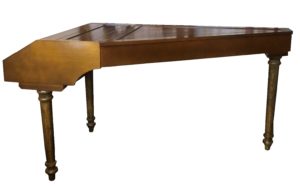
Harpsichord by Schüler und Wittmayer, Bad Reichenhall 1949 – Eric Feller Collection (2)
The harpsichord has 2 rows of wooden jacks with leather quills, two registers (8′ and 4′) and a divided lute for the 8′ register. The compass is 4 ½ octaves (CC – f3). Interesting is that the jacks are pushed down by a metal spring. The nameboard is signed with:
“Schüler und Wittmayer”
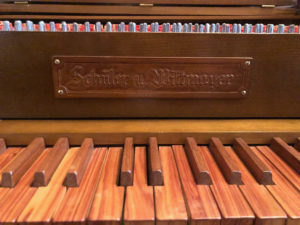
Harpsichord by Schüler und Wittmayer, Bad Reichenhall 1949 – Nameboard – Eric Feller Collection
The lid of the instrument is divided in two parts and the fallboard functions as a music stand. Below is the year of manufacture 1949 written in pencil. The registers can only be switched using a sliding coupler. In the front position the 4′ stop can be heard, in the middle position the combination of 8′ and 4′ and in the rear position the 8′ stop. There are two levers for the lute on the sides.
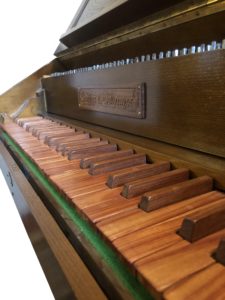
Harpsichord by Schüler und Wittmayer, Bad Reichenhall 1949 – Eric Feller Collection (3)
The sound of the instrument is very clear and rich in overtones. Because of its modern construction it is a completely new designed instrument and the sound is not comparable to historical harpsichords.
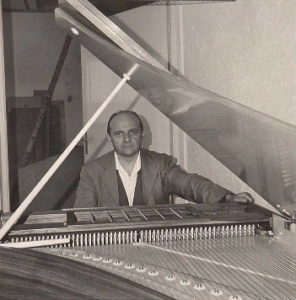
Kurt Wittmayer (1917 – 1997)
Kurt Wittmayer was born on November 22, 1917 in Sibiu, Romania. After graduating from high school, he studied organ in Leipzig, Rome and Salzburg. From 1945 he taught himself how to build harpsichords and clavichords, first alone and later with the engineer Rudolf Schüler (1911 – 1995). In February 1949 they both opened a workshop for historical keyboard instruments in Bad Reichenhall. However, the cooperation lasted only about 3 years and in 1951 both separated and each built their own instruments. Due to the increasing demand for the new instruments, Kurt Wittmayer was able to continuously expand his workshop.
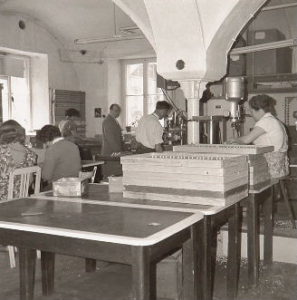
Kurt Wittmayer Company (1)
From 1950 he built instruments in Königsdorf, from 1952 in Geretsried-Gartenberg and in 1967 also in Wolfratshausen. The instruments reached a high production number. In later years, the company also built historical copies, as the trend was getting away from the “Rastenbauweise” (industrial/serial construction). Kurt Wittmayer died on September 4, 1997 in Bad Tölz.
Kurt Wittmayer Company (2)
Der Beitrag Schüler und Wittmayer 1949 erschien zuerst auf Eric Feller Early Keyboard Instruments Collection.
]]>Der Beitrag Neupert 1934 erschien zuerst auf Eric Feller Early Keyboard Instruments Collection.
]]>This single manual harpsichord made by Neupert in Bamberg is one of the rare harpsichords from the pre-war period, perfectly preserved with all parts original and playable.
The case is made of dark walnut and has a square wing shape with closed case at the bottom. On the right side there is a small brass hook for locking the instrument. The harpsichord has 2 rows with wooden jacks with leather quills (so-called “troho jacks“), two registers (8′ and 4′) and a lute stop for the 8 ‘register, which is not divided. The compass is 4 ½ octaves (CC – f3).
The signature “Neupert Bamberg” is located in the middle of the nameboard. The serial number is 15978.
The sound of this harpsichord is very warm und present. Because of its modern construction it is a completely new designed instrument and the sound is not comparable to historical harpsichords. Compared to identical instruments from the 1960s and 1970s, the sound is convincing multiple times.
Der Beitrag Neupert 1934 erschien zuerst auf Eric Feller Early Keyboard Instruments Collection.
]]>Der Beitrag Kurt Hutzelmann 1967 erschien zuerst auf Eric Feller Early Keyboard Instruments Collection.
]]>The one-manual instrument was built by Kurt Hutzelmann in 1967 in Eisenberg / Thuringia. It has a register (8 ‘). With a special construction via pedal, this harpsichord can lift the dampers (similar to the right pedal on modern pianos). Furthermore, the instrument has a lute stop. The case is made of ash wood. Above the keyboard is the inscription:
“K. Hutzelmann
Eisenberg Th.”
The instrument is single-strung and has a steel frame to ensure a longer tuning. The serial number is 1747 and is engraved on the right in the steel frame. The jacks are equipped with goose quills.

Kurt Hutzelmann Cembalo 1967 – Eric Feller Collection – Keyboard
Due to the sophisticated construction of the jacks (separating the damper from the jack and using a pedal for lifting the dampers), it is possible to create very interesting sound effect. This can also be combined with the lute. Unfortunately, this construction did not prevail and only very few instruments were made of this series.
Kurt Hutzelmann was born in 1889. On August 17, the piano factory Kurt Hutzelmann was founded in Eisenberg and exists till today (2019). Kurt Hutzelmann died in 1971. A more detailed description of the company history can be found on their homepage (click here).

Kurt Hutzelmann Cembalo 1967 – Eric Feller Collection – Nameboard
Der Beitrag Kurt Hutzelmann 1967 erschien zuerst auf Eric Feller Early Keyboard Instruments Collection.
]]>Der Beitrag Neupert 1961 – Telemann erschien zuerst auf Eric Feller Early Keyboard Instruments Collection.
]]>The case is made from walnut and has a square wing shape with an open soundboard. The instrument has 2 sets of jacks and has the new called OK-Jacks with silver tone plectra’s developed by Neupert. The elongated and round jacks are made of light metal and have two spring-assisted hand adjustment screws on both ends. These innovations are intended to minimize the susceptibility of the jacks and the instrument is easier to regulate. Removing the jacks to regulate is no longer necessary.
The instrument has a compass of 4 ½ octaves (CC – f3) and a plastic keyboard. Furthermore, there are two registers (8 ‘and 4′) as well as a divided lute stop for the 8’ register. On the nameboard is the signature “Neupert” on the right side. The serial number is 20193 and is stamped on the right side of the wrest plank.
According to old sales catalogs of the Neupert company, the instrument is called the Telemann model, based on the composer Georg Philipp Telemann (1681 – 1767). The designation of individual models of harpsichords after well-known composers was very popular in the 1950s – 1970s by many harpsichord makers (Neupert, Sperrhake, Wittmayer, etc.).
The sound of the instrument is very present. Because of its modern construction it is a completely new designed instrument and the sound is not comparable to historical harpsichords.
Der Beitrag Neupert 1961 – Telemann erschien zuerst auf Eric Feller Early Keyboard Instruments Collection.
]]>Der Beitrag Virginal after Vitus de Trasuntino c. 1990 erschien zuerst auf Eric Feller Early Keyboard Instruments Collection.
]]>
Catharina van Hemesser 1548 – Wallraf-Richartz Museum Köln
Virginals are much smaller than harpsichords. The strings run parallel to the keyboard and are pucked by a jack.
The Virginal in the Eric Feller Collection was made by Heugel after original instruments. It is constructed on the basis of instruments made by Vitus de Trasuntino (Venice).
The case is made of walnut with a circumferential profile edge. The soundboard is made of spruce wood and has two bridges. The instrument uses plastic jacks with Delrin quills. The keyboard is made of pear wood and the case rests on a renaissance-style stand. On the left side next to the keyboard is a small box with lid.
The sound is very warm and has a variety of timbres. These timbres arise due to the design. Virginals have two bridges that rest on the soundboard. Due to the small dimensions it can be used very well for solo and chamber music.
Der Beitrag Virginal after Vitus de Trasuntino c. 1990 erschien zuerst auf Eric Feller Early Keyboard Instruments Collection.
]]>Der Beitrag William de Blaise 1961 erschien zuerst auf Eric Feller Early Keyboard Instruments Collection.
]]>The case is made in walnut with shellac and stands on three conical round legs. The jacks are made of wood and have leather plectrums. Furthermore, it has a lyre with four pedals and a hand stop on the left side above the keyboard. The instrument is made in the typical “Rastenbauweise” (industrial/serial construction) of that period. The nameboard bears the inscription:
“William de Blaise
London“
On the right side of the wrest plank the stamped serial number 578. In addition to the serial number, there is a drilled holder for the original tuning key. The keyboard has a compass of 5 octaves (GG – g3) and is made of plastic. The disposition (8 ‘, 8’-lute, 4 ‘, 16′, 16’-lute) is based on the popular Bach disposition of that time. This goes back to the disposition of a harpsichord in the Musical Instruments Museum in Berlin. The harpsichord in the Berlin collection, which was probably built by Johann Heinrich Harrass (1665 – 1714), acted as some kind of prototype with its disposition for the newly build harpsichords (see: H. Henkel: „Der Cembalobau der Bach-Zeit im sächsisch-thüringischen und im Berliner Raum“, in: „Bericht über die Wissenschaftliche Konferenz zum II. Internationalen Bach-Fest der DDR“, Leipzig 1977, pp. 361–374.)
The instrument by Harrass supposedly came from the possession of Wilhelm Friedemann Bach, who is said to have inherited it from his father Johann Sebastian Bach. However there is no proof of this. It can be assumed that the aura of the name and the alleged provenance of Johann Sebastian Bach have contributed decisively to the fact that precisely that instrument in Berlin acted as a prototype.
The entire William de Blaise harpsichord is very well and precise made (especially the case). The cases were made by the Welmar Piano Company and the other works like stringing, voicing and action were made by de Blaise himself. Through the cooperation with Welmar he was able to produce around 60 instruments per year.
The sound of this harpsichord is very rich in overtones and more “silvery” than for example the instrument by Martin Sassmann in the Eric Feller Collection (see: Harpsichord Martin Sassmann ca. 1960 – click here).

William de Blaise at his workshop
William de Blaise was born in Latvia in 1907 and was a flutist in the Israel Philharmonic Orchestra until he moved to England in 1952. There he built harpsichords, which were in the modern construction tradition of the German instrument makers. In addition to the usual instruments he built also small harpsichords with small dimensions under the name Harpsichord Traverso, which he sold with great success. He also was the only one who built three-manual harpsichords after the dispositions of Hieronymus Albrecht Hass (1689 – 1752).

Cembalo William de Blaise 1961 – Eric Feller Collection – Nameboard

Harpsichord by William de Blaise 1961 – Eric Feller Collection – Soundboard
Der Beitrag William de Blaise 1961 erschien zuerst auf Eric Feller Early Keyboard Instruments Collection.
]]>Der Beitrag Anonymous c. 1650 erschien zuerst auf Eric Feller Early Keyboard Instruments Collection.
]]>The case is covered with fine cloth and decorated on the outside and inside with fine paintings. All around are rocailles, flowers and angels. The upper lid is painted with birds, angels, flowers and tendrils that frame a dancing female person. On the inside of the lid, there is a landscape with lake, which is framed on the left and right with tendrils. Five different people draw attention to themselves: in the foreground is a dancing couple. The lady wears a wide dark red skirt and is facing the viewer head-on and the gentleman is wearing red trousers and a hat. He stands with his back to the viewer and faces the lady. Two more people are on the left. They are musicians. One of them plays a lute. On the right side is another musician playing the flute. The society is framed by the statue of an angel on the left side and an urn on the right side, both of which are elevated on a pillar as a pedestal. In the background are trees that are arranged around a lake.
The whole scene seems very dynamic and not static, suggesting a hopeful life that finds the space for a relaxed personal expression in music and dance. The dance as a central theme acts dedicated staged. The colouring of the entire painting of the inner lid is mainly made in earth tones. Contrasting colours to the landscape are the red and green clothes of the people. Another contrast is created by the outer side of the lid when the instrument is closed.
The harpsichord is single-manual instrument and has an 8′-register. The soundboard has an intricately carved rose in the middle. The compass of the instrument is 3 octaves plus 2 tones and short bass octave (CC, F – g2) and it rests on a later rococo stand. The original jacks are made of wood and it can be seen remains of quills. The keyboard is extremely narrow and far too small for an adult hand. Furthermore, the overall harpsichord is very small in size but incorporates all the characteristics of large instruments. This suggests the assumption that it was a custom-made instrument for the children of an obviously very art-loving and rich family. So far, no comparable instruments can be found. The possibility that it could maybe an instrument from the workshop of Leopold Franciolini, can ruled out.
Further research is currently in process!

Harpsichord Anonymous c. 1650 – Children’s-Harpsichord (3) – Eric Feller Collection

Harpsichord Anonymous c. 1650 – Children’s-Harpsichord (4) – Eric Feller Collection
This harpsichord is on permanent display at the Kellinghusen Museum “betont – Ton und Tasten Museum”!
Der Beitrag Anonymous c. 1650 erschien zuerst auf Eric Feller Early Keyboard Instruments Collection.
]]>Der Beitrag Zuckermann after italian Instruments c. 1985 erschien zuerst auf Eric Feller Early Keyboard Instruments Collection.
]]>The case is made of cedar wood with surrounding frames and fillings and decorative brass hinges. The soundboard is made of spruce and it has a carved rose in the middle. The instrument has 2 sets of plastic jacks with Delrin and 2 register (8 ‘, 8’) and a lute. It rests on a (unsuitable for Italian copies) stand, which was designed after English models (“trestle stand”). The sound is very present and has a variety of timbres.
With the emerging historical performance practice, the need for instruments increased. Firms such as Neupert or Sperrhake mainly produced modern harpsichords that combined many elements of modern piano making, but they had little to do with historic harpsichords and their sound. Historic copies were relatively rare and very expensive in the mid 20th century. Wolfgang Zuckermann recognized this gap in the market and began in the late 1950s in the United States to offer cheap kits. The kits gave the opportunity for customer to built their own harpsichord for a relatively low price. However, these self-made harpsichords are always a reflection of the skills of their builders.
Wolfgang Zuckermann was born on October 11, 1922 in Berlin. Due to the Jewish religion of his family, he fled with his parents in 1938 to the United States. After training as a child psychologist, he become interested in construction of harpsichords and began in the 1950s to sell kits for harpsichords, which were based on historical originals. In 1969, he sold his company (which is still represented today with different branches worldwide) and moved to England. In 1995 he moved to France and lived in Avignon. He wrote two books about harpsichord construction:
- 1969 The Modern Harpsichord. October House
- 1986 The Modern Harpsichord: Twentieth Century Instruments and Their Makers. Reprint Services Corp.
Wolfgang Zuckermann died on 3 November 2018.

Zuckermann Harpsichord c.1985 – Eric Feller Collection (5)
Der Beitrag Zuckermann after italian Instruments c. 1985 erschien zuerst auf Eric Feller Early Keyboard Instruments Collection.
]]>Der Beitrag Martin Sassmann c. 1960 erschien zuerst auf Eric Feller Early Keyboard Instruments Collection.
]]>
This instrument is made in the typical “Rastenbauweise” (industrial/serial construction) of that time. The curved shaped case is made of cherry wood and has an open soundboard at the bottom. The jacks are made of plastic with leather plectrums. Furthermore, it has five pedals (registers and coupler) and 3 hand stops (buff). On the nameboard is the signature “Sassmann“. The serial number 1768 is stamped on the right side of the wrest plank.
According to old sales catalogs of the Sassmann Company, the instrument is the model named “Schütz“, according to the composer Heinrich Schütz (1585 – 1672). The designation of individual models of harpsichords to well-known composers was very popular in the 1950s – 1970s by many harpsichord makers (Neupert, Sperrhake, Wittmayer, etc.) – but there were no historical references from instrument to composer.
The sound of the instrument is absolutely voluminous, brilliant and offers a variety of timbres according to the many registers and registration options. Because of its modern construction it is a completely new instrument and the sound is not comparable to historical harpsichords.
The disposition of the harpsichord is:
- Lower manual: 8 ‘, 8′ – buff, 16′, 16’ – buff
- Upper manual: 8 ‘, 8′ – buff, 4’
This disposition is the so-called “Bach disposition” which goes back to the dispositions of a harpsichord in the Musical Instruments Museum in Berlin. The harpsichord in the Berlin collection, which was probably built by Johann Heinrich Harrass (1665 – 1714), acted as some kind of prototype with its dispositions for the newly build harpsichords (see: H. Henkel: „Der Cembalobau der Bach-Zeit im sächsisch-thüringischen und im Berliner Raum“, in: „Bericht über die Wissenschaftliche Konferenz zum II. Internationalen Bach-Fest der DDR“, Leipzig 1977, pp. 361–374.)
The instrument by Harrass supposedly came from the possession of Wilhelm Friedemann Bach, who is said to have inherited it from his father Johann Sebastian Bach. However there is no proof of this. It can be assumed that the aura of the name and the alleged provenance of Johann Sebastian Bach have contributed decisively to the fact that precisely that instrument in Berlin acted as a prototype.
Wolfgang Joachim Zuckermann lists eight types of instruments in his book “The Modern Harpsichord” built by Sassmann:
Kleinspinett
- Compass: BB – f3
- Disposition: 8’
Spinet „Silbermann“
- Compass: BB – f3
- Disposition: 8’ and buff
Harpsichord „Kleinod“ – single-manual
- Compass: BB – f3
- Disposition: 8’, 4’, divided buff 8’
Harpsichord „Scarlatti“ – single-manual
- Compass: AA – f3
- Disposition: 8’, 4’, divided buff 8’
Harpsichord „Pertici“ – single-manual
- Compass: AA – f3
- Disposition: 8’, 8’, 4’, buff or 16’, 8’, 4’, buff 16’ and 8’
Harpsichord „Baffo“ – double-manual
- Compass: AA – f3
- Disposition upper manual: 8’, 8’ – buff
- Disposition lower manual: 8’, 4’
- Knee coupler
Harpsichord „Schütz“ – double-manual
- Compass: AA – f3 or GG – f3 or GG – g3
- Disposition upper manual: 8’, 4’ or 8’, 8’ or 8’
- Disposition lower manual: 8’, 16’ or 8’, 4’, 16’ or 8’, 4’
- coupler, 5 pedals
Harpsichord „Bach“ – double-manual
- Compass: FF – f3
- Disposition upper manual: 8’, 4’, 8’ – buff
- Disposition lower manual: 8’, 16’, 16’ – buff
- coupler, 4 pedals
Martin Sassmann was born in 1924. In the Second World War he was a pilot and started his apprenticeship with J. C. Neupert in 1948 which he finished in 1953 with his master examination. In 1955 he opened his own workshop in Lennep. The growing business moved in 1966 to Hückeswagen-Wiehagen. Since the opening of the company in 1955 to 1969 and with about 20 employees a total of about 1500 instruments have been built. The annual production included about 45 double manual harpsichords, 50 single manual harpsichords, 20 spinets and 4 clavichords. (See: W. J. Zuckermann: “The Modern Harpsichord” 1969)
In 1987 the business changed its name to “Sassmann & Kramer” and in 1990 was transformed into a GmbH. After several other business partners, the company closed in 2009.
In the late 1960s and 1970s the company started producing instruments in a historical style, following the trend and demand for historical copies.
Der Beitrag Martin Sassmann c. 1960 erschien zuerst auf Eric Feller Early Keyboard Instruments Collection.
]]>Der Beitrag Thomas Barton c. 1720 erschien zuerst auf Eric Feller Early Keyboard Instruments Collection.
]]>The case and the original stand are made of walnut and the keyboard is made of ivory and ebony. This instrument with its typical English bentside shape was very popular in the late 17th and 18th century. This design suggests a more recent dating, whereas older spinets were built with a straight case (see: Spinet Stephan Keene 1690 – Eric Feller Collection).
On the nameboard was originally a signature that has faded over the centuries.
The instrument has a compass from GG – g3 and has one 8′ register. The jacks were originally made from Raven keels, which are replaced in the restoration by Turkey keels.
Thomas Barton lived from about 1685 to 1735. He was regarded as a harpsichord and spinet maker and was an apprentice to Stephan Keene from 1699 – 1706. His workshop was in Bishopsgate London. After his apprenticeship with Stephan Keene he set up his own business in 1706. Only a few spinets have survived and one harpsichord made in 1709.
Other surviving instruments by Thomas Barton:
- 1727 spinet – former collection of Joanna Leach, England
- 1730 spinet – National Museum of American History, USA
Der Beitrag Thomas Barton c. 1720 erschien zuerst auf Eric Feller Early Keyboard Instruments Collection.
]]>Der Beitrag Stephan Keene c. 1690 erschien zuerst auf Eric Feller Early Keyboard Instruments Collection.
]]>„Stephanus Keene – Londini Fecit“
Sadly the keyboard is not original. There are eighteenth century keys of the square piano type. I guess it’s made around 1780.
The instrument features in D. Boalch as number 21. It was owned by one Charles Thornton, then by Roger Warner of Burford, who had it repaired by Michael Thomas of Hurley. It was sold in 1957 to Dr. B. E. Juel – Jensen of Oxford and is in the Eric Feller Early Keyboard Collection since 2006.
This spinet was displayed on TV in the Film “Händel – Der Film” by Ralf Pleger.
Stephan Keene was born in Sydenham (Oxfordshire) at around 1640 and was one of the most famous spinet makers in the 17th. century. He was apprenticed from 1662 to the virginal maker Gabriel Townsend for seven years, and became a freeman of the Joiner’s Company (and, in 1704–5, its Master). Keene was obviously an able teacher of his craft and had several apprentices:
- Abraham Richardson 1664 – 1671
- Robert Smith 1670 – 1677
- John Harris 1675 – 1685
- Leonard Dutton 1682 – 1689
- Richard Vesey 1687 – 1694
- Edward Blunt 1693 – 1700
- Thomas Barton 1699 – 1706
- Charles Brackley 1703 – 1711
Whether he took any more after 1711 is unknown but it is unlikely since he would already have been in his seventies and died around 1719/20.
The list of his apprentices reads like a who’s who of famous spinet makers. All went on to become well-known instrument makers.
Further surviving instruments by Stephan Keene:
- 1668 virginal – Russell Collection of Early Keyboard Instruments, Edinburgh England
- 1685 spinet – Royal College of Music, London England
- 1700 spinet – National Gallery of Victoria, Melbourne Australia

Stephan Keene ca. 1690 – Nameboard – Eric Feller Collection
Der Beitrag Stephan Keene c. 1690 erschien zuerst auf Eric Feller Early Keyboard Instruments Collection.
]]>