Der Beitrag Travelling Harmonium by James Smith & Son c. 1875 erschien zuerst auf Eric Feller Early Keyboard Instruments Collection.
]]>The origins of the harmonium lie at the intersection of European organ traditions and Asian mouth-organs such as the Chinese sheng. In 1779, Christian Gottlieb Kratzenstein in Copenhagen designed the first free‑reed instrument, drawing direct inspiration from Chinese prototypes. By circa 1810, Germany witnessed the production of early keyboard instruments employing free reeds—namely the Aeoline (Eschenbach & Schlimbach) and the Physharmonika (Anton Haeckl)—which anticipated the harmonium’s structure and mechanics. A pivotal advancement came thereby in around 1833, with Gabriel Joseph Grenié’s orgue expressif in France, enabling dynamic tonal variation through air pressure modulation. The consummate form was realised by Alexandre‑François Debain, who patented the first instrument under the name harmonium in 1840/42. Equipped with pedal‑operated bellows and a wind reservoir, Debain established the technical benchmarks that would define harmonium construction throughout the nineteenth century.
Technical Variants: Pressure‑bellows versus Suction‑bellows Systems
Debain’s original conception was a pressure‑bellows instrument, whereby the air stored in a wind reservoir is released upon key depression. In the United States, from the 1860s onwards, James Cahart and subsequently Mason & Hamlin introduced the suction‑bellows harmonium, wherein air is drawn through under‑pressure. This design proved simpler, more economical, and better suited to mass production—and by around 1870 had come to dominate the world market.
The Harmonium’s Evolution in India
In the late nineteenth century, the harmonium was introduced to India by European missionaries and colonial officials. Encountering a rich indigenous musical tradition, the instrument was rapidly adapted to local contexts. A transformative innovation was made by Dwarkanath Ghose of Dwarkin & Sons in Calcutta in 1875: he replaced the European pedal‑bellows design with a hand‑pump, to accommodate the practice of performing while seated on the ground. Additionally, drone‑stops and a scale‑changer were incorporated to meet the exigencies of Indian music—such as the rendering of ragas and microtonal intervals.
By approximately 1915, India had become a principal centre of harmonium production—especially in Bengal and Gujarat. The so‑called Indian hand harmonium emerged as a standard instrument across devotional, classical, and popular musical spheres.
Integration and Controversies
During the twentieth century, the harmonium became central to ensemble accompaniment and solo expression throughout South and Southeast Asia—particularly in Ghazal, Qawwali, Bhajan, and Hindustani classical styles. Musicians such as Bhaiyya Ganpatrao integrated the instrument into the thumri repertoire of the Khayal tradition.
At the same time, the harmonium was embroiled in cultural controversy. In India’s nationalist movement, it was widely perceived as a symbol of Western hegemony. Rabindranath Tagore famously described it as “the bane of Indian music”. All India Radio banned its use in classical music broadcasts in 1940—a prohibition that was not fully lifted until 1971. Nonetheless, the Indian harmonium remained an enduring fixture of South Asian musical practice to this day.
Travelling Harmoniums in the Late Nineteenth Century
Concurrently with the harmonium’s adoption in India, a specialised variant—the travelling harmonium—emerged during the late nineteenth century. These instruments were compact, foldable, lightweight, and able to withstand challenging climatic conditions—making them ideal for missionary use in remote territories.
Christian mission societies introduced travelling harmoniums to numerous colonial regions, including India, China, and Japan. They were employed in liturgical accompaniment, in mission schools, at ecclesiastical stations, and in domestic worship—especially where full‑scale organs or pianos were impracticable.
- In China, from the 1890s, harmoniums were integrated into mission schools to teach Western hymnody and music theory.
- In Japan, during the Meiji era (1868 – 1912), harmoniums featured in Christian educational institutions. Notably, Yamaha later emerged as one of the first domestic producers of such reed‑organs.
- In India, travelling harmoniums delivered by missionaries quickly became adapted locally and absorbed into indigenous musical forms (as noted above).
These instruments were generally foldable into case‑form, with reduced keyboards and limited registers—features that rendered them practical for improvised congregational accompaniment, whether in a tent‑meeting or mission school setting. Moreover, they served an educational function: facilitating hymn‑singing, choir practices, and instruction in Western music notation. In this capacity, they exerted a significant influence upon local musical cultures—particularly in India, where the harmonium ultimately evolved into a culturally transformed, indigenous fixture.
The Travelling Harmonium by James Smith & Son
The specimen under discussion is a foldable travelling harmonium, crafted circa 1875 by James Smith & Son of Liverpool. Its case is fashioned from polished rosewood (palisander), and it is preserved within its original travel box, complete with brass handles on either side for practical carriage.
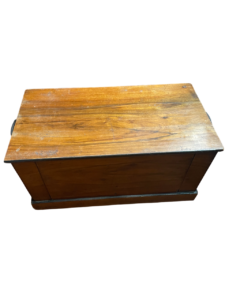
Harmoium James Smith and Son, Liverpool ca. 1875 (3) – Eric Feller Collection
The instrument features a keyboard overlaid with ivory and rosewood, spanning three octaves (C–C³). Beneath the keyboard lie five register levers, activating the registers Clarinette, Flute, Forte, Celeste, and one undecipherable label, each mounted with small ceramic plaques bearing inscriptions.
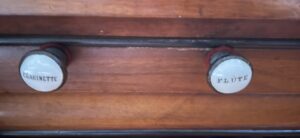
Harmoium James Smith and Son, Liverpool ca. 1875 (7) – Eric Feller Collection
In the open state, two cloth‑lined foot pedals emerge, housing the bellows mechanism. On the instrument’s upper surface appears the following signature:
“By Special Appointment
76, 74, & 72 Lord St. – James Smith & Son Liverpool
To The Queen.”
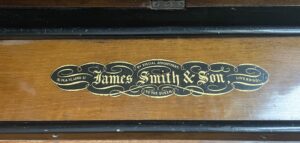
Harmoium James Smith and Son, Liverpool ca. 1875 (signature) – Eric Feller Collection
The timbre is notably compact, direct, and somewhat nasal in character. Though its resonating body is modest compared to that of larger cabinet harmoniums, it retains the quintessential tonal hue of free‑reed instruments. Articulation is immediate, with limited sustain.
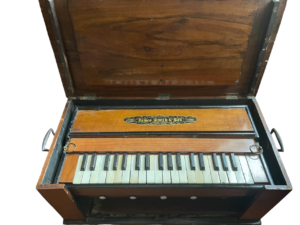
Harmoium James Smith and Son, Liverpool ca. 1875 (5) – Eric Feller Collection
Registers such as Flute or Celeste produce softer, flute‑like tones, whereas Forte and Clarinette render brighter, more assertive colours. Although acoustically constrained by virtue of its compact size, the instrument nevertheless yields a surprisingly lively and tonally varied sound, subtly refined by the player’s manipulation of air pressure.
James Smith & Son (Music Sellers), Liverpool
The firm James Smith & Son (Music Sellers) Ltd., located at 72–76 Lord Street, Liverpool, is one of the most longstanding musical instrument retailers in northern England. Its development not only reflects the history of the music trade in the 19th and 20th centuries but also the profound transformations that the British musical landscape underwent due to industrialisation, colonial history, wartime impacts, and technological change.
1. Foundation and Rise (1825–1912)
Founded in 1825, James Smith & Son quickly established itself as a significant music shop on one of Liverpool’s central commercial streets. The location on Lord Street provided high visibility and accessibility – a decisive advantage in this booming port and industrial city. By the latter half of the 19th century, the company ranked among the leading suppliers of keyboard instruments, particularly pianos and grand pianos, as well as harmoniums and organs.
A renovation of the premises by the renowned architectural firm William Culshaw & Son in 1874/75 gave the shop a modern appearance. The display of musical instruments – notably over 24 concert grands – testified not only to economic strength but also to cultural ambition.1
2. The Wright Era and the Golden Age (1912–1939)
In 1912, the company was acquired by Ernest Sidney Wright, whose family ran it for several generations. Under his leadership, James Smith & Son became the largest sheet music retailer in the Merseyside region and a supplier to numerous cultural institutions.
Of particular note was the company’s role in equipping transatlantic luxury liners of the Cunard Line with high-quality grand pianos – a task requiring both craftsmanship excellence and logistical expertise. The premises also served as a venue for concerts by prominent pianists and as an examination site for music grades. The store thus became a cultural centre far beyond mere commerce.2
3. Destruction during World War II and Loss of Archives
A decisive event was the destruction of the premises during the 1942 air raids. As a result of the German bombings of Liverpool (The Blitz), the shop and all company archives were lost to fire. Consequently, essential documents relating to the company’s early history were irretrievably destroyed – a loss which significantly complicates historical reconstruction today.3
4. Structural Change and End of Instrument Trading (1945–1974)
After the war, both economic and cultural circumstances changed fundamentally. With the advent of new media, altered consumption habits, and a declining interest in classical home music, the company’s focus shifted.
The sale of the last grand piano in 1974 symbolised the end of active musical instrument retail at James Smith & Son. In this context, the longstanding piano tuning contract with the Liverpool Philharmonic Orchestra was also terminated – another indicator of the company’s evolving role.4
5. Present Day: From Musical Instrument Retailer to Consumer Electronics Store
Today, the company continues under the original name James Smith & Son (Music Sellers) Ltd., but has entirely specialised in the sale of television and audio equipment. It operates branches in the Southport area and the surrounding Liverpool region. The tradition is thus maintained, albeit under changed conditions.
Despite this transformation, the company’s history remains a significant testimony to the role of music retail in British urban and cultural history. It exemplifies how closely trade history, colonialism, urban infrastructure, instrument manufacturing, and musical culture are interwoven.
References
- Bygone Liverpool, “Lord Molyneux’s House and the Early Development of Lord Street, Liverpool,” https://bygoneliverpool.wordpress.com/2021/02/14/lord-molyneuxs-house-and-the-early-development-of-lord-street-liverpool/.
- Facebook post on the history of James Smith & Son (Music Sellers), https://www.facebook.com/photo.php?fbid=741153039382821&id=127403904091074.
- British Record Shop Archive, “James Smith & Son, Liverpool,” https://britishrecordshoparchive.org/shops/james-smith–son/.
© Eric Feller – Early Keyboard Collection – June 2025
Der Beitrag Travelling Harmonium by James Smith & Son c. 1875 erschien zuerst auf Eric Feller Early Keyboard Instruments Collection.
]]>Der Beitrag Cabinet Piano John Broadwood and Sons c. 1820 erschien zuerst auf Eric Feller Early Keyboard Instruments Collection.
]]>The cabinet piano was a form of upright piano distinguished by its tall, often intricately decorated case, adorned with elaborate wood inlays, turned columns, and elegant embellishments that complemented the interiors of the affluent bourgeoisie. Unlike the smaller square pianos, it offered a more powerful sound and longer string length while occupying less space than a grand piano. Its tall soundboard and vertical construction allowed for greater string tension, resulting in a fuller and more resonant tone than earlier domestic instruments. The popularity of cabinet pianos endured until the mid-19th century but was eventually supplanted by the cottage piano, a more compact and practical version of the upright piano.
The instrument presented here was made around 1820 by John Broadwood & Sons in London. The case is made of solid mahogany and is richly decorated with ornate brass appliqués, while the front panel is covered with its original yellow silk. Stylistically, the instrument adheres to the Regency aesthetic, characterised by elegant, clean lines and intricate decorative elements.
The natural keys are covered with ivory, while the sharps are made of ebony. The instrument is equipped with two wooden pedals (dampers and una corda).
The hammers are leather-covered, and the instrument features a bichord stringing, ensuring a warm and resonant tonal quality. It features the English double-action with abstract levers, known for its precision and dynamic response. The nameboard is adorned with brass inlays and bears the signature:
“John Broadwood and Sons. / Makers to His Majesty and the Princesses /
Great Pulteney Street London Golden Square”

Cabinet Piano J. Broadwood and Sons,c. 1820 – Eric Feller Collection (signature)
This cabinet piano bears the serial number 2652. The tuning pins are positioned at the top. Beneath the keyboard, there are two small compartments with lockable doors. On either side above the keyboard, retractable candle sconces can be extended when needed.
This instrument is distinguished by its exceptional elegance and produces a rich, warm, and resonant tone, making it a remarkable example of early 19th-century piano craftsmanship.
John Broadwood was born on 6th October 1732 in Oldhamstocks near Cockburnspath in Scotland. He learned the profession of being a cabinetmaker like his father before.
In 1761 he started working for Burkat Shudi (1702 – 1773) in London and in 1770 became his business partner. In 1771 he opened his own shop on Great Pulteney Street in London. In 1769 he married Burkat Shudi’s daughter Barbara in her first marriage and had four children with her. After his wife’s death in 1776 he married Mary Kitson in 1781 and had six children with her. He died on 17th July 1812 in London.
Other surviving Cabinet Pianos by John Broadwood and Sons:
- 1827/28 Cabinet Piano (No. 3538) – Gemeentemuseum, The Hague The Netherlands
- 1828/29 Cabinet Piano (No.4042) – Metropolitan Museum of Art, New York USA

Cabinet Piano J. Broadwood and Sons, c. 1820 – Eric Feller Collection
Der Beitrag Cabinet Piano John Broadwood and Sons c. 1820 erschien zuerst auf Eric Feller Early Keyboard Instruments Collection.
]]>Der Beitrag Longman and Broderip 1782 – Travel Piano erschien zuerst auf Eric Feller Early Keyboard Instruments Collection.
]]>In the history of instrument making, travel instruments have been documented as early as the 17th century. They were rarely made and mostly on explicit request of a customer. For more information on the history of travel instruments, please click here.
The case of the instrument is made of mahogany with different inlays. It rests on a simple mahogany frame and each the four legs have brass castors at the ends. To the left of the keyboard is a small hand stop for controlling the dampers.
The instrument has a Single Action, single damper and is double strung. The nameboard is decorated with multi-coloured, inlaid garlands and bears the inscription in an oval cartridge:
“Longman and Broderip
Musical Instrument Makers
No. 26 Cheapside and No. 13 Haymarket
London”
The keys are made of ivory and ebony, and the lower keys are each decorated with an additional notch that has been coloured with iron gall ink. This detail was very common as a decorative element on harpsichord keyboards and can be found here as a decorative remnant.

Longman and Broderip, London c. 1782 Travel Piano – Eric Feller Collection (2)
For detailed information about Longman & Broderip here!
So far, only one other travel piano with similar specifications by Longman and Broderip has survived and is now in the Metropolitan Museum in New York. The instrument there has a smaller range of only 3 octaves and has even smaller dimensions.

Portable Square Piano by Longman & Broderip c. 1790 – Metropolitan Museum New York (1)

Portable Square Piano by Longman & Broderip c. 1790 – Metropolitan Museum New York (2)
Der Beitrag Longman and Broderip 1782 – Travel Piano erschien zuerst auf Eric Feller Early Keyboard Instruments Collection.
]]>Der Beitrag Dulcitone Thomas Machell and Sons c. 1870 erschien zuerst auf Eric Feller Early Keyboard Instruments Collection.
]]>At the same time as Thomas Machell, the French Victor Mustel invented the Typophone in 1866, also a tuning fork piano like the Dulcitone. Mustel continued to experiment and finally invented the Célesta in 1886, which he patented in the same year. The Dulcitone is now considered the precursor of the celesta.
The Dulcitone in the Eric Feller Collection is made of dark mahogany and has a range of 5 octaves (AA – a3). It is the model F, which has the largest compass. A wooden pedal is attached to the front right leg, which can be used to operate the dampers. The keys are made of ivory and ebony. The back of the instrument is decorated with fretwork and red cloth and bears the words Dulcitone. The signature is on the front cover and bears the inscription:
“Dulcitone
Patentees and Sole Makers
Thomas Machell and Sons
Glasgow, Scotland”
In the early days Machell produced three models of these instruments in different price ranges:
- Model B: 3½ octaves in mahogany (Chippendale shape) or oak (smoked) complete with music stand for £ 12
- Model R: 4 octaves in mahogany or oak for £ 15
- Model F: 5 octaves in mahogany or oak for £ 18.
Other versions were added later, which were related to the taste of the time.
You can find an original catalogue of the company here – click here.

Dulcitone Thomas Machell, Glasgow ca. 1870 – Eric Feller Collection (3)
The Dulcitone was used because of its size and the fact that it did not go out of tune, especially on trains and ships. It was also often taken by missionaries to remote areas to accompany church services there. As a result of this, many of these instruments found their way into the most various areas of the world. Around 6,000 of these instruments were made, but only a few have survived in playable condition to this day.

Hints on adjusting the Dulcitone
Other preserved instruments by Thomas Machell & Sons:
- 1897 – Whittaker’s Musical Museum, New Zealand
- 1875 – 1899 – National Museum of American History, USA
Der Beitrag Dulcitone Thomas Machell and Sons c. 1870 erschien zuerst auf Eric Feller Early Keyboard Instruments Collection.
]]>Der Beitrag Cottage Piano William Rolfe and Sons 1835 erschien zuerst auf Eric Feller Early Keyboard Instruments Collection.
]]>The case is made of solid mahogany with very fine inlays and the front is decorated with red silk. The keyboard is made of ivory and ebony. At both ends of the keyboard are two retractable platforms for candle holders that can be pulled out via a small ivory button. The instrument has two wooden pedals (dampers & una corda) and a compass of 6 octaves (FF – f4). The hammers are covered with felt and the instrument is double strung with an English Double Action and abstracts. The nameboard is decorated with various brass inlays and bears the signature:
„W. Rolfe & Sons
Manufacturers
112 Cheapside London”
The serial number 1656 appears on the right sight of the pin block. The music stand rests under the keyboard and can be hung into the cylindrical cover lid.
The instrument comes from the former collection of Mary and Kenneth Mobbs in Bristol. According to records, it was acquired from Rev. Gordon Robinson on April 7th, 1977. During the time in the possession of Mary and Kenneth Mobbs, the piano was loaned and exhibited at the Royal Academy of Music Museum.

Cottage Piano W. Rolfe & Sons, London 1835 – Eric Feller Collection (Nameboard)
William Rolfe worked as a piano maker from 1785 to about 1828. His exact dates of birth and death are not known yet. From 1785 he worked with Samuel Davis and the company was run under the name Rolfe & Davis. In 1797 both developed a patent for a “Turkish-Music-Stop” with cymbals and drums. According to R. Harding, this patent is the oldest testimony to such a change in the form of a janissary stop, which was very popular in the 1820s (especially by Viennese instruments) and then disappeared very quickly.
At the same time William Rolfe worked as an instrument maker and music publisher and was a partner of Thomas Culliford with whom he produced instruments for the company Longman & Broderip. He also sold his instruments under his name. After the bankruptcy of Longman & Broderip in 1796, he worked only under his name.
In 1807, his two sons Nicholas and Thomas became partners in the father’s company. From 1814, the company was renamed to William Rolfe & Sons and there were additional premises in the London Wall Street no. 32 added. The main address was since its founding in Cheapside 112. From about 1820 instruments were made under the name William Rolfe and Compy. The company existed until 1889.
Other surviving instruments by William Rolfe & Sons:
- 1820 – 1825 – Upright Piano – Private collection, Gates County USA
- 1814 – 1820 – Upright Piano – Museu da Musica Lisbon, Portugal
Der Beitrag Cottage Piano William Rolfe and Sons 1835 erschien zuerst auf Eric Feller Early Keyboard Instruments Collection.
]]>Der Beitrag Cottage Piano John Broadwood and Sons 1833 erschien zuerst auf Eric Feller Early Keyboard Instruments Collection.
]]>According to the serial number, this instrument was made in London in 1833. The case is made of solid mahogany and the front is decorated with green silk. The keyboard is made of ivory and ebony. At both ends of the keyboard there are two retractable platforms for candle holders that can be pulled out via a small ring. The instrument has two wooden pedals (dampers, “blind pedal” with no function) and a compass of 6 octaves (FF – f4). The hammers are covered with felt and the instrument is double strung with an English double action with abstracts. The nameboard is decorated with various inlays and bears the signature:
“John Broadwood and Sons. / Makers to his Majesty and the Princesses / Great Pulteney Street Golden Square London”
There is a second handwritten signature on the wrest plank: “H. B.” or “J. B.” (illegible) The serial number is 1778 and can also be found on the wrest plank.
The instrument comes from the former collection of Mary and Kenneth Mobbs in Bristol. According to records, the instrument was acquired from Rev. W. T. H. B. Davies on February 19, 1986. During the time in the possession of Mary and Kenneth Mobbs, the piano was loaned and exhibited at the Royal Academy of Music Museum.
John Broadwood was born on October 6, 1732 in Oldhamstocks near Cockburnspath in Scotland. He learned the trade of cabinet maker like his father had before. In 1761 he started working for Burkat Shudi (1702 – 1773) in London and became his business partner in 1770. In 1771 he opened his own shop on Great Pulteney Street in London. John Broadwood married Burkat Shudi’s daughter Barbara in 1769 and had four children with her. After the early death (1776) of his wife, he married Mary Kitson in 1781 and had six children with her. He died in London on July 17, 1812. (see: M. Clinkscale: Makers of the Piano 1700 – 1820, Oxford University Press 1999)
Other surviving instruments by John Broadwood & Sons:
1823 – Cottage Piano – David Brenner, Riverside USA
c. 1835 – Cottage Piano – Musée des Instruments de Musique, Brussels Belgium
c. 1840 – Cottage Piano – The Royal Academy of Music, London England
Der Beitrag Cottage Piano John Broadwood and Sons 1833 erschien zuerst auf Eric Feller Early Keyboard Instruments Collection.
]]>Der Beitrag Goulding & D’Almaine 1823 – 1834 erschien zuerst auf Eric Feller Early Keyboard Instruments Collection.
]]>The instrument was made between 1823 and 1834 by “Goulding & D’Almaine” in London. The solid mahogany Regency style case is decorated with various inlays. The front is covered with the original silk. The keyboard is made from ivory and ebony. At the ends of the keyboard there are two retractable candle holders which can be pulled out via a small ring. The instrument has three wooden pedals (dampers, una corda and swell). The use of a lid swell is known by square pianos but only a few upright instruments have this feature too. Inside the piano is a mechanism which can lift the lid via a pedal. The compass is 6 octaves (FF – f4), the hammers are covered with felt and the instrument is double strung. The action is an English double action with abstracts. The nameboard is decorated with various inlays and bears the signature:
“Patent
Goulding & D’Almaine
20 Soho Square
London“
On the action is a second handwritten signature:
“M. Scott Dealer + Tuner Bath”
This indicates that the instrument probably comes from Bath or the surrounding area. In the 18th and early 19th centuries Bath was a popular place to be of the often art-loving aristocracy.
The instrument impresses with its small dimensions and excellent workmanship.
“Goulding & D’Almaine” was founded in 1785 by George Goulding at No. 25 James Street, Covent Garden. In 1798 Thomas D’Almaine and Phipps (the first name is not yet known) join the company to “Goulding, Phipps & D’Almaine” until about 1810 (sometimes there is also the name “Goulding & Co.” found on instruments of that period). After around 1810 Phipps left the company and another partner with the name Potter joined the company. Again, no first name is known. The company was from then on named “Goulding, D’Almaine, Potter & Co.” and was at No. 124 Bond Street, from where they moved in 1810/11 to No. 20 Soho Square. From 1803 to 1816 the company had a branch at No. 7 Westmoreland Street in Dublin. Potter left the company in 1823 and from then until 1834 the company was known as “Goulding & D’Almaine” or “Goulding, D’Almaine & Co.” (the company also acted as a music publisher). The name “D’Almaine, Potter, Wood & Co.” dates from 1834 until about 1840 when James Wood (a woodwind instrument maker) became a partner. By this time Goulding’s nephew Thomas Mackinley had already become a partner in the company. George Goulding retired completely in 1847 and his nephew took over the company until his death. (See M. Clinkscale: Makers of the Piano 1700-1820, Oxford University Press 1999)
Other preserved instruments made by Goulding & D’Almaine:
- 1823 – 1834 upright piano – Museu da Musica Lisbon, Portugal
Der Beitrag Goulding & D’Almaine 1823 – 1834 erschien zuerst auf Eric Feller Early Keyboard Instruments Collection.
]]>Der Beitrag Cabinet Piano John Broadwood and Sons c. 1835 erschien zuerst auf Eric Feller Early Keyboard Instruments Collection.
]]>The case of the instrument is made of solid mahogany and is richly decorated with wooden applications. The front is covered with the original red silk. The entire instrument is held in the typical “Regency Style“.
The keyboard is made from ivory and ebony and the instrument has two wooden pedals (dampers and una corda).
The hammers are covered with leather and the instrument is double strung. The action is a form of the English double action with abstracts.
The nameboard is decorated with brass inlays and bears the signature:
“John Broadwood and Sons. / Makers to His Majesty and the Princesses /
Great Pulteney Street London Golden Square”
The serial number is handwritten on the first key and reads: 6853. The tuning pins are at the top. Beneath the keyboard are two small doors.
John Broadwood was born on 6th October 1732 in Oldhamstocks near Cockburnspath in Scotland. He learned the profession of being a cabinetmaker like his father before.
In 1761 he started working for Burkat Shudi (1702 – 1773) in London and in 1770 became his business partner. In 1771 he opened his own shop on Great Pulteney Street in London. In 1769 he married Burkat Shudi’s daughter Barbara in her first marriage and had four children with her. After his wife’s death in 1776 he married Mary Kitson in 1781 and had six children with her. He died on 17th July 1812 in London.
Other surviving instruments by John Broadwood and Sons:
- 1827/28 Cabinet Piano (No. 3538) – Gemeentemuseum, The Hague The Netherlands
- 1828/29 Cabinet Piano (No.4042) – Metropolitan Museum of Art, New York USA
This instrument is on permanent display at the Kellinghusen Museum “betont – Ton und Tasten Museum”!
Der Beitrag Cabinet Piano John Broadwood and Sons c. 1835 erschien zuerst auf Eric Feller Early Keyboard Instruments Collection.
]]>Der Beitrag Travel Piano by Luigi Violi 1768 erschien zuerst auf Eric Feller Early Keyboard Instruments Collection.
]]>This unusual and very small travel piano was made by Luigi Violi in Bologna in 1768.
The instrument is made of walnut and has no stand or legs. At the end of both sides are small carrying handles made of brass.
Inside the entire action is covered by a dust cover (covered with green silk) with an integrated music stand. Underneath the dust cover is a handwritten signature that it was lined 1838 with new silk.
The nameboard bears in a small porcelain cartridge the signature:
“No. 129
Luigi Violi Fece
Bologna Anno 1768″
The signature “No. 129” is probably the production number of the instrument.
The instrument has a 4 octaves compass with short octave (C, F – f3) and it has a simple Prellmechanik. On the right of the keyboard is a small hand stop (harp).
So far no other instruments have been preserved by Luigi Violi.
This square piano is on permanent display at the Kellinghusen Museum “betont – Ton und Tasten Museum”!
Der Beitrag Travel Piano by Luigi Violi 1768 erschien zuerst auf Eric Feller Early Keyboard Instruments Collection.
]]>