Der Beitrag Zuckermann after Georg Woytzig (1688) 1990 erschien zuerst auf Eric Feller Early Keyboard Instruments Collection.
]]>Although the clavichord was increasingly replaced by the more advanced fortepiano in the late 18th and early 19th centuries, it experienced renewed appreciation in the 20th century through historical performance practice, led by Wanda Landowska (1879 – 1959). In modern musicology, it serves as a key instrument for researching the playing practice and musical expression of the Baroque and early Classical periods. Working with the clavichord not only offers a return to past musical traditions, but also a deeper insight into the sound aesthetics of an era in which the connection between musician and instrument was more direct and personal than ever before.
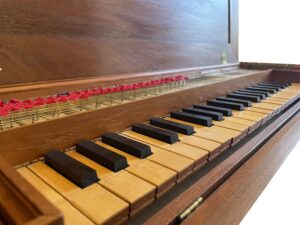
Clavichord Zuckermann King of Sweden, c. 1990 after Georg Woytzig (1688) – Eric Feller Collection (2)
The clavichord presented here was built from a kit by Zuckermann around 1990, which was designed based on an instrument by Georg Woytzig from 1688. This model is marketed by Zuckermann under the name “King of Sweden” and is very popular with musicians. Due to its compact shape, low weight and charming sound, this instrument offers the possibility of authentically reproducing the literature of the 16th and early 17th centuries.
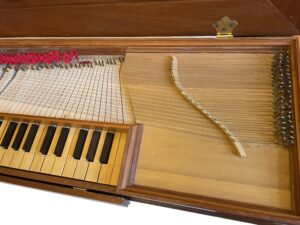
Clavichord Zuckermann King of Sweden, c. 1990 after Georg Woytzig (1688) – Eric Feller Collection (3)
The instrument does not have a stand. The case is built from American cherry wood and the soundboard consists of spruce. The tangents are made of brass. The range is 45 keys (C/E – c3), the strings are double-chord and made of brass. The clavichord is triple-fretted.
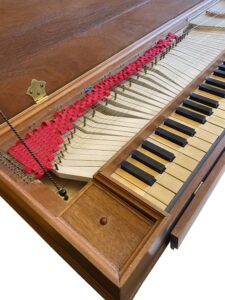
Clavichord Zuckermann King of Sweden, c. 1990 after Georg Woytzig (1688) – Eric Feller Collection (4)
As the only mechanical keyboard instrument, the clavichord has the possibility of influencing the sound even after the tangent has been hitting the string by changing the pressure on the key periodically. This creates the typical vibrato effect that only clavichords can produce.
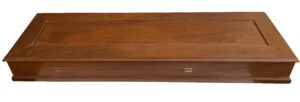
Clavichord Zuckermann King of Sweden, c. 1990 after Georg Woytzig (1688) – Eric Feller Collection (5)
Der Beitrag Zuckermann after Georg Woytzig (1688) 1990 erschien zuerst auf Eric Feller Early Keyboard Instruments Collection.
]]>Der Beitrag Heugel 2013 erschien zuerst auf Eric Feller Early Keyboard Instruments Collection.
]]>The heyday of the clavichord took place in the 17th and 18th centuries, particularly in Central Europe. The German and Scandinavian regions became important centres for the production of this instrument type. Instrument makers, including well-known personalities such as Gottfried Silbermann (1683 – 1753), Johann Adolph Hass (1713 – 1779) and Christian Gottlob Hubert (1714 – 1793), contributed to perfecting the clavichord by introducing innovative mechanisms and construction techniques.
The clavichord continued to develop into an instrument of great versatility. Musicians such as Carl Philipp Emanuel Bach (1714 – 1788) and Wolfgang Amadeus Mozart (1756 – 1791) appreciated the expressive nature of the clavichord, which made it possible to convey subtle emotional nuances in music.
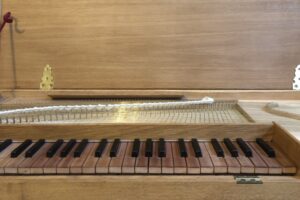
Clavichord Heugel, 2013 – Eric Feller Collection (keyboard & action)
This small portable clavichord was made in 2013 from a kit produced by Heugel. It is based on original instruments from the 17th century. The case is made of oak and the instrument has no legs. These small instruments are simply placed on a table and played there. The light weight of only 14 kg makes it an ideal travel instrument. The keyboard is made of pear and ebony. The compass is 4 octaves plus 2 tones (C – d3), double strung. As further characteristic, this clavichord is unfretted, which means that there are two strings for each key. As the only mechanical keyboard instrument, the clavichord thus has the possibility of influencing the sound even after the tangent has been hitting the string by changing the pressure on the key periodically. This creates the typical vibrato effect that only clavichords can produce. The tangents are made of brass and the soundboard is made of spruce.
This instrument has a lovely singing, delicate and lyrical sound.
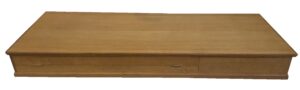
Clavichord Heugel, 2013 – Eric Feller Collection (case)
Der Beitrag Heugel 2013 erschien zuerst auf Eric Feller Early Keyboard Instruments Collection.
]]>Der Beitrag Neupert 1954 erschien zuerst auf Eric Feller Early Keyboard Instruments Collection.
]]>This large clavichord was made by Neupert in Bamberg / Germany and represents a modern instrument from the post-war period. Based on the serial number, the clavichord was made in 1954. Due to historical performance practice, the construction of harpsichords, spinets and clavichords was increasingly resumed in the 20th century.
The case is made of walnut and the instrument has 4 curved Chippendale style legs. The signature by Neupert and the stamped serial number (No. 18588) can be found inside of the case on the left side.
The inverted keyboard has a compass of 5 octaves (FF – f3) and the instrument is double strung. A further characteristic is that this clavichord is unfretted, which means that there are two strings for each key. In contrast to this construction is the fretted Viennese clavichord from c.1780 in the Eric Feller Collection (for further information click here).
Playing with the typical vibrato effect is also possible on this instrument. As the only mechanical keyboard instrument, the clavichord thus has the possibility of influencing the sound even after the tangent has been hitting the string by changing the pressure on the key periodically.
The instrument impresses with its warm and exquisite sound. Due to its size, a comparatively loud sound can be achieved, especially in the bass range.
The instrument was acquired in the 1950s by Rudolf Knop who was the first principal of the new established Music School in Wolfsburg.
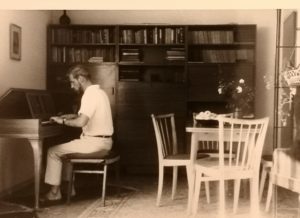
Rudolf Knop playing the Neupert Clavichord (c. 1960)
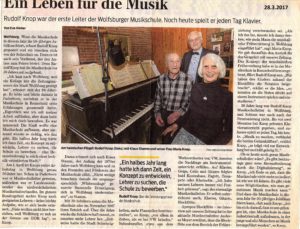
Rudolf Knop – Newspaper article 28.3.2017
Instruments from the Neupert company were produced in large numbers and the company is still producing instruments today. You can find a summary of the company’s history on their website (click here).
Der Beitrag Neupert 1954 erschien zuerst auf Eric Feller Early Keyboard Instruments Collection.
]]>Der Beitrag Johannes Morley 1968 erschien zuerst auf Eric Feller Early Keyboard Instruments Collection.
]]>The case of the delicate instrument is painted white and stands on four fluted, tapering legs. The lid is painted blue inside and bears the Latin inscription in golden colour:
“MUSICA MAGNORUM EST SOLAMEN DULCE LABORUM”
This inscription can be found on historical instruments and was often used for decoration on modern instruments. The translation is: “Music is a sweet consolation for great efforts.” The name board is signed with:
“JOHN MORLEY LONDINI FECIT”
The keyboard is made with black lower keys and white upper keys. The compass is 4 octaves and two tones (CC – d3) and the instrument is double strung. A further characteristic is that this clavichord is unfretted, which means that there are two strings for each key. In contrast to this construction is the fretted Viennese clavichord from c.1780 in the Eric Feller Collection (for further information click here).
Playing with the typical vibrato effect is also possible at this instrument. As the only mechanical keyboard instrument, the clavichord thus has the possibility of influencing the sound even after the tangent has been hitting the string by changing the pressure on the key periodically.
The entire instrument shows excellent workmanship and has a very sweet sound. Due to the small size and the low weight, it can be used well as a travel instrument.
The Morley factory in London has a long tradition of instrument building. An overview of the history of the company can be found on their website (click here).
Der Beitrag Johannes Morley 1968 erschien zuerst auf Eric Feller Early Keyboard Instruments Collection.
]]>Der Beitrag Anonymous c. 1780 erschien zuerst auf Eric Feller Early Keyboard Instruments Collection.
]]>The case of the instrument is made from walnut and mahogany in various marquetries and French polish. At the keyboard it is decorated with bird’s eye maple. On the right of the front there are traces of a small castle which was disassembled over the time and replaced with a piece of veneer wood. The keys are made of bone and ebony. The compass is 4 ½ octaves (CC – f3). On the left side (next to the keyboard) is a small hidden box where tuning tools and spare strings could be stored. The tangents are made of iron.
The clavichord also has a notched and narrow nameboard. This feature is actually typical for Viennese fortepianos and shows that the clavichord must be made on a customer’s special request by a piano maker. The instrument is very-well made build and shows high craftsmanship and care.
The individual keys are made very long. Due to this design playing with the so-called “Bebungen” is very possible. As the only keyboard instrument, the clavichord thus has the possibility of influencing the sound even after the key has been played. By changing the pressure on the key periodically it will produce a vibrato-like effect.
The instrument is fretted and double strung. By fretted clavichords, 2 to 4 keys use the same string at different spots.
Clavichords were highly valued and played by many composers and instrumentalists even after the dissemination of the then new piano. Despite the low volume they offer an impressive sound spectrum.
In the 20th century, the clavichord experienced a rediscovery, especially in the context of historical performance practice. Musicians and instrument makers began to take a renewed interest in historical instruments, and the clavichord became popular again in the early music scene. Today, it is appreciated by musicians and lovers of early music and finds its place in concerts and recordings.
Der Beitrag Anonymous c. 1780 erschien zuerst auf Eric Feller Early Keyboard Instruments Collection.
]]>