Der Beitrag Longman and Broderip c. 1785 for Charles Burney erschien zuerst auf Eric Feller Early Keyboard Instruments Collection.
]]>The case is made of mahogany with surrounding inlays of different coloured woods. On display are various flowers and tendrils as well as Greek amphorae, all are made with coloured inlays. Above the keyboard are also garlands and various flowers inlays. The entire decoration is outstanding and of the highest artistic ability. The instrument rests on a trestle stand. The nameboard bears the inscription on a rosewood shield:
“Longman and Broderip
London
No. 26 Cheapside & No. 13 Haymarket”
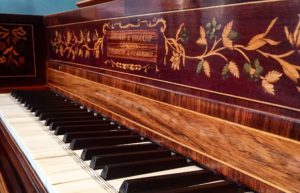
Tangentenflügel Longman & Broderip c. 1785 – Eric Feller Collection (Tangent Piano) – Nameboard
Inside are handwritten the initials J. W. and the signature:
“Made for Mr. Burney”
The keyboard has a compass of 5 octaves (FF – f3) and is made of ivory and ebony. The keys are each decorated with fine lines, which was coloured with ink. This detail of decoration was very popular on harpsichords and can be found here as a decorative remnant. The instrument has a tangent action with bare wooden tangents and single dampers. Under the instrument are two knee levers for controlling the dampers and moderator. The bridge is not divided. In the bass range, the bridge is delicately carved as a stylized fishtail.
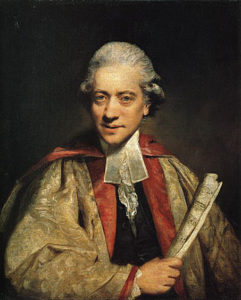
Portrait of Charles Burney by Joshua Reynolds 1781 – National Portrait Gallery London
The signature indicates that the instrument was built for Charles Burney and ordered directly from Longman & Broderip. Burney, who through his travels in Europe visited a variety of personalities of musical life at the end of the 18th century and various instrument makers, must there have come into contact with tangent pianos. Back home in England he commissioned the company to build such an instrument for him. Tangent actions were barely known in England. Only a few instrument makers (Frederick Beck, Humphry Walton, John Statman and Charles Trute) were familiar with that kind of action.
Like Vienna and Paris, London was the major centre of instrument making in the 18th and 19th centuries. In the mid-1760s some instrument makers, mostly German-speaking, immigrated to England. Above all, the German instrument maker Johann Christoph Zumpe (1726 – 1790) from Fürth.
In the 1750s he immigrated to London and worked at the workshop of the famous harpsichord maker Burkat Shudi (1702 – 1773). In 1761 he founded his own business on Princes Street and built the first Fortepianos in England. The instruments of Zumpe were all daintily built and have a simple single action. So far, however, there is no evidence that Zumpe has not built instruments with other actions. Due to its origin, it is likely that he also knew other actions from his time in southern Germany.
The St. Petersburg-born and Naples-based piano maker Giacomo Ferdinando Sievers (1810 – 1878) wrote in 1868:
“Il Pianoforte. Guida pratica per construttori, Accordatori, Dilettanti and Possessori di Pianoforti con 300 disegni parte intercalati nel testo e parte in apposito atlante di Giacomo Ferd. Sievers Fabbricante di Pianoforti in Napoli” that in 1828 he repaired several instruments with tangential actions in Riga. Furthermore, he also describes in detail the tangent action that Zumpe is said to have built:
“In England and Germany some harpsichords were made with jacks that struck two unison strings. In 1828, when I was in Riga, I repaired several of these instruments that had been made in Nuremberg in 1754. In England, during that period, Zumpe produced the same model with an intermediate lever. This maker covered the jacks with soft leather, thus they produced a faint but quite pleasant sound; those [percussive jacks] made in Germany were not covered with leather and produced a shrill sound. These jacks were placed inside a leathered guide, which looked like a comb, that which was supported in order to allow space between the key and the jack; Zumpe’s intermediate lever was written on the back by means of a parchment.”
It is not sure if Sievers really meant Zumpe in his description or maybe another instrument maker. Also possible are instruments from Zumpes workshop, which were revised with a new action. However, this is one of the main sources of tangent instruments in England.
Today there are only three instruments with tangent action are known ( November 2019):
- Tangent piano by Fredericus Beck 1790 (private collection England),
- Tangent piano Anonymous, probably also made by Beck (Collection of the Museum of the College of Music in Osaka, Japan),
- Remains of a case of an Anonymous grand, probably made in England first half of the 19th century (Collection Germanisches Nationalmuseum (Inv.: MINe 153, Nürnberg, formerly in the Neupert Collection).
Furthermore the Eric Feller Collection can add to this two other English tangent instruments:
- Tangent piano by Longman & Broderip, London 1785,
- Tangent square piano by Charles Trute, London 1790
The development and commonness of tangent instruments in the United Kingdom has happened quite occasionally.
A detailed article about tangent pianos can be found at the publications of the Eric Feller Collection (click here)!
Further research on the instrument is still ongoing!
Sources:
- AWOUTERS, M. – DE GEYSER, I. – VANDENBERGHE, S., Catalogus van de Muziekinstrumenten, Brugge, Gruuthusemuseum, 1985.
- BAUER, Wilhelm A. – DEUTSCH, Otto Erich, Mozart. Briefe und Aufzeichnungen, vol. II, 1777-1779, New York, Bärenreiter, 1962.
- BOALCH, Donald H., Makers of the Harpsichord and Clavichord 1440-1840, Oxford, Claredon Press, 1995.
- BRUNNER, Hans, Das Klavierklangideal Mozarts und die Klaviere seiner Zeit, Augsburg, Filser, 1933
- BURNEY, Charles, The present state of music in France and Italy, 2. Edition, London, 1773.
- FORKEL, Johann Nicolaus, Allgemeine Litteratur der Musik oder Anleitung zur Kenntniß musikalischer Bücher, welche von den ältesten bis auf die neusten Zeiten bey den Griechen, Römern und den meisten neuern europäischen Nationen sind geschrieben worden, Leipzig, Schwickertschen Verlage, 1792.
- CLARKE, Christopher, The English piano, in Music of the past: instruments and imagination. Actes des Recontres Internationales hormoniques, Lausanne, 2004, Bern-Berlin-Frankfurt-New York-Oxford-Wien, 2006, pp. 239-270.
- CLINKSCALE, Martha Novak, Makers of the Piano 1700-1820, Oxford, University Press, 1993.
- COLE, Michael, The pianoforte in the classical Era, Oxford, University Press, 1998.
- DI STEFANO, Giovanni Paolo, Il Pianoforte in Sicilia. Storia e costruttori dal XVIII al XX secolo, tesi di laurea in Discipline dell’Arte della Musica e dello Spettacolo, Università degli Studi di Palermo, Facoltà di Lettere e Filosofia, relatore Prof. Amalia Collisani, 2003.
- ESCHLER, Thomas Jürgen, Die Sammlung historischer Musikinstrumente des Musikwissenschaftlichen Instituts der Universität Erlangen-Nürnberg, Wilhelmshaven, Noetzel, Heinrichshofen-Bücher, 1993.
- GOBBETT, Aldo James, Fortepiano a tangenti (Tangentenflügel) Späth e Schmahl Regensburg 1790, in Strumenti per Mozart, a cura di Marco Tiella e Romano Vettori, Rovereto, Edition Longo, pp. 181-191.
- HARDING, Rosamond E. M., The Pianoforte. Its History Traced to the Great Exhibition of 1851, Cambridge, University Press, 1978.
- HENKEL, Hubert, Besaitete Tasteninstrumente. Deutsches Museum Kataloge der Sammlungen, Musikinstrumentensammlung, Frankfurt am Main, Bochinsky, 1994.
- HERRMANN, Heinrich, Die Regensburger Klavierbauer Späth und Schmahl und ihr Tangentenflügel. Inaugural-Dissertation zur Erlangung der Doktorwürde der hohen philosophischen Fakultät der Bayerischen Friedrich-Alexanders-Universität Erlangen, Erlangen, Buchdruckerei Karl Döres, 1928.
- JURGENSON, William, The importance of the Tangentenflügel to the Development of the German Piano, in Instruments à claviers – expressivité et flexibilité sonore. Actes des Recontres Internationales harmoniques, Lausanne, 2002, Bern, Peter Lang, 2003, pp. 55-61.
- KLAUS, Sabine Katharina, Der Instrumentenmacher Johann Matthäus Schmahl (1734- 1793) im Spiegel der Ulmischen Intelligenzblätter, «Musica Instrumentalis», I, 1998, pp. 72-93.
- KÖNIG, Johann Ulrich, Des Marchese, Scipio Maffei, Beschreibung eines neu erfundenen Claviceins auf welchem das piano und forte zu haben, nebst einigen Betrachtungen über die Musikalischen Instrumente, in Johann Mattheson, «Critica Musica», II, Hamburg, 1725, pp. 335-342.
- LATCHAM, Michael, Mozart and the Pianos of Johann Andreas Stein, «The Galpin Society Journal», LI, 1998, pp. 114-153.
- LATCHAM, Michael, Franz Jakob Spath and the Tangentenflügel, an Eighteenth-Century Tradition, «The Galpin Society Journal», LVII, 2004, pp. 150-170.
- MARPURG, Wilhelm, Kritische Briefe über die Tonkunst, vol. II, Berlin, 1763.
- MENGER, Reinhardt, Der Tangentenflügel – ein Fortepiano, in De musica et cantu, Studien zur Geschichte der Kirchenmusik und der Oper. Helmut Hucke zum 60. Geburtstag, Hildesheim, Zürich, New York, 1993, pp. 523-526.
- RIECHE, Christiane, Der Späthsche Tangentenflügel, in «Händel-Hausmitteilungen», 1996/1, p. 24.
- RIPIN, Edwin M.. – POLLENS, Stewart, Tangent piano, in The New Grove’s Dictionary of Music and Musicians, 2. Auflage, London, 2001.
- SCHMID, Armin, „Waren mir dir spättischen Clavier die liebsten“. Orgeln. Tangenten – und Hammerflügel, Clavichorde von Späth und Schmahl in Regensburg für Kirche, Adel und Bürger, «Mälzels Magazin Zeitschrift für Musikkultur in Regensburg», IV/1, 2001.
- SIEVERS, Giacomo Ferdinando, Il Pianoforte. Guida pratica per costruttori, accordatori, dilettanti e possessori di Pianoforti, Napoli, Stabilimento Tipografico Ghio, 1868.
- TAGLIAVINI, Luigi Ferdinando, Giovanni Ferrini and his harpsichord a penne e a martelletti’, in «Early Music», XIX, 1991, pp. 398-408.
- THON, Christian Friedrich Gottlieb, Über Klavierinstrumente, Sondershausen, Bernhard Friedrich Voigt, 1817.
- VOGEL, Benjamin, Two Tangent Square Pianos in Poland, «Journal of the American Musical Instrument Society», XX, 1994, pp. 84-110.
© Eric Feller – Early Keyboard Collection – November 2019
Der Beitrag Longman and Broderip c. 1785 for Charles Burney erschien zuerst auf Eric Feller Early Keyboard Instruments Collection.
]]>Der Beitrag Anonymous c. 1760 erschien zuerst auf Eric Feller Early Keyboard Instruments Collection.
]]>Tangent instruments were present in various European countries such as Italy, England, Germany and Poland. They played an important role in the development of keyboard instruments.
This tangent piano is an early example of instruments from the Italian area. The keyboard is made of boxwood and has carved ornaments on the keys (similar to harpsichords made in Italy). The bass is double strung and triple strung at the other notes. The instrument only has a small compass of 4 octaves (C / E – c3). Below the keyboard there are nicely carved ornaments. The soundboard is made of cypress wood and there are two painted parchment rosettes and a continuous bridge. Many features of that instrument show a clear relation to harpsichord construction. The keys are numbered behind the nameboard and each is decorated with an ornament – a signature is missing.
There is a simple tangent action with bare wooden tangents and single dampers that can be operated via a knee lever.
Due to the design and appearance the instrument can be dated to the time around 1760.
Further research is currently in progress.
This instrument is on permanent display at the Kellinghusen Museum “betont – Ton und Tasten Museum”!
Sources:
- H. Herrmann: Die Regensburger Klavierbauer Späth und Schmahl und ihr Tangentenflügel, Erlangen: Karl Döres 1928.
- K. Restle: Bartolomeo Cristofori und die Anfänge des Hammerclaviers. München 1991.
- M. N. Clinkscale: Makers of the Piano, 1700–1820. Oxford University Press, Oxford 1993.
- M. Latcham: Franz Jakob Spath and the Tangentenflügel, an Eighteenth-Century Tradition, Galpin Society Journal 2004, article LVII, p. 150
- S. Rampe: Mozarts Claviermusik – Klangwelt und Aufführungspraxis, Kassel, Basel, London, New York, Prag: Bärenreiter 1995
- G. di Stefano: Tangentenflügel e altri pianoforti con martelletti non imperniati. 2007
- B. Vogel, Fortepian polski. Budownictwo fortepianów na ziemiach polskich od poł. XVIII w. do II wojny światowej, (Warszawa, 1995)
- B. Vogel, ‘Two Tangent Square Pianos in Poland’, Journal of the American Musical Instrument Society 20 (1994)
© Eric Feller – Early Keyboard Collection – May 2018
Der Beitrag Anonymous c. 1760 erschien zuerst auf Eric Feller Early Keyboard Instruments Collection.
]]>Der Beitrag Ignacy Skurski c. 1770 erschien zuerst auf Eric Feller Early Keyboard Instruments Collection.
]]>Due to the simultaneous emergence of the Fortepiano and the desire for new sounds and improvement, tangent instruments were quickly displaced by the Fortepiano and fell into oblivion.
Based on its design and the external appearance this tangent piano dates back to around 1770.
It has a small compass of 4 ½ octaves (C – f3). There are no dampers just a small stop for a lute. Furthermore, the instrument is single strung just in the bass and double strung in the other notes. The action is hidden in a small box and there are two tangents per key (leathered and bare wood). By using a small stop the player can change between the two registers. So far, this type of action only exists in Polish instruments, so it can be assumed that the instrument was probably made in the Polish area.
The instrument was in absolute original condition and showed no previous restoration or modifications, all of the tangents are original. It was restored to high standards and convinces with a strong and overtone-rich sound.
There is no signature but it is likely that it comes from the workshop or the circle of Ignacy Skurski in Sandomierz.
Further research is currently in progress.
Sources:
- H. Herrmann: Die Regensburger Klavierbauer Späth und Schmahl und ihr Tangentenflügel, Erlangen: Karl Döres 1928.
- K. Restle: Bartolomeo Cristofori und die Anfänge des Hammerclaviers. München 1991.
- M. N. Clinkscale: Makers of the Piano, 1700–1820. Oxford University Press, Oxford 1993.
- M. Latcham: Franz Jakob Spath and the Tangentenflügel, an Eighteenth-Century Tradition, Galpin Society Journal 2004, Artikel LVII, S. 150
- S. Rampe: Mozarts Claviermusik – Klangwelt und Aufführungspraxis, Kassel, Basel, London, New York, Prag: Bärenreiter 1995
- G. di Stefano: Tangentenflügel e altri pianoforti con martelletti non imperniati. 2007
- B. Vogel, Fortepian polski. Budownictwo fortepianów na ziemiach polskich od poł. XVIII w. do II wojny światowej, (Warszawa, 1995)
- B. Vogel, ‘Two Tangent Square Pianos in Poland’, Journal of the American Musical Instrument Society 20 (1994)
- B. Vogel, ‘„Szpinet ze strunami i klawiszami”. Najstarszy zachowany fortepian polski’, Zeszyty Sandomierskie 39 (2015)
© Eric Feller – Early Keyboard Collection – May 2018
Der Beitrag Ignacy Skurski c. 1770 erschien zuerst auf Eric Feller Early Keyboard Instruments Collection.
]]>